

About this worksheet
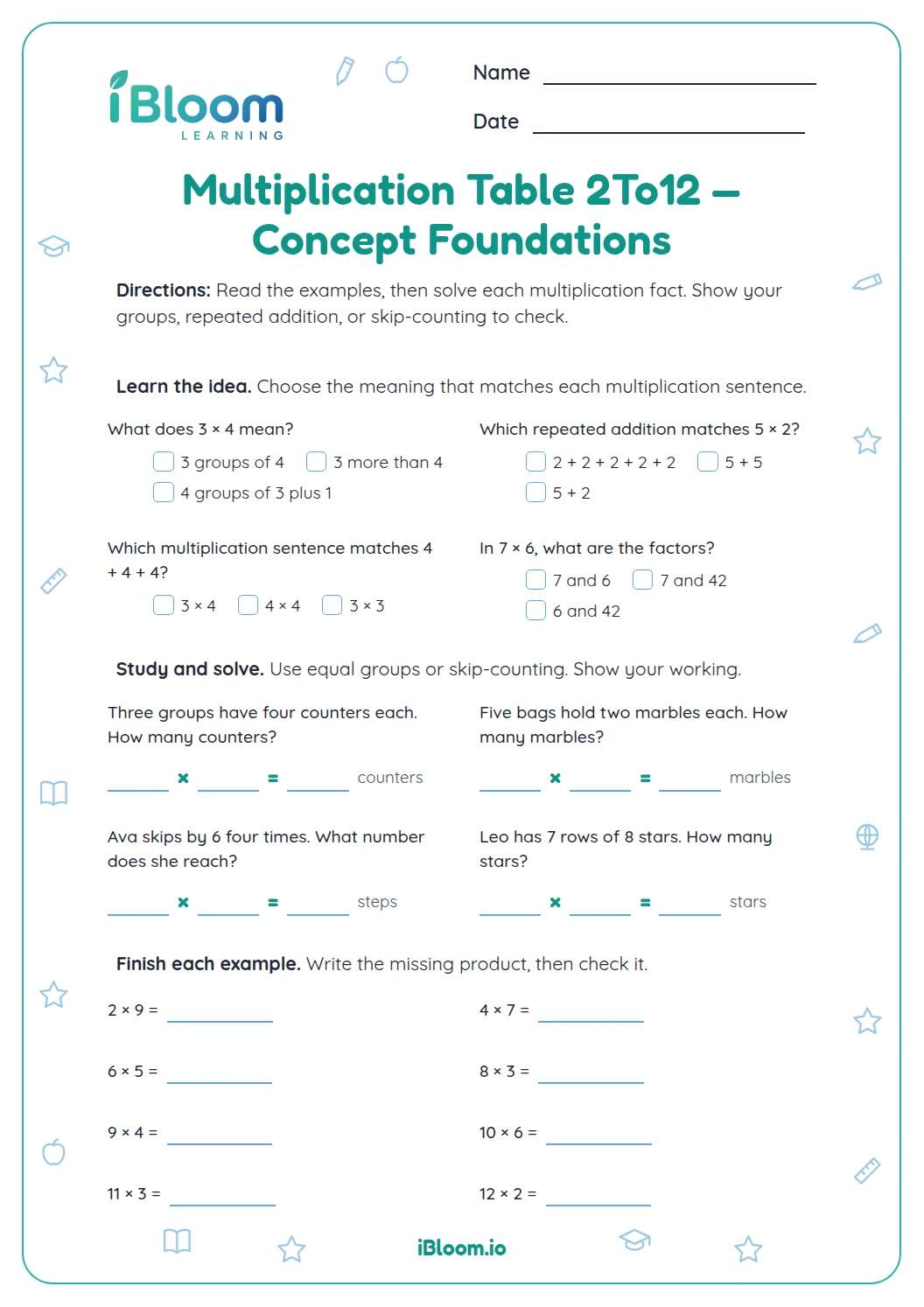
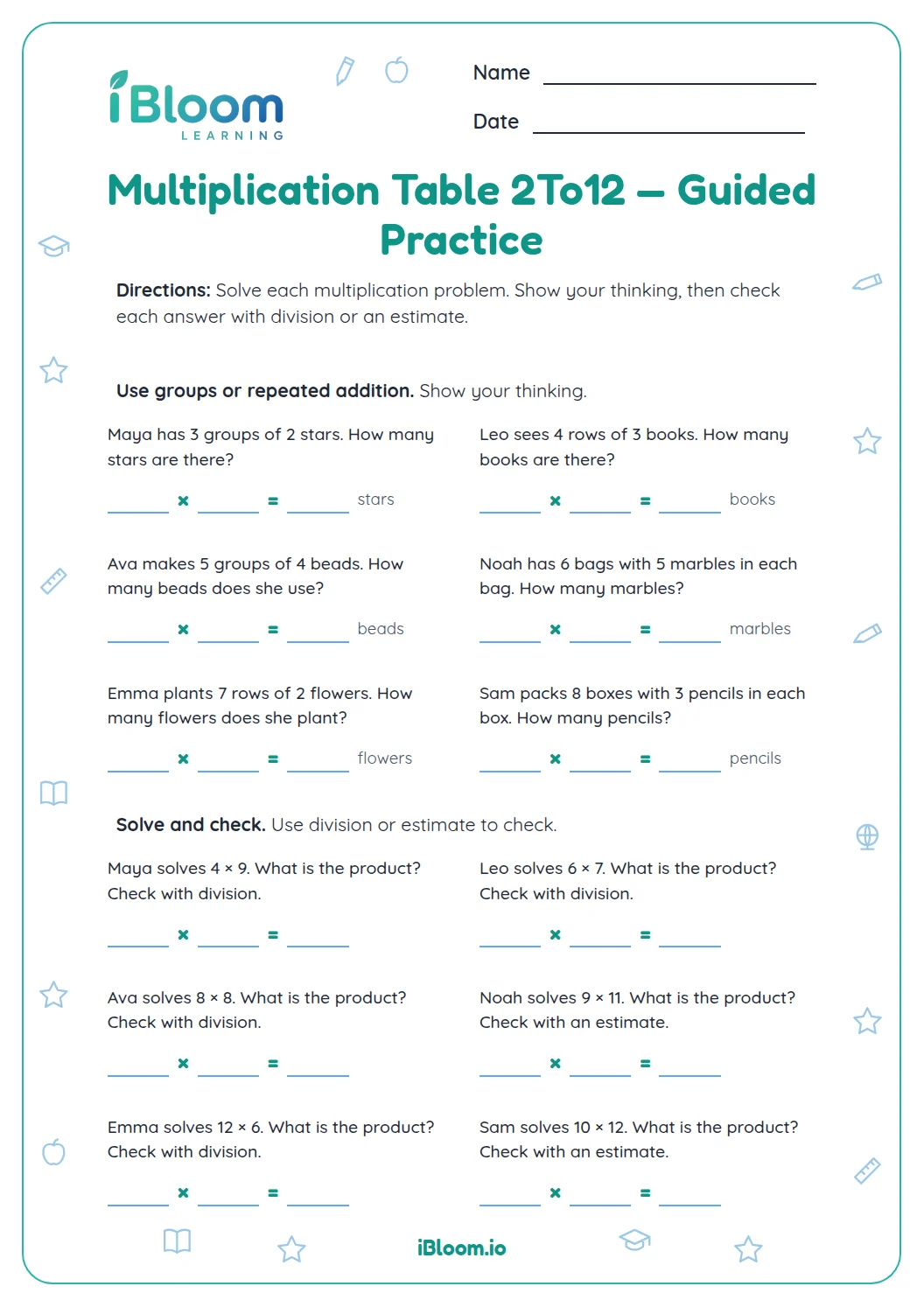
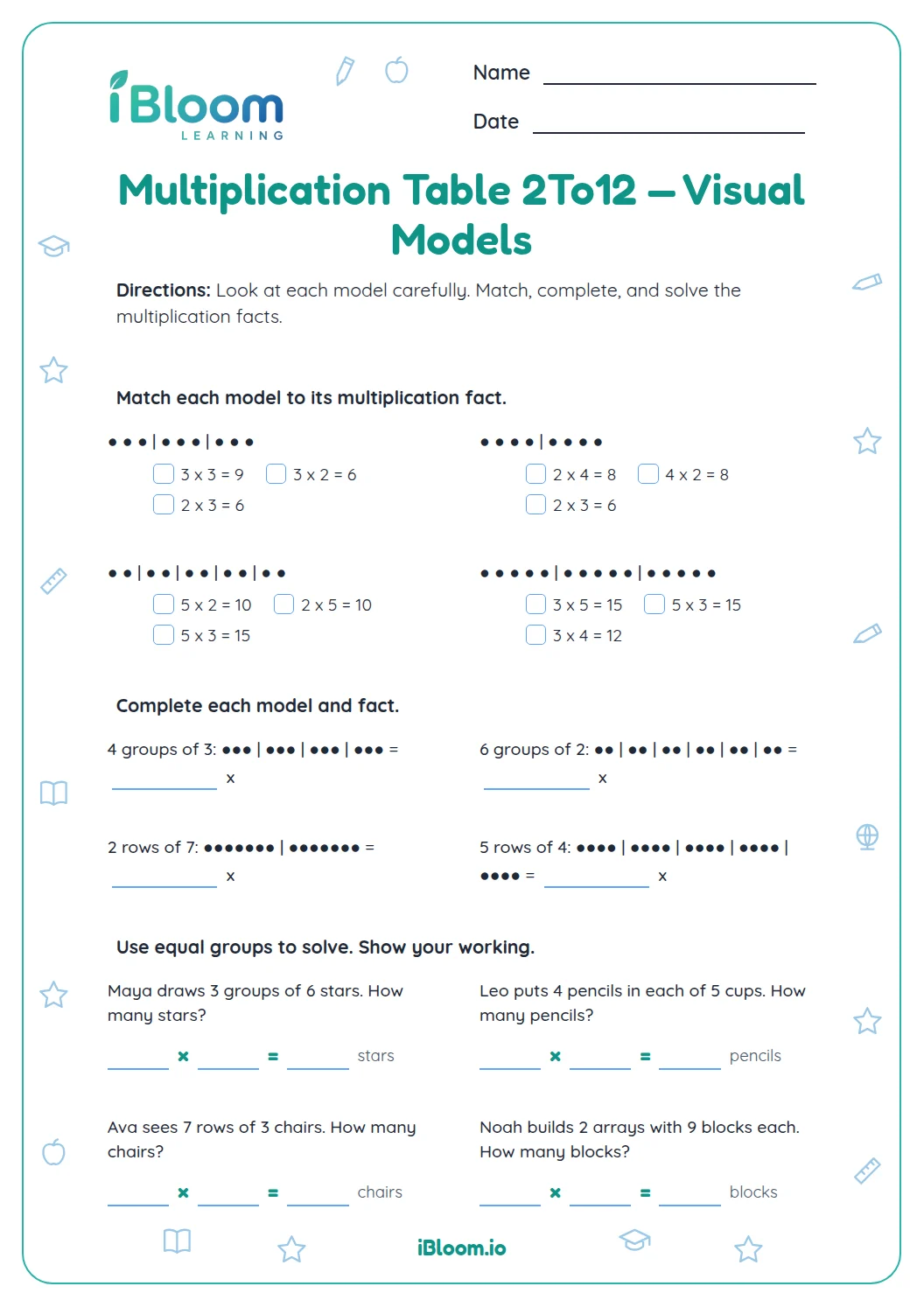
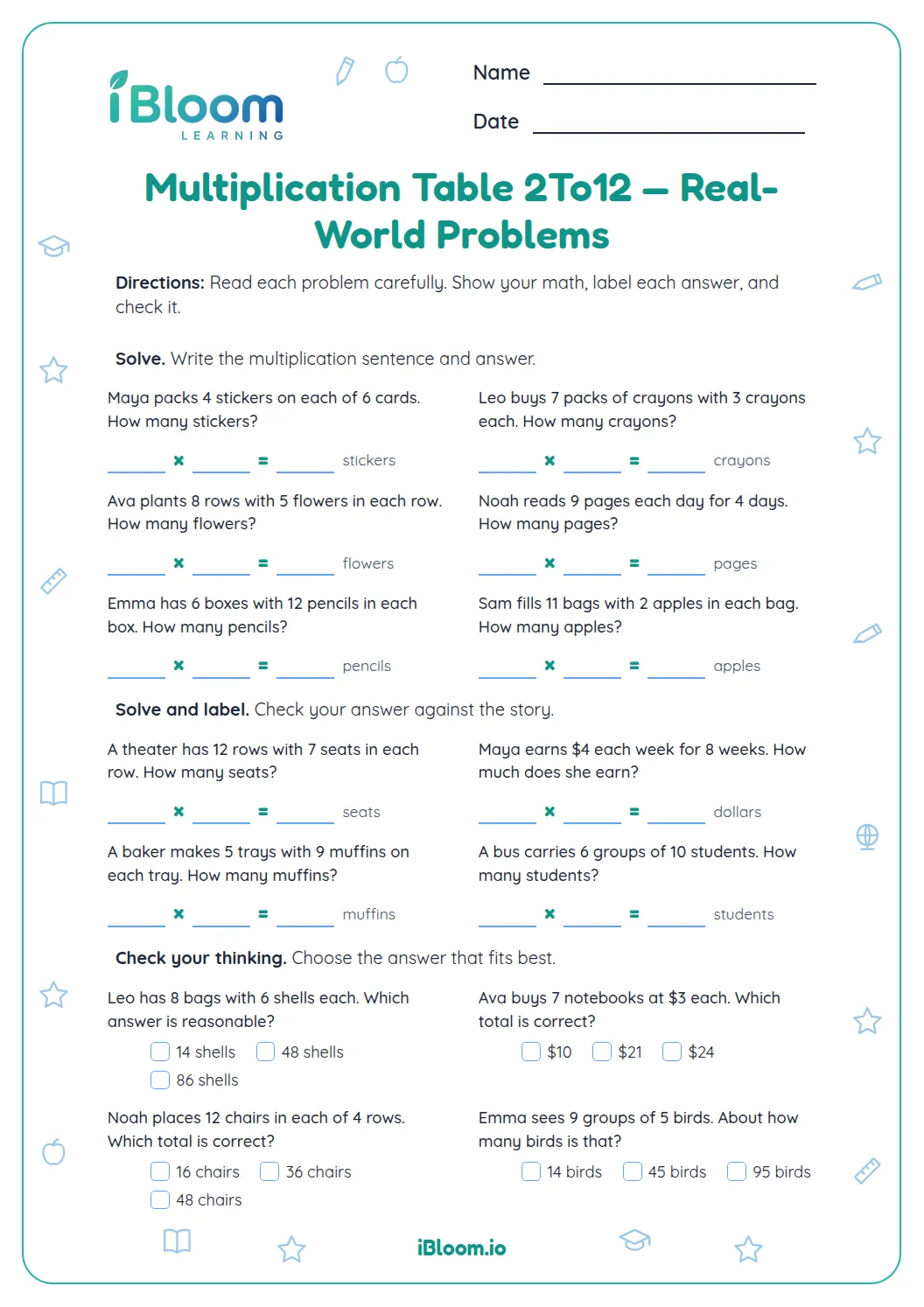
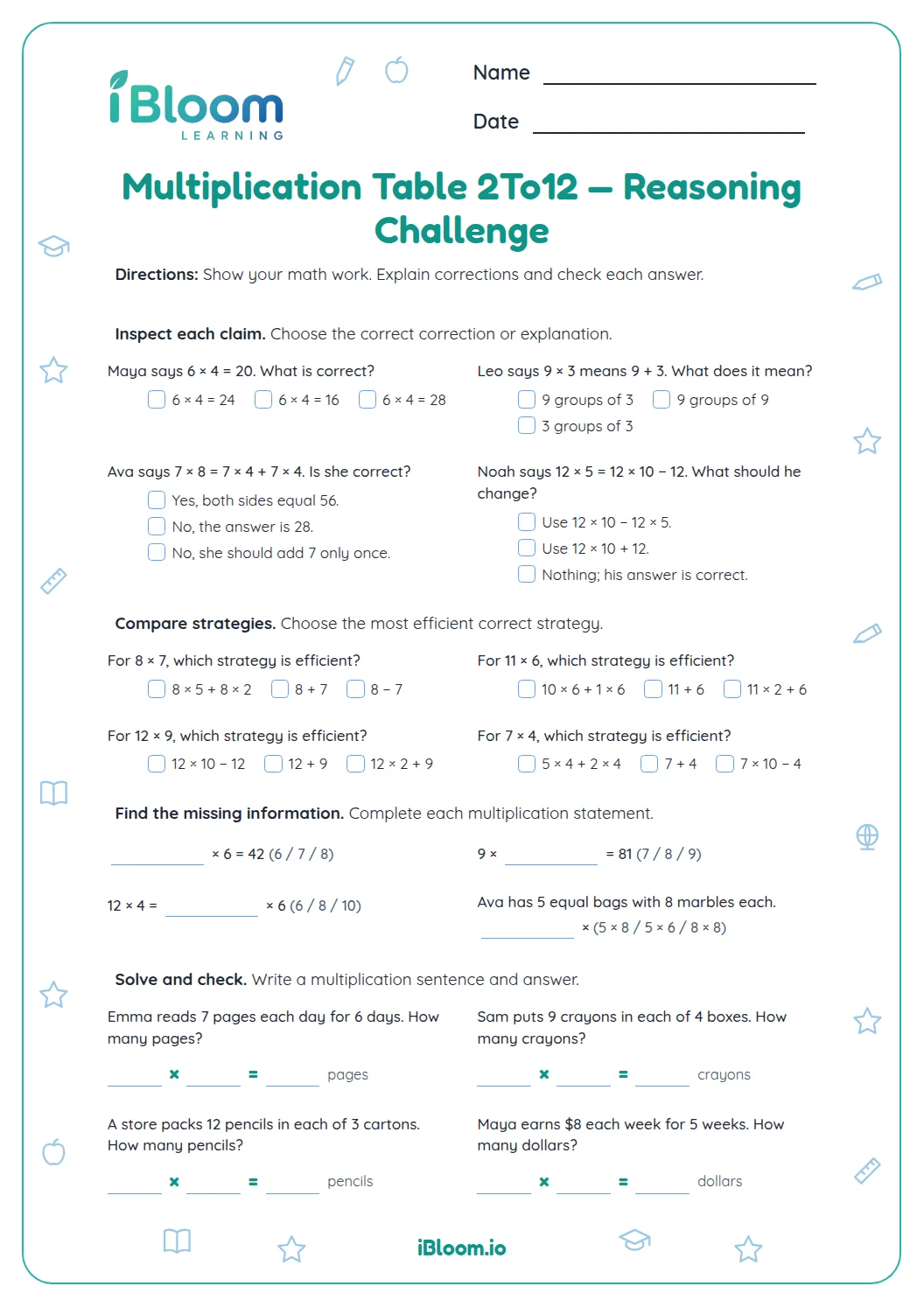
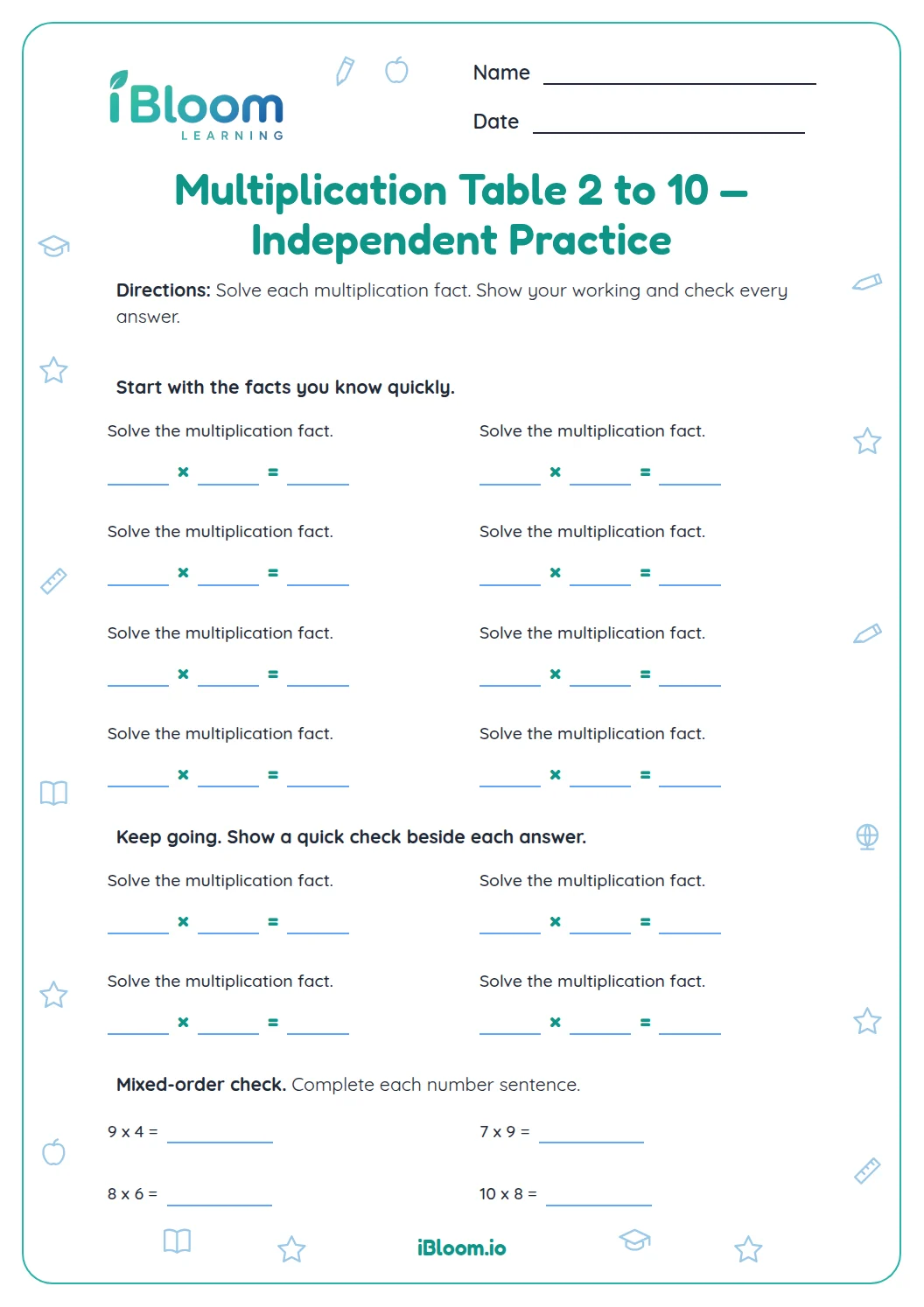
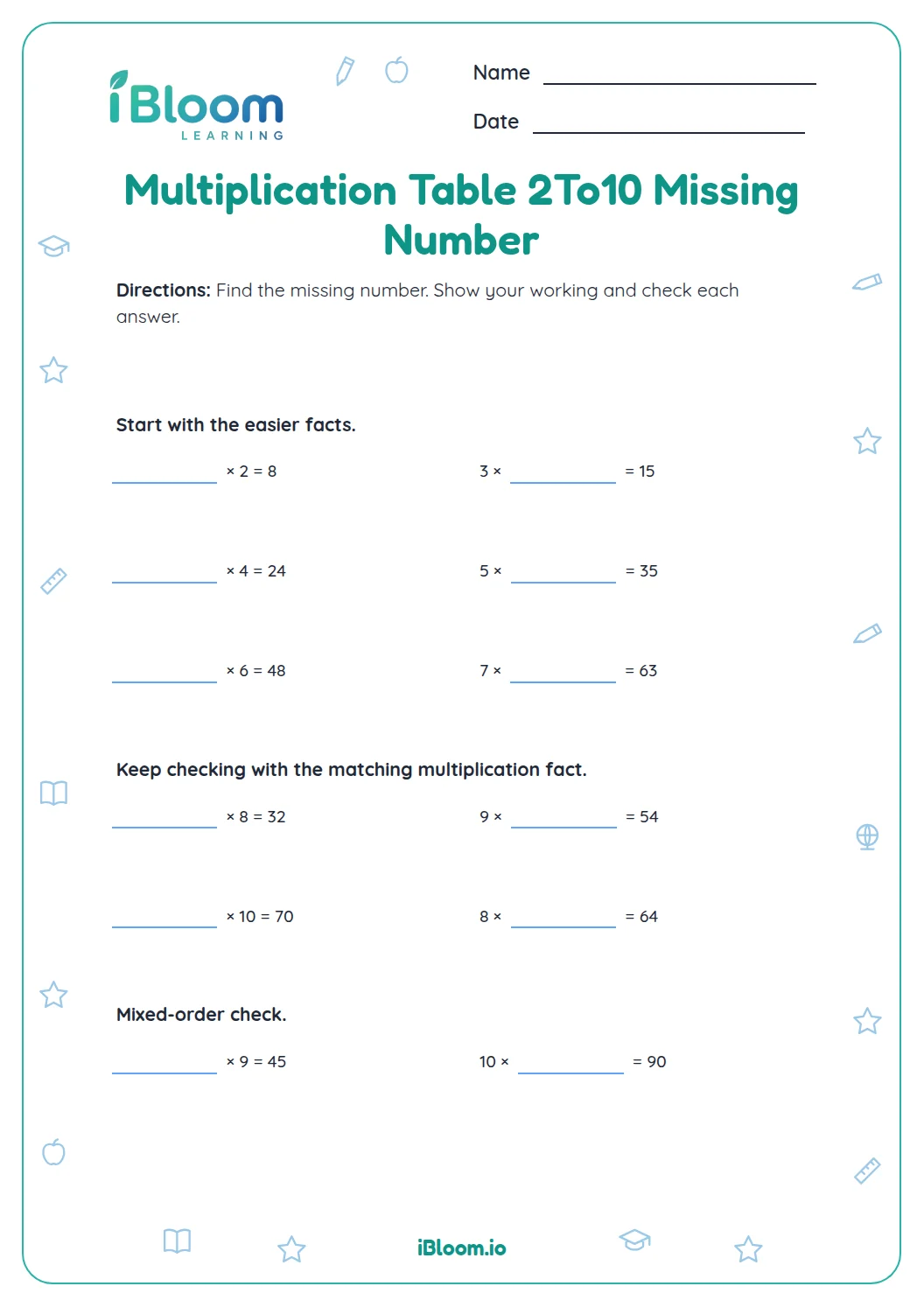
This Grade 3 worksheet offers 18 independent multiplication equations across the named 2–12 fact range. Every product is 100 or less. Students find each product and can use a known fact or pattern to check it. A separate key lists the answers. The practice aligns with CCSS 3.OA.C.7.
Aligned to 3.OA.C.7
How can students practice multiplication facts?
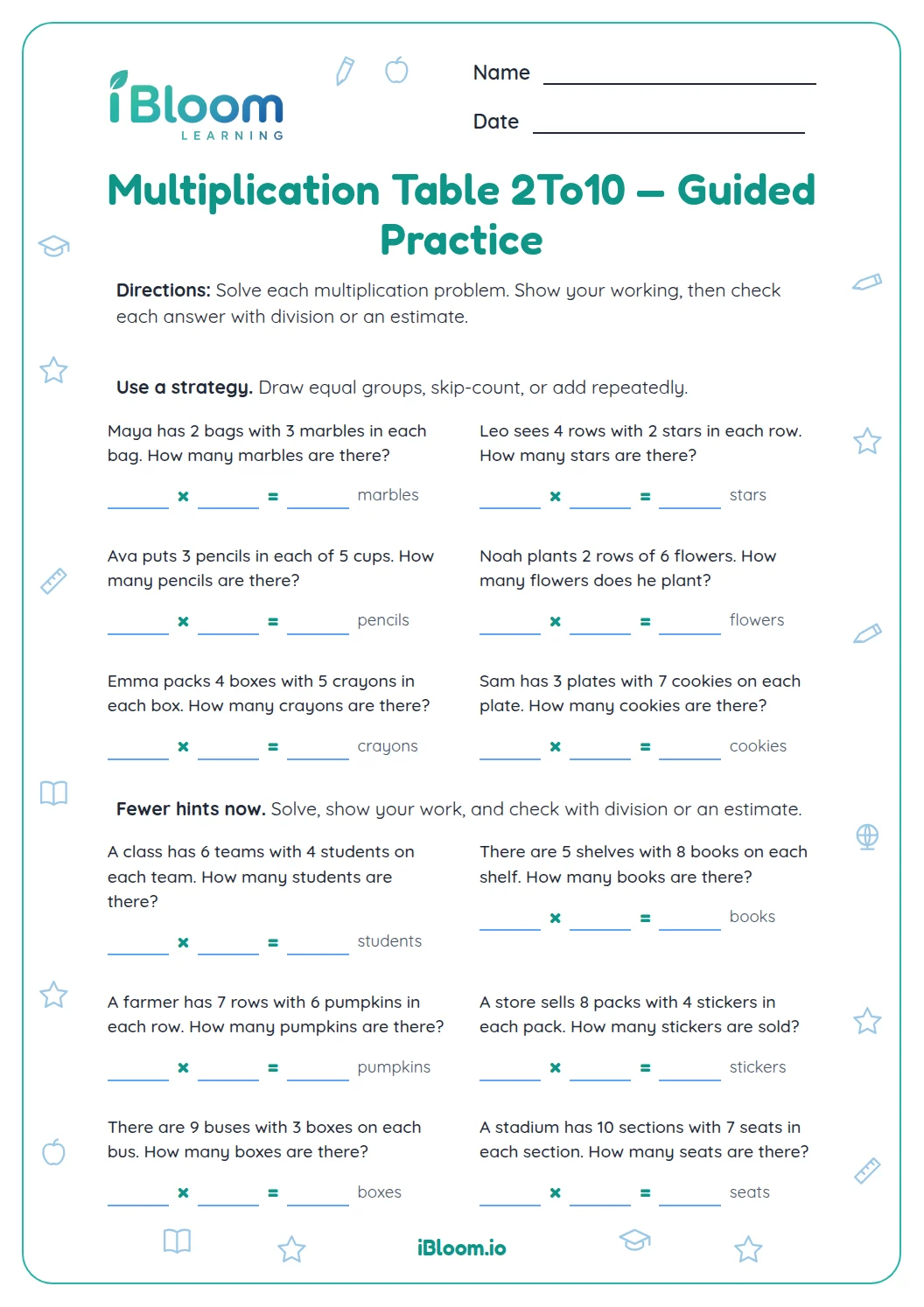
Each equation has one answer space. For 7 × 7, seven groups of seven make 49. For a less familiar fact, build from a known product or switch the factor order.
How do patterns help with harder facts?
The factors range from 2 through 12, while every product stays within 100. For example, use 10 × 8 plus one more group of 8 to find 11 × 8 = 88.
Which facts appear on the worksheet?
There are 18 equations across the 2–12 fact range. The separate key gives one product for each equation.
How to use this worksheet
- 1Read the equation and name the factors.
- 2Recall a known fact or build one from a nearby fact.
- 3Write the product in the blank.
- 4Check by switching the factors or using a related equation.
- 5Review any fact that took extra time.
Mistakes to watch for
The mistake
Adding the factors instead of multiplying them.
The fix
Say the factors as equal groups and ask how many objects are in all.
The mistake
Misremembering a product by one group.
The fix
Check the product with repeated addition or a related known fact.
The mistake
Thinking that switching factors changes the product.
The fix
Use a matching array or equation to see that 7 × 9 and 9 × 7 have equal products.
Common Core alignment
This worksheet gives focused practice with the listed Common Core skill.
Recall and use multiplication facts within 100.
On this sheet: All equations practice multiplication facts within 100, using factors through 12.
Show the official wordingHide the official wording
Fluently multiply and divide within 100, using strategies such as the relationship between multiplication and division (e.g., knowing that 8 × 5 = 40, one knows 40 ÷ 5 = 8) or properties of operations. By the end of Grade 3, know from memory all products of two one-digit numbers.
What to practice next
Make more practice
Further reading
Questions parents and teachers ask
What factors does the worksheet include?
The 18 equations use factors from 2 through 12, and every product is 100 or less. Students practice a mixed set rather than completing one table at a time. The key gives one product for each equation to check their work.
Is there an answer key?
Yes. A separate answer key page lists each product. After finishing the worksheet, students can use it to identify facts to practice again and check their calculations with a related multiplication equation. Encourage the student to correct the equation before moving on to the next fact.
How can a child check a product?
Switch the order of the factors or build the fact from a known one. For example, 11 times 8 can be checked as 10 times 8 plus one more group of 8, which totals 88. Switching factors keeps the same product and gives a fast self-check.
Why are facts from 2 through 12 mixed together?
Mixing facts across the 2–12 range asks students to identify and solve each equation independently. Every product is within 100. A student can use a known fact or a related pattern, then check the result with the answer key.
How long should practice take?
Plan for about 20 minutes, depending on how quickly the student recalls products. Accuracy and strategy matter more than speed; a student can pause to build a less familiar fact from equal groups. A short second pass through missed facts can reinforce accurate recall.