

About this worksheet
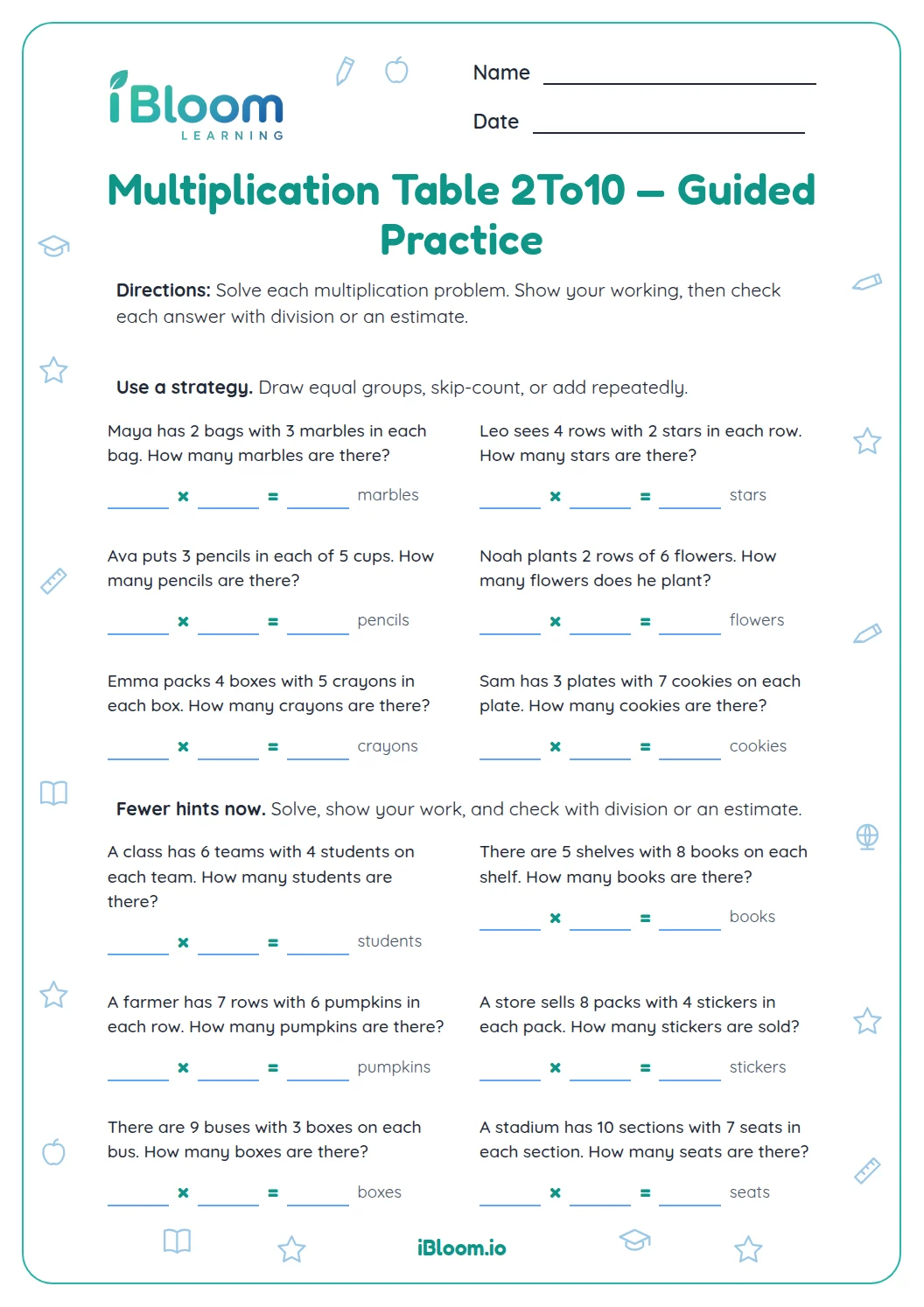
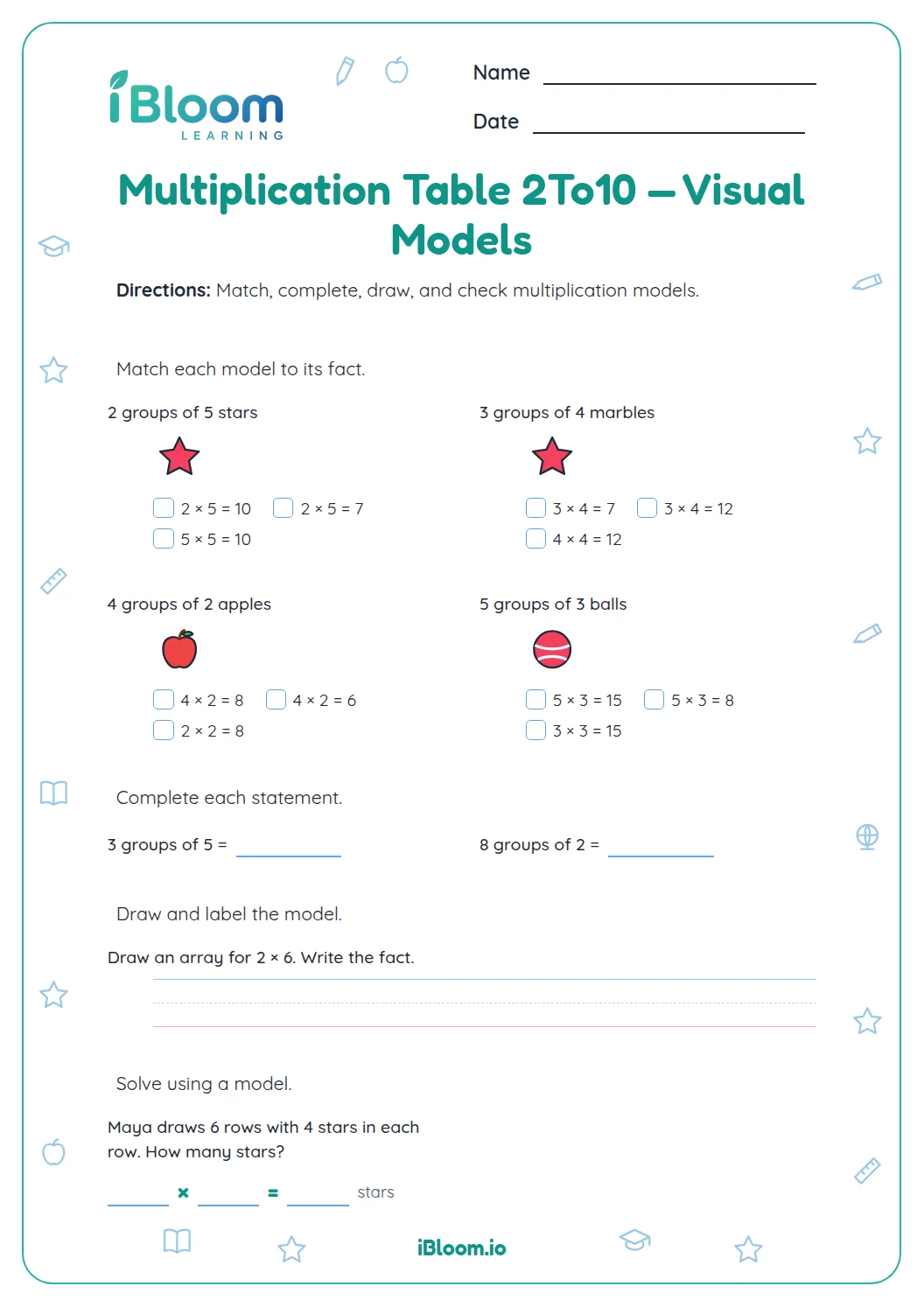
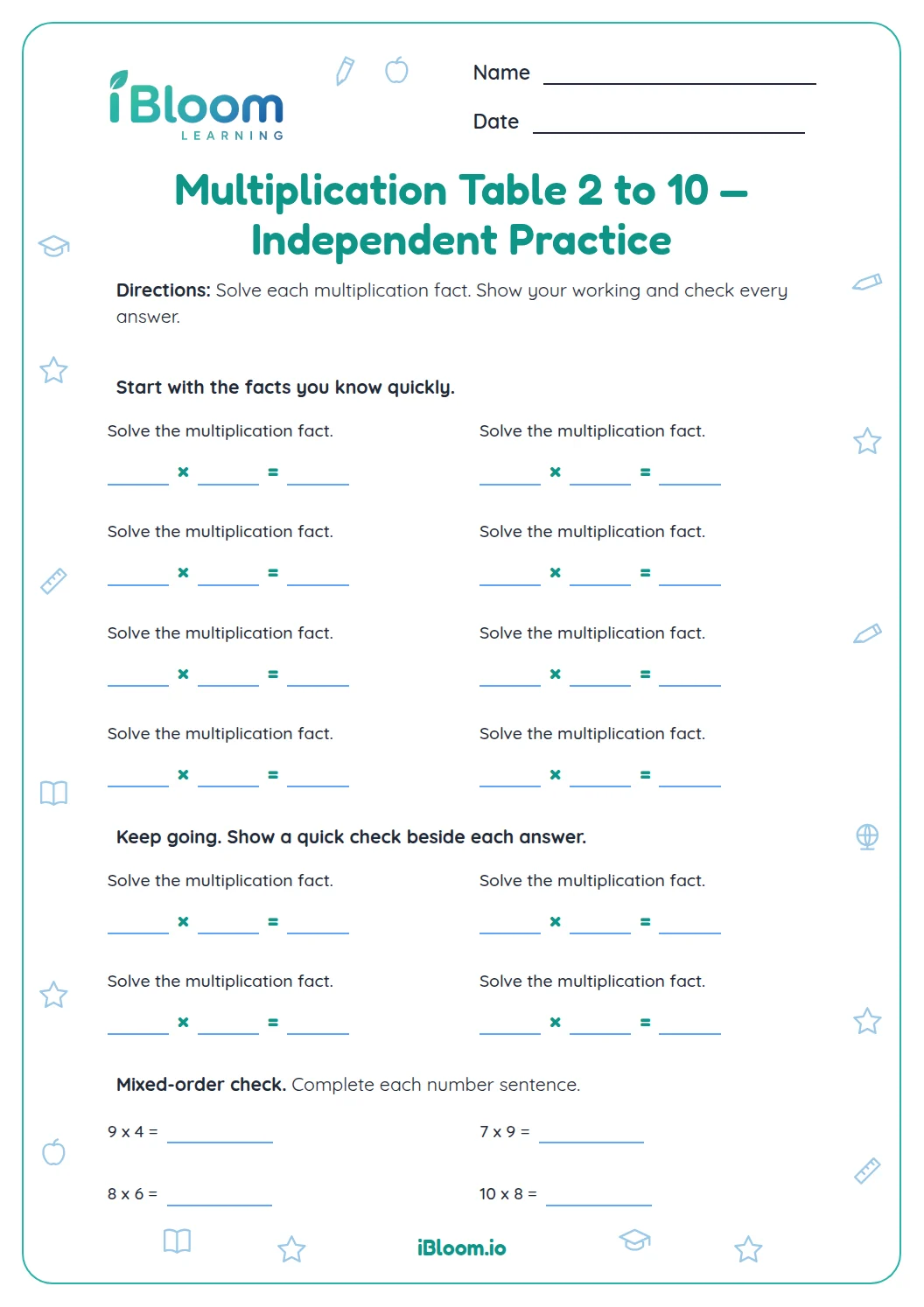
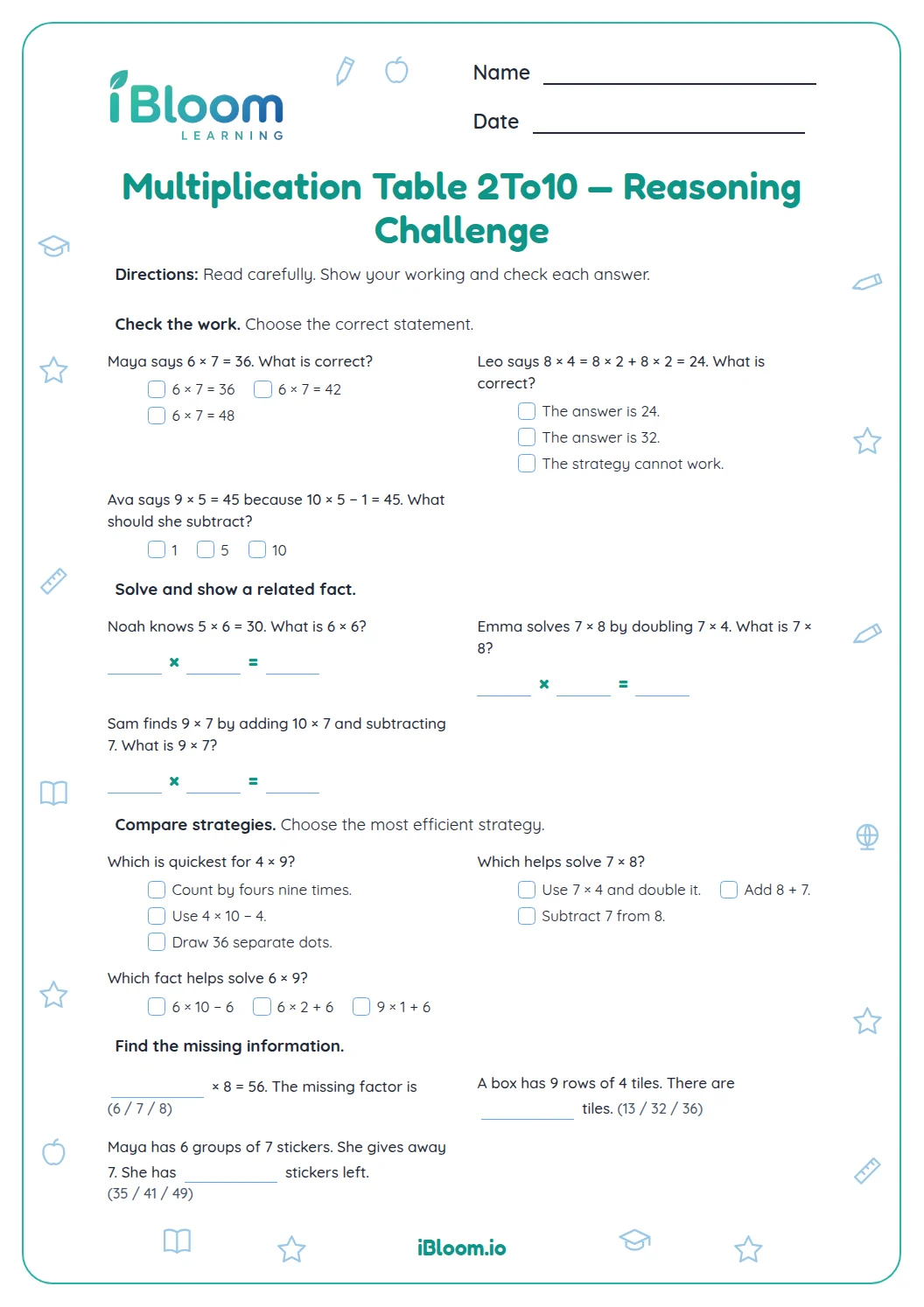
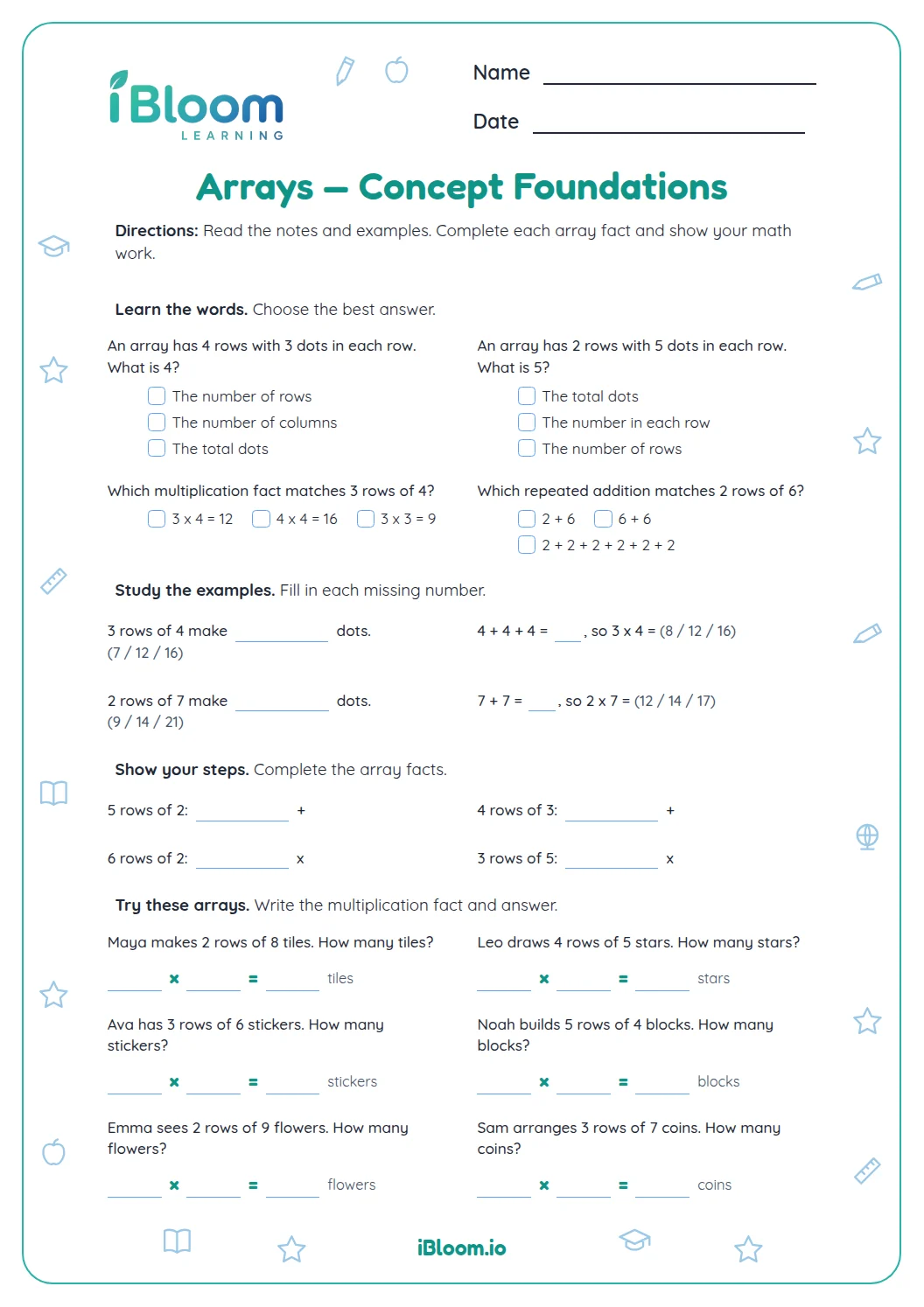
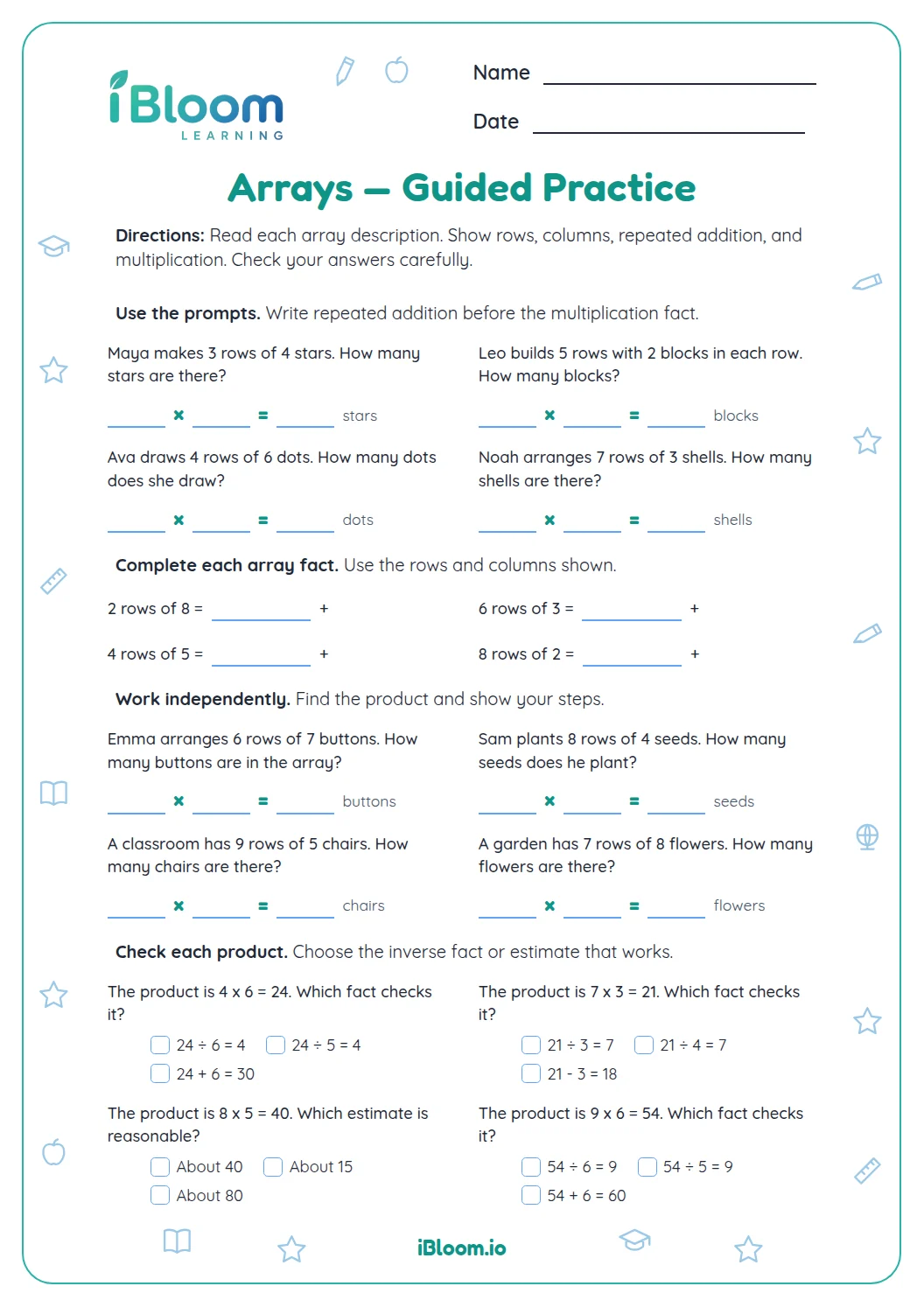
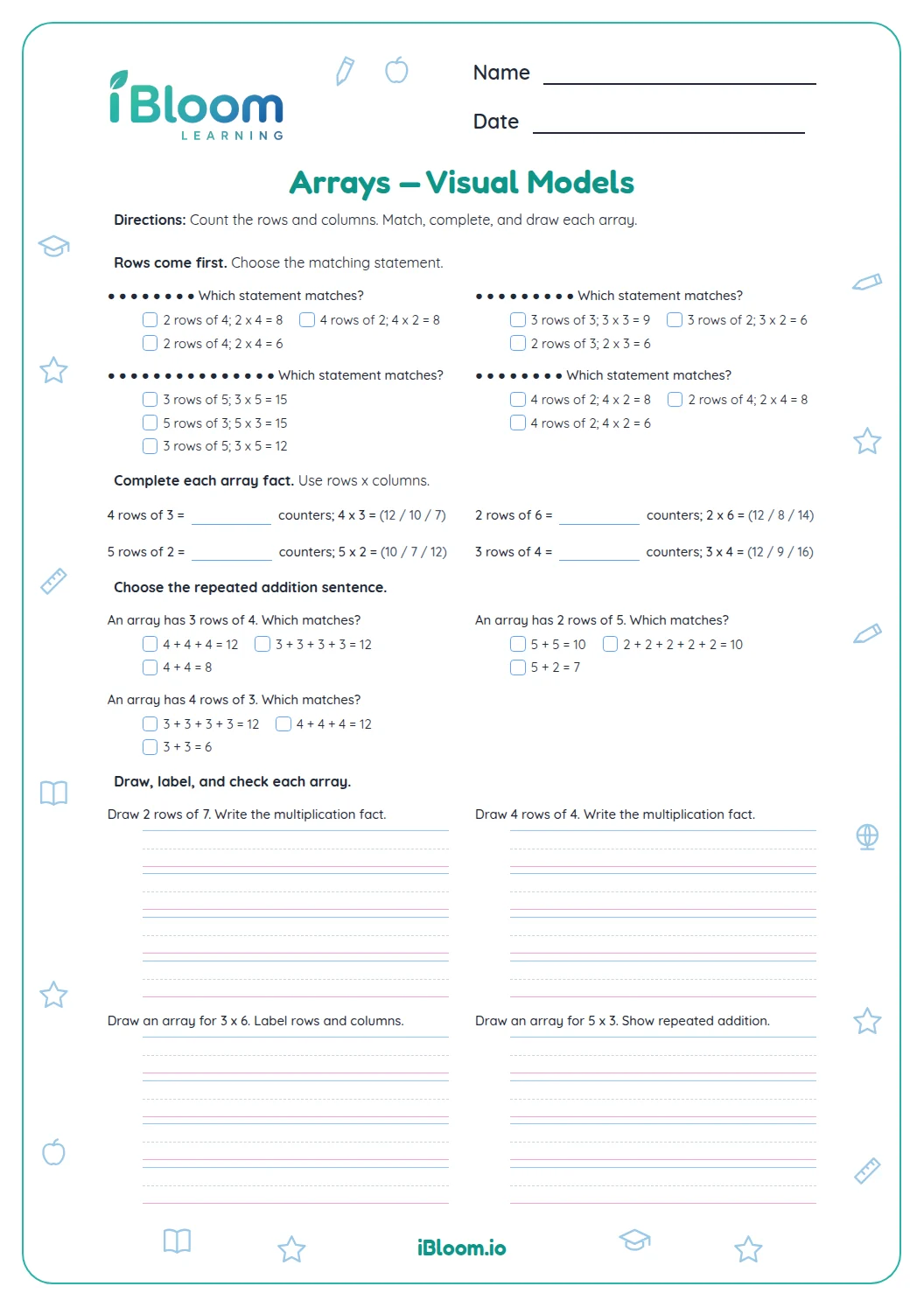
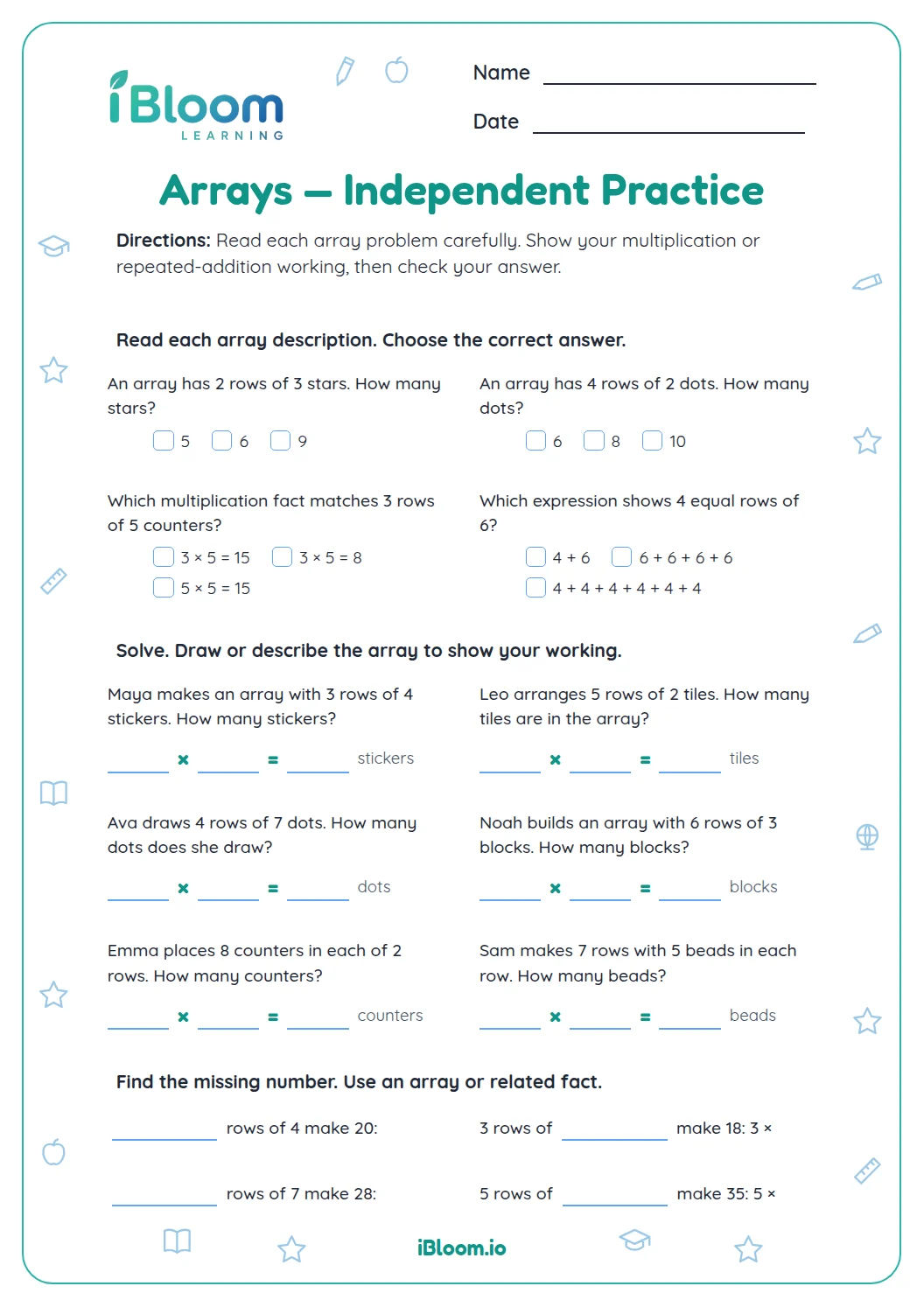
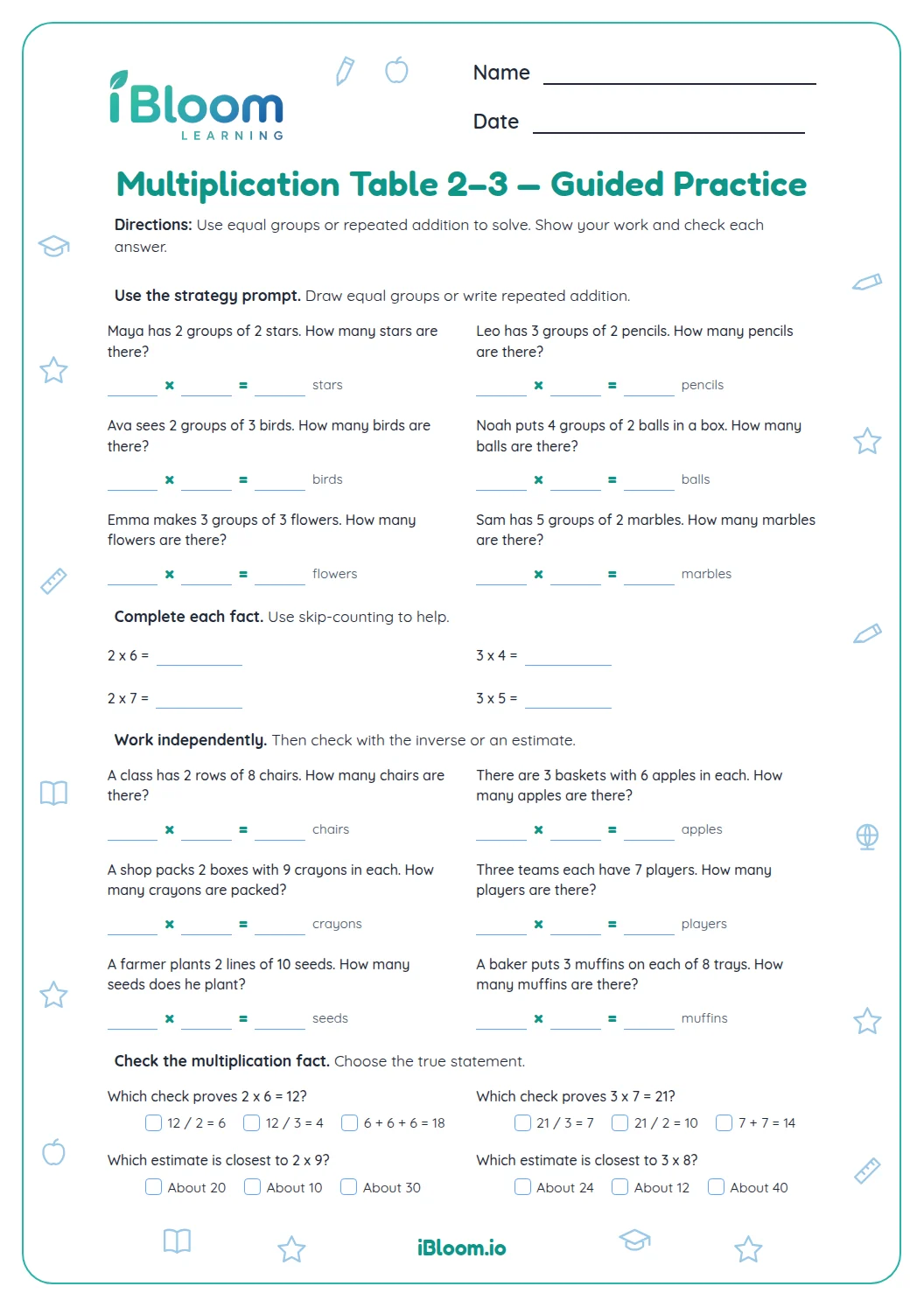
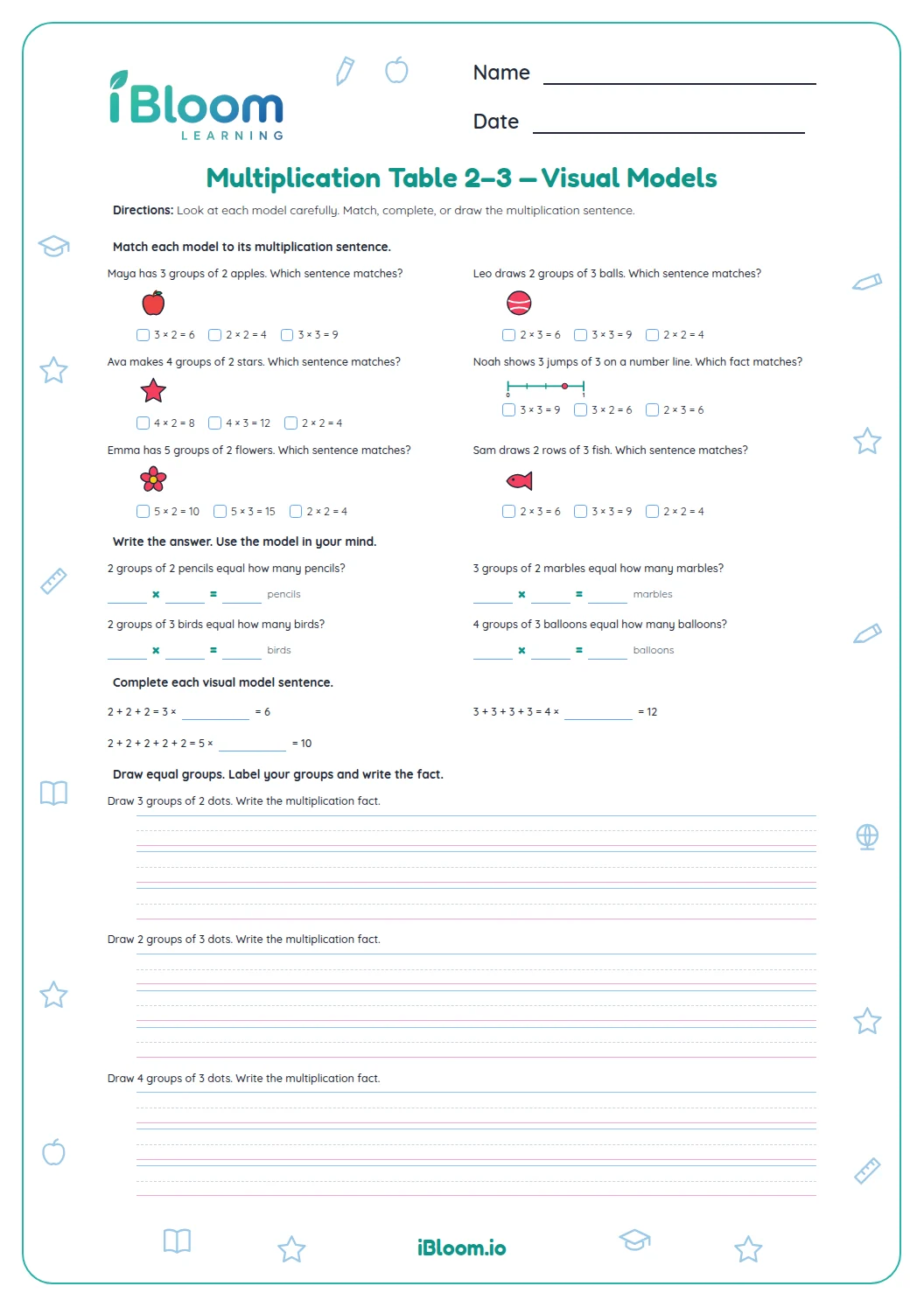
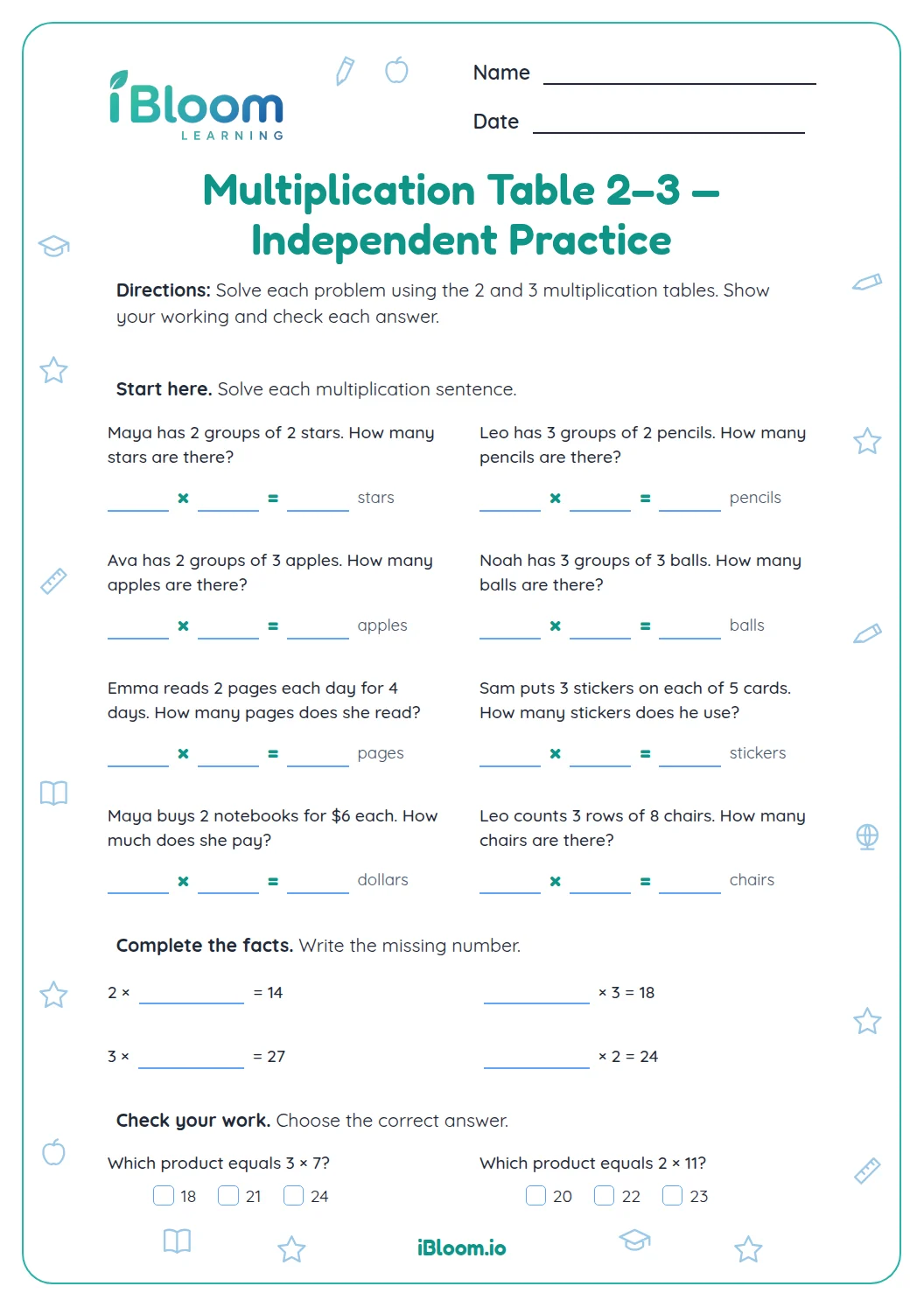
This Grade 3 worksheet connects equal groups, repeated addition and multiplication facts across tables 2 through 10. Learners read an array, connect repeated addition to a product, find products and a missing factor, and solve short situations. A final strategy prompt uses a related fact. The work aligns with CCSS 3.OA.A.1.
Aligned to 3.OA.A.1
How does an array show equal groups?
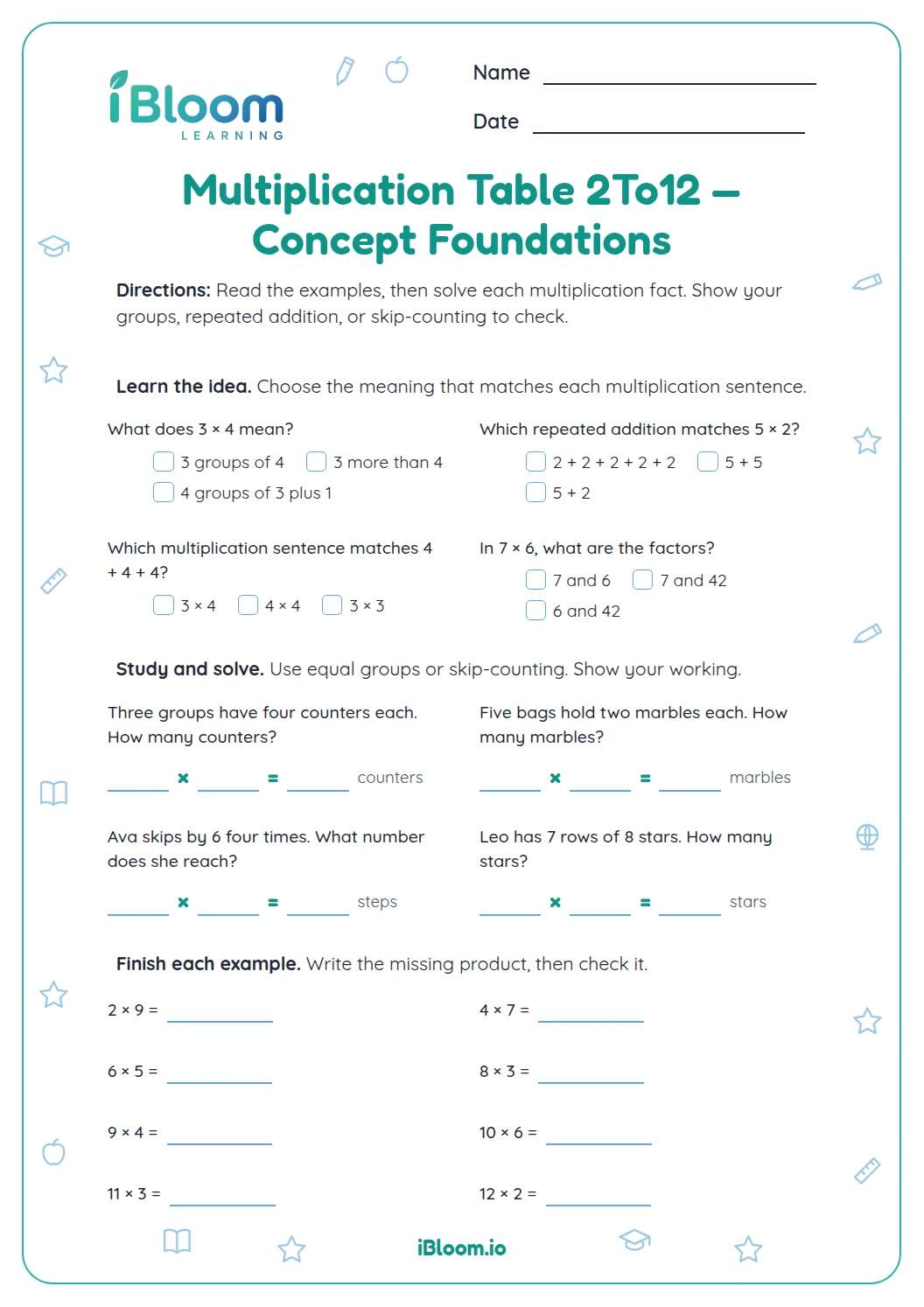
An array organizes objects into equal rows. Three rows of four dots contain 12 dots, so 3 × 4 represents three groups of four. Repeated addition, 4 + 4 + 4, gives the same total.
- 1The array has 3 rows with 4 dots in each row.
- 2Add 4 + 4 + 4, or count all the dots.
- 3There are 12 dots, so 3 × 4 = 12.
How do facts help with a missing factor?
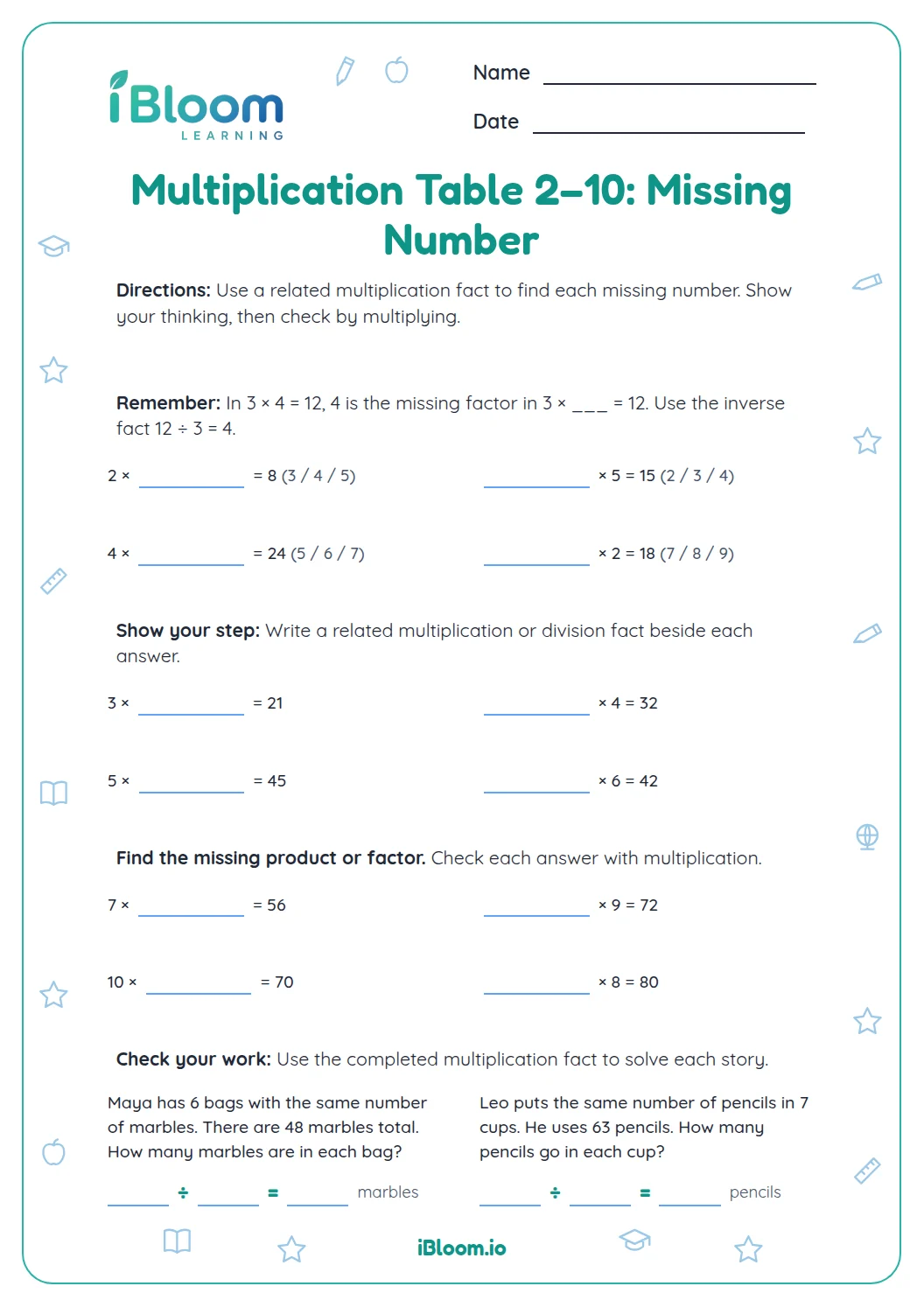
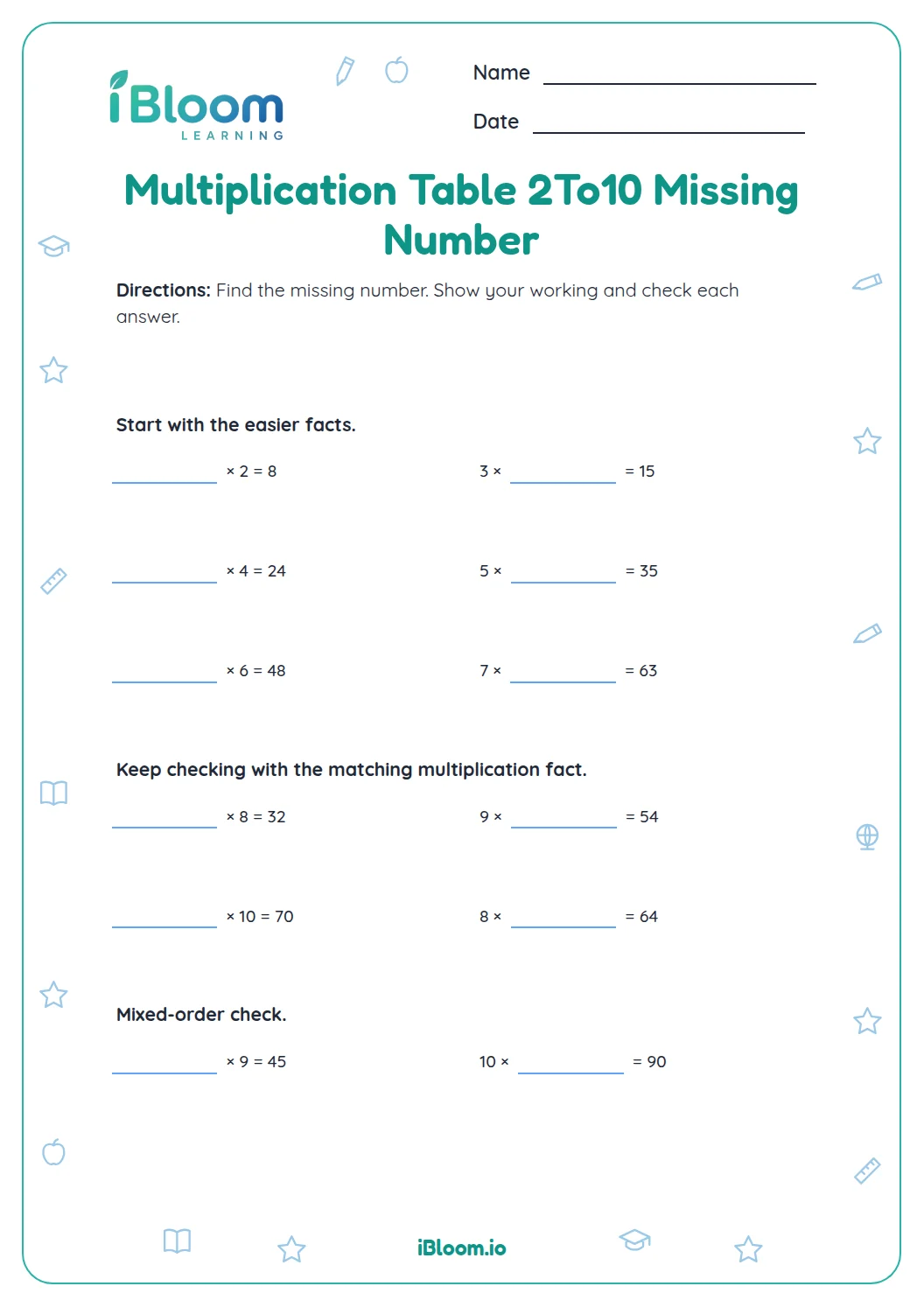
A known product can help find an unknown group count. In ___ × 6 = 42, count by sixes until reaching 42: six groups make 36 and one more makes 42, so the missing factor is 7.
How do multiplication facts model stories?
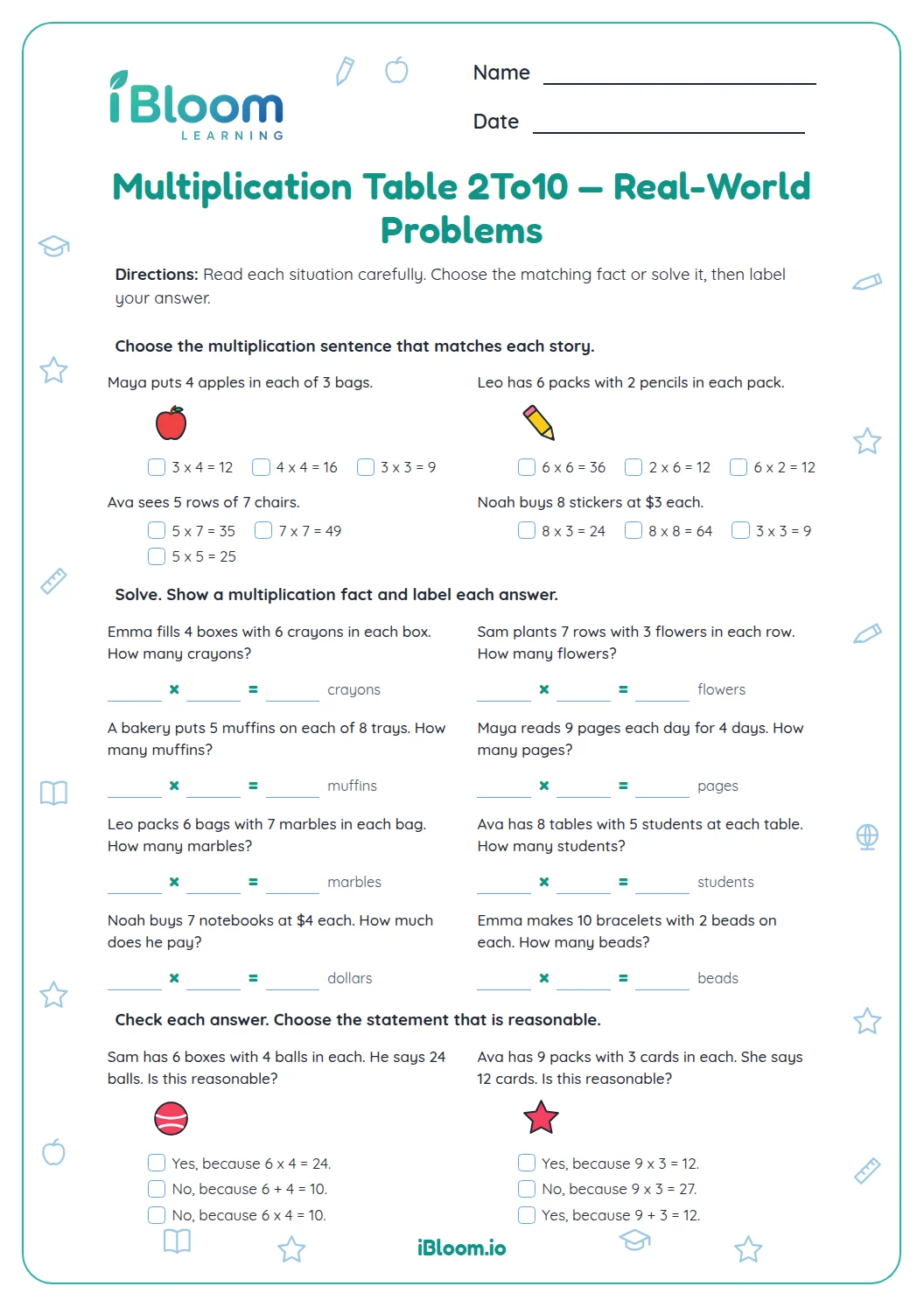
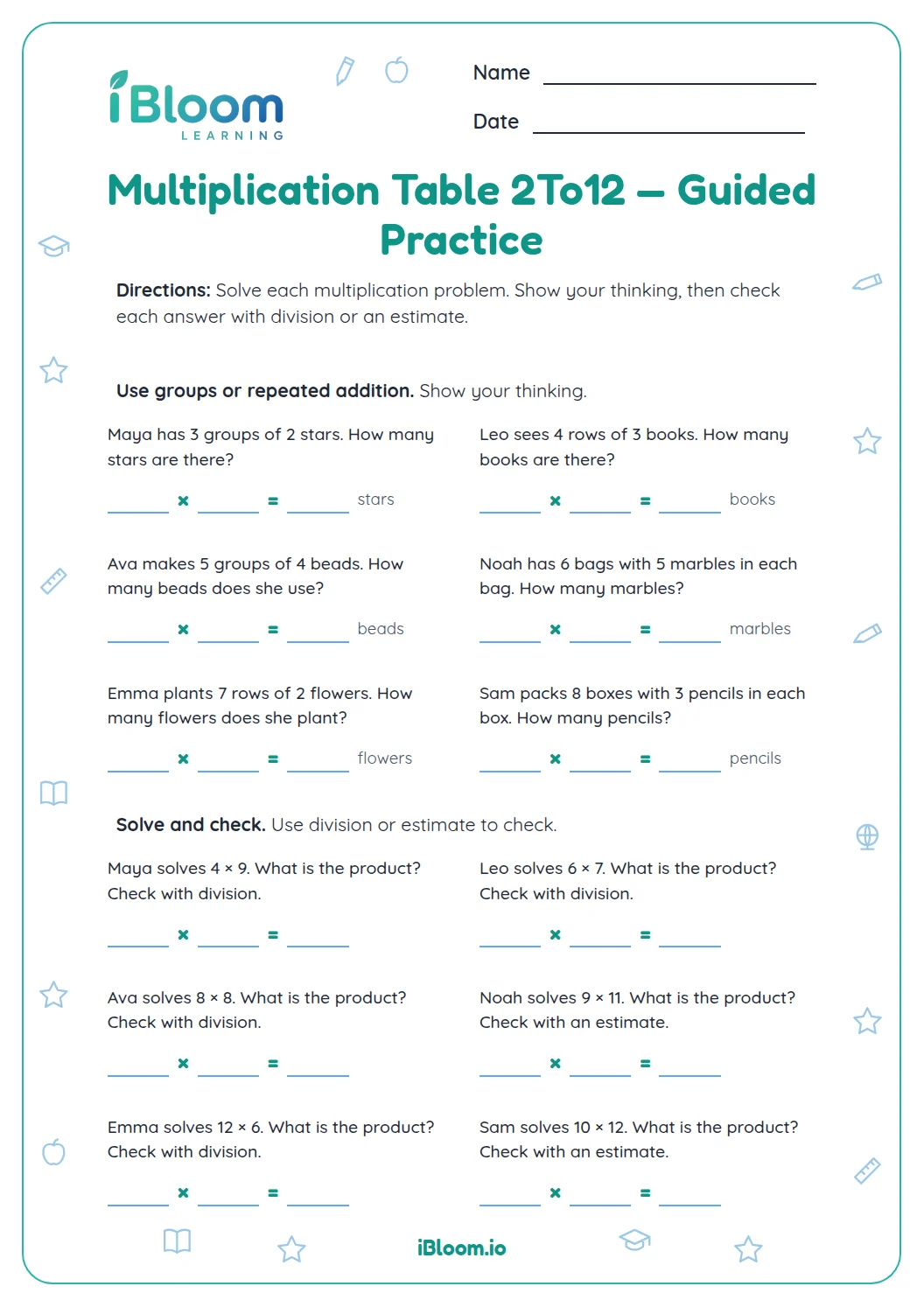
Find the number of equal groups and the number in each group. Four boxes with six crayons each represent 4 × 6, or 24 crayons. Naming both numbers before multiplying helps keep the story straight.
How to use this worksheet
- 1Study the array and identify its number of rows and dots per row.
- 2Connect repeated addition to the matching multiplication fact.
- 3Use skip-counting or a related product to solve a fact.
- 4For a missing factor, count groups until you reach the product.
- 5In each story, identify equal groups, solve, and include the unit.
- 6Use the final strategy prompt to describe a related fact.
Common mistakes and quick fixes
The mistake
Reversing the row count and the number in each row when explaining an array.
The fix
Name both quantities first: 3 rows of 4 is 3 × 4.
The mistake
Stopping one group early while skip-counting to a product.
The fix
Count each group once and check the number of jumps against the missing factor.
The mistake
Giving a number without the story’s unit.
The fix
Reread the question and label the result in crayons, seeds, days, players or books.
Curriculum alignment
Equal-group models connect multiplication expressions to their products.
Interpret each product as a total made from equal groups.
On this sheet: The array, repeated-addition item and story problems represent products as equal groups.
Show the official wordingHide the official wording
Interpret products of whole numbers, e.g., interpret 5 × 7 as the total number of objects in 5 groups of 7 objects each.
What to practice next
Make more practice
Further reading
Questions parents and teachers ask
What multiplication tables are practiced?
The sheet uses factors from 2 through 10. Learners connect equal groups and repeated addition to facts, solve a missing factor, and apply products in short situations. The array shows three rows with four dots in each row.
How does the array connect to a multiplication sentence?
Count the rows and the objects in each row. Three rows of four dots make 12, which can be written 3 × 4 = 12 and as 4 + 4 + 4 = 12. The matching sum repeats the row size once for each row in the array.
How can a known fact help with a new product?
Use the known product and add or subtract one equal group. For example, if 5 × 6 = 30, then 5 × 7 is one more group of 5, or 35. The known product is 30, then one more group of five makes 35.
How many questions and pages are included?
There are 14 questions in four parts, printed over two worksheet pages. The answer key also spans two pages and includes the products, story answers and a sample strategy response. The set connects equal-group models with multiplication facts.
Do the story problems use equal groups?
Yes. The stories describe equal boxes, rows, weeks, teams and stacks. Each gives the number of groups and the amount in each group so a multiplication fact models the situation. The story prompts ask for totals of crayons, seeds, days, players and books.