







About this worksheet
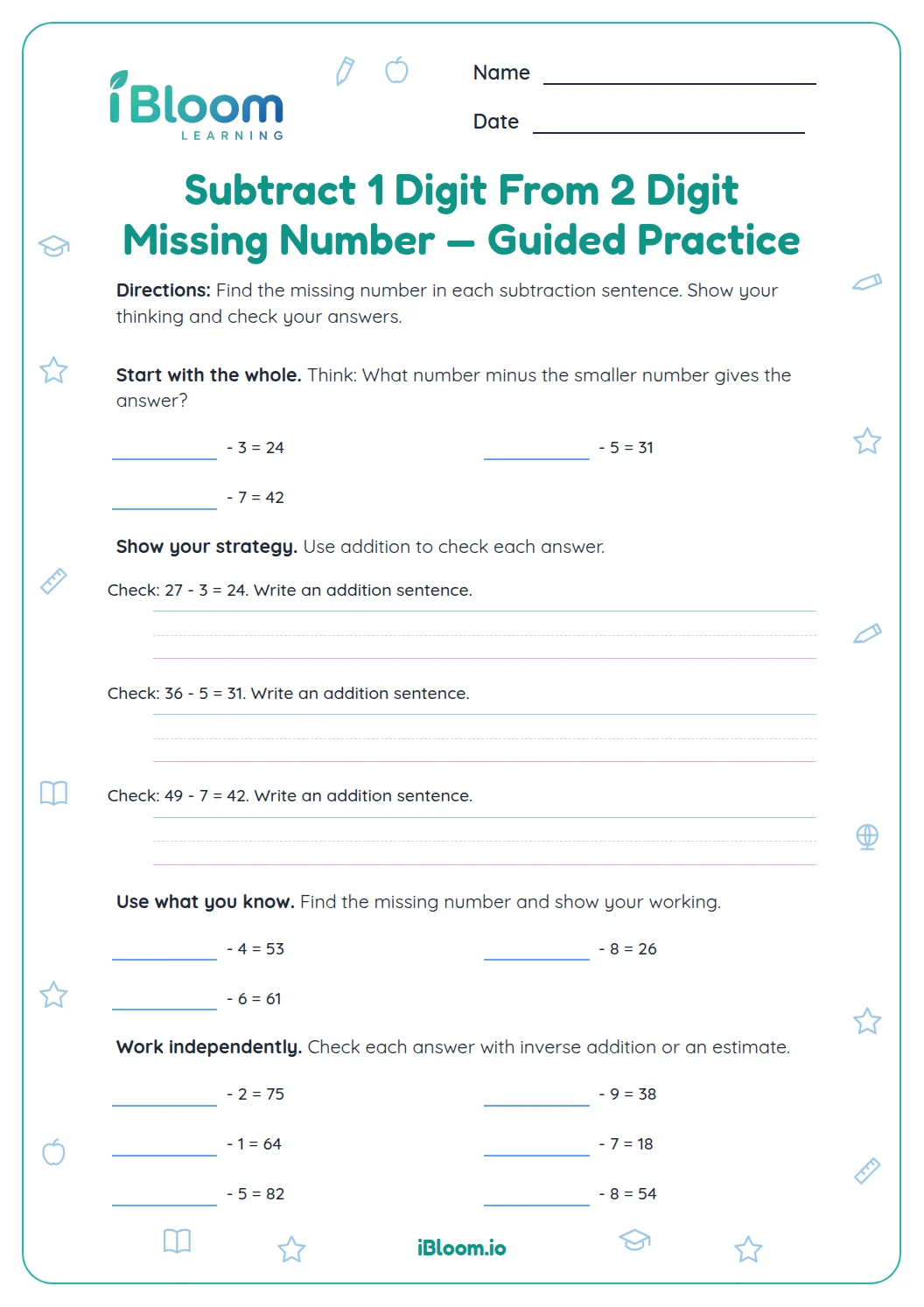
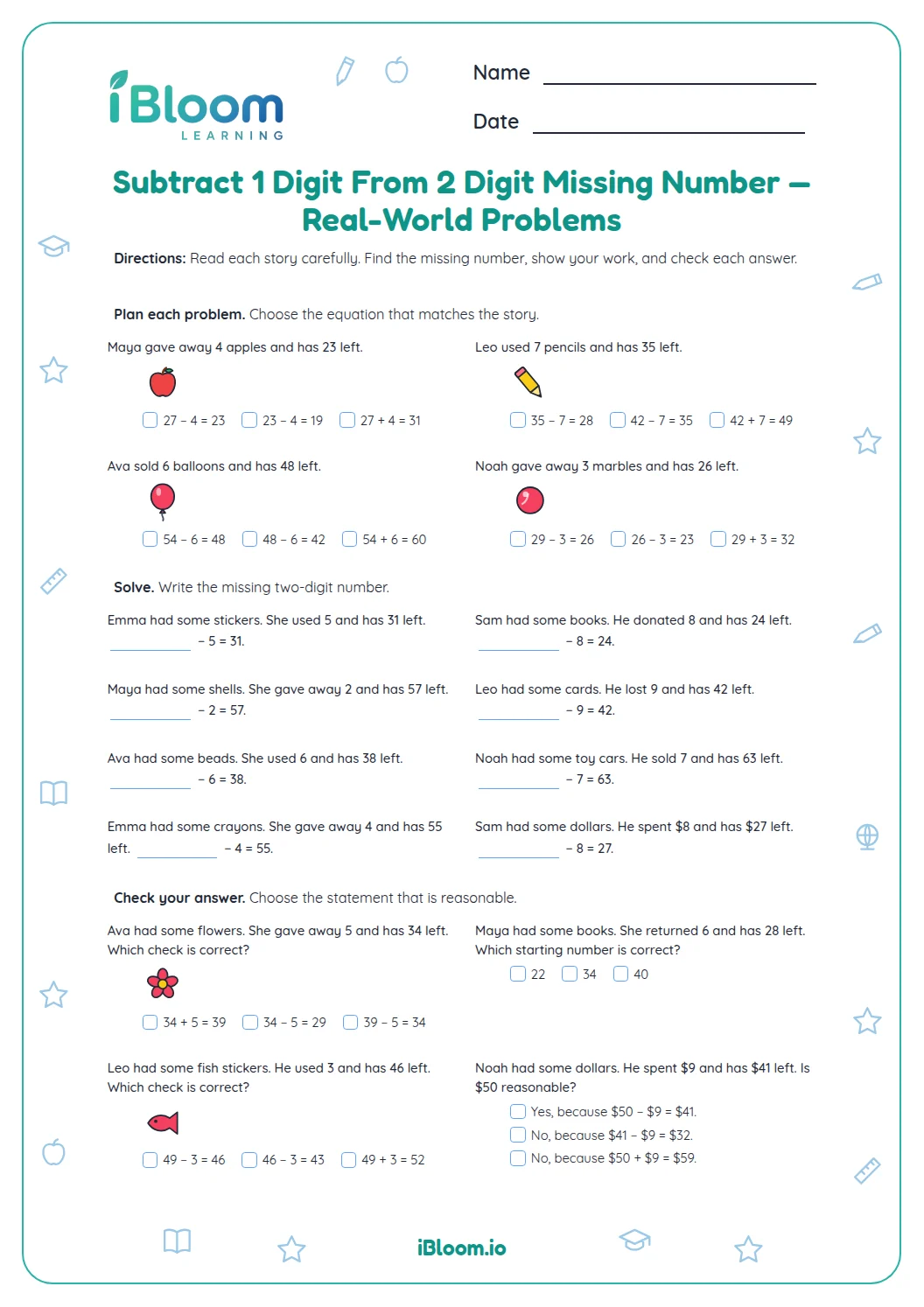
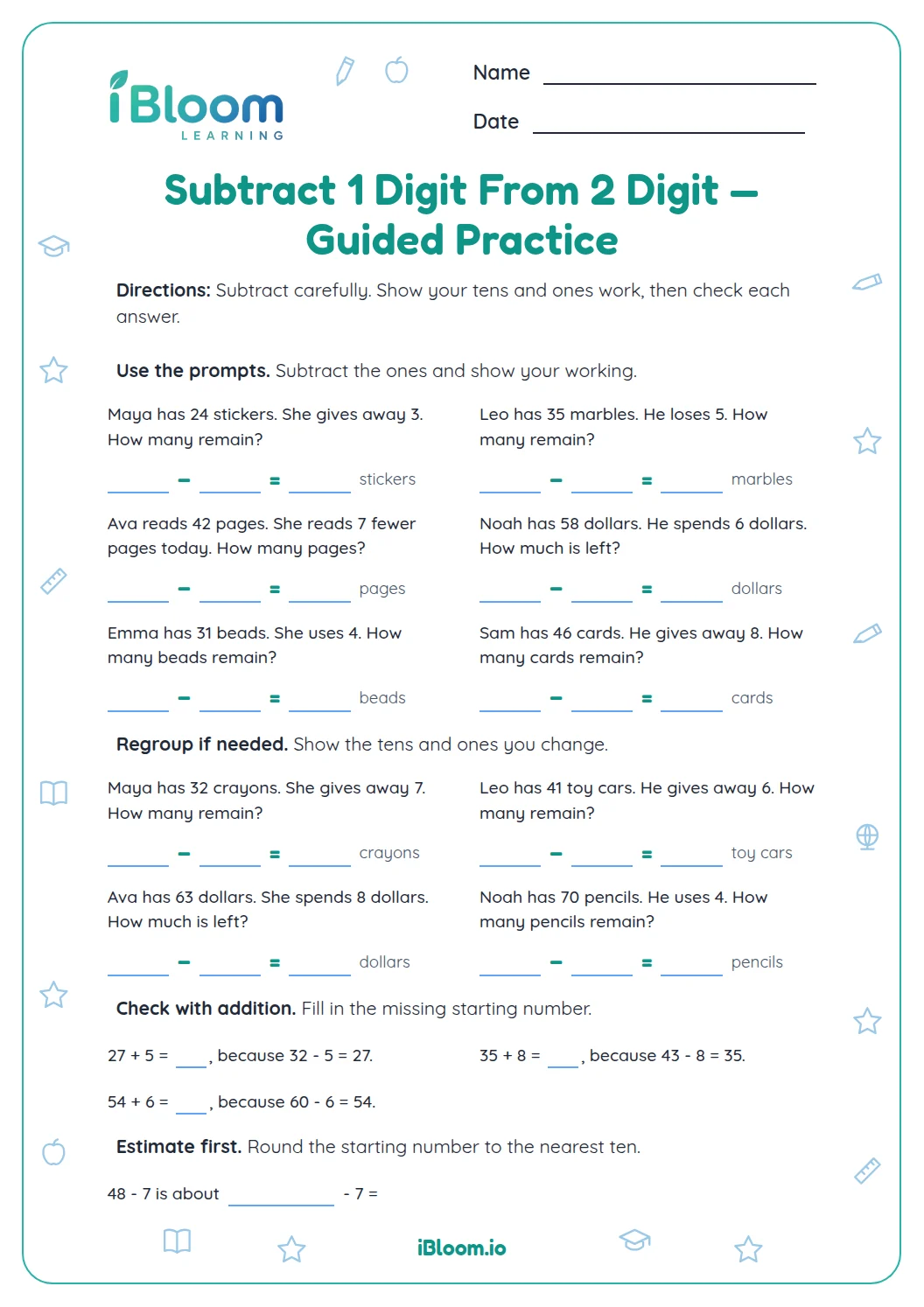
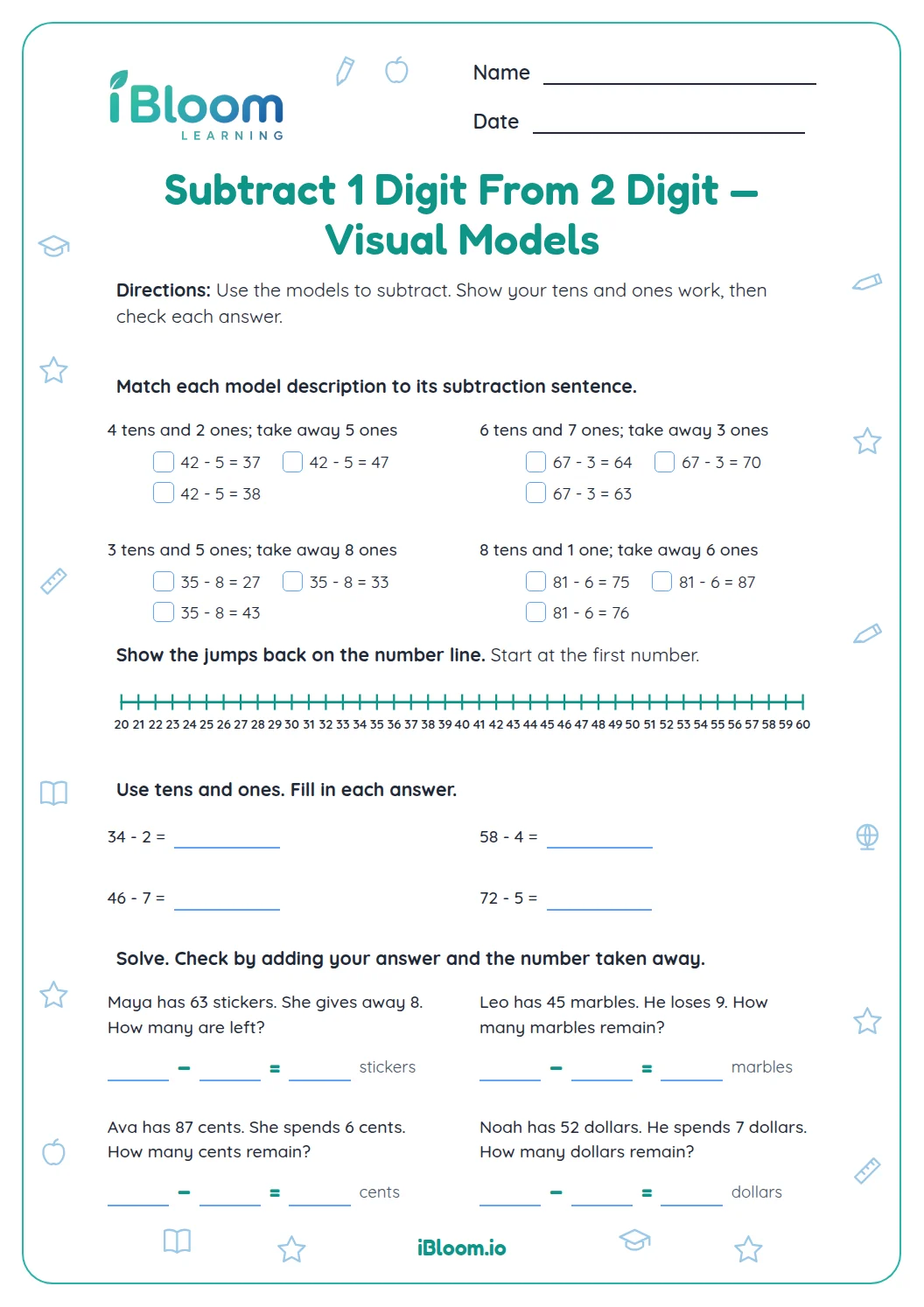
This free Grade 3 reasoning worksheet uses two-digit numbers with one-digit amounts subtracted. Children solve ten missing-number equations, answer four choices about checks, a bead problem, and a mental strategy, and explain two errors. Some blanks hide the starting number; others hide the amount taken away. The contrast makes children decide what the blank represents before calculating. Practice supports Common Core 2.NBT.B.5 through addition and subtraction within 100. A separate key supplies all fourteen fixed answers and sample responses for the two explanations.
Aligned to 2.NBT.B.5
What does the blank stand for?
In 42 − ___ = 37, the starting number and amount left are known, so children find how much was removed. In ___ − 6 = 48, the starting amount is unknown, so children restore the six that were removed.
Read the entire equation aloud before choosing an operation. A blank at the beginning needs a different calculation from a blank after the minus sign.
The last four equations in Part A alternate between the two kinds of blank. Each crosses a ten, so children must choose the operation again instead of repeating the previous one automatically.
- 142 − ___ = 37
- 2Count from 37 to 40: 3.
- 3Count from 40 to 42: 2.
- 43 + 2 = 5, so the missing number is 5.
- 5Check: 37 + 5 = 42.
Which addition equation checks a subtraction answer?
The amount left plus the amount removed must equal the starting number. Part B asks children to select that relationship rather than just an equation containing the same digits.
For 54 − 7 = 47, the check is 47 + 7 = 54. For ___ − 8 = 35, the useful equation is 35 + 8 = 43. Both checks rebuild the starting amount.
Question 13 applies missing-amount reasoning to beads. Question 14 checks the original sheet’s subtract-ten strategy: 61 − 8 = 61 − 10 + 2 = 53. Adding 2 back corrects for subtracting 2 too many.
What makes the last two questions a challenge?
Question 15 presents a child who added 42 and 37 to fill 42 − ___ = 37. The correction is 5 because the blank asks for the amount removed, not a total of the two known numbers.
Question 16 reverses the position of the blank. Subtracting 6 from 48 gives 42, but the starting amount must be 54 so that removing 6 leaves 48. A complete explanation includes an addition or subtraction check.
How to use this worksheet
- 1Ask the child to identify the starting number, removed amount, and amount left in question 1.
- 2Complete Part A, using counting up across a ten when helpful.
- 3Substitute each answer into its original equation and read it aloud.
- 4In Part B, choose the addition checks, solve the bead problem, and check the subtract-ten strategy.
- 5For Part C, write the correction and one sentence or equation explaining why it works.
Mistakes to notice and fix
The mistake
Adding the two known numbers to find the amount removed.
The fix
Find the gap between the starting amount and the amount left.
The mistake
Subtracting again to find a missing starting number.
The fix
Add back the removed amount, then test the completed subtraction.
The mistake
Counting the starting number as the first step when counting up.
The fix
Count jumps: from 37 to 38 is one jump, not two.
Common Core alignment
Use addition and subtraction within 100 to find and check missing numbers.
On this sheet: Students solve missing-number subtraction sentences and check them with addition.
Show the official wordingHide the official wording
Fluently add and subtract within 100 using strategies based on place value, properties of operations, and/or the relationship between addition and subtraction.
What to practice next
Make more practice
Further reading
Questions parents and teachers ask
Which numbers can be missing?
Part A hides either the two-digit starting number or the one-digit amount taken away. Children should name that role before solving. For example, 42 − ___ = 37 asks how much was removed, while ___ − 6 = 48 asks how many there were at first.
Can children count up instead of regrouping?
Yes, counting up is useful for finding the small gap between two nearby numbers. In 42 − ___ = 37, count 3 to reach 40 and 2 more to reach 42. The total gap is 5, which can be checked by adding 37 + 5.
Why does Part B use addition?
Addition rebuilds the starting amount, so it checks whether the subtraction relationship is correct. If 54 − 7 = 47, then 47 + 7 must equal 54. Ask the child to identify the amount left and the amount removed before selecting the matching check.
What should a written explanation include?
Each explanation should give the corrected missing number and a reason that fits its position. For question 15, 5 works because 37 + 5 = 42. For question 16, 54 works because 54 − 6 = 48. Equivalent explanations using counting up are also acceptable.
Does the answer key allow different methods?
Yes, the missing numbers and choices have fixed answers, while the final two responses have sample explanations. A child may count up, use a known addition fact, or explain with tens and ones. Mark the relationship and the computation, rather than requiring the exact sample wording.