





About this worksheet
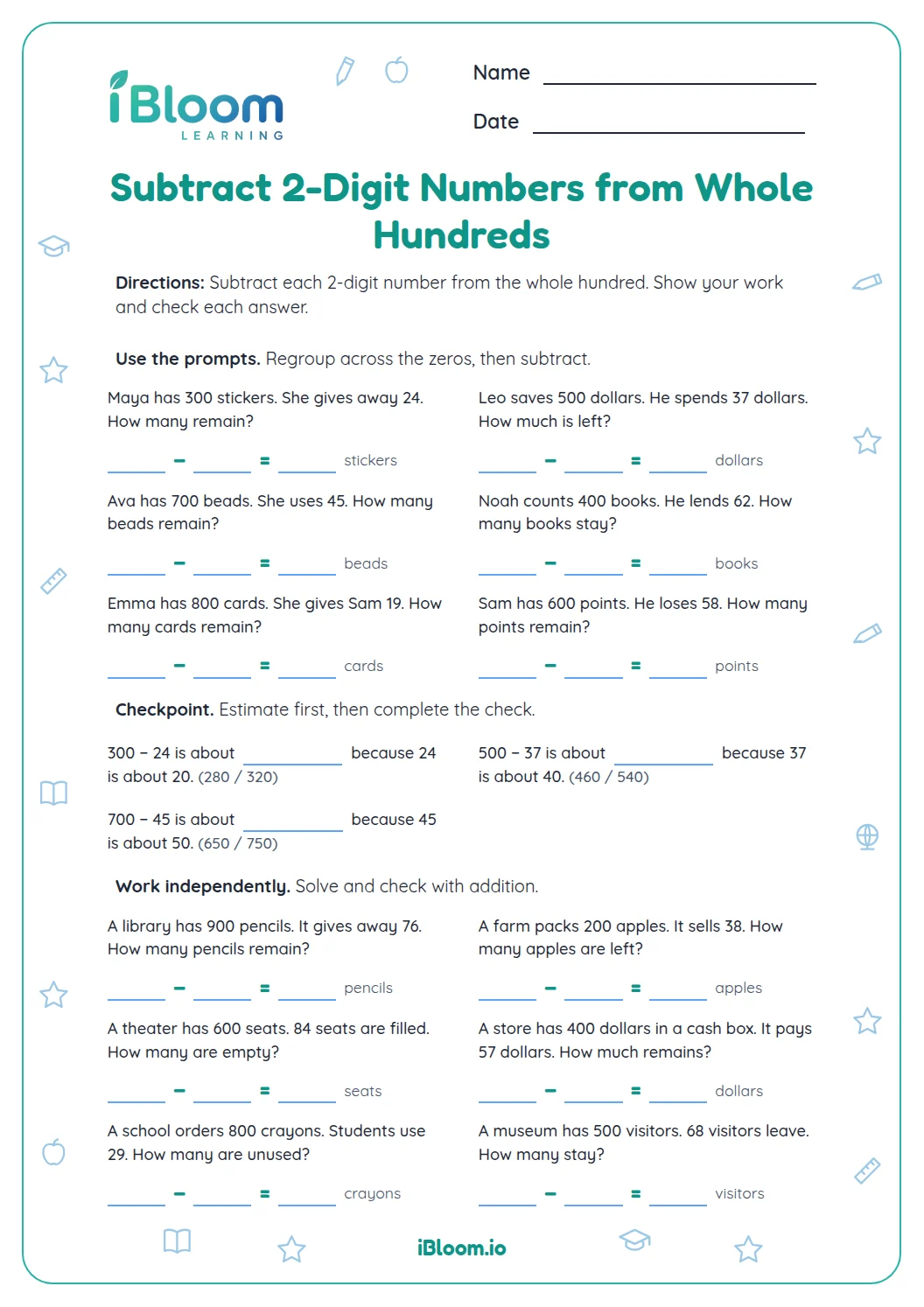
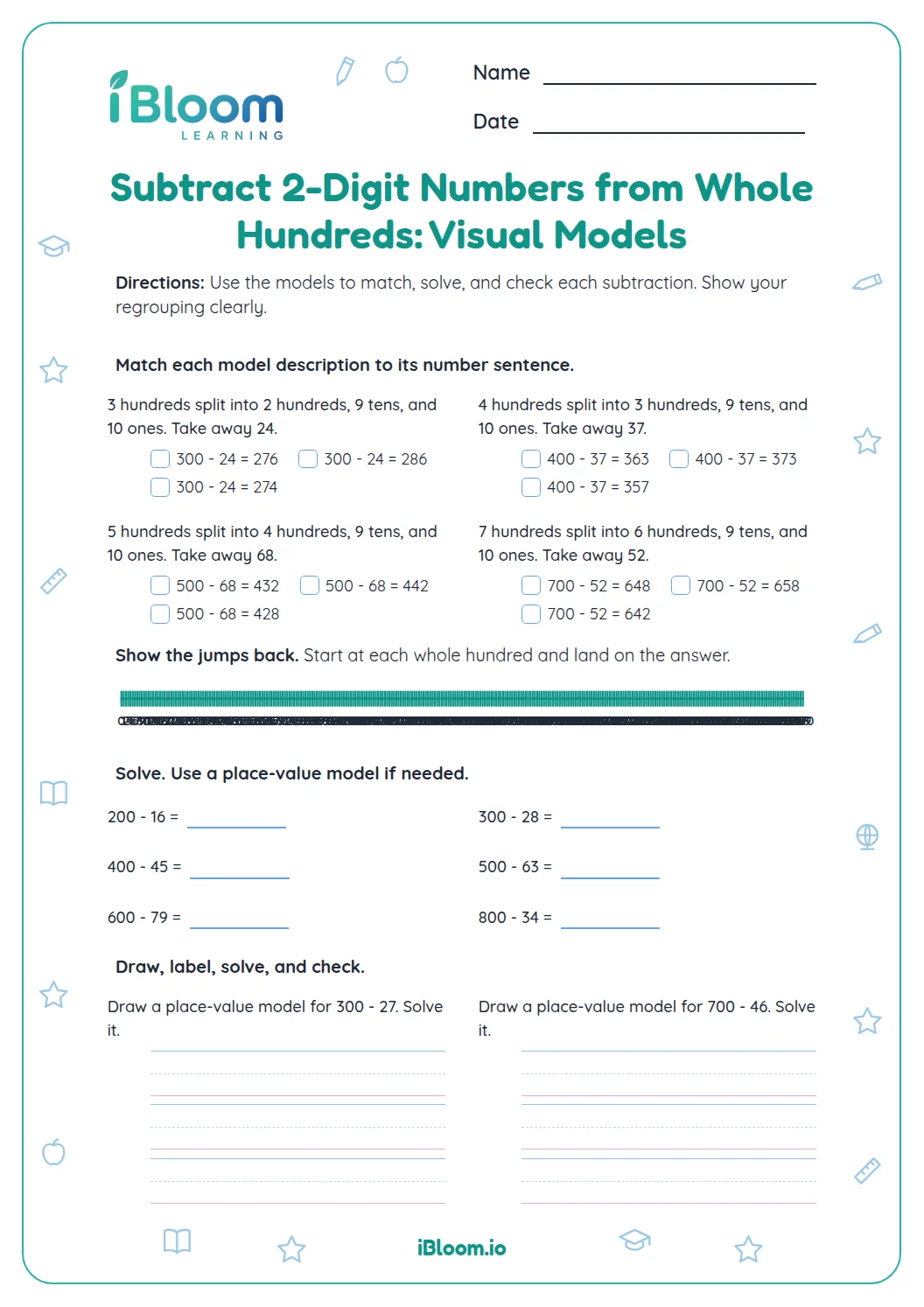
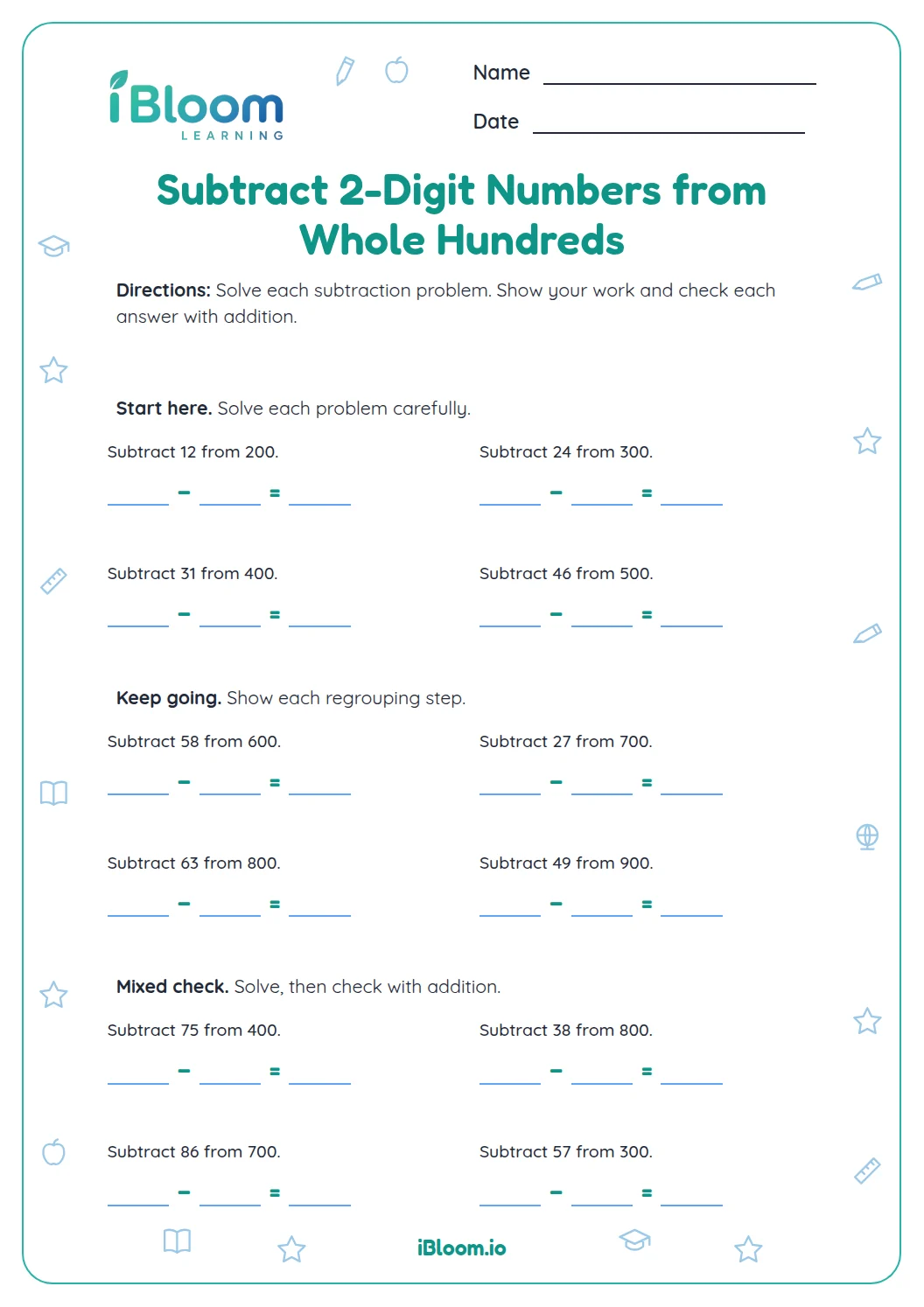
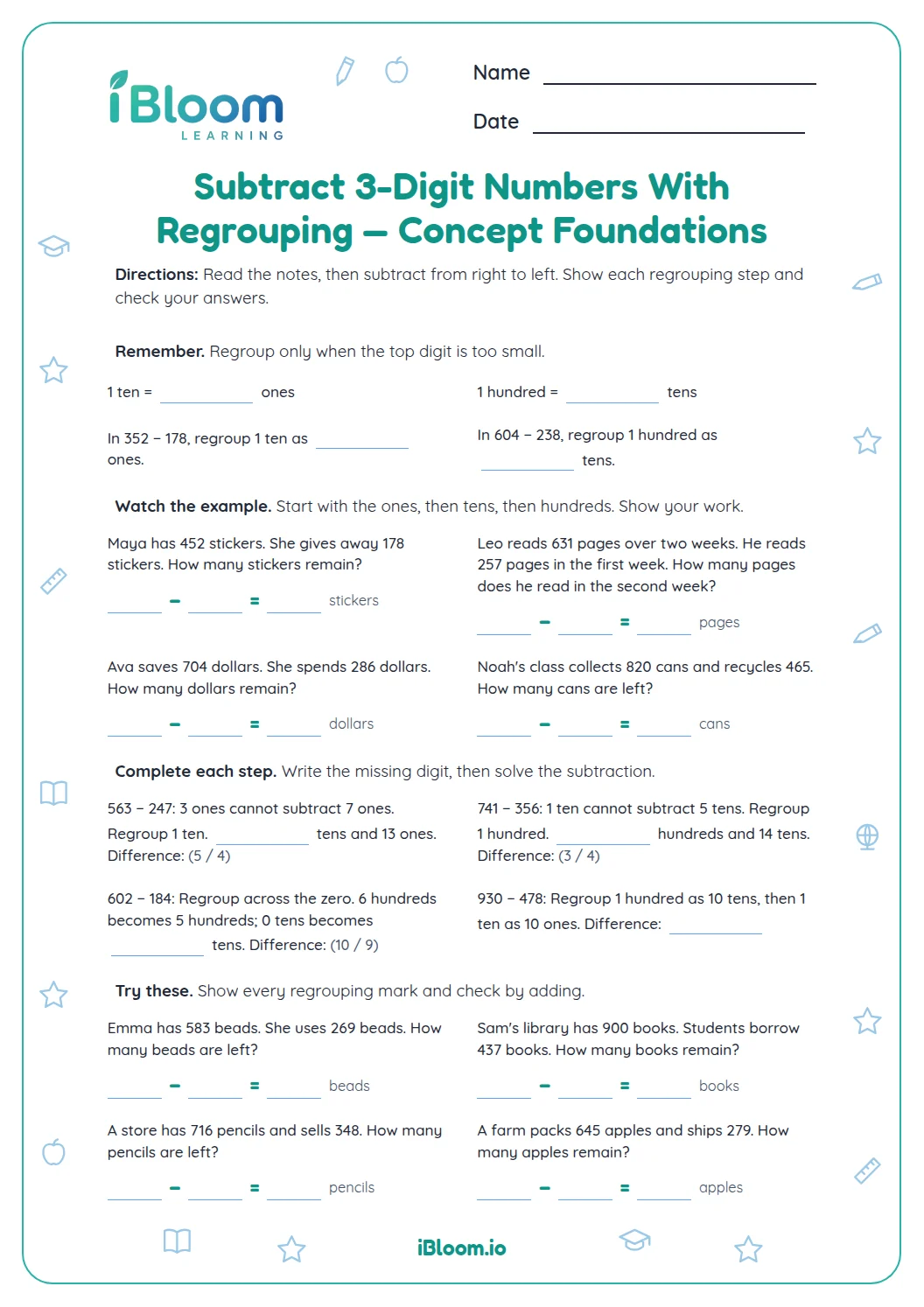
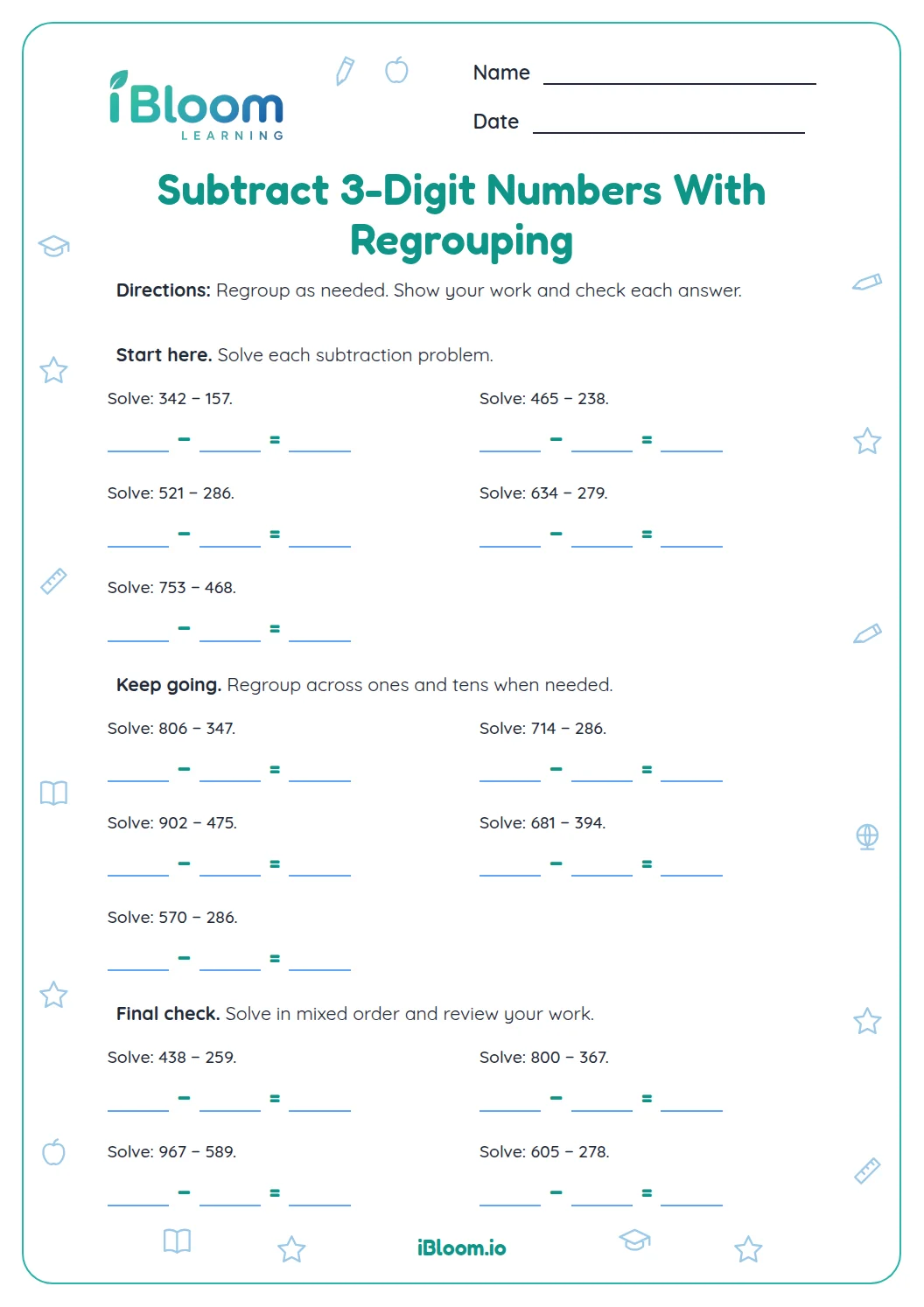
This free Grade 3 worksheet uses base-ten drawings to explain subtraction across two zeros. Children trade one hundred for ten tens, then one ten for ten ones. Part A has two model questions: one shows three hundreds, and one shows a traded hundred as nine shaded tens and ten unshaded ones. Part B asks children to rename two whole hundreds. Part B has eight subtraction calculations, and Part C has two word problems. All calculations stay within 1,000 and practice CCSS 3.NBT.A.2. A separate answer key gives the trading answers and differences.
Aligned to 3.NBT.A.2
What do the block drawings represent?
Each large grid represents 100, and each small square represents 1. Question 1 starts with three hundred blocks. Question 2 shows one traded hundred as nine shaded tens and ten unshaded ones. Questions 3 and 4 ask how many hundreds remain when the amount is renamed.
The shaded and unshaded parts still total 100: 90 + 10 = 100. Put those parts with the remaining hundreds to rename 300 or 500 as hundreds, 9 tens, and 10 ones.
Why does 300 become 2 hundreds, 9 tens, and 10 ones?
One of the hundreds becomes ten tens, leaving the other hundreds. One of those ten tens becomes ten ones, leaving nine tens. The renamed amount keeps the same value: 300 = 2 hundreds + 9 tens + 10 ones.
- 1300 − 148
- 2Rename 300: 2 hundreds, 9 tens, 10 ones.
- 3Ones: 10 − 8 = 2. Tens: 9 − 4 = 5. Hundreds: 2 − 1 = 1.
- 4Answer: 152. Check: 152 + 148 = 300.
How do the calculations connect to the word problems?
Part C gives eight whole-hundred starting amounts from 300 through 900. Each subtraction requires exchanging through both zeros. Children can write the renamed amount beside a calculation before finding its difference.
Part C asks how many library books remain after borrowing and how many tickets remain after sales. Children can write a subtraction sentence, solve, and select the matching answer.
Trade, subtract, and check
- 1Point to a hundred square and name its value as 100.
- 2Use Part A to follow the first trade and then the second trade.
- 3Before each Part B subtraction, rename the starting hundred as hundreds, tens, and ones.
- 4Subtract ones, then tens, then hundreds; record the difference.
- 5For each word problem, write the subtraction sentence and label the answer.
- 6Add the difference to the amount taken away to check the starting total.
Mistakes to notice and how to help
The mistake
Keeping ten tens after also making ten ones.
The fix
One ten was traded away. After both exchanges there are nine tens and ten ones.
The mistake
Leaving all three hundreds in 300 after trading a hundred.
The fix
Cross out one hundred when it becomes tens. Only two hundreds remain.
The mistake
Subtracting the smaller digit from the larger digit in each column.
The fix
Keep the order of the subtraction. For 300 − 148, trade first so the ones calculation is 10 − 8.
Common Core alignment
Subtract from whole hundreds using base-ten exchanges.
On this sheet: The model questions explain the exchanges used in the calculations and word problems.
Show the official wordingHide the official wording
Fluently add and subtract within 1000 using strategies and algorithms based on place value, properties of operations, and/or the relationship between addition and subtraction.
What to practice next
Make more practice
Further reading
Questions parents and teachers ask
What do the shaded and unshaded squares mean?
Each large grid is worth 100, and each small square is worth 1. In questions 2 and 3, the nine shaded columns represent nine tens. The ten unshaded squares represent ten ones. Together they show the hundred that was traded, ready to use when subtracting.
Why are there nine tens after both trades?
There are nine tens because one of the ten tens was exchanged for ten ones. The first trade changes one hundred into ten tens. The second trade uses one of those tens. Keeping ten tens and also adding ten ones would make the total ten too large.
Do all six calculations need both trades?
Yes, each calculation starts with a whole hundred and subtracts a number with a nonzero ones digit. There are no ones or tens available at first. Children exchange a hundred for tens, then a ten for ones, before subtracting in the usual place-value method.
How can children check 400 − 176?
They can add the difference, 224, to 176 and check that the sum is 400. They can also inspect the renamed starting amount: three hundreds, nine tens, and ten ones. Subtracting one hundred, seven tens, and six ones leaves two hundreds, two tens, and four ones.
Can we use real blocks with this worksheet?
Yes, real base-ten blocks can help children carry out the exchanges in Part A. Begin with three hundreds, as in question 1. Trade one hundred for ten tens, then one ten for ten ones. Match the nine tens and ten ones to the shaded and unshaded parts in question 2.