






About this worksheet
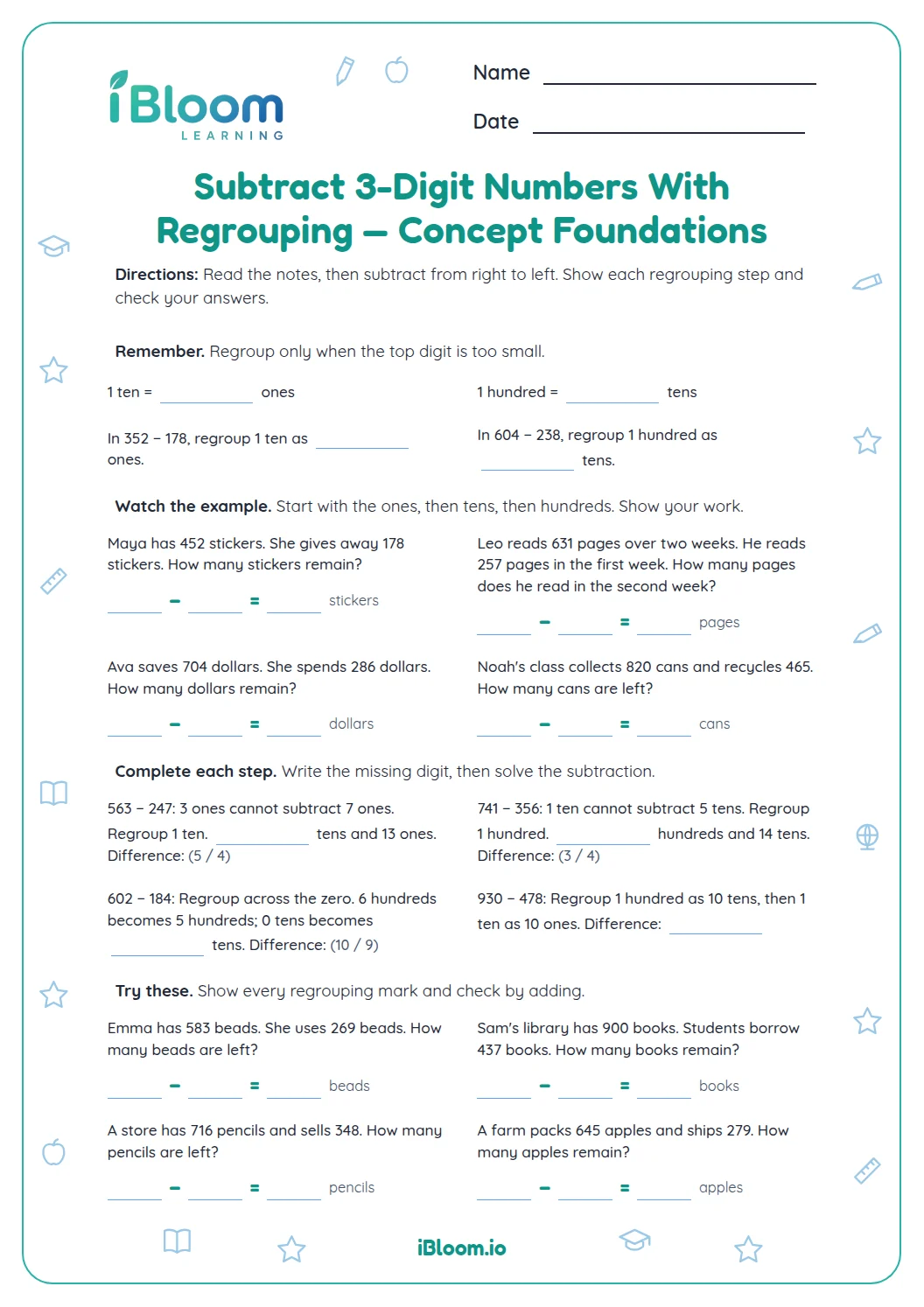
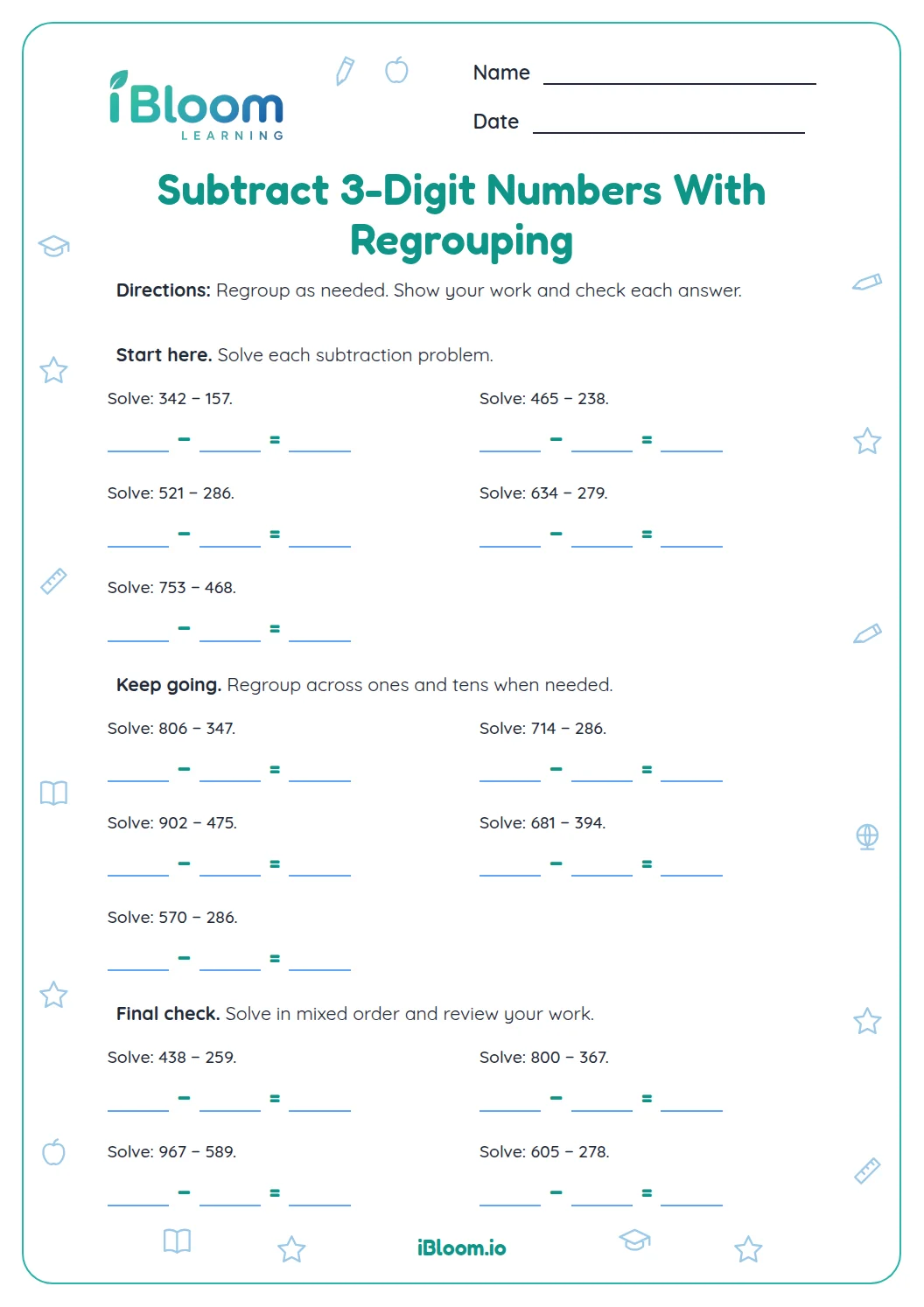
This free Grade 3 worksheet builds fluency when subtraction requires regrouping across two zero places, as in 600 − 247. Children solve multi-digit problems, correct incorrect differences, compare expressions, fill missing values, and solve short stories. The problems ask for careful place-value regrouping and offer chances to check subtraction with addition. It aligns with Common Core 3.NBT.A.2 and includes a separate answer key.
Aligned to 3.NBT.A.2
How do you regroup across two zero places?
When a number has zeros in the tens and ones places, regroup from a larger place. For 600 − 247, trade 6 hundreds for 5 hundreds and 10 tens; trade 1 ten for 9 tens and 10 ones. Then subtract ones, tens, and hundreds.
Question 1 is 600 − 247. After regrouping, 10 − 7 = 3 ones, 9 − 4 = 5 tens, and 5 − 2 = 3 hundreds. The difference is 353.
- 1600 − 247
- 2Regroup: 600 becomes 5 hundreds, 9 tens, 10 ones
- 310 − 7 = 3; 9 − 4 = 5; 5 − 2 = 3
- 4Difference: 353
- 5Check: 353 + 247 = 600
How can addition check a subtraction answer?
Add the difference to the amount taken away. For question 2, 444 + 356 = 800, which checks 800 − 356 = 444.
This also helps catch a borrowing error: compare each place value and make sure the sum returns to the original minuend.
How do children reason about subtraction results?
Questions 5 and 6 give incorrect differences to correct. Questions 7 through 9 ask children to compare results or use subtraction in a short story. Read the whole prompt, calculate, and use addition to check when useful.
Questions 10 through 14 ask for missing values and one more application. All problems use numbers within 1,000 and practice subtraction with regrouping.
How to use this worksheet
- 1Line up ones, tens, and hundreds.
- 2Regroup from the first nonzero place to the left.
- 3Rename the places affected by each trade.
- 4Subtract each place value.
- 5Add the difference to the amount subtracted to check.
Common mistakes and quick fixes
The mistake
Borrowing from the tens place when it is zero.
The fix
Trade one hundred for 10 tens first, then trade one ten for 10 ones.
The mistake
Leaving the original hundreds unchanged after regrouping.
The fix
Reduce the hundreds by one when trading it for tens.
The mistake
Accepting a difference without checking.
The fix
Add the difference and subtrahend; the sum should equal the starting number.
This sheet practices the following Common Core skill.
Children subtract within 1,000 using place value and addition to check.
On this sheet:
Show the official wordingHide the official wording
Fluently add and subtract within 1000 using strategies and algorithms based on place value, properties of operations, and/or the relationship between addition and subtraction.
What to practice next
Make more practice
Further reading
Questions parents and teachers ask
What does “regroup across two zeros” mean?
In 600 − 247, trade 6 hundreds for 5 hundreds and 10 tens, then trade 1 ten for 9 tens and 10 ones. Subtract the ones, tens, and hundreds to get 353. Adding 353 and 247 checks the result. This is the regrouping strategy practiced here.
How many questions are on this worksheet?
There are 14 questions on two worksheet pages. Children solve subtraction, correct a claimed difference, compare expressions, find missing values, and solve short story problems. The separate two-page key shows the answers. The tasks move from direct calculations toward missing-value and story contexts.
How can I check 600 − 247?
Regroup 600 as 5 hundreds, 9 tens, and 10 ones. Then subtract by place: 10 − 7 = 3, 9 − 4 = 5, and 5 − 2 = 3, so the difference is 353. Check by adding 353 + 247.
Why compare two subtraction expressions?
Comparing expressions asks children to calculate carefully and interpret the results. For example, 800 − 529 is 271, while 700 − 428 is 272, so 700 − 428 is greater by 1. The key confirms both results so the comparison can be checked.
What can a child do after finding an incorrect answer?
Work out the subtraction, then use addition to check it. For example, 500 − 236 is 264, not 336; adding 264 + 236 returns 500. The same check can help locate a regrouping or subtraction error. Have the child explain which place was regrouped and why.