






About this worksheet
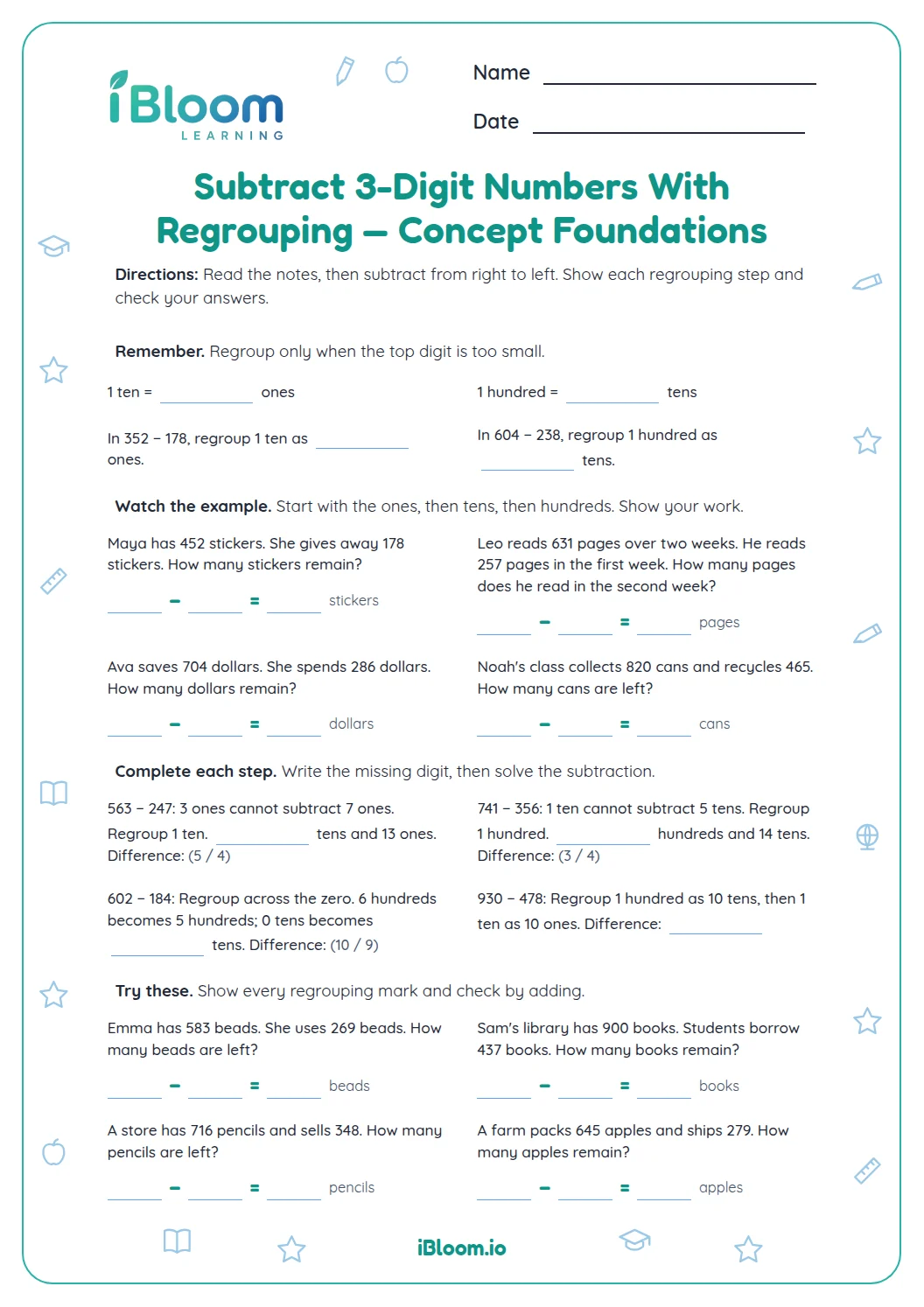
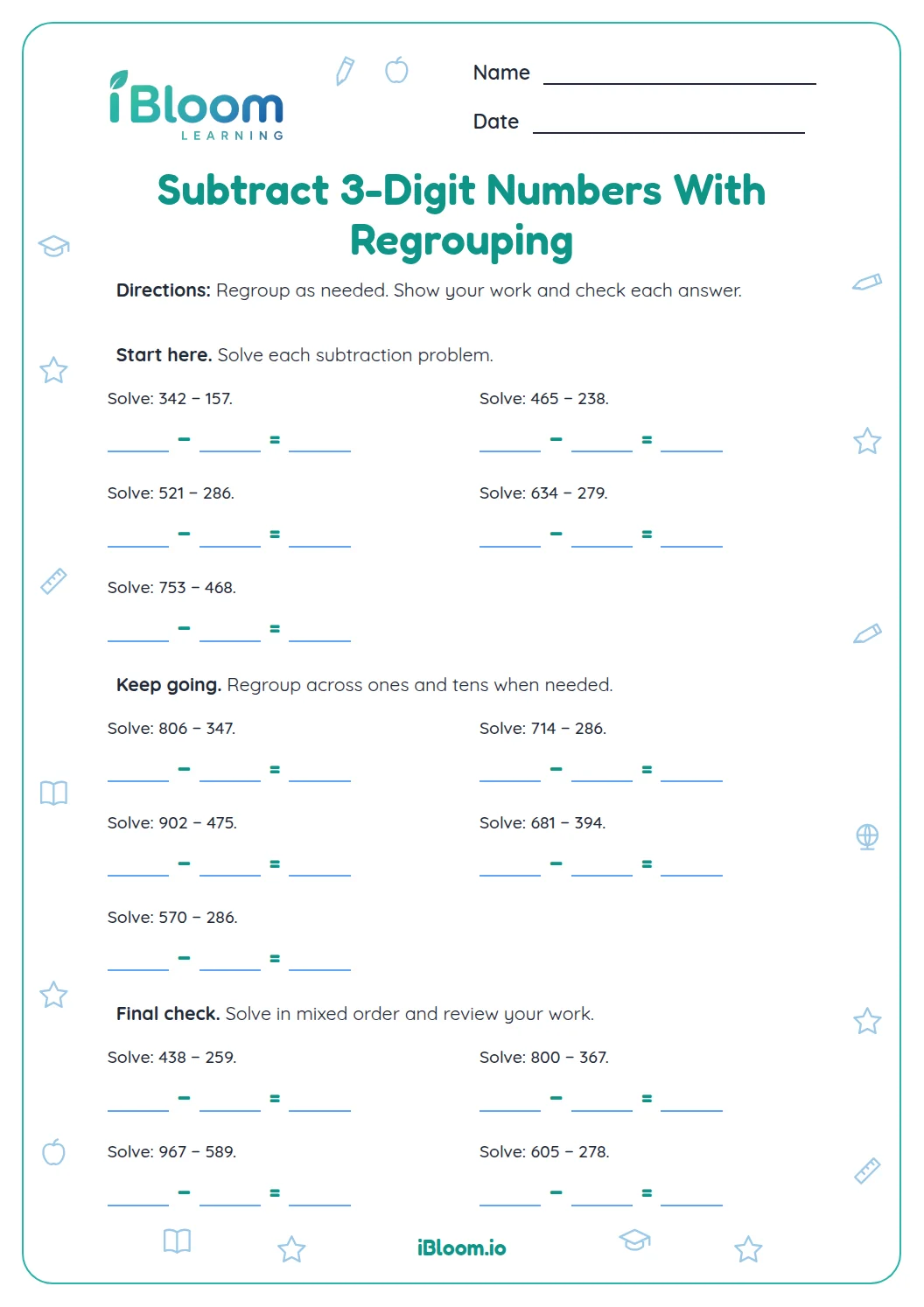
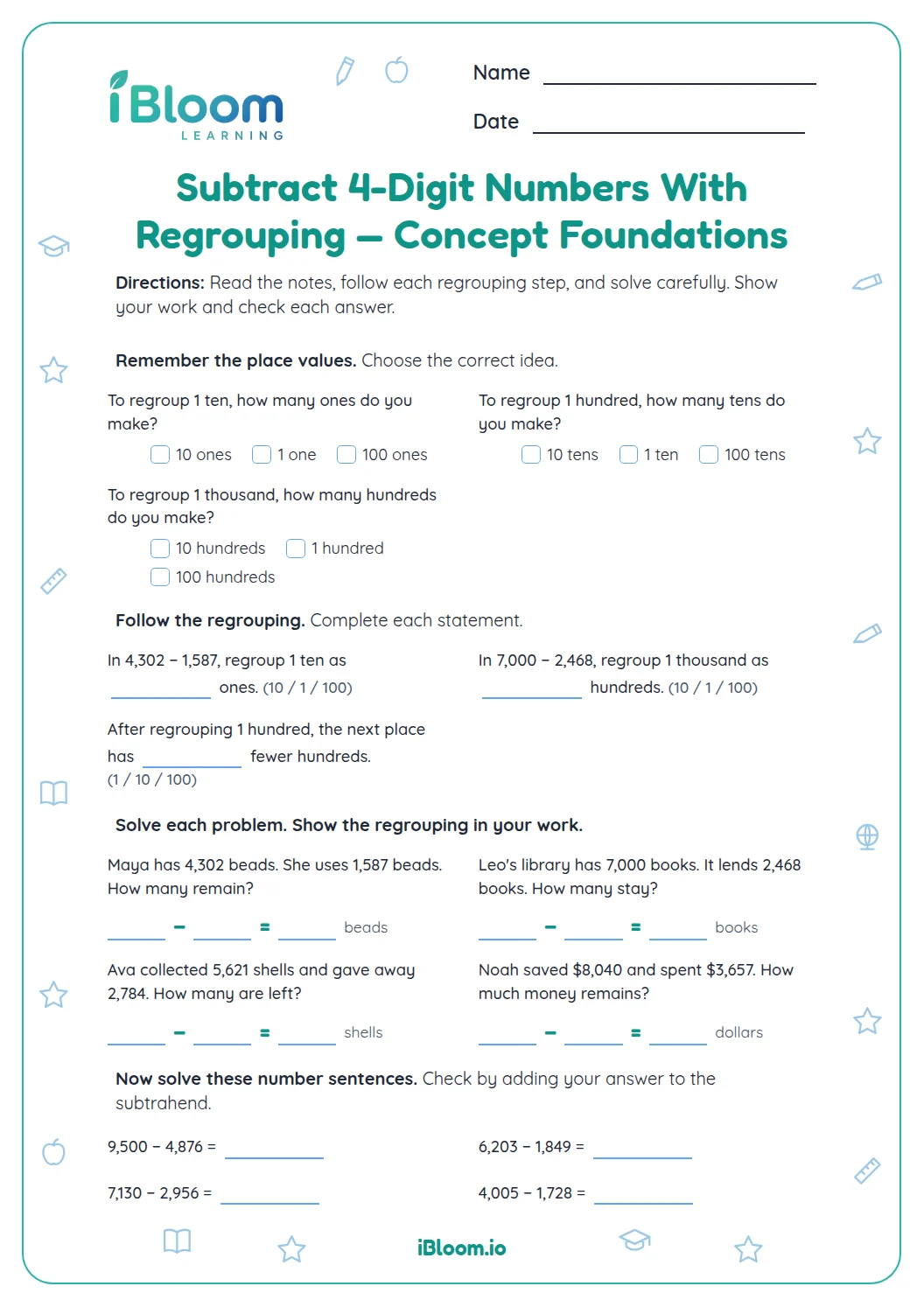
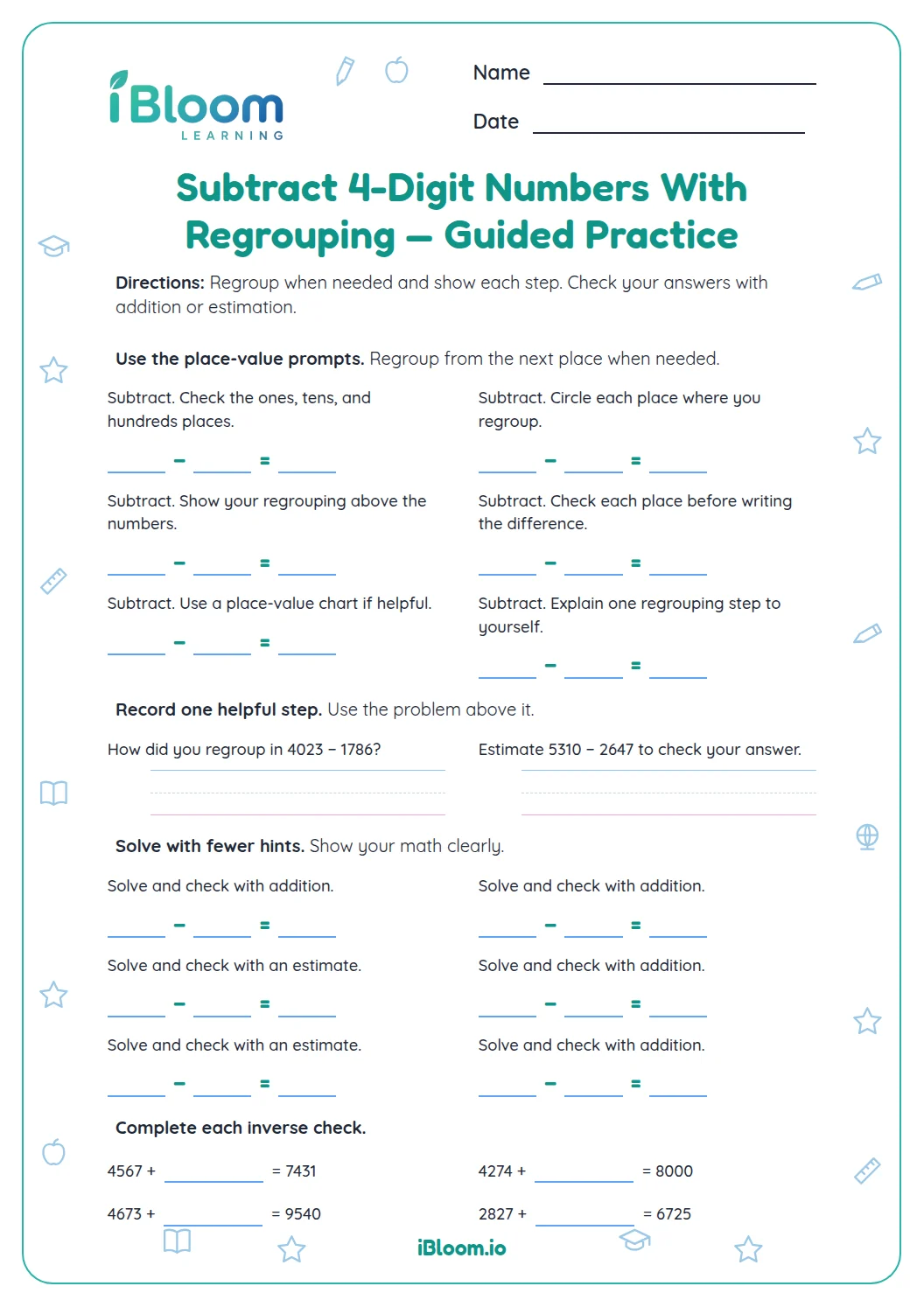
This free worksheet gives Grade 3 children fourteen opportunities to regroup across three zeros. Every starting number is a whole thousand, so children must exchange through the hundreds and tens before subtracting the ones. Part A subtracts three-digit numbers; Part B subtracts four-digit numbers. Working grids give space to align digits and record exchanges independently. The sheet practices the standard subtraction algorithm described in Common Core 4.NBT.B.4, and the separate key supplies all fourteen differences.
Aligned to 4.NBT.B.4
What happens to the three zeros when you regroup?
For 4,000, exchange one thousand to make 3 thousands and 10 hundreds. Exchange one hundred to make 9 hundreds and 10 tens. Exchange one ten to make 9 tens and 10 ones. The value stays 4,000 throughout.
The middle places become 9 because each passes one group to the next smaller place. The ones become 10 because that is where the chain of exchanges stops.
How does the method work in question 7?
Write 1,286 under 4,000 with ones beneath ones. After regrouping, subtract one column at a time, starting at the right.
- 14,000 = 3,000 + 900 + 90 + 10
- 2Ones: 10 − 6 = 4; tens: 9 − 8 = 1
- 3Hundreds: 9 − 2 = 7; thousands: 3 − 1 = 2
- 44,000 − 1,286 = 2,714
- 5Check: 2,714 + 1,286 = 4,000
How can children check their own subtraction?
Add the difference to the number taken away. For question 1, 753 + 247 = 1,000, so 753 is correct. Addition checks the full number, including the changed thousands digit.
Part A keeps the number taken away to three digits. Part B adds a thousands digit to subtract as well. If a result is wrong, compare the written exchanges with the original value before repeating the subtraction.
How to use this worksheet
- 1Ask the child to name the thousands, hundreds, tens, and ones places in 4,000.
- 2Review the exchange chain with a different problem before beginning independent work.
- 3Have the child align the numbers in each grid and record every changed digit.
- 4Subtract from right to left and write the difference in the answer box.
- 5Add the difference and the subtracted number; the total should equal the starting number.
Mistakes to notice and fix
The mistake
Changing all three zeros to 10.
The fix
The hundreds and tens each give one group away, leaving 9 hundreds and 9 tens; only the ones stay at 10.
The mistake
Leaving the starting thousands digit unchanged.
The fix
Cross out the original thousands digit as soon as one thousand is exchanged.
The mistake
Subtracting the smaller digit from the larger digit in each column.
The fix
Keep the order of the numbers. Regroup the top number when its digit is too small.
Curriculum alignment
Use the standard algorithm to subtract whole numbers after regrouping across three zeros.
On this sheet: Fourteen problems require aligned subtraction and a sequence of place-value exchanges across three zeros.
Show the official wordingHide the official wording
Fluently add and subtract multi-digit whole numbers using the standard algorithm.
What to practice next
Make more practice
Further reading
Questions parents and teachers ask
Does every problem require crossing three zeros?
Yes. Every starting number is a whole thousand, and every number being subtracted has a nonzero ones digit. The child must exchange through hundreds and tens to reach the ones place. This repeated structure lets them practice the same regrouping chain with fourteen different differences.
Why do the hundreds and tens become 9?
Each of those places receives ten groups and then passes one group to the next smaller place. Ten hundreds become nine hundreds after one hundred is exchanged for tens. Ten tens become nine tens after one ten is exchanged for ones, leaving ten ones to subtract from.
What is the answer to 4,000 − 1,286?
The difference is 2,714. Rename 4,000 as 3 thousands, 9 hundreds, 9 tens, and 10 ones. Subtract 6 ones, 8 tens, 2 hundreds, and 1 thousand in their columns. Adding 2,714 and 1,286 gives 4,000, which confirms the result for question 7.
How do the two parts differ?
Part A subtracts three-digit numbers from whole thousands. Part B subtracts four-digit numbers, so children must also subtract a thousands digit after completing the exchanges. Both parts provide working grids and require the same careful record of the regrouped hundreds, tens, and ones.
How much help should I give during independent practice?
Review the exchange sequence before the child starts, then let them record the steps independently. If they get stuck, ask which place can supply a group and what its value becomes afterward. Use the answer key after the attempt, and check a missed answer by addition together.