




About this worksheet
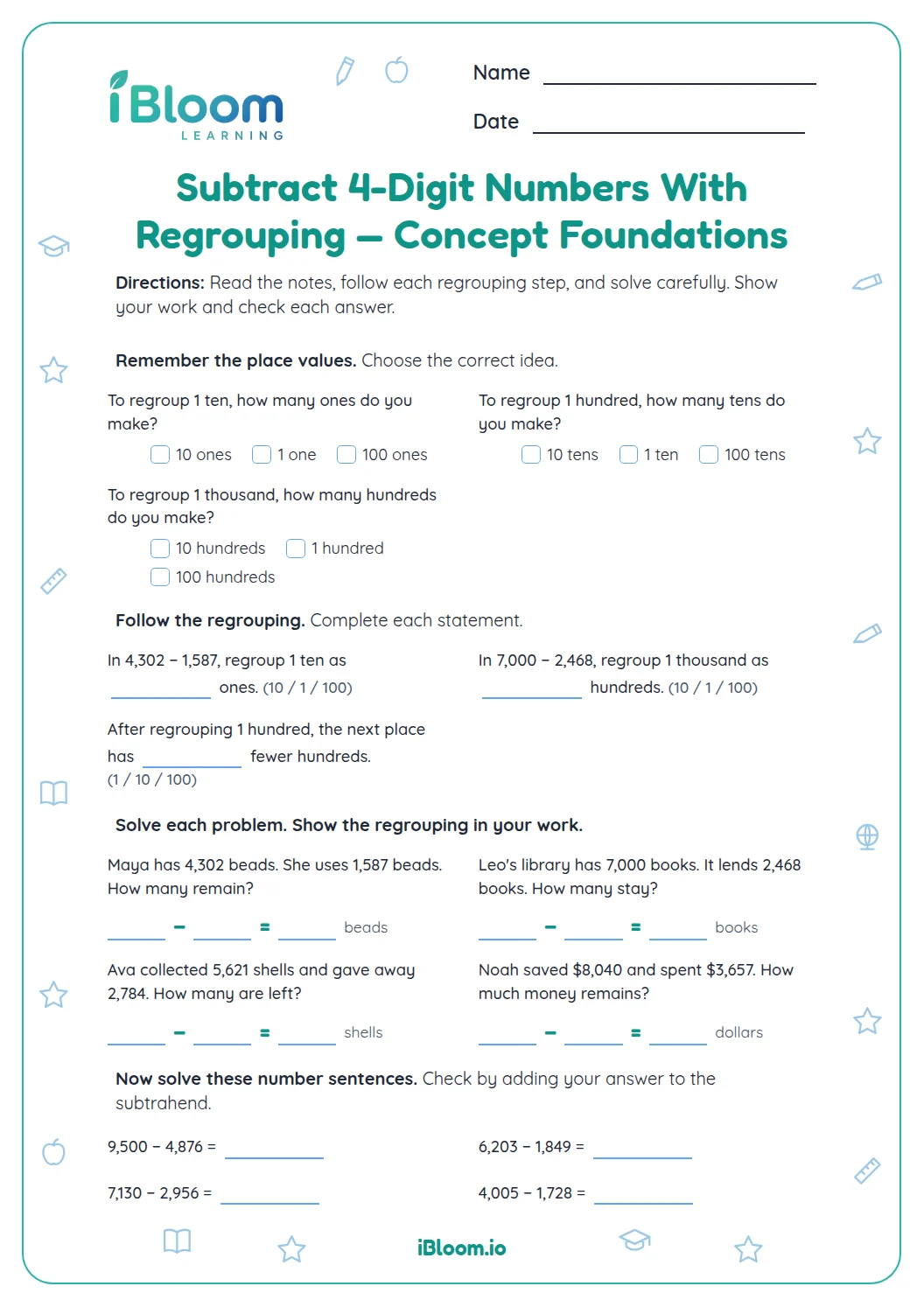
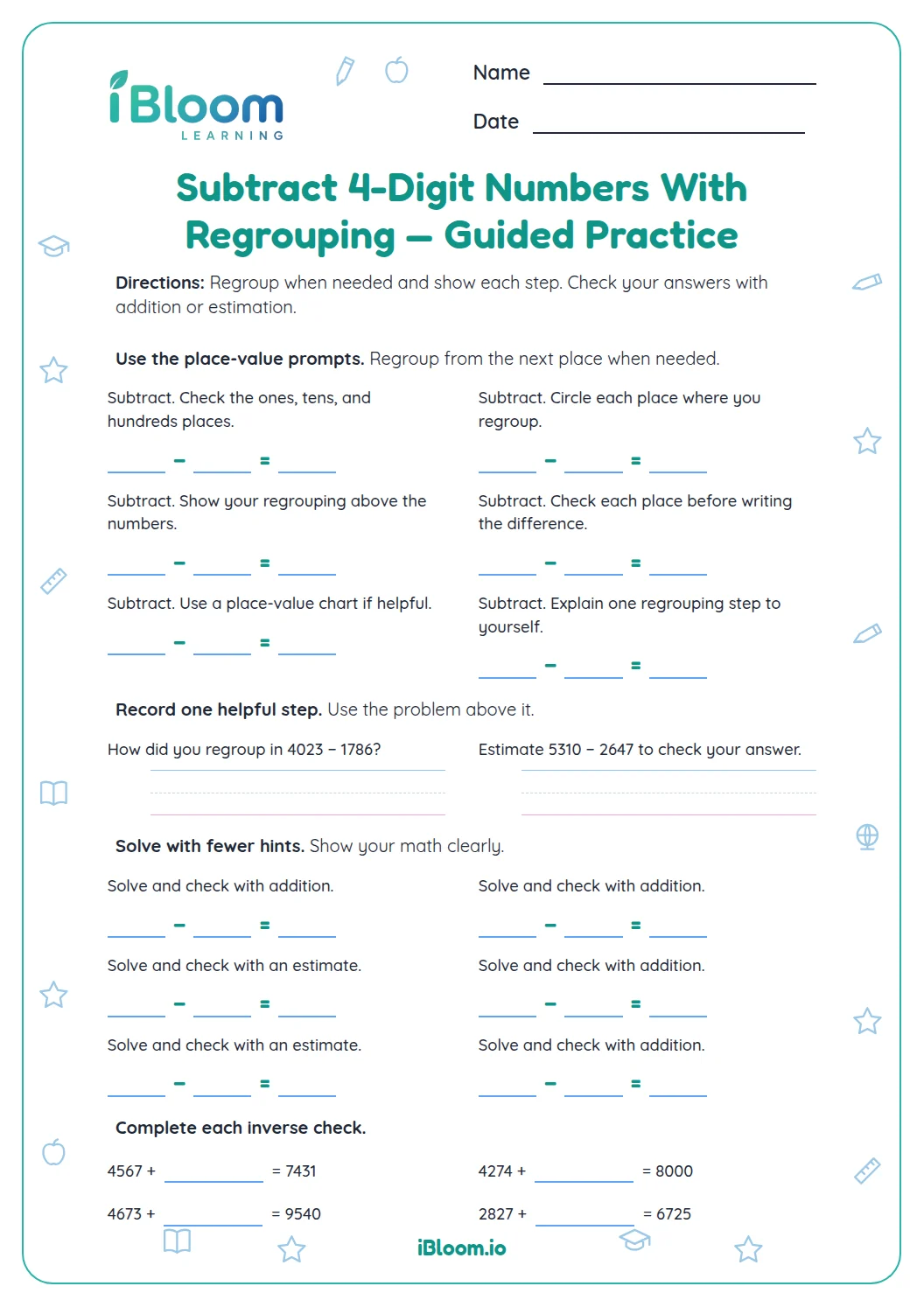
This printable gives students 14 real-world subtraction problems with four-digit quantities and regrouping across three zero places. Part A begins with books, tickets, and other familiar totals; Part B continues with a wider mix of contexts. Each item asks for one remaining or missing amount and provides an answer line. The practice builds place-value reasoning with the standard subtraction algorithm, aligned to Common Core 4.NBT.B.4. A separate answer key lists each result with its unit.
Aligned to 4.NBT.B.4
Why does subtracting across zeros take several regroupings?
A zero has no units to trade in that place. To subtract the ones, regroup from the nearest nonzero place, trading across each zero. The place values change but the total quantity stays the same.
How can you keep each place value organized?
Write the larger amount first and subtract the amount used or removed. Regroup one place at a time and subtract each column.
- 15,000 − 1,286
- 2Regroup across the zeros, then subtract by place.
- 35,000 − 1,286 = 3,714
- 4Check: 3,714 + 1,286 = 5,000.
What should the answer include?
Read the final question again and include the matching unit, such as books, feet, or dollars. An addition check can confirm that the remaining amount plus the amount removed equals the starting amount.
How to use this worksheet
- 1Underline the starting amount and the amount removed.
- 2Write a subtraction equation in the order the story describes.
- 3Regroup through each zero, one place at a time.
- 4Subtract each place value and record the difference.
- 5Add the difference to the amount removed to check.
Common mistakes and quick fixes
The mistake
Subtracting a zero without regrouping.
The fix
Trade from the next nonzero place and record each regrouping step.
The mistake
Changing the value while regrouping.
The fix
Keep the total the same: one ten trades for ten ones, one hundred for ten tens.
The mistake
Giving a number without its story unit.
The fix
Reread the question and label the answer in books, feet, dollars, or the unit used.
Common Core alignment
This sheet connects the practice to a specific Common Core skill.
Subtract multi-digit whole numbers with the standard algorithm.
On this sheet: Story quantities require subtracting across three zero places with regrouping.
Show the official wordingHide the official wording
Fluently add and subtract multi-digit whole numbers using the standard algorithm.
What to practice next
Make more practice
Further reading
Questions parents and teachers ask
What does “across three zeros” mean here?
The starting number has zero hundreds, tens, and ones, so regrouping must pass through those three places. The first problem, 5,000 − 1,286, shows why each place needs attention. The separate answer key lists the response, and a quick reread helps children connect each answer to its clue.
How should students organize the subtraction?
Write the four-digit amounts in matching place-value columns, then regroup through each zero before subtracting. Students can show each trade in the answer space and check by adding the difference to the amount taken away. Keeping digits aligned makes the trades easier to follow.
Why use four-digit numbers for this practice?
The worksheet title focuses on regrouping through the hundreds, tens, and ones places when those digits are zero. The four-digit starting amounts make each of those trades visible in the subtraction work. A place-value check can confirm the difference.
Are units included in the answer key?
Yes. The key labels answers in the units used in the story, such as books, tickets, feet, and dollars. This helps students connect the calculation to the question. The separate answer key lists the response, and a quick reread helps children connect each answer to its clue.
How many problems are on the printable?
There are 14 real-world subtraction questions across two worksheet pages, with a separate two-page answer key. Each question asks for one remaining amount and names the unit when a unit applies. The story settings include books, tickets, food, and distance.