






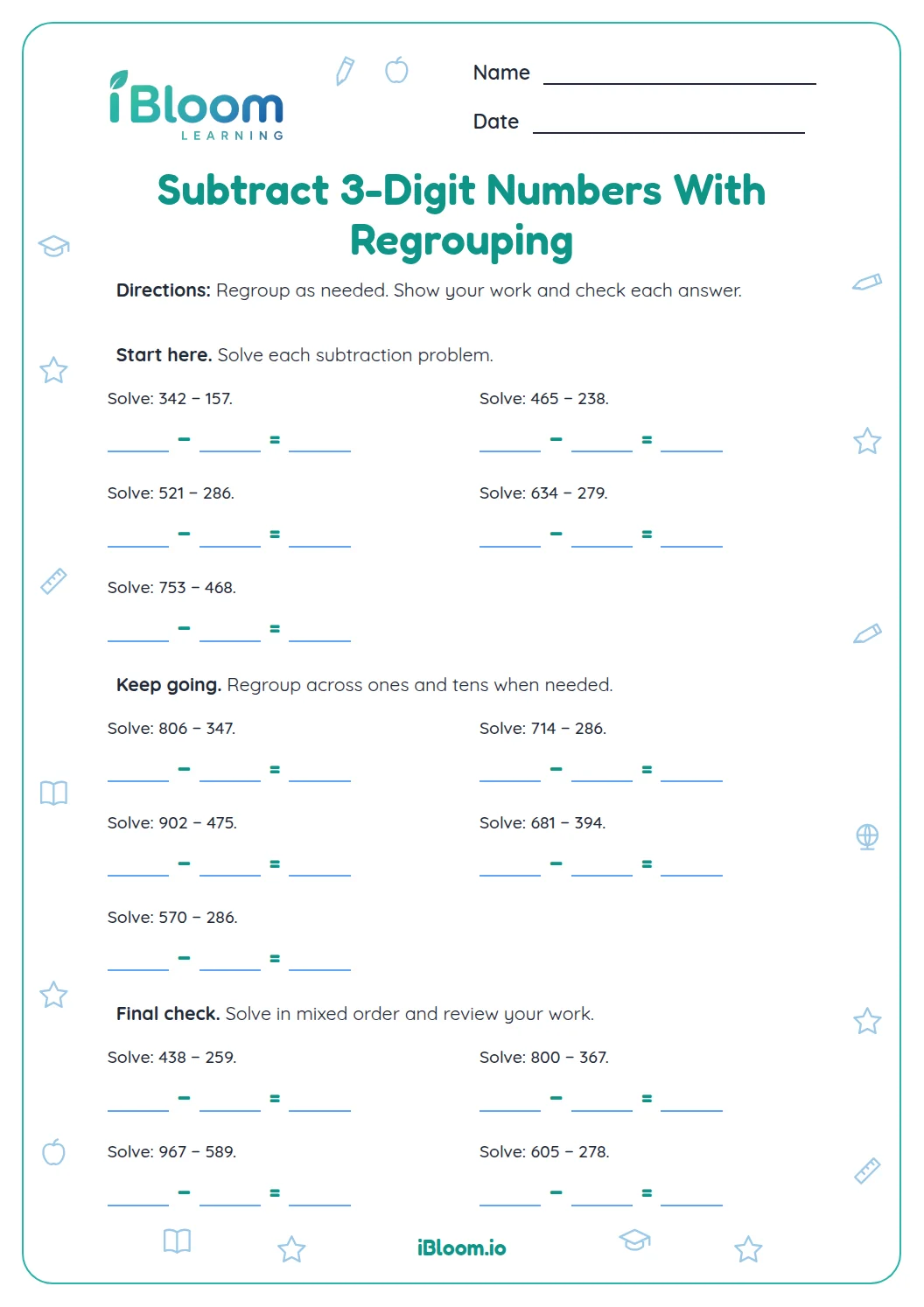
About this worksheet
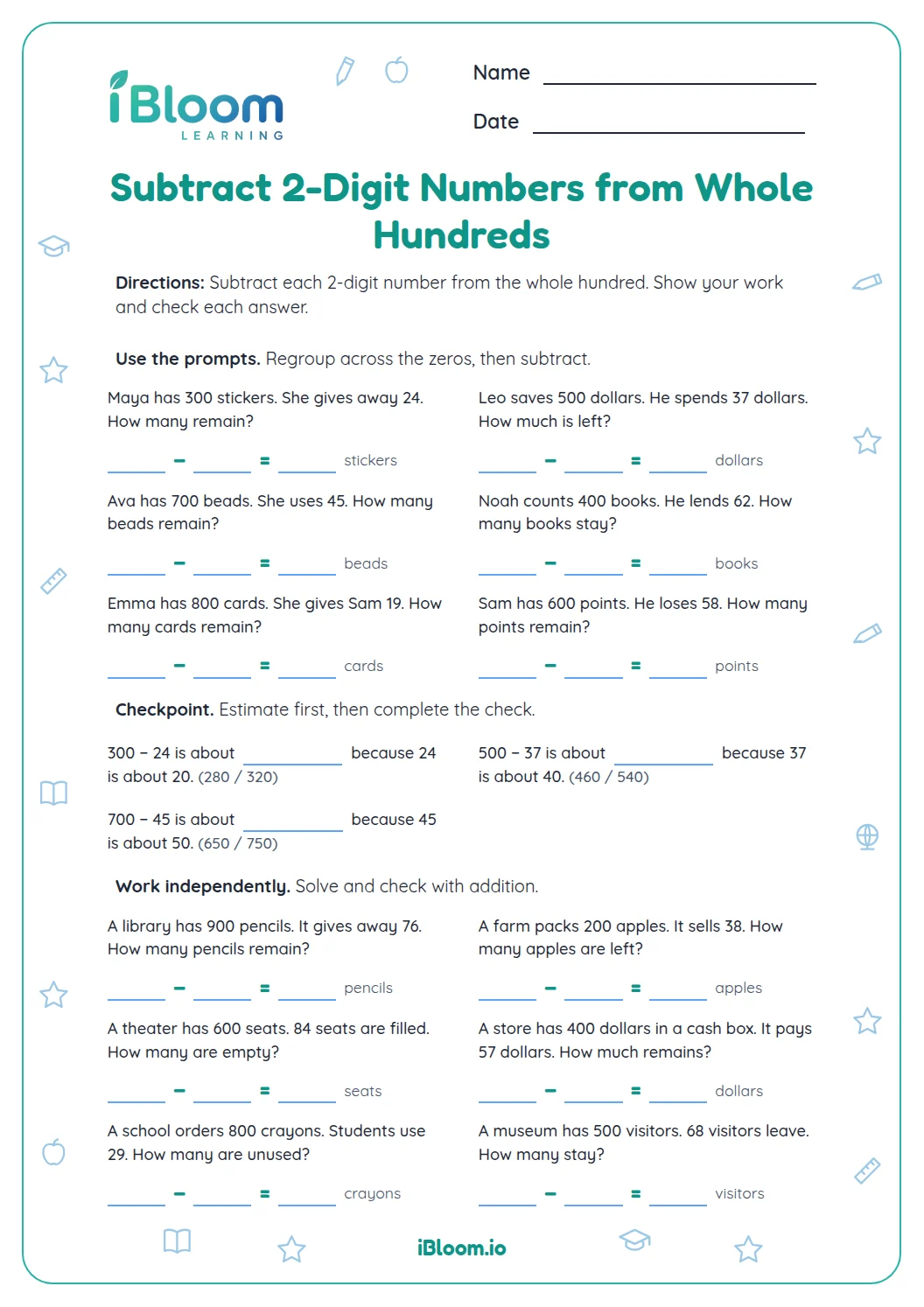
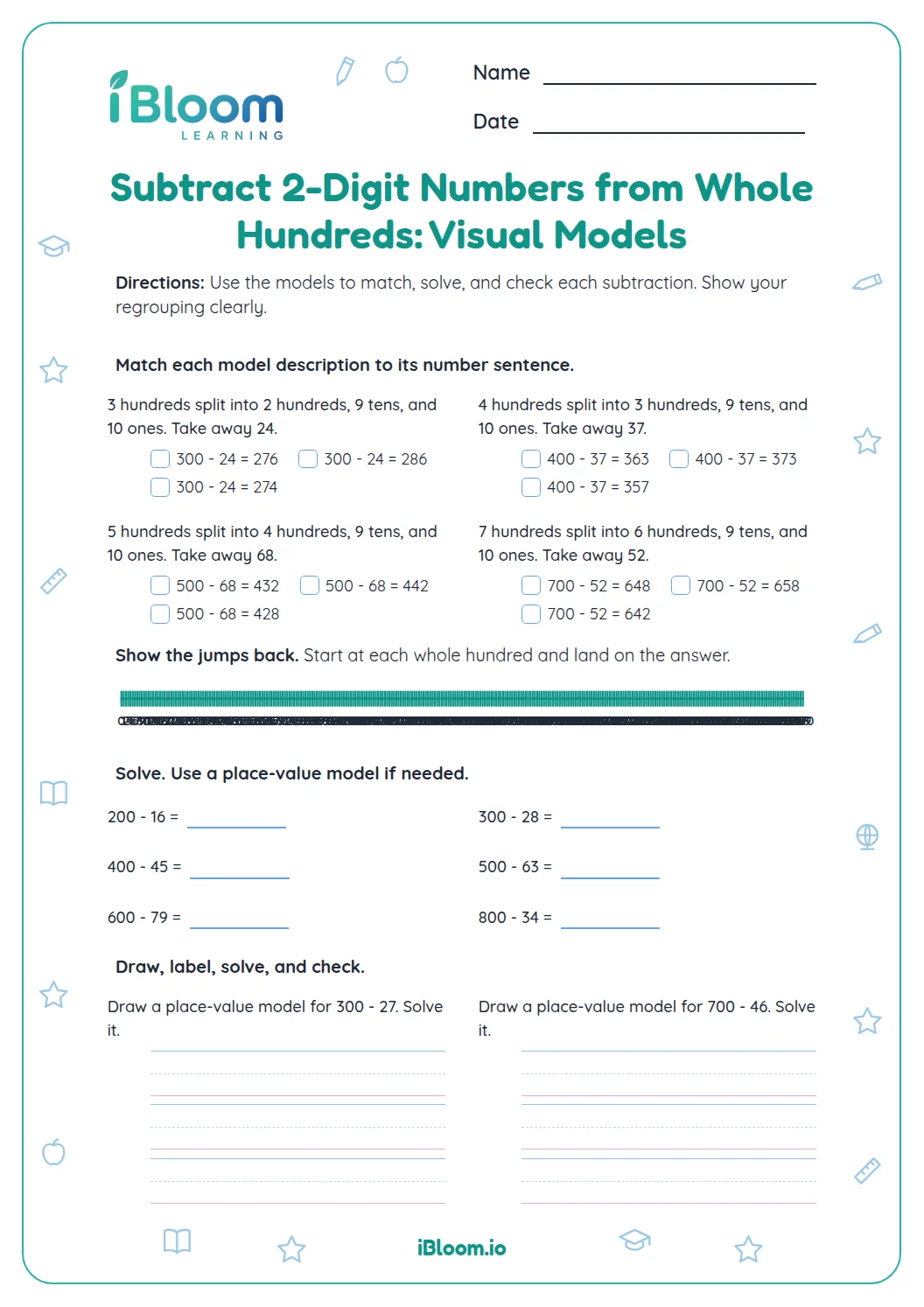
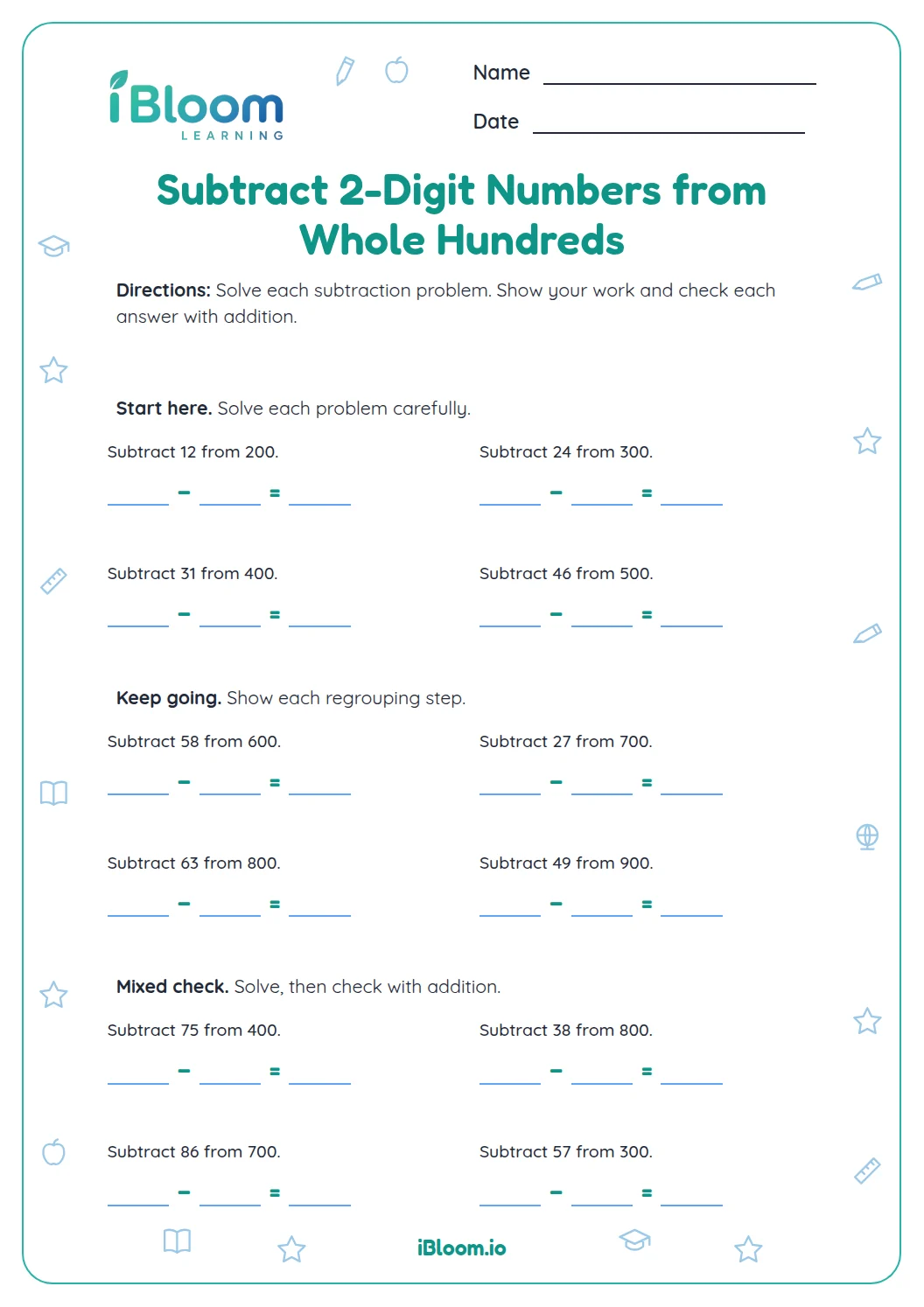
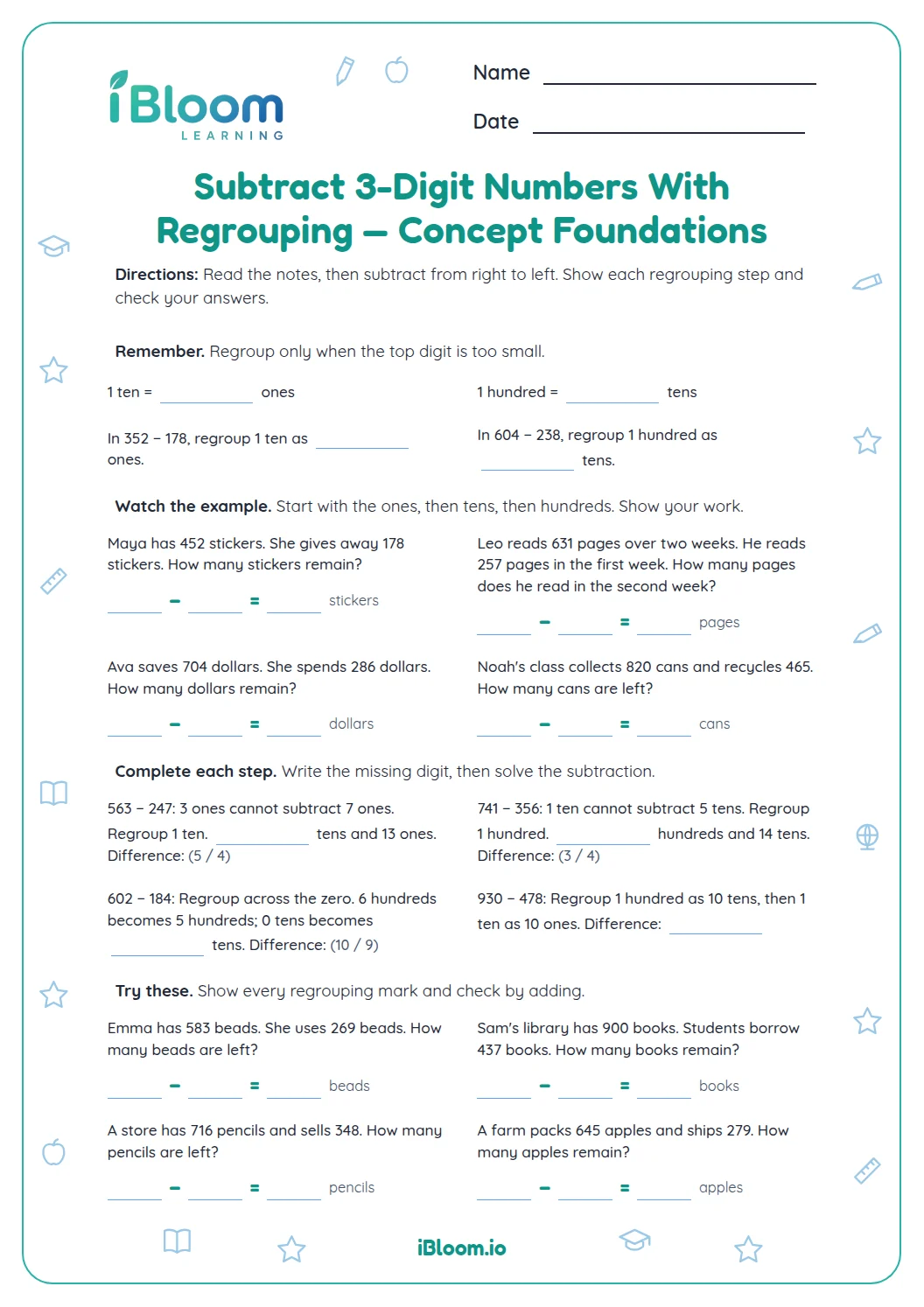
This Grade 3-labeled printable focuses on the named skill of subtracting four-digit numbers across zero places. Students reason about exchanges, solve six fresh calculations, and identify valid addition checks. The worksheet and separate key keep the work focused on regrouping and accurate differences.
Aligned to 4.NBT.B.4
How do you regroup across zero places?
Rename the first nonzero place to make value available in the places to its right. Continue exchanging until the needed place has enough units to subtract.
- 13,000 − 1,458
- 23,000 − 1,000 = 2,000
- 32,000 − 458 = 1,542
- 4Check: 1,542 + 1,458 = 3,000
How can addition check a difference?
Add the difference and the amount subtracted. The sum should equal the starting number. Question 14 gives a valid check for 8,000 − 3,475.
What does each part ask students to do?
Part A asks six questions about exchanges and checking. Part B has six four-digit calculations with working space. Part C has two reasoning and check questions.
How to use this worksheet
- 1Read the minuend and subtrahend carefully.
- 2Exchange one thousand for 10 hundreds, then regroup through the zero places.
- 3Subtract each place after regrouping.
- 4Add the difference and subtrahend to check the minuend.
- 5Use the key to compare the arithmetic and regrouping reason.
Common mistakes and quick fixes
The mistake
Trying to subtract 7 from 0 without regrouping.
The fix
Exchange value from a nonzero place to make units available.
The mistake
Regrouping from the thousands but forgetting to reduce that place.
The fix
When one place gives value to the next, decrease that place by one.
The mistake
Checking by subtracting in the same direction again.
The fix
Add the difference and subtrahend to see if they make the original minuend.
Curriculum alignment
Use place-value strategies and algorithms to add and subtract multi-digit whole numbers.
On this sheet:
Show the official wordingHide the official wording
Fluently add and subtract multi-digit whole numbers using the standard algorithm.
What to practice next
Make more practice
Further reading
Questions parents and teachers ask
What does “regroup across zeros” mean?
The starting number has zero digits in places between a nonzero digit and the place being subtracted. In 5,000 − 2,347, students exchange a thousand for 10 hundreds, then regroup through the zero places until the ones can be subtracted.
How many questions are on this sheet?
There are 14 questions across three parts. Six choices ask students to reason about regrouping, six equations ask for differences, and two choices ask why regrouping is necessary. A two-page key lists the answers. The worksheet gives space for students to work through the exchanges before recording a final difference.
How can a student check a difference?
Add the difference to the number being subtracted. For example, 2,653 + 2,347 = 5,000 checks 5,000 − 2,347 = 2,653. If the sum returns to the starting number, the subtraction is correct. This check uses the inverse relationship between addition and subtraction.
What is in the final part?
The last two questions ask why regrouping is needed in 5,000 − 2,347 and 8,000 − 3,526. Students choose the reason that zero places do not contain units to subtract directly. Each calculation starts with a whole thousand and subtracts a four-digit number.
How long should the worksheet take?
Plan for about 25 minutes, including time to show regrouping. Students can work through the reasoning choices, solve the six equations, and then use addition to check their differences against the key. The choice format lets students focus on the regrouping reason before solving the equations.