






About this worksheet
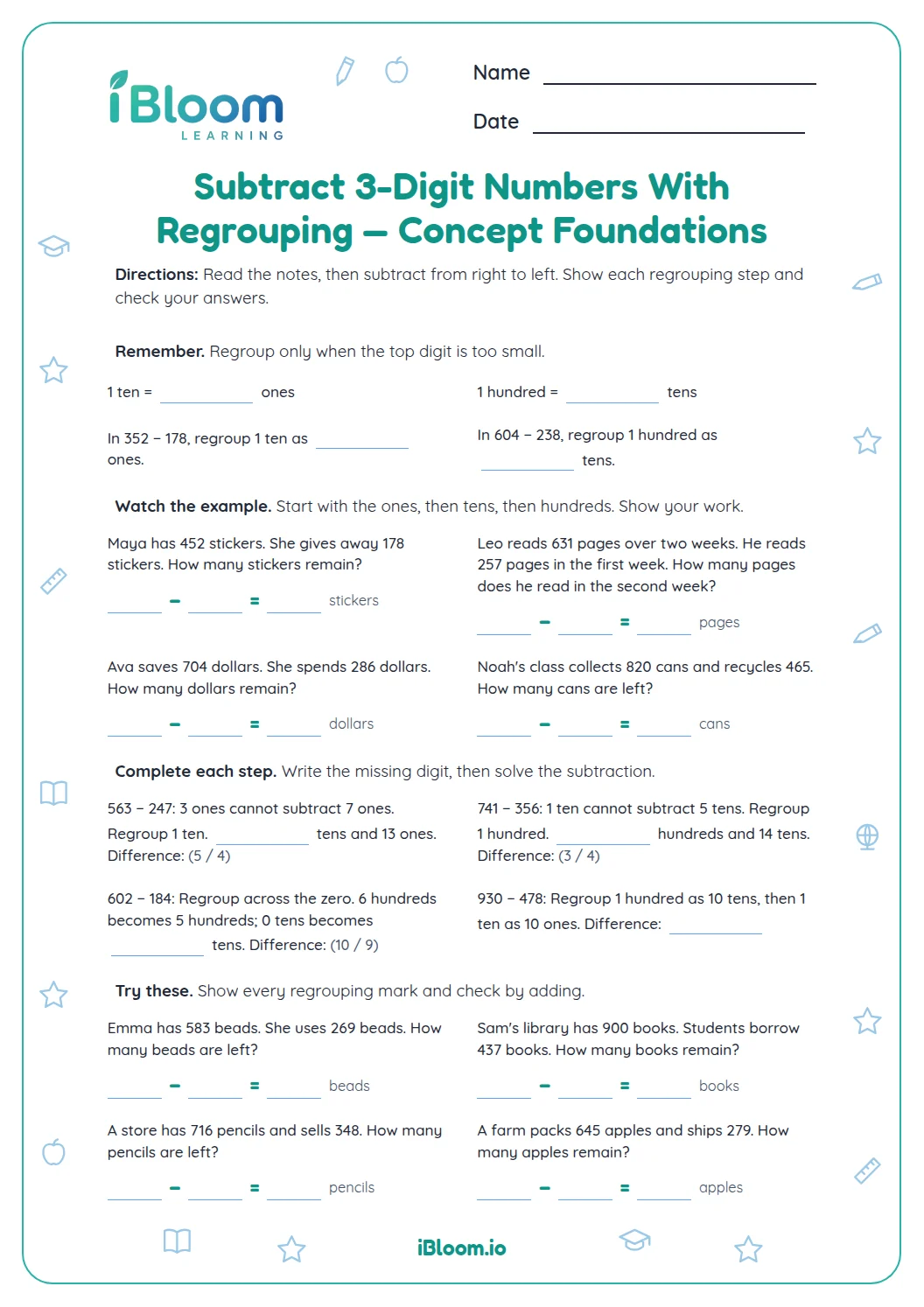
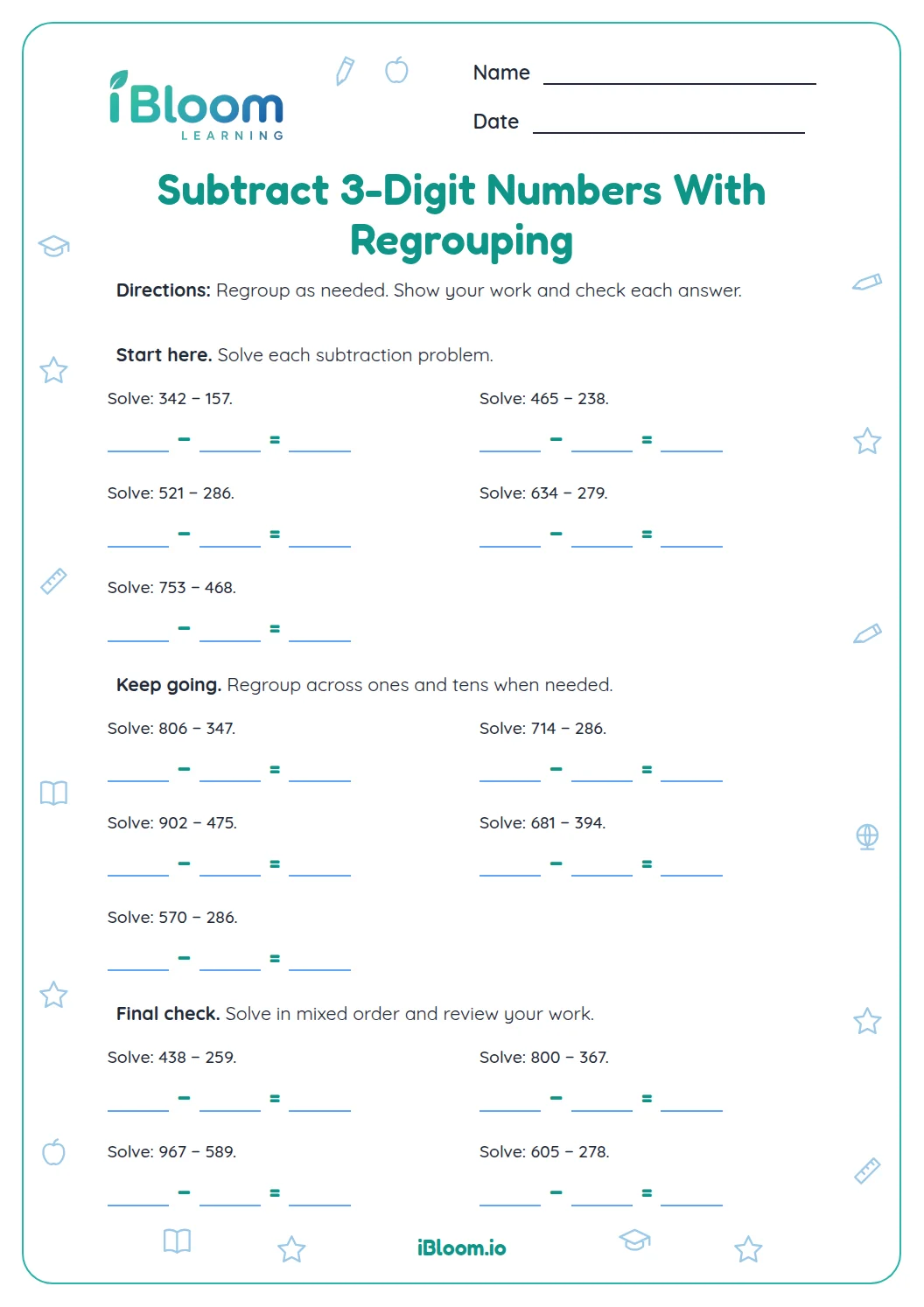
This free Grade 3 worksheet focuses on subtraction problems such as 5,000 − 2,347, where regrouping must pass across the hundreds, tens, and ones places. Students first review what each digit represents and how one place can be renamed as 10 units in the next place. They then solve 10 four-digit equations and apply the method in two short money stories, checking each difference by addition. A separate answer key shows the expected responses.
What do the place-value checks review?
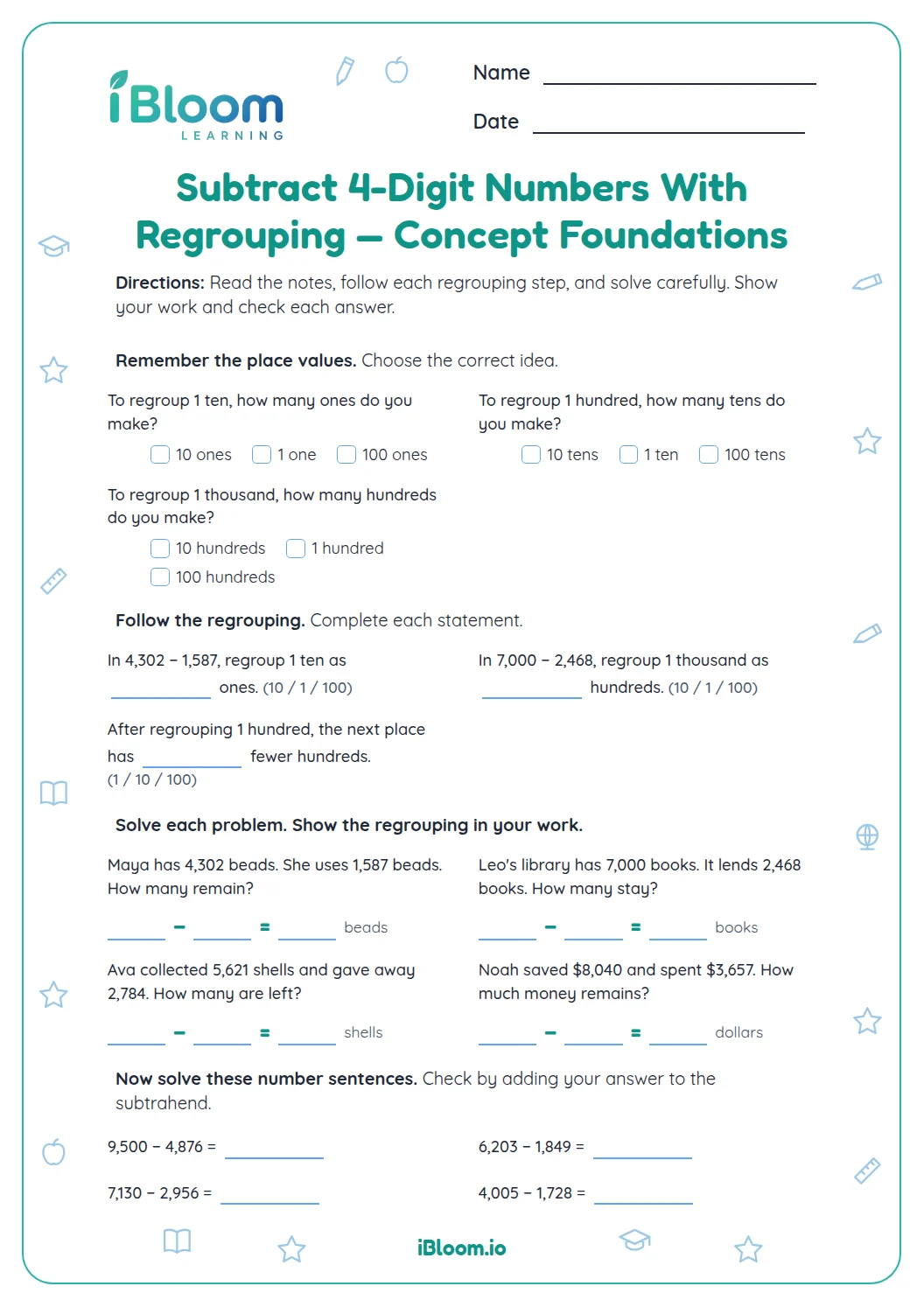
Part A reviews the trades needed before subtraction. One thousand is 10 hundreds, one hundred is 10 tens, and one ten is 10 ones. These exchanges let students subtract even when the minuend begins with zeros in those places.
How can students keep regrouping organized?
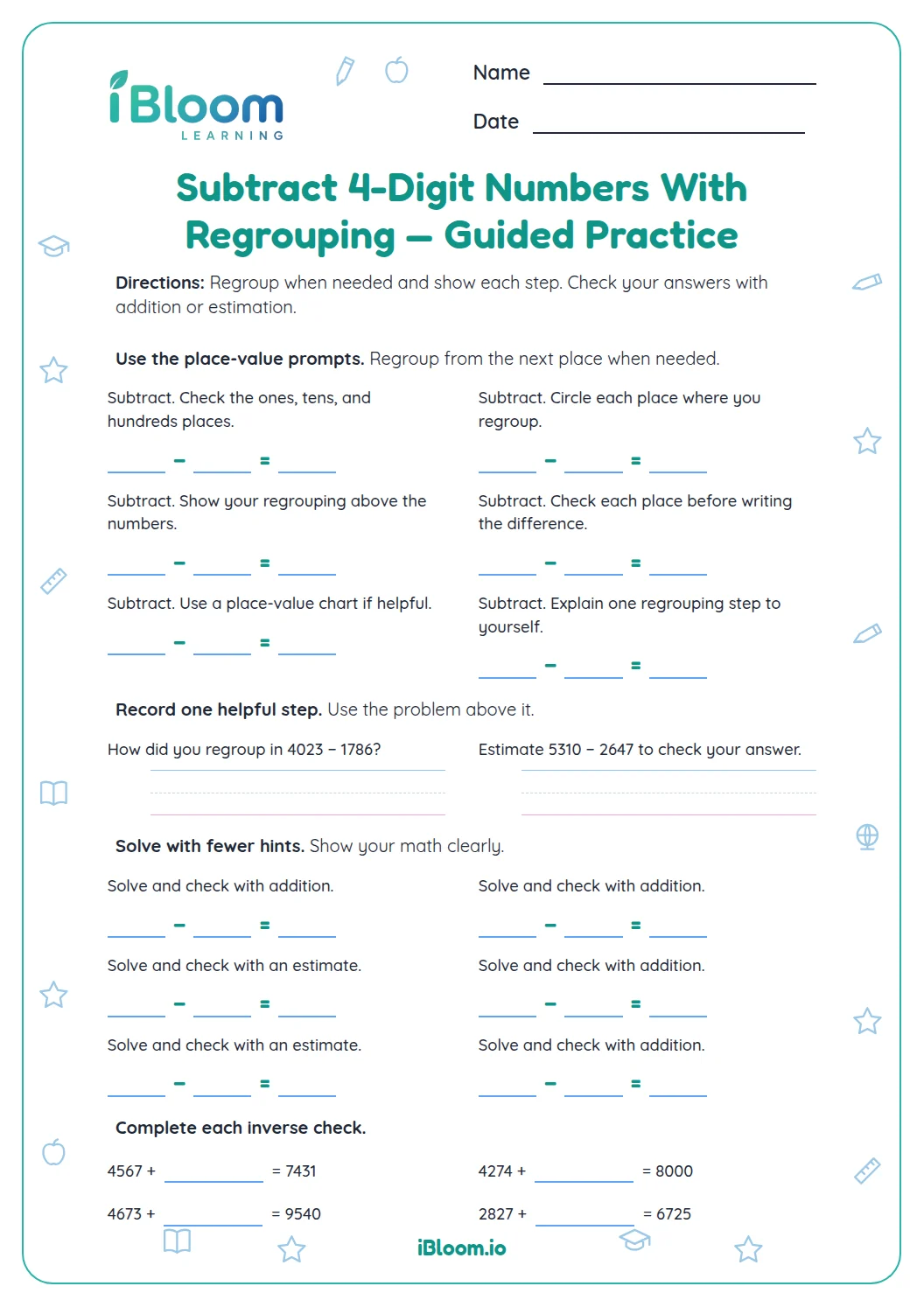
Part B gives 10 equations with different four-digit minuends and subtrahends. Record each renamed value above its place, then subtract from ones toward thousands. In q5, 5,000 − 2,347 = 2,653 after regrouping across each zero.
How can addition check a story problem?
Part C applies the same subtraction method to two money situations. Add the amount spent or used to the remaining amount; the sum should match the starting total.
How to use this worksheet
- 1Start with the place-value reminder in Part A.
- 2Set up each subtraction problem by place value.
- 3Regroup from left to right through every zero that blocks a trade.
- 4Subtract from ones toward thousands.
- 5Add the difference to the number subtracted and check that the minuend returns.
Common mistakes and quick fixes
The mistake
Treating a zero as if it can be subtracted from a larger digit below it.
The fix
Trade from the next nonzero place, and carry the renamed values across every zero.
The mistake
Changing a place value without reducing the place that was traded.
The fix
When 1 thousand becomes 10 hundreds, the thousands decrease by 1.
The mistake
Subtracting the larger digit from the smaller digit in a column.
The fix
Regroup first so the top digit is large enough, then subtract the bottom digit from it.
What to practice next
Make more practice
Questions parents and teachers ask
What does this worksheet practice?
It focuses on subtracting a four-digit number from a multiple of 1,000 when the minuend has three zeros. Students begin with four place-value checks, solve 10 equations, and apply the method in two money stories. The separate key shows the expected responses.
How do you regroup across three zeros?
There are 16 questions in three parts: four place-value checks, 10 subtraction equations, and two word problems. The worksheet uses two pages, with a separate two-page answer key. The first part reviews the trades that make subtraction across zeros possible.
What is an example from the worksheet?
For 5,000 − 2,347, regroup 5 thousands as 4 thousands and 10 hundreds, then rename through the tens and ones places. The difference is 2,653. Add 2,653 + 2,347 to check that the result returns to 5,000. The regrouped columns show each trade.
Why does the worksheet use addition to check subtraction?
Addition reverses subtraction: the difference plus the amount taken away should equal the starting amount. If the sum does not match the minuend, check the regrouping and subtraction columns. The final part asks students to use this check on the equations.
Is an answer key included?
Yes. A separate two-page answer key shows the answers to all 16 items, including the four place-value checks and both money stories. Students can check a group after finishing, then use addition to locate a regrouping error in any subtraction problem.