






About this worksheet
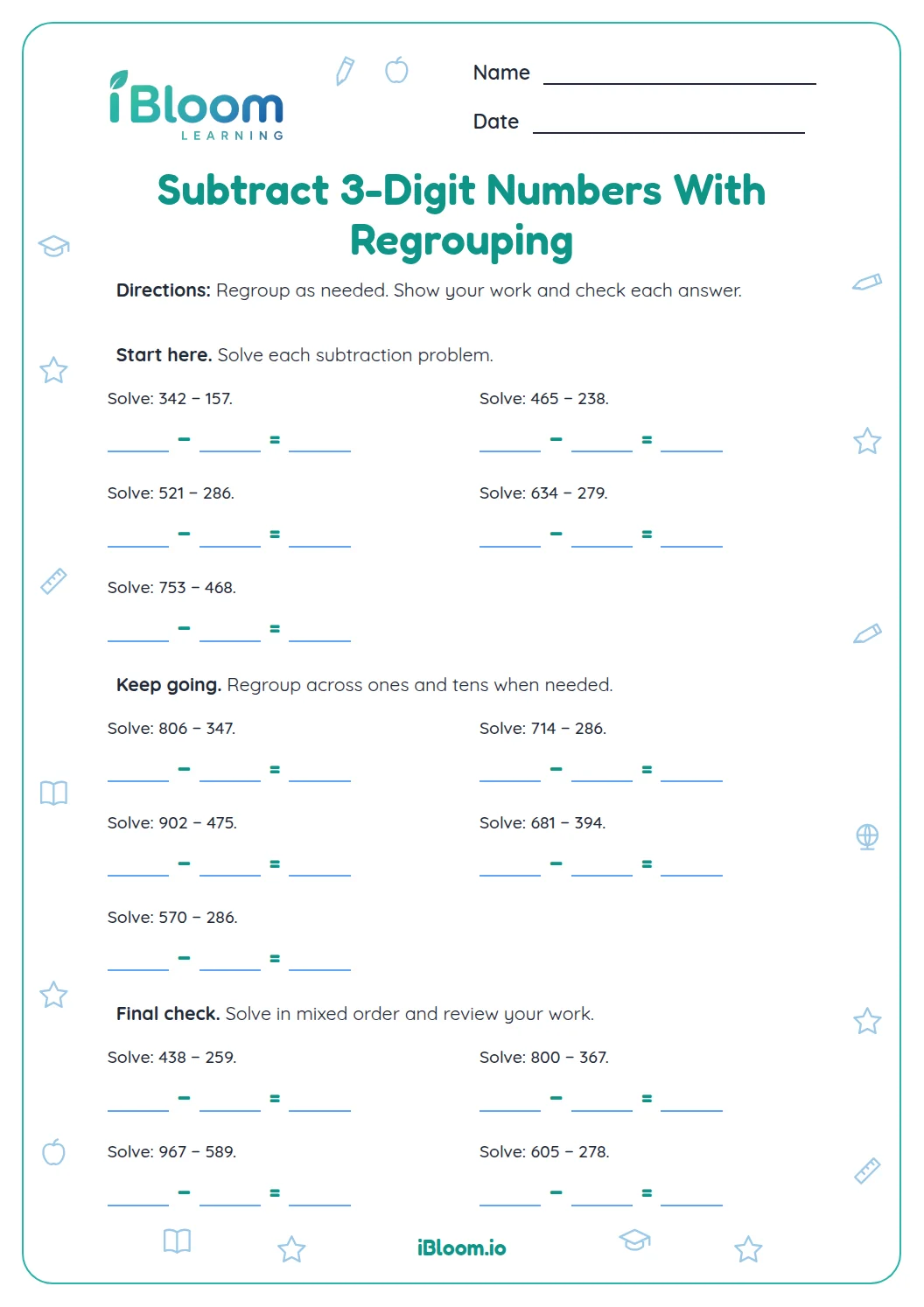
This worksheet gives Grade 3 learners 16 four-digit subtraction problems. The first nine pair each problem with a place-value table; every item requires regrouping through zero places. Students can track thousands, hundreds, tens, and ones, then check by adding the subtrahend to the difference. The skill aligns with the Grade 4 standard for multi-digit subtraction.
Aligned to CCSS.Math.Content.4.NBT.B.4
How can a thousand be regrouped?
A number such as 5,000 has no hundreds, tens, or ones. To subtract 2,347, trade from the thousands into hundreds, then continue trading until each place has enough units. The place-value table keeps each column visible.
- 15,000 − 2,347 = 2,653
- 2Track each trade from thousands through hundreds and tens.
- 3Check: 2,653 + 2,347 = 5,000.
How does the chart support subtraction?
Each table lines up the minuend and subtrahend by place. Record each regrouping trade in the matching column, subtract, and use addition to check the difference.
- Part A uses tables to track regrouping through zero places.
- Part B continues the skill and checks differences by addition.
How can addition check the difference?
Add the subtrahend to the difference. The total should return to the original number. For example, 5,000 − 2,347 = 2,653, and 2,653 + 2,347 = 5,000.
How to use this worksheet
- 1Read the thousands, hundreds, tens, and ones in the table.
- 2Align the minuend and subtrahend by place.
- 3Trade from a larger place until each column has enough to subtract.
- 4Subtract in each place and combine the difference.
- 5Add the subtrahend back; the sum should match the starting number.
Common mistakes and quick fixes
The mistake
Subtracting each digit without regrouping through the zeros.
The fix
Trade from the next nonzero place until the ones, tens, and hundreds each have enough units.
The mistake
Forgetting that one thousand becomes ten hundreds.
The fix
Record the trade in the hundreds column before continuing to tens and ones.
The mistake
Checking by subtracting again in the same way.
The fix
Use the inverse operation: add the difference and the subtrahend to get 1,000.
Common Core alignment
The problems use place-value reasoning and the standard algorithm to subtract multi-digit whole numbers.
Students subtract multi-digit whole numbers using the standard algorithm.
On this sheet: The four-digit problems use the standard algorithm to subtract across zero places.
Show the official wordingHide the official wording
Fluently add and subtract multi-digit whole numbers using the standard algorithm.
What to practice next
Make more practice
Further reading
Questions parents and teachers ask
What does “across three zeros” mean here?
Every item starts with a four-digit multiple of 1,000 and subtracts a number that requires trading through zero places. For example, 5,000 − 2,347 requires regrouping from thousands into hundreds, then into tens and ones. The table helps track the trades.
What visual model appears on the page?
Each of the 16 problems has a table with thousands, hundreds, tens, and ones columns. The top row shows the starting number and the next row shows what is subtracted. Students can use the columns to record trades before finding the difference.
How can a student check an answer?
Add the subtrahend to the difference. The sum should be 1,000. For example, the answer to 1,000 − 276 is 724 because 724 + 276 equals 1,000. The key also makes it easy to review a missed problem by reversing the subtraction with addition.
Why do all problems begin with 1,000?
The starting numbers vary from 5,000 to 9,000, and the subtrahends also vary. This keeps the practice centered on regrouping across zero places while asking students to attend to different digits in every problem. The printed prompts and the separate key let an adult review the same skill with the child.
Does the printable include an answer key?
Yes. The answer key lists the difference for each of the 16 four-digit subtraction problems. Students can review the place-value trades and verify each answer by adding the subtrahend back to the difference. The printed prompts and the separate key let an adult review the same skill with the child.