




About this worksheet
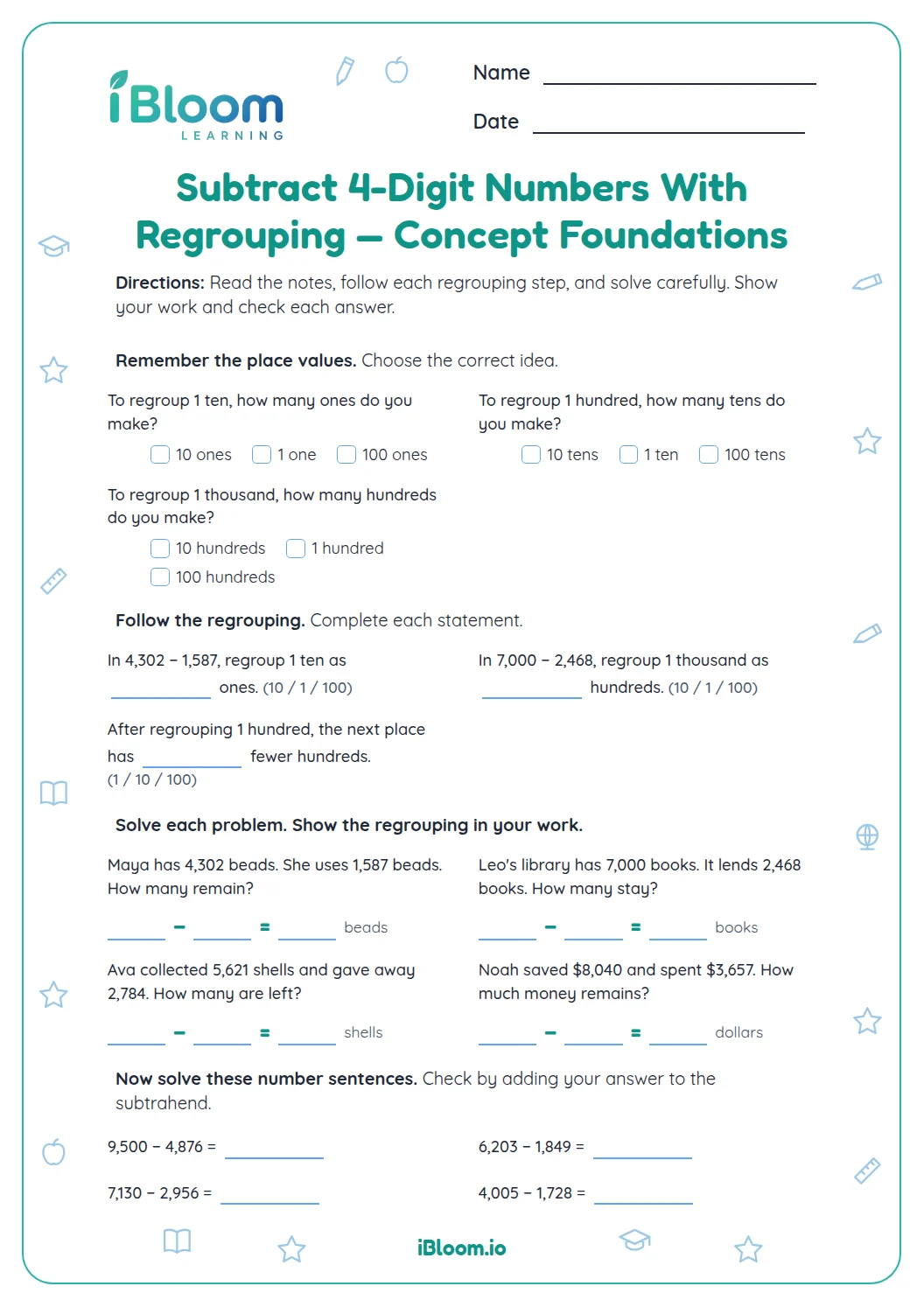
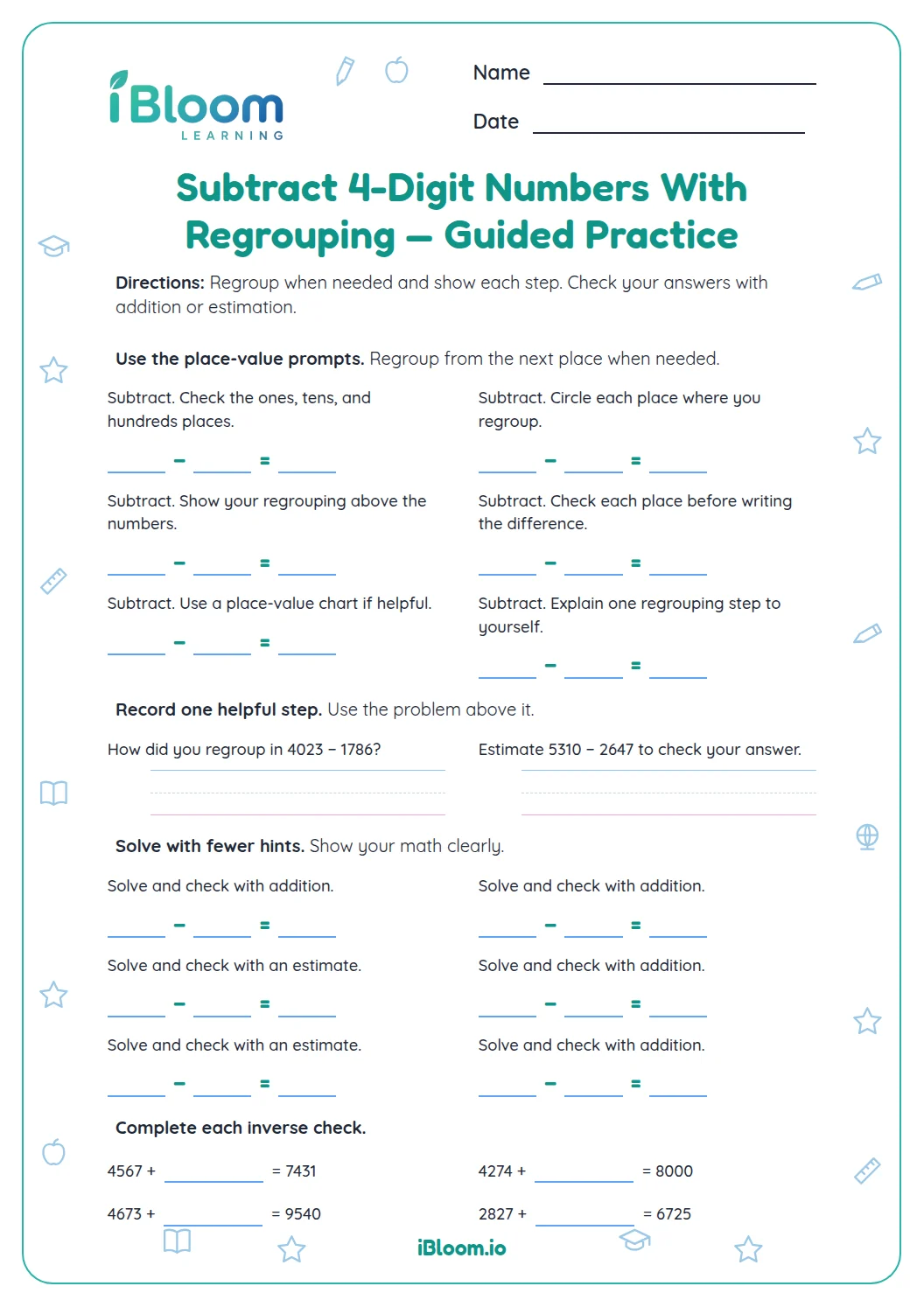
This printable worksheet practices subtracting a three- or four-digit number from a whole thousand when regrouping must pass through zero places. Learners solve 16 problems in three parts, record the regrouping chain, and check differences by addition. The sheet is labeled Grade 3 in its source title; the four-digit standard algorithm practiced here is described in CCSS 4.NBT.B.4. A separate answer key is included.
Aligned to 4.NBT.B.4
What happens when you regroup across zeros?
A zero has no units to subtract in that place. Trade from the first nonzero place to the left: one thousand becomes 10 hundreds. If the hundreds place is then traded, one hundred becomes 10 tens. Continue until the needed place has enough units.
- 15,000 − 2,347
- 2Trade 1 thousand: 4 thousands and 10 hundreds.
- 3Trade 1 hundred: 9 hundreds and 10 tens.
- 4Trade 1 ten: 9 tens and 10 ones.
- 5Subtract each place to get 2,653.
What will children practice?
All 16 questions subtract a three- or four-digit number from a whole thousand. The first part establishes the regrouping chain, the next set repeats it with varied values, and the final four problems ask learners to check by addition. The answer key gives each difference.
How can an adult support the practice?
Use question 1, 5,000 − 2,347, to model the trades: rename 5,000 as 4 thousands, 9 hundreds, 9 tens, and 10 ones. Subtract each column to get 2,653, then check that 2,653 + 2,347 = 5,000.
How to use this worksheet
- 1Start at the ones place and compare the digits.
- 2If a place has too few units, trade one from the next nonzero place.
- 3Record every place changed by the trade.
- 4Subtract each column and combine the difference.
- 5Add the difference to the subtrahend to check.
Mistakes to watch for
The mistake
Borrowing directly from the thousands without changing the middle places.
The fix
Show each trade through hundreds and tens before subtracting.
The mistake
Writing 10 in a place but leaving the place to its left unchanged.
The fix
Reduce the place you traded from by one.
The mistake
Subtracting the smaller digit from the larger in every column.
The fix
Regroup first so each top digit is large enough to subtract.
Common Core alignment
This worksheet practices multi-digit subtraction with regrouping.
Subtract multi-digit whole numbers using the standard algorithm.
On this sheet: The problems subtract four-digit numbers and require regrouping across zero places.
Show the official wordingHide the official wording
Fluently add and subtract multi-digit whole numbers using the standard algorithm.
What to practice next
Make more practice
Further reading
Questions parents and teachers ask
Why does regrouping across zeros take several trades?
Each place is worth ten of the place to its right. To subtract ones from 5,000, trade one thousand for 10 hundreds, then trade one hundred for 10 tens and one ten for 10 ones. The chain creates units in the needed columns while keeping the number equal to 5,000.
What is 5,000 minus 2,347?
It is 2,653. Regroup across the zero places so the ones, tens, and hundreds can be subtracted. Add 2,347 + 2,653 to check that the sum returns to 5,000. Question 1 uses this example, and the answer key shows the difference.
Should learners subtract from right to left?
Yes. Begin with ones, then tens, hundreds, and thousands. When a top digit is too small, regroup before subtracting in that column. Keep the trades visible so each place reflects the changes made to its neighbor. Every problem on this sheet uses this column method.
How many problems are on the sheet?
The worksheet has 16 problems in three parts. Each subtracts a three- or four-digit number from a whole thousand, so the regrouping chain crosses zero places. A separate two-page answer key lists every difference for checking and follows the same question order.
How can I check a difference?
Add the difference to the number being subtracted. For example, 2,653 + 2,347 should equal 5,000. If the sum does not return to the starting number, inspect the regrouping and subtraction in each place. The last part of the worksheet calls for this check.