






About this worksheet
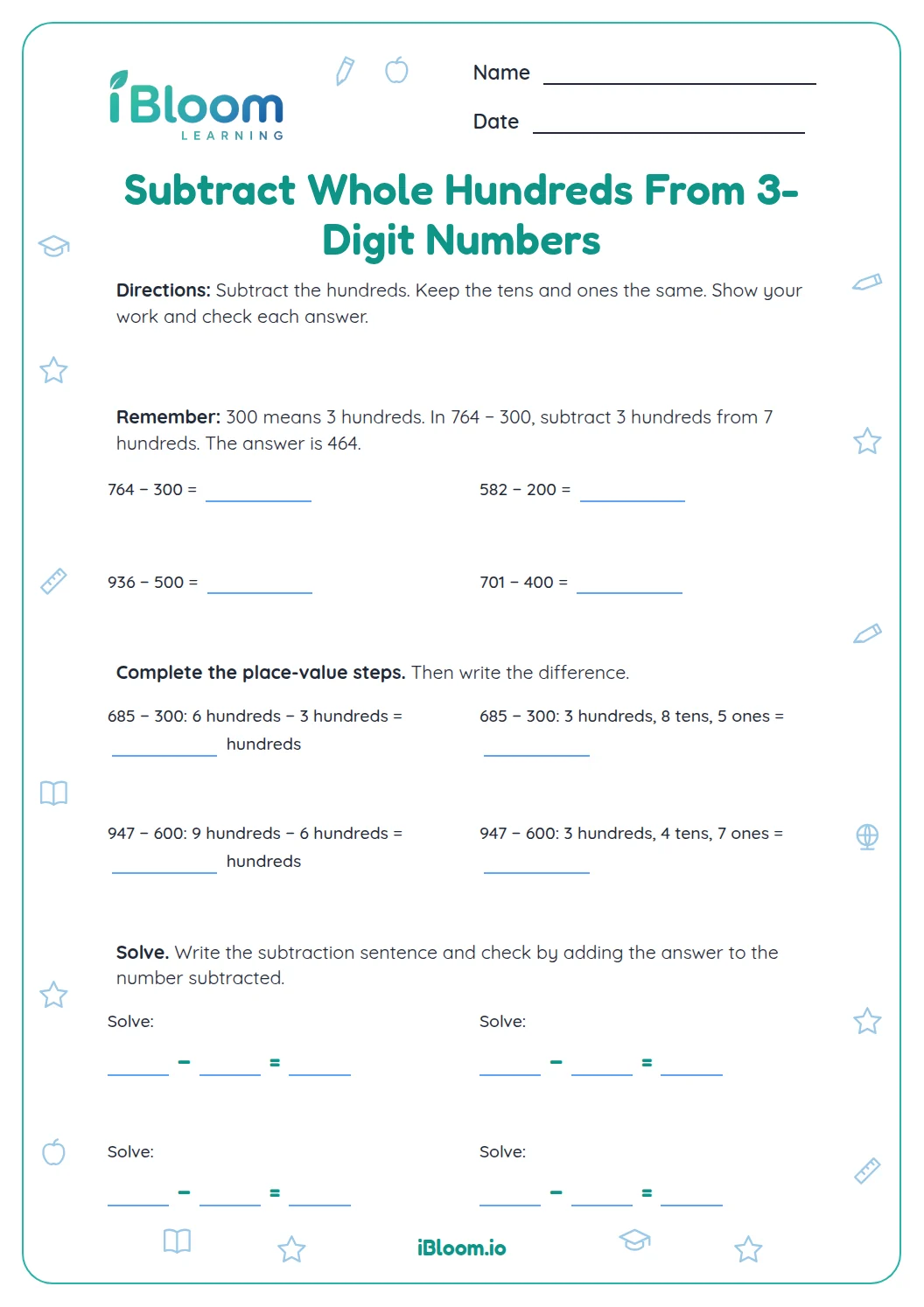
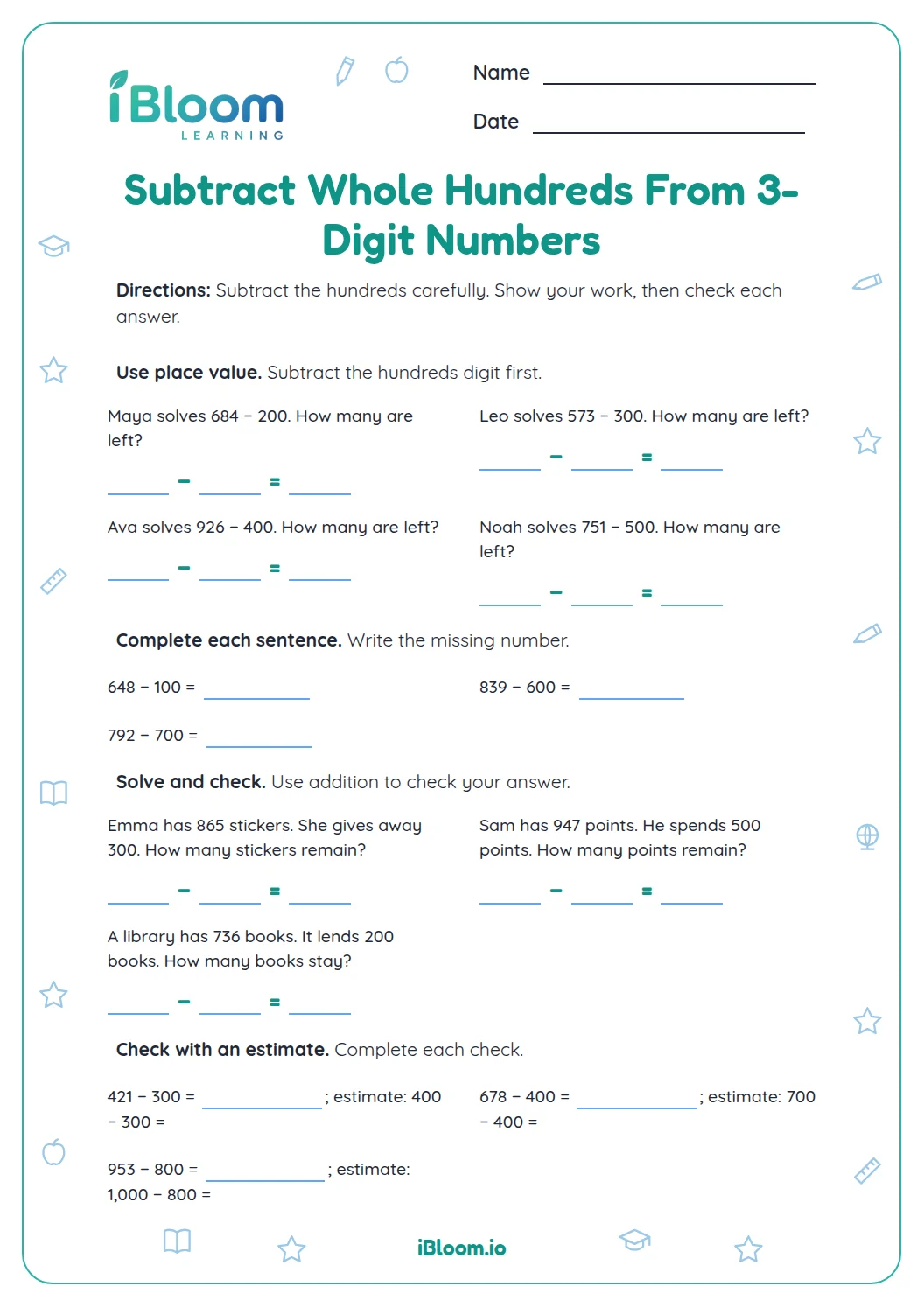
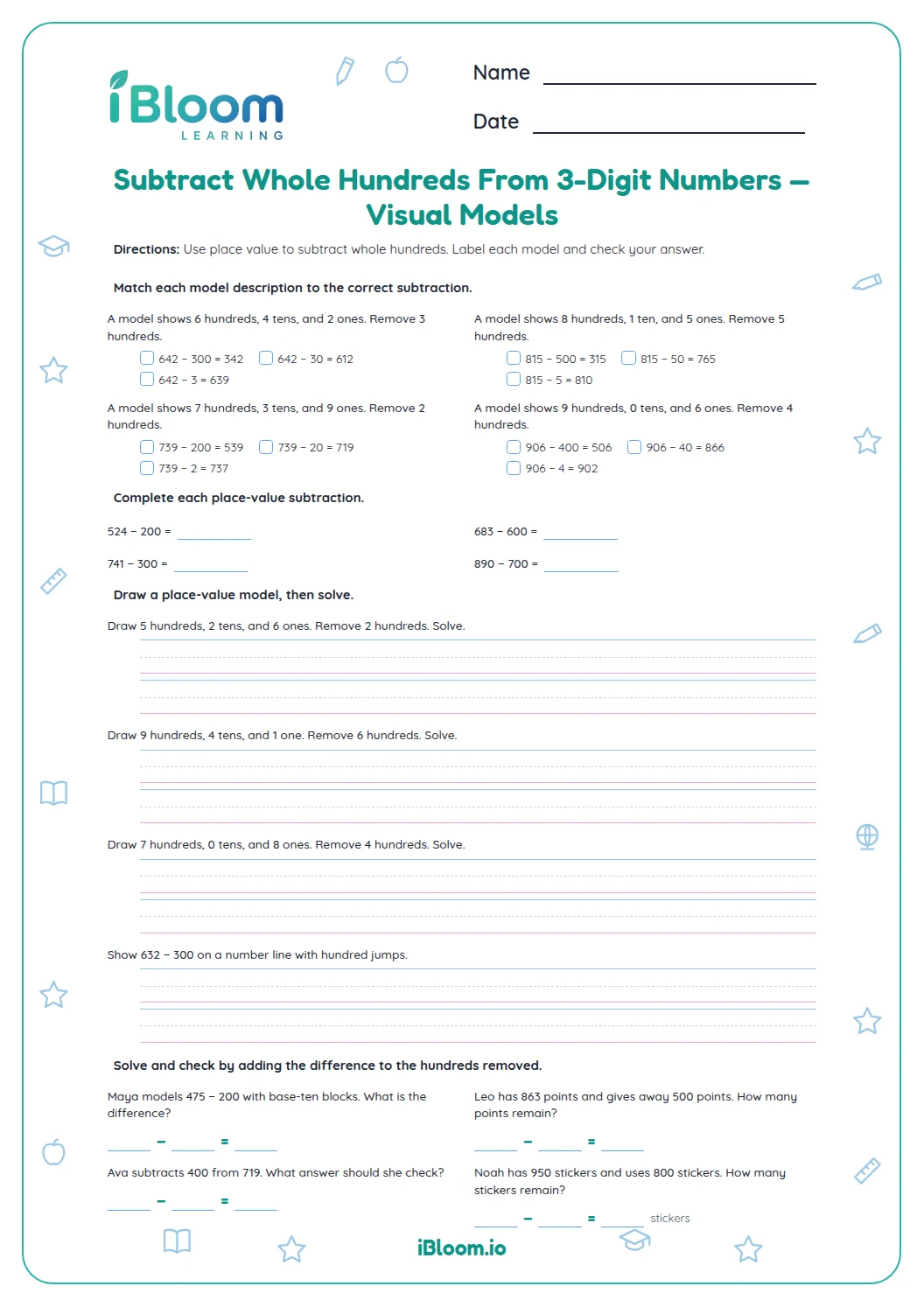
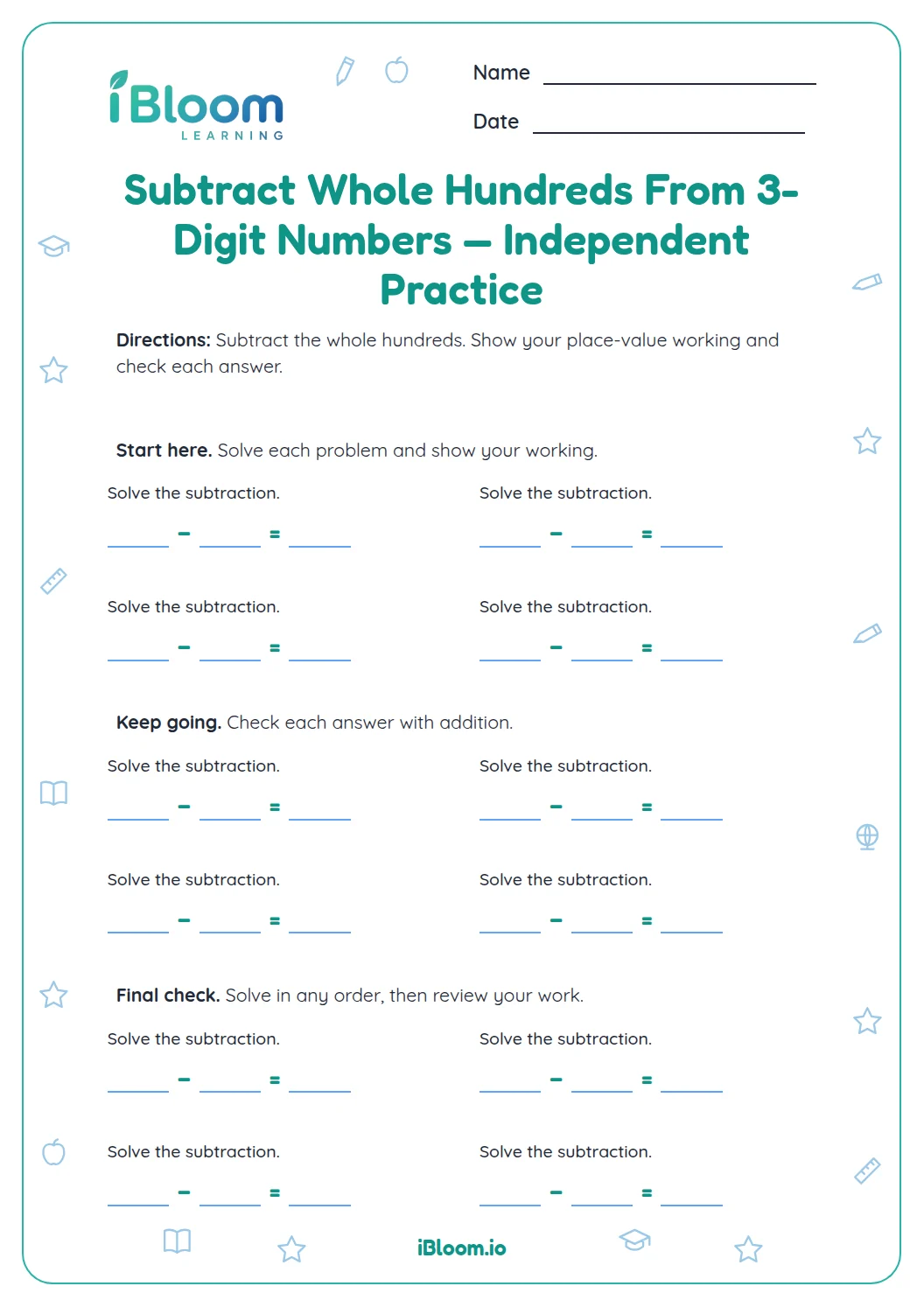
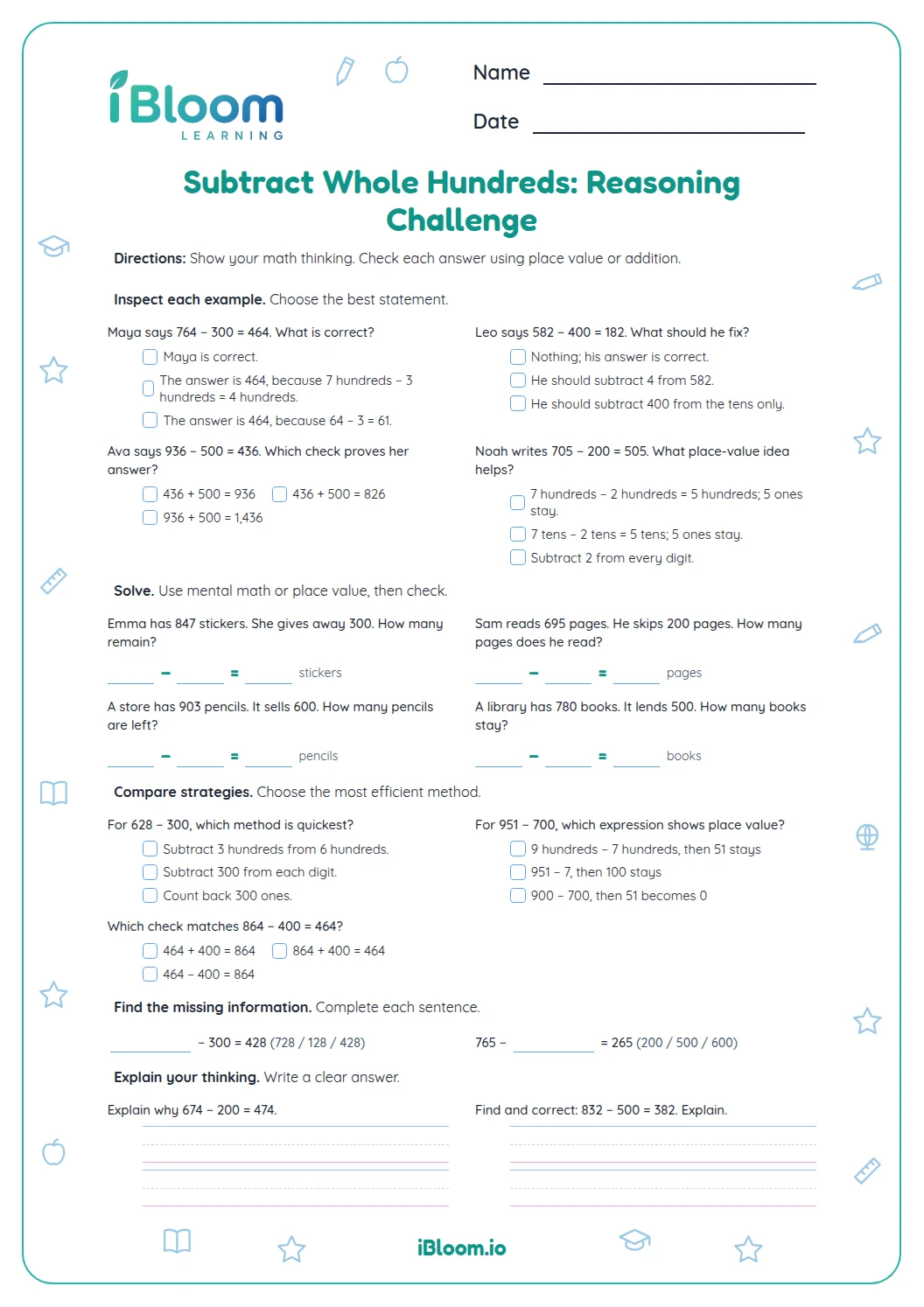
This Grade 3 worksheet gives 14 short stories about subtracting a whole hundred from a three-digit quantity. Students choose the amount that remains or the part not yet used, with all questions focused on removing 200 through 900. The answer key lists each difference. This practice supports CCSS 3.NBT.A.2 place-value strategies for subtraction within 1,000.
Aligned to 3.NBT.A.2
How do stories show subtraction?
Look for the starting amount and the whole hundred removed. The question may ask what remains, what is unsold, or how many are still to plant.
How can place value make the difference clear?
In Question 1, 684 books minus 300 books leaves 384 books. Three hundreds are removed; the tens and ones remain.
- 1684 − 300 = 384 books
- 2Check: 384 + 300 = 684 books
How can students check a choice?
Add the subtracted hundred back to the chosen answer. If the total matches the original amount, the choice works.
How to use this worksheet
- 1Underline the starting amount in a story.
- 2Find the whole hundred that is taken away.
- 3Subtract the hundreds and keep the tens and ones in view.
- 4Choose the amount that matches what the question asks.
- 5Add the hundred back to check the result.
Mistakes to watch for
The mistake
Subtracting the hundreds digit but leaving an incorrect hundreds place.
The fix
Subtract the value 300, not just the digit 3; then read the resulting number aloud.
The mistake
Dropping a zero in a result such as 806 − 400.
The fix
Use place value columns and check by adding the difference and 400.
The mistake
Giving a number without the requested unit.
The fix
Reread the story and include books, meters, seats, or another named unit where appropriate.
Common Core alignment
This worksheet gives focused practice with the listed Common Core skill.
Use place-value strategies to subtract within 1,000 in short stories.
On this sheet: Each problem subtracts whole hundreds from a three-digit number within 1,000.
Show the official wordingHide the official wording
Fluently add and subtract within 1000 using strategies and algorithms based on place value, properties of operations, and/or the relationship between addition and subtraction.
What to practice next
Make more practice
Further reading
Questions parents and teachers ask
How does a student solve each story?
Find the starting amount and the whole hundred being taken away. Choose the difference that answers the question, then check by adding the hundred back. For example, 684 books minus 300 leaves 384 books, and 384 plus 300 returns to 684.
What if the answer has a zero?
Keep each place value in the answer. In the hall story, 806 seats minus 400 empty seats leaves 406 filled seats, with zero tens. Adding 400 back to 406 returns to 806 and confirms the zero belongs in the tens place.
What does the worksheet ask students to do?
The 14 short stories describe three-digit amounts and a whole hundred removed. Students choose the difference that fits each situation, such as books remaining, tickets unsold, or trees still to plant. The multiple-choice format keeps attention on the subtraction and its meaning.
How can I use the answer key?
The separate key marks the correct difference for every story. Ask the student to explain what the answer represents, then add the hundred back to check an uncertain response. The sum should match the starting quantity named in the story.
Which hundreds do the problems use?
The subtracted amounts range from 200 to 900, and each starting number is three digits. The stories include books, seats, meters, tickets, food, and other familiar quantities. Each asks for a remaining or missing amount after whole hundreds are removed.