





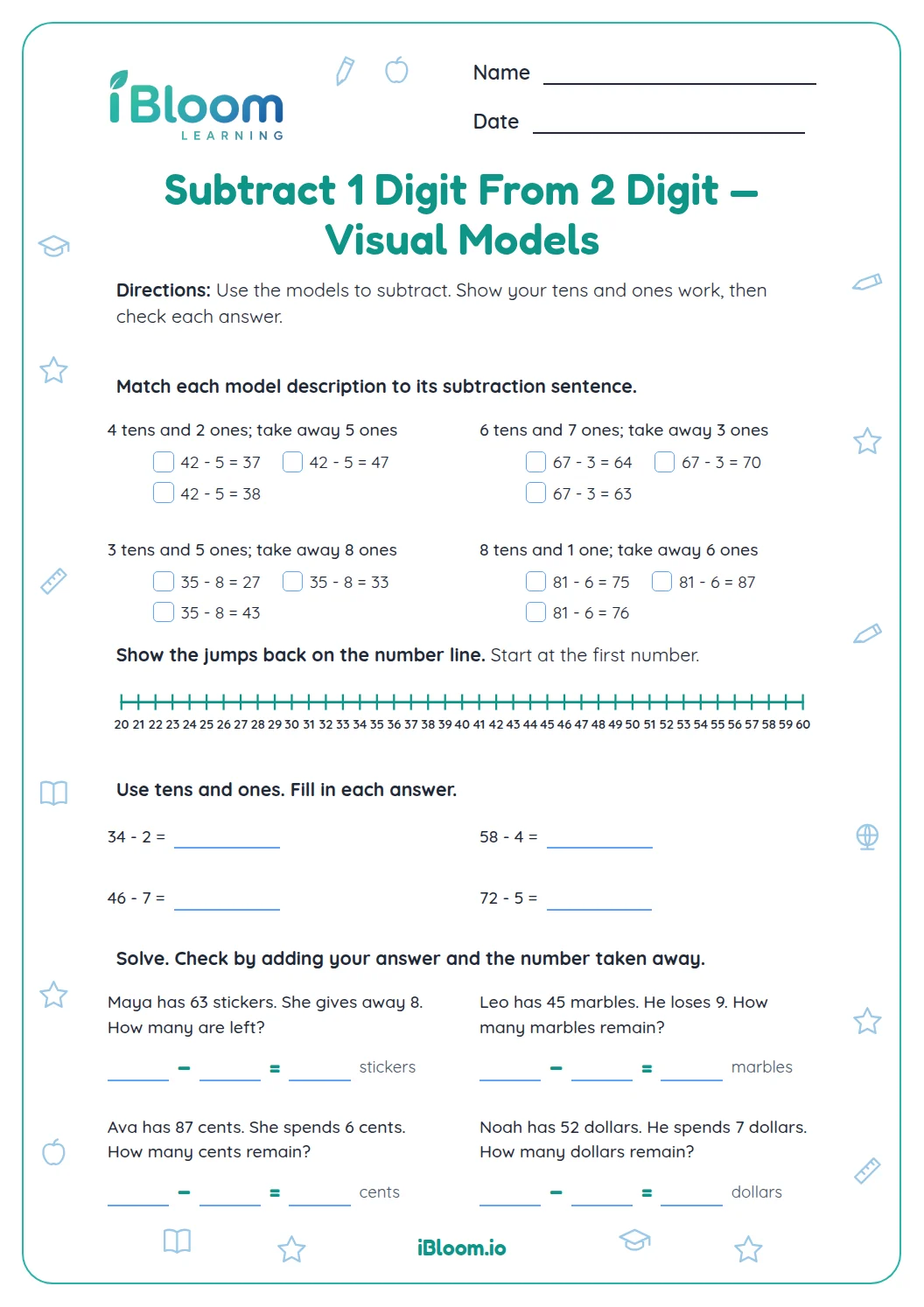
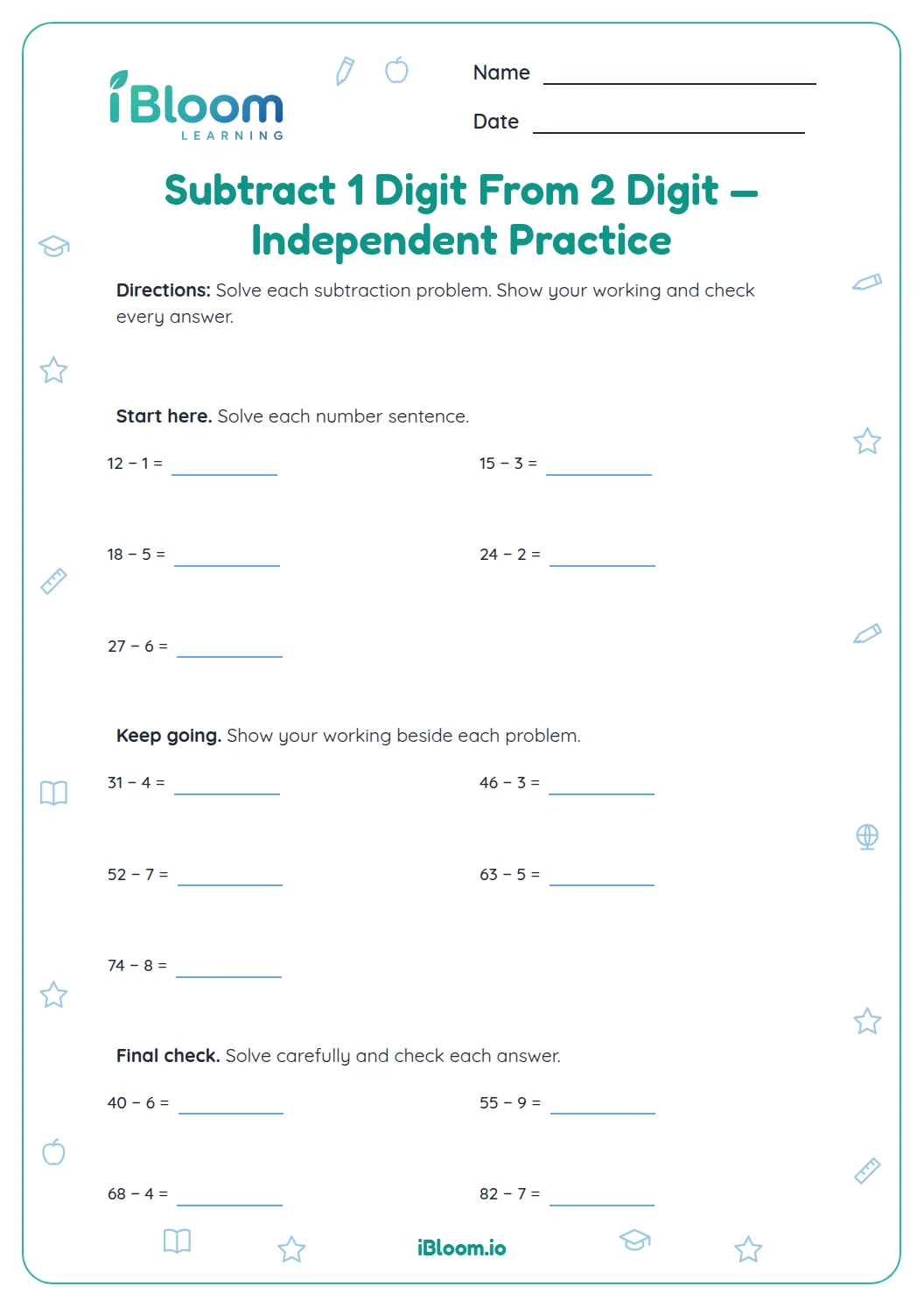
About this worksheet
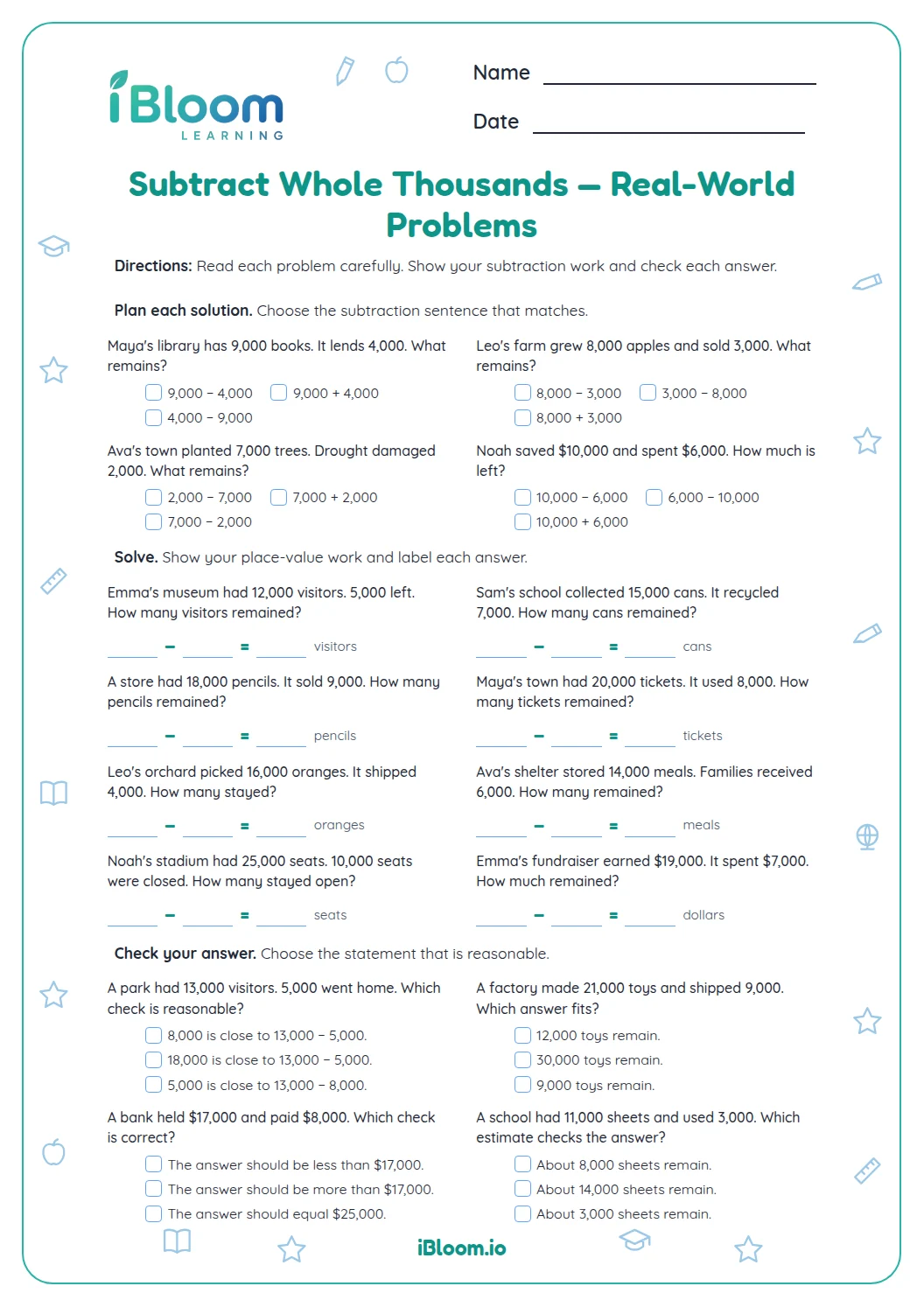
Use place value to subtract whole thousands, find missing numbers, and make sense of the difference in short situations. The challenge includes comparison, inverse reasoning, and an addition-versus-subtraction error to explain.
Think in groups of one thousand
A whole thousand is 1,000. When both numbers are whole thousands, subtract the counts of thousands: 8 thousands − 5 thousands = 3 thousands, so 8,000 − 5,000 = 3,000.
For a missing number, use the relationship between subtraction and addition. If ___ − 3,000 = 4,000, ask what added to 3,000 makes 7,000.
- 1___ − 3,000 = 4,000
- 24,000 + 3,000 = 7,000
- 3The missing number is 7,000.
What will you reason about?
Part A compares equations and differences. Part B fills missing amounts. Part C uses stories and asks you to explain a mistake. Every number is a whole thousand.
- Part A: choose a true or greatest-difference statement
- Part B: find missing values
- Part C: solve stories and explain reasoning
- A separate answer key
How to work through the challenge
- 1Read each number as a count of thousands.
- 2For a missing value, use addition to check the subtraction relationship.
- 3In stories, identify the starting amount and what was taken away.
- 4For the error question, say what operation Noah used and check the difference.
Common subtraction slips
The mistake
Adding the two amounts instead of finding how many remain.
The fix
Ask whether the story combines groups or removes part of a starting amount.
The mistake
Subtracting the smaller digit from the larger in the wrong order.
The fix
Keep the starting amount first: minuend − subtrahend = difference.
What to practice next
Make more practice
Further reading
Questions parents and teachers ask
What does subtracting whole thousands mean?
It means subtracting amounts such as 8,000 and 3,000, where each amount is a whole number of thousands. This worksheet uses comparisons, missing-number equations, short situations, and explanations to connect subtraction to thousands. Each calculation keeps the thousands place visible.
How can I check a subtraction answer?
Add the difference to the number being subtracted. If 9,000 − 4,000 = 5,000, check that 5,000 + 4,000 returns to 9,000. This inverse check also helps with a missing minuend or subtrahend. The answer key shows the expected results.
What is on the 16-question worksheet?
The four parts ask students to reason about differences, complete missing-number equations, solve short situations, and explain or check a claim. Every calculation uses whole thousands, matching the named skill. A separate key includes the answers and sample reasoning for open responses.
How do I solve a missing-number subtraction?
Use the relationship among the minuend, subtrahend, and difference. For ___ − 3,000 = 4,000, combine 4,000 and 3,000 to find the starting amount, 7,000. Check by subtracting 3,000 from 7,000. This same check works for a missing subtrahend.
Is an answer key included?
Yes. The separate key lists the correct values and gives sample reasoning for written responses. For explanations, a child may use different words from the sample and still be correct if the explanation identifies the operation or place-value relationship accurately.