







About this worksheet
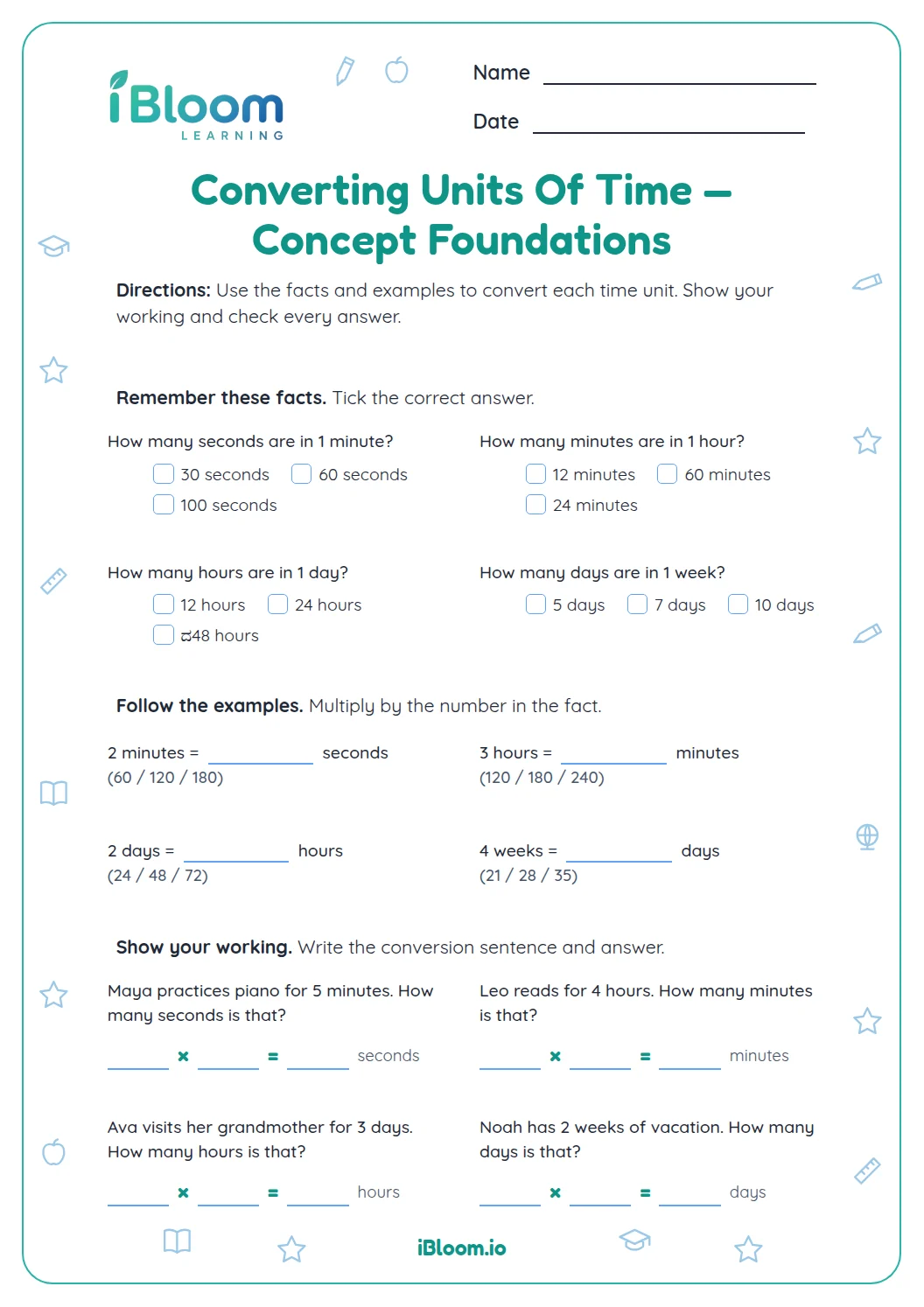
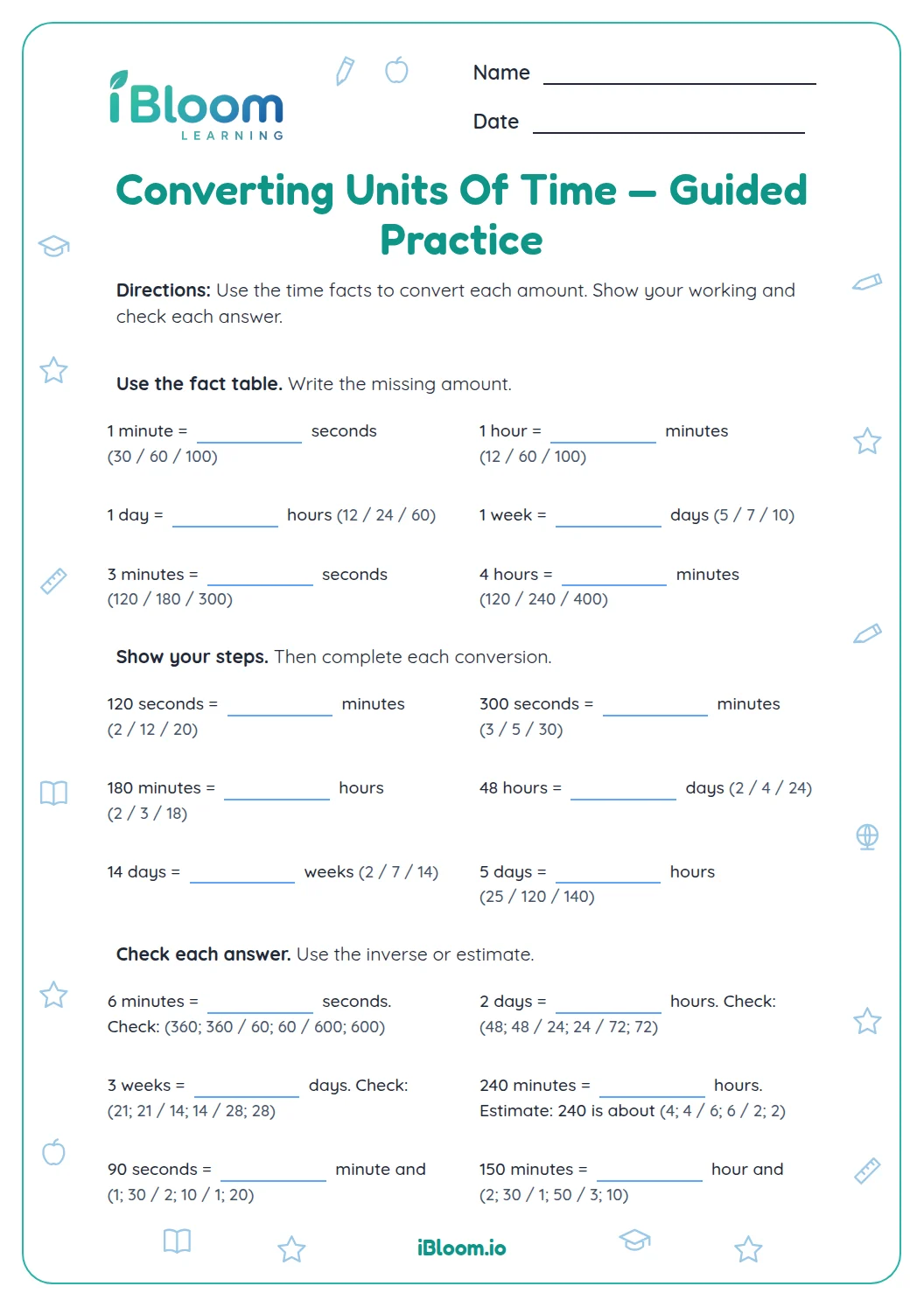
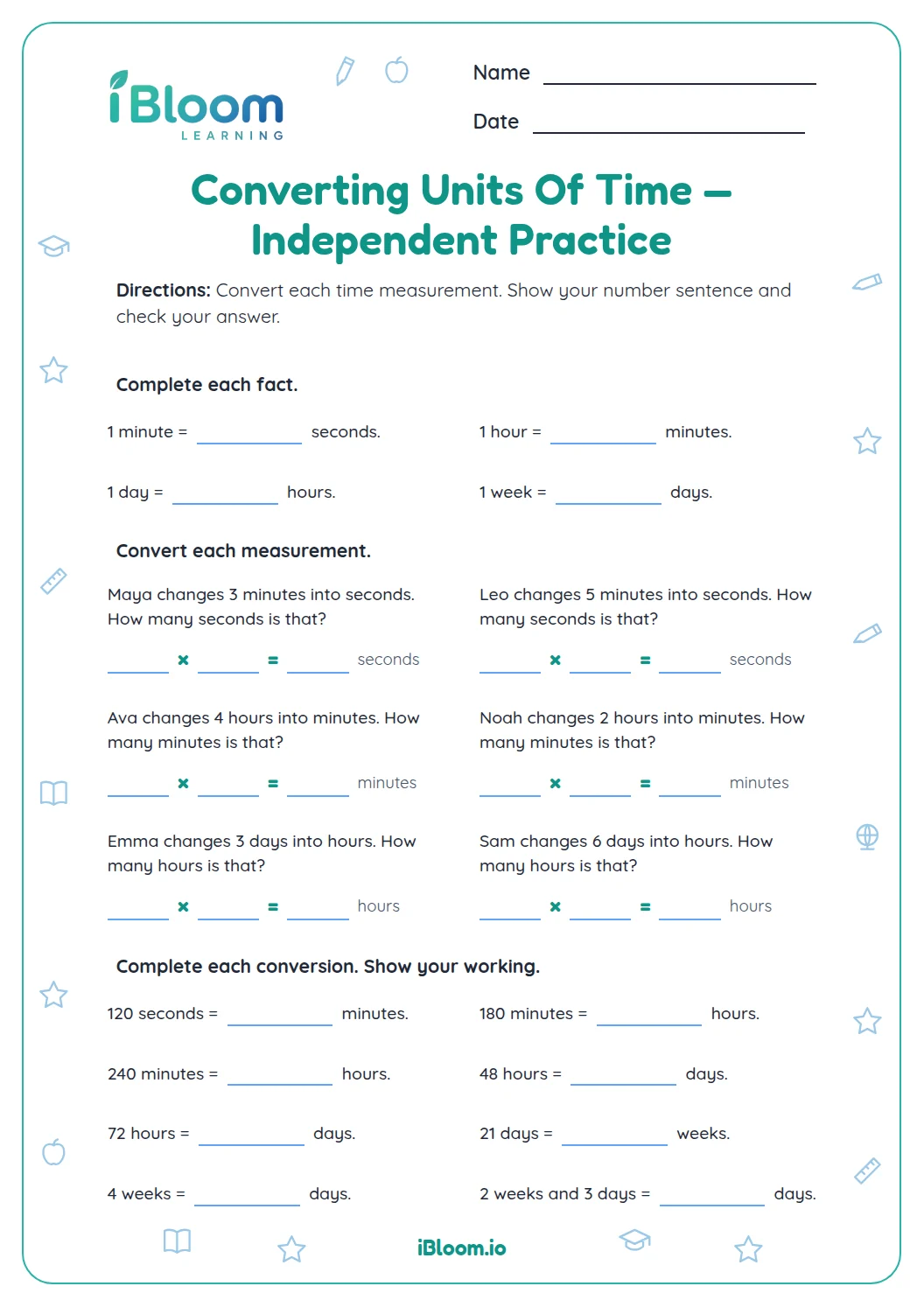
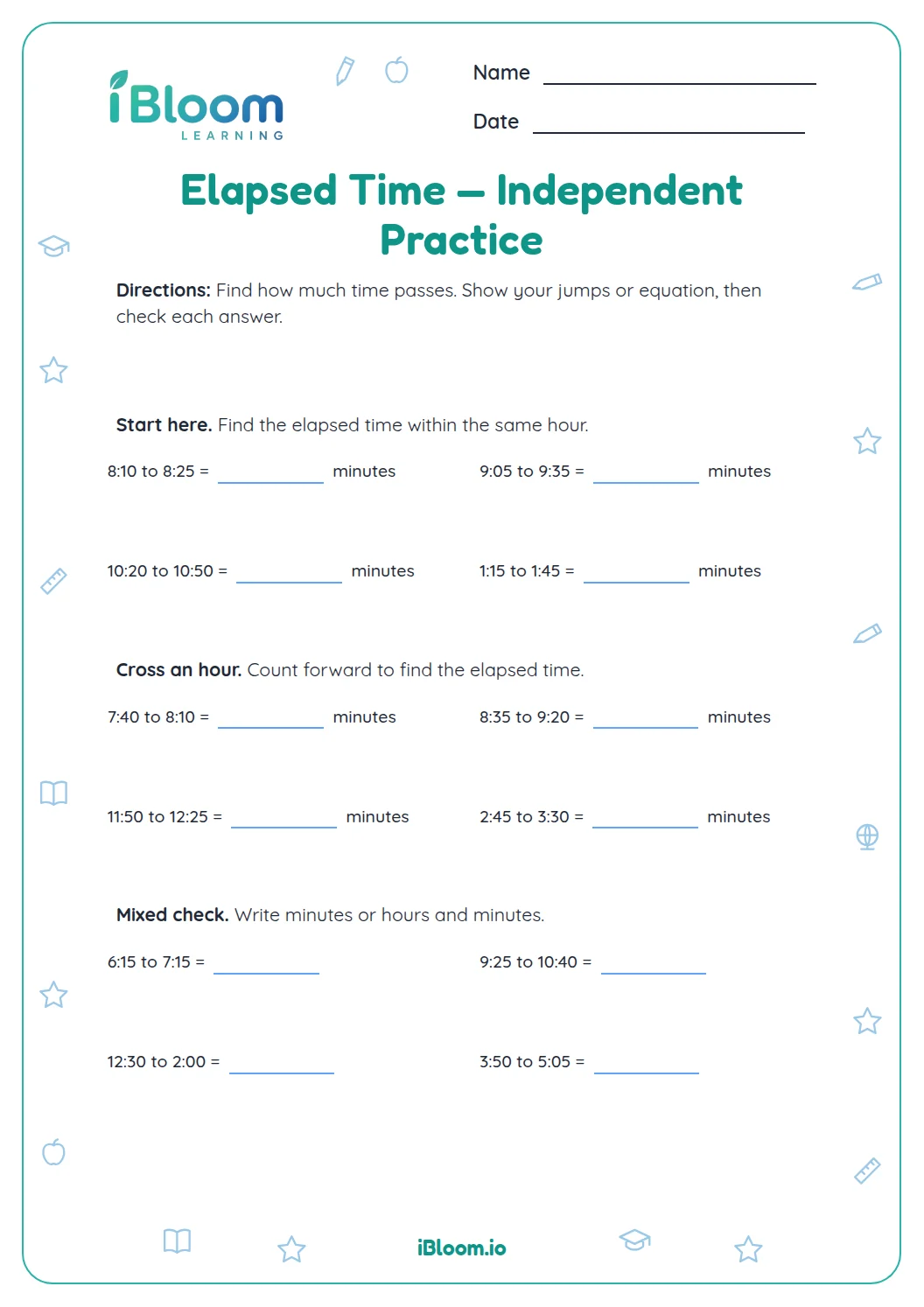
This Grade 3 printable gives 18 questions on converting hours, minutes, days, and weeks. Students work in both directions with basic conversions, include extra minutes in hour conversions, and apply the relationships to short situations. A separate answer key is included. Expressing a larger time unit in a smaller unit practices CCSS 4.MD.A.1.
Aligned to 4.MD.A.1
Which time-unit facts appear first?
The first 12 questions convert hours and minutes, days and hours, and weeks and days. Several questions ask students to convert in the reverse direction or include extra minutes.
- Part A: convert between hours and minutes.
- Part B: convert between days, hours, and weeks.
- Part C: use conversions in six short situations.
How do students convert hours to minutes?
Use 60 minutes for each hour. Multiply hours by 60 to get minutes; divide minutes by 60 to get hours when the conversion is exact.
- 11 hour 25 minutes
- 260 minutes + 25 minutes = 85 minutes
- 3Answer: 85 minutes
How are days and weeks related to hours?
There are 24 hours in a day and 7 days in a week. Multiply when changing a larger unit into smaller units; divide for the reverse conversion.
Where do the conversions appear in context?
The final six questions use durations for a walk, film, camp activity, trip, reading challenge, and class project. Each asks for an equivalent amount in a named unit.
How to use this worksheet
- 1Write the conversion fact you need, such as 1 hour = 60 minutes.
- 2Multiply to change a larger unit into smaller units.
- 3Divide to change smaller units into larger units when the conversion is exact.
- 4For mixed hours and minutes, convert the hours and add the extra minutes.
- 5Check the answer key and include the requested unit.
Common mistakes and quick fixes
The mistake
Using 24 minutes in an hour instead of 60.
The fix
Keep the facts distinct: 60 minutes per hour and 24 hours per day.
The mistake
Multiplying when changing from smaller units to larger units.
The fix
Use division for exact conversions from minutes to hours or hours to days.
The mistake
Forgetting extra minutes in a mixed duration.
The fix
Convert the hours to minutes, then add the remaining minutes.
Common Core alignment
Students express larger time units in smaller units and record equivalent measurements.
Express hours, days, and weeks in equivalent smaller time units.
On this sheet: Questions convert larger time units into smaller units and use equivalent time measurements.
Show the official wordingHide the official wording
Know relative sizes of measurement units within one system of units including km, m, cm; kg, g; lb, oz; l, ml; hr, min, sec. Within a single system of measurement, express measurements in a larger unit in terms of a smaller unit. Record measurement equivalents in a two-column table.
What to practice next
Make more practice
Questions parents and teachers ask
How many minutes are in an hour?
One hour has 60 minutes. To change 2 hours to minutes, multiply 2 by 60 to get 120 minutes. Questions also ask students to reverse this relationship and change minutes into hours. The first part practices both directions, and Part C uses the fact in context.
How do you convert a mixed number of hours and minutes?
Convert the hours to minutes, then add the extra minutes. Question 5 changes 1 hour 25 minutes into 60 + 25, or 85 minutes. Keeping the extra minutes prevents an incomplete conversion. Question 6 uses the same process with a different duration.
How many hours are in a day?
One day has 24 hours. For question 16, 2 days is 2 × 24, or 48 hours. The worksheet also connects hours with days and days with weeks in both directions. Students use these facts again in the story questions.
Does the worksheet include an answer key?
Yes. A separate key gives the results for all 18 conversions and situations, including the requested units. Students can check the conversion fact as well as the final number. The key follows the questions in the same order for easy checking.
What kinds of time units appear?
The questions connect hours, minutes, days, and weeks. Students convert in both directions and apply the same facts to durations such as a walk, film, trip, reading challenge, or project. The final part uses all these relationships in context. The answer key lists each equivalent value.