




About this worksheet
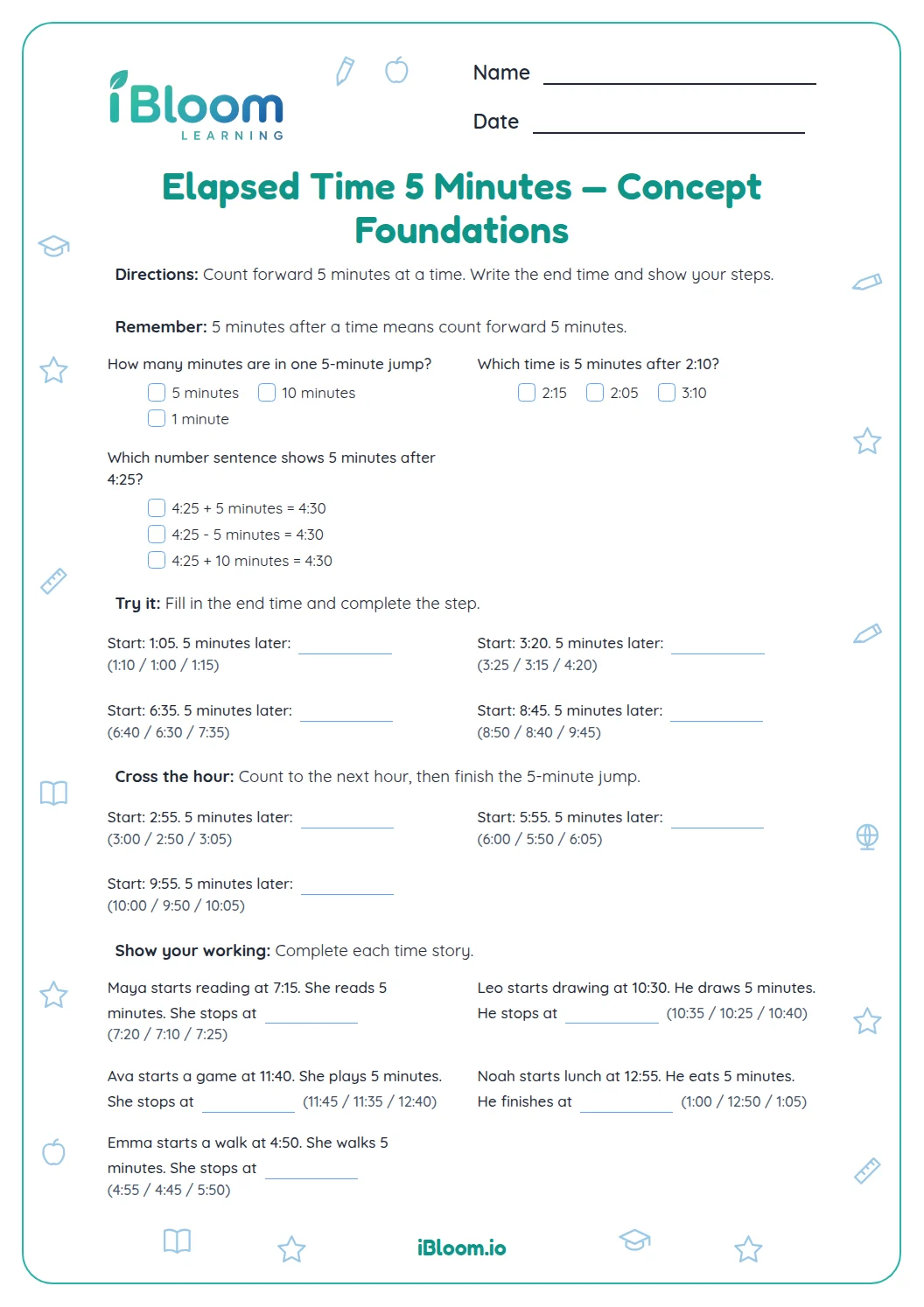
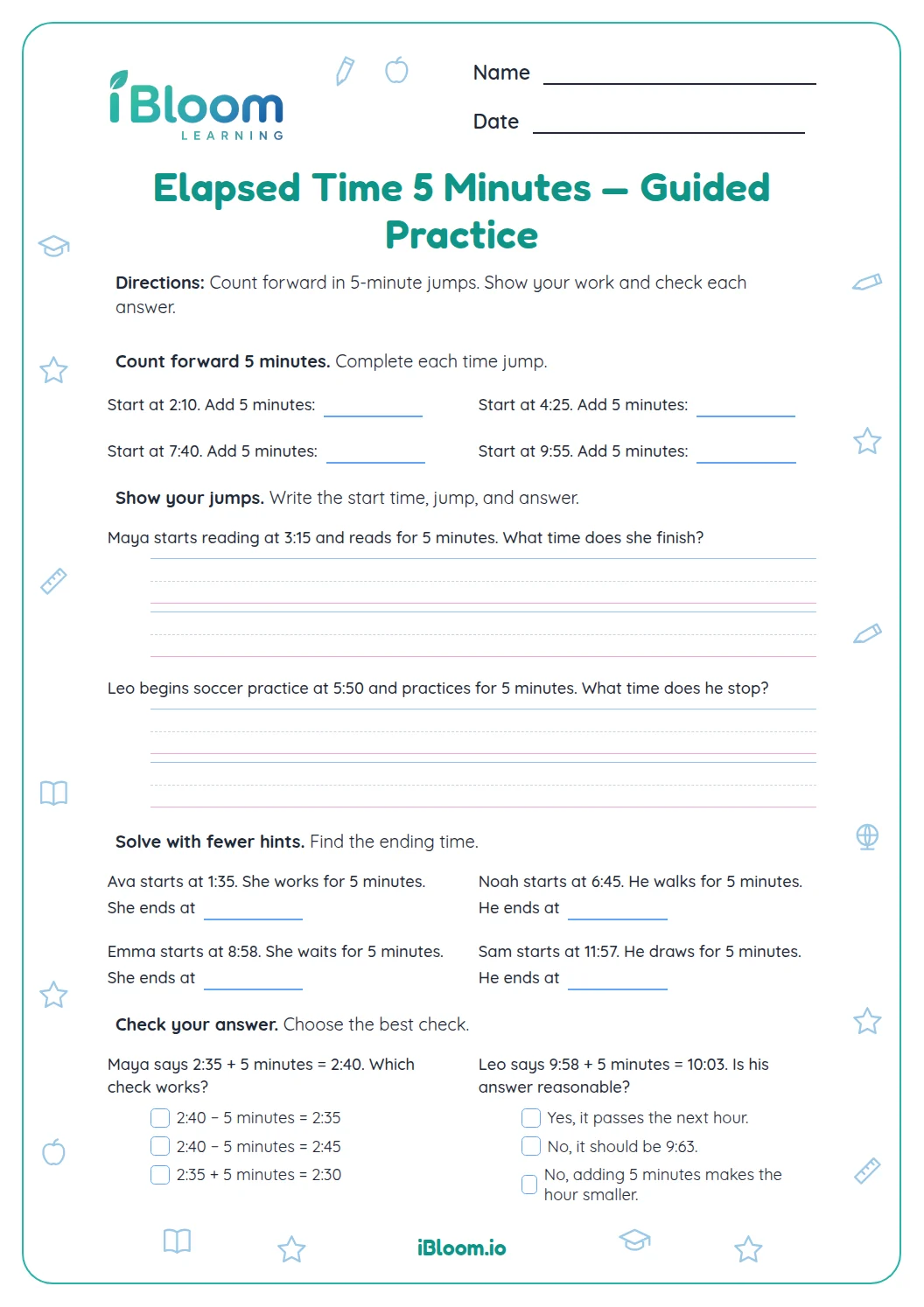
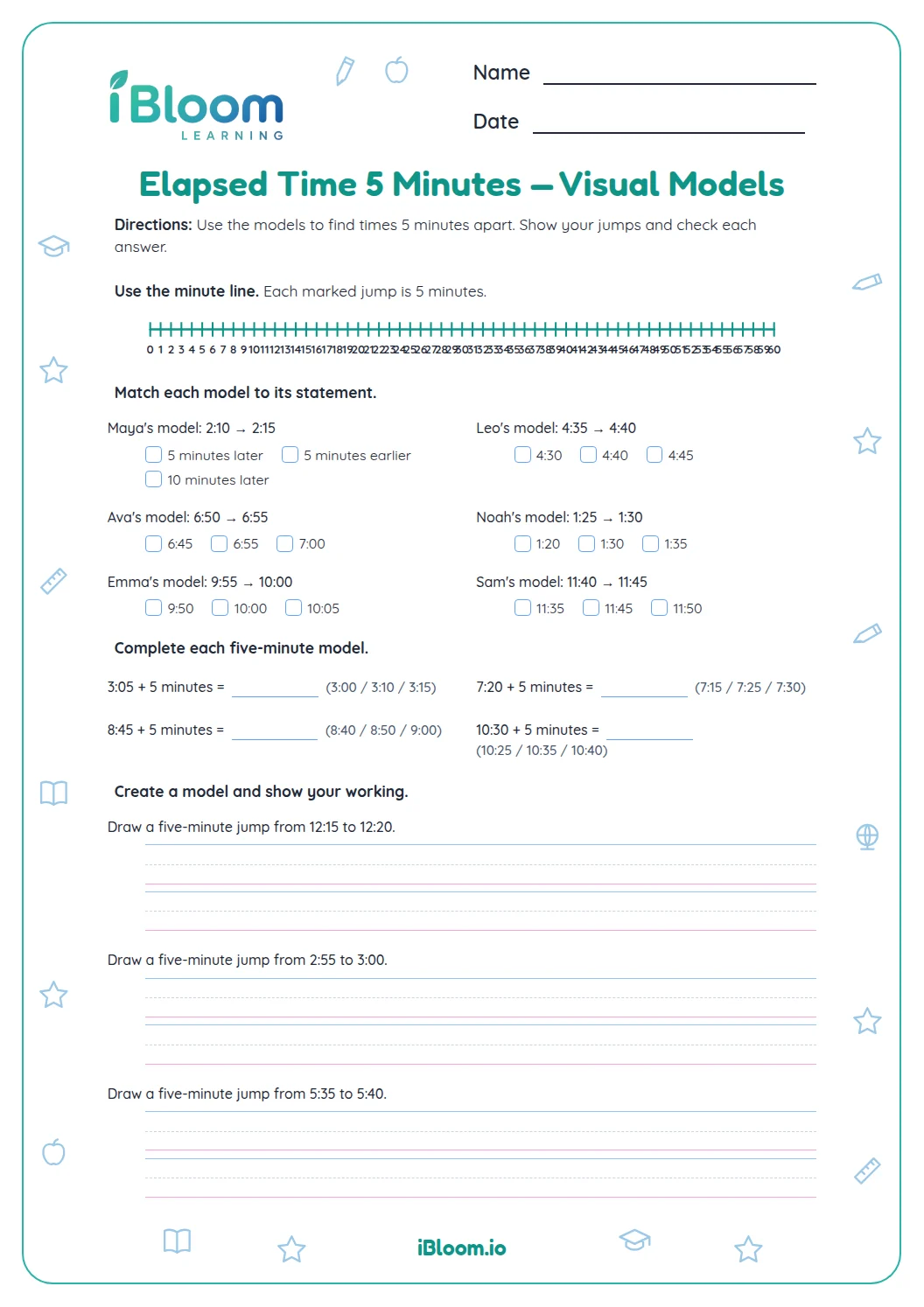
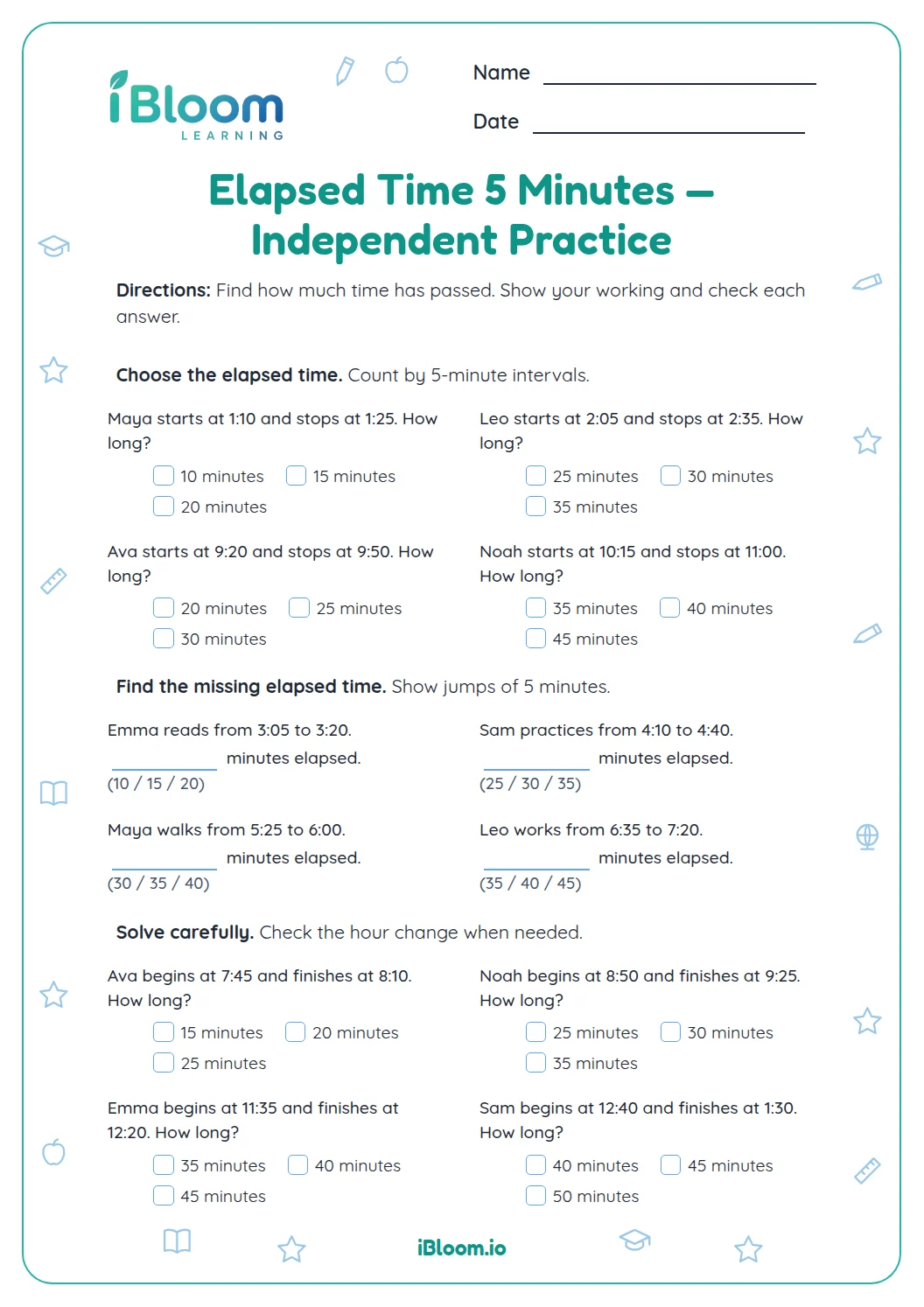
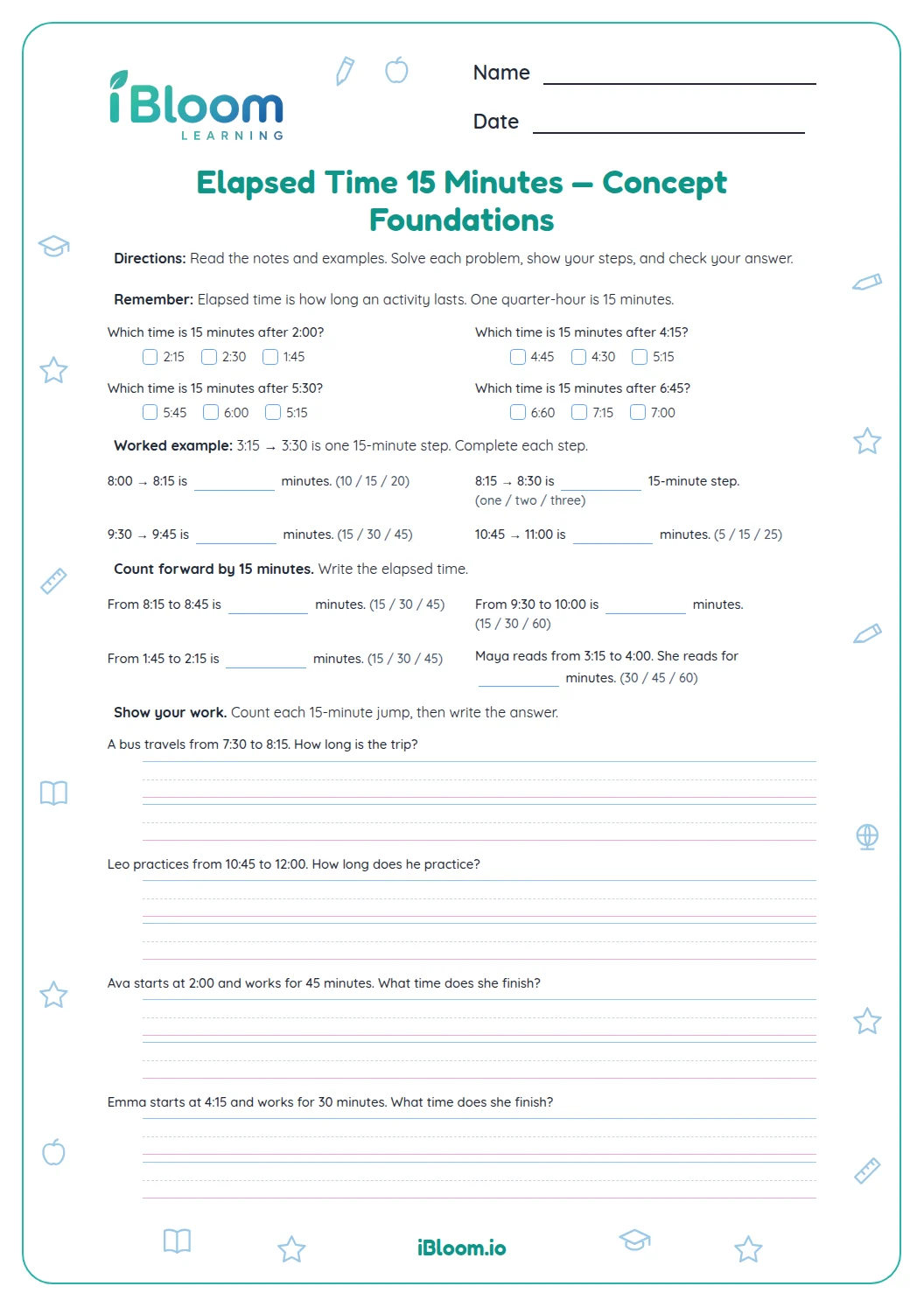
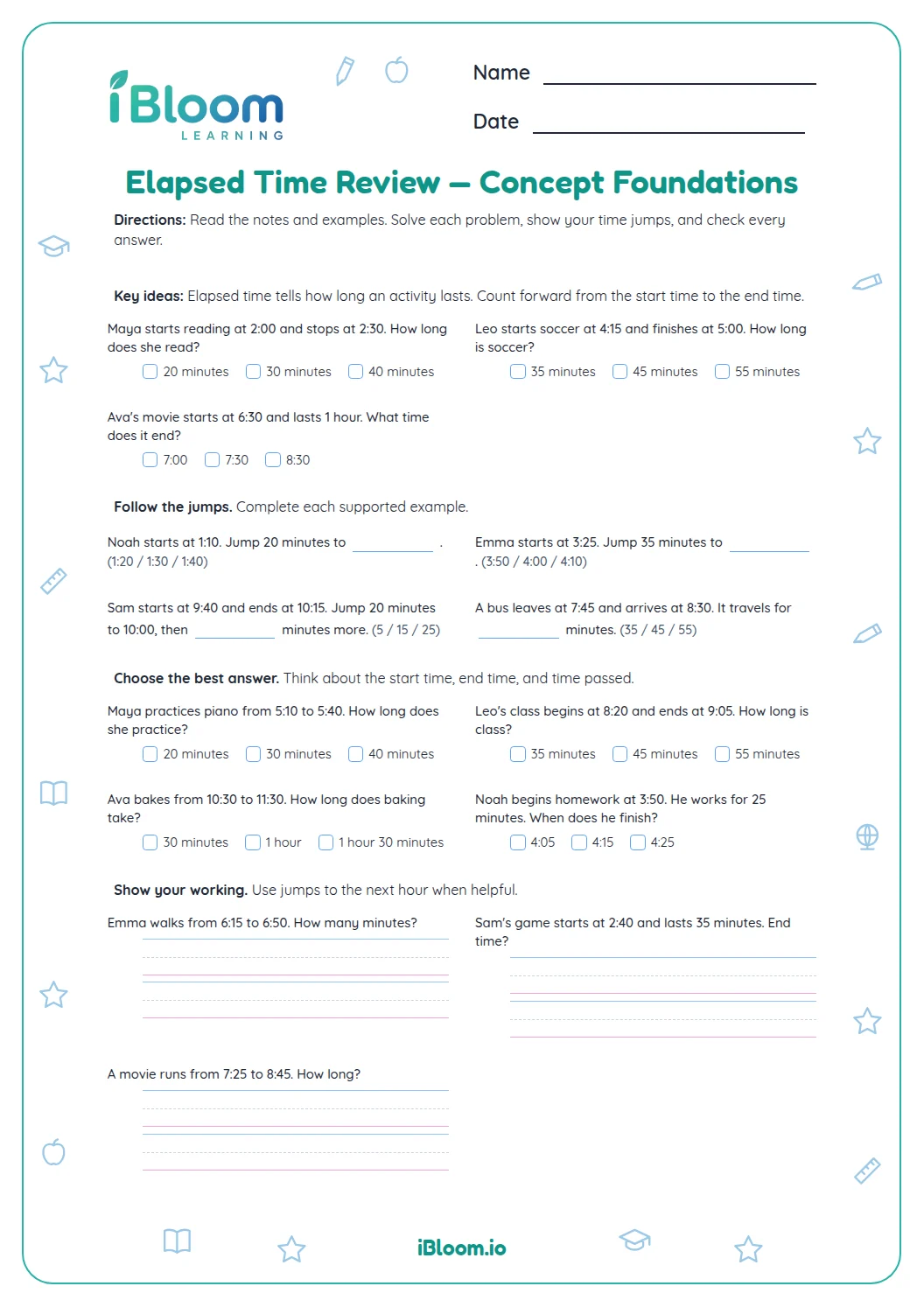
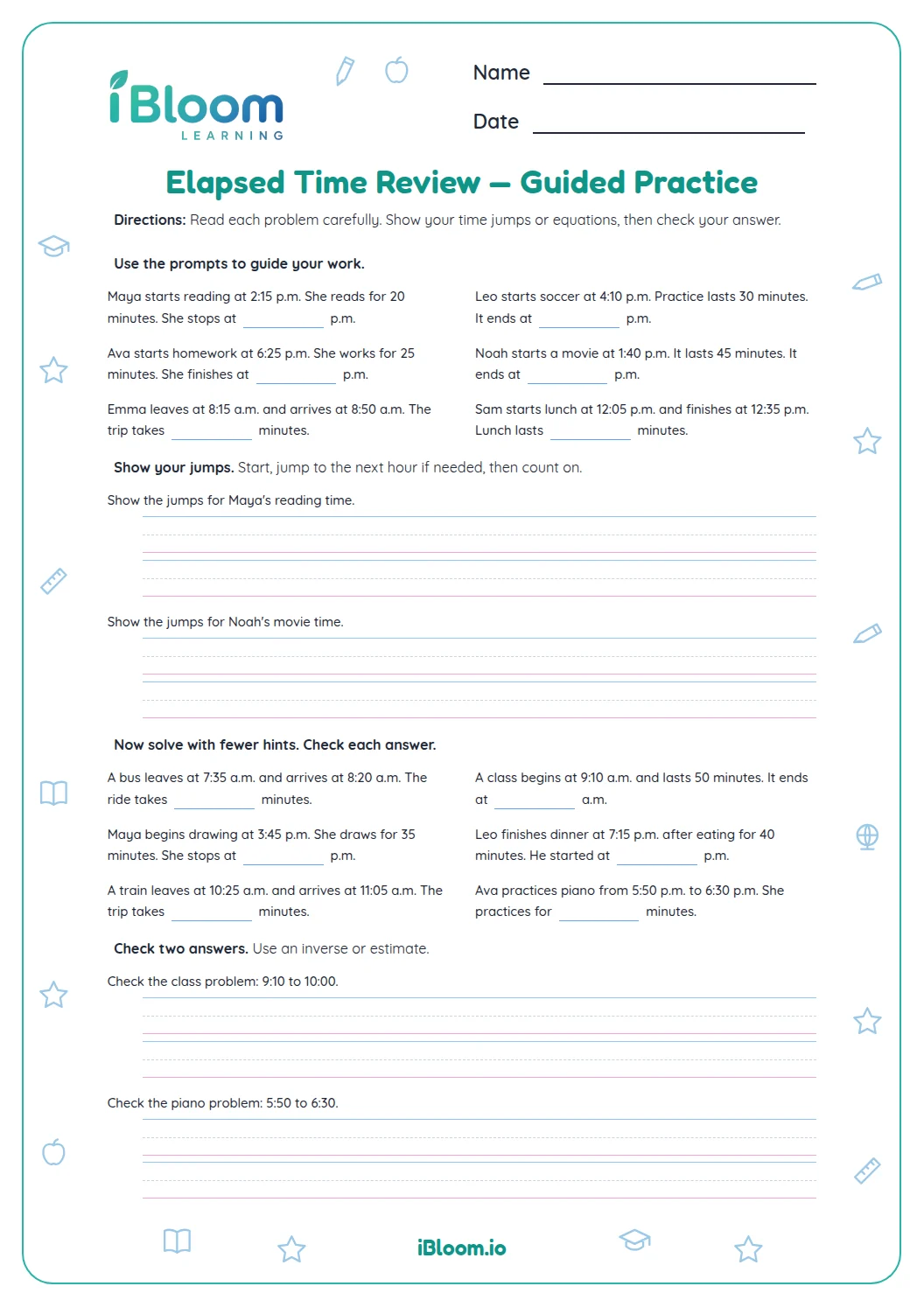
This free Grade 3 elapsed time worksheet introduces time intervals with clear, manageable steps. In the first half, students read an analog start time and count forward by five-minute jumps to find an end time. Then they find the number of minutes between a start and end time, including intervals that cross an hour. The answer key gives each ending time or elapsed-minute total, creating a concrete way to review counting on and time intervals.
Aligned to 3.MD.A.1
How do you read an analog clock?
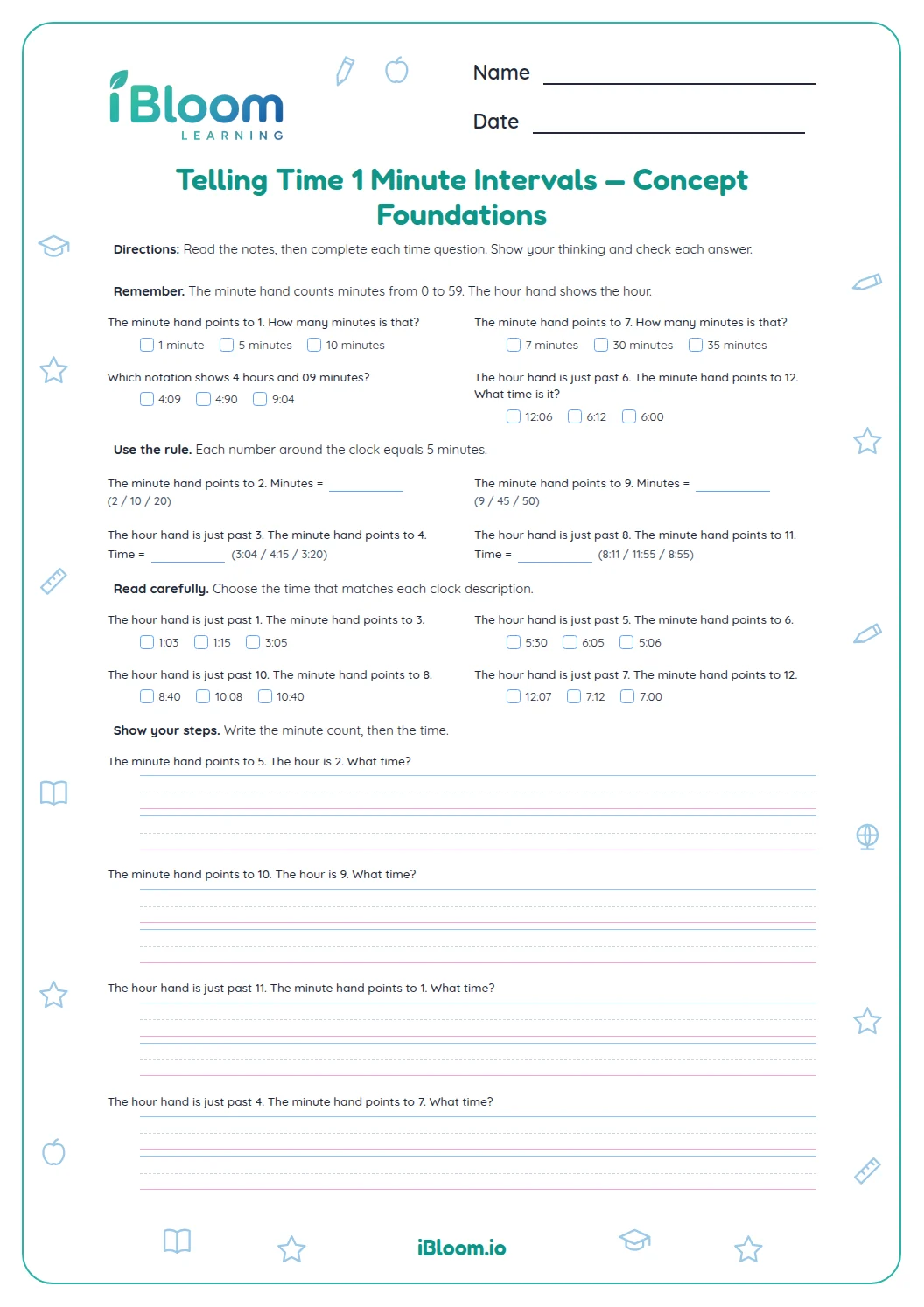
Part A shows four clocks. Read the hour hand and minute hand to name each time to the nearest five minutes. These opening questions review the clock readings used in elapsed-time work.
How do you find a time gap?
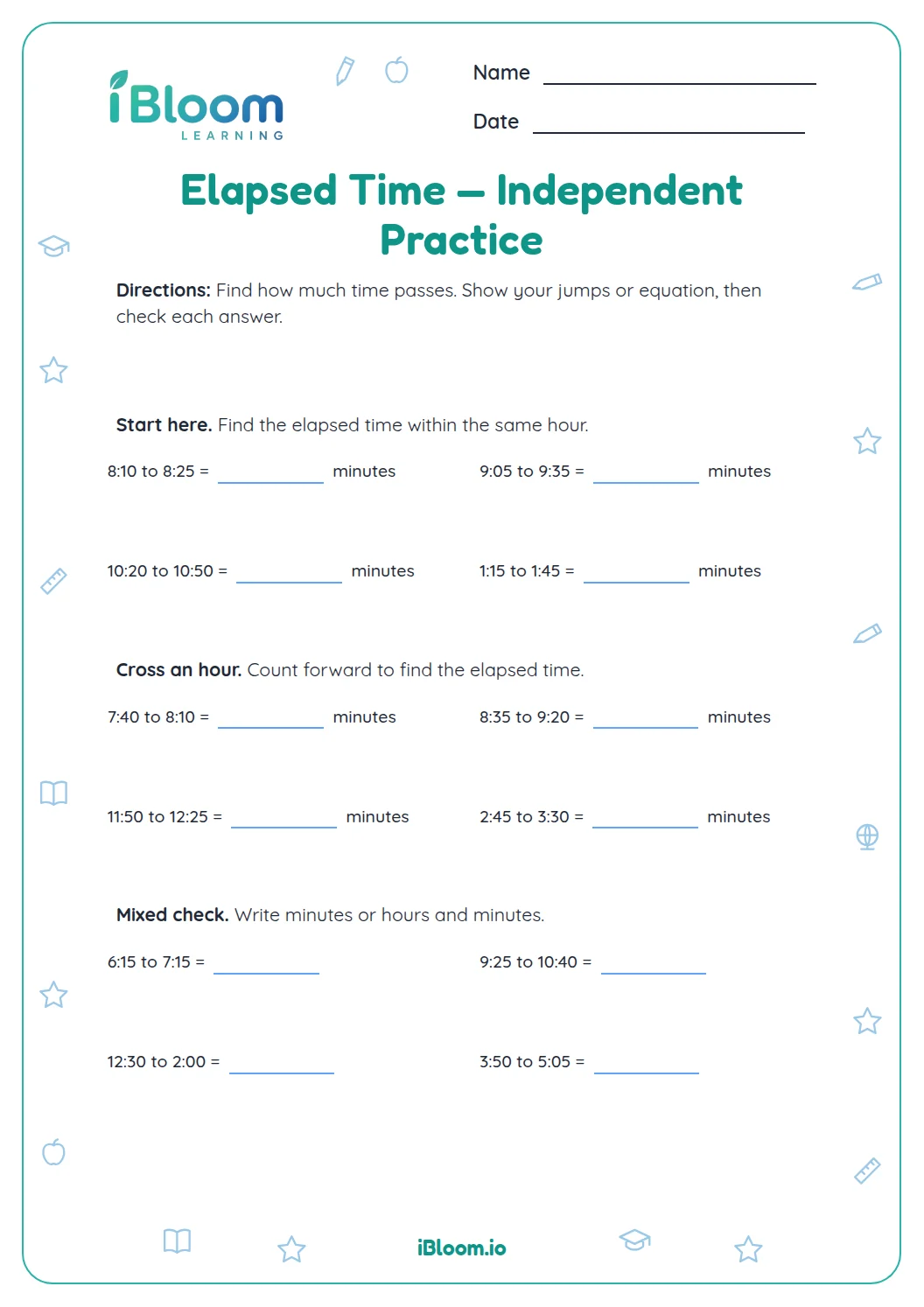
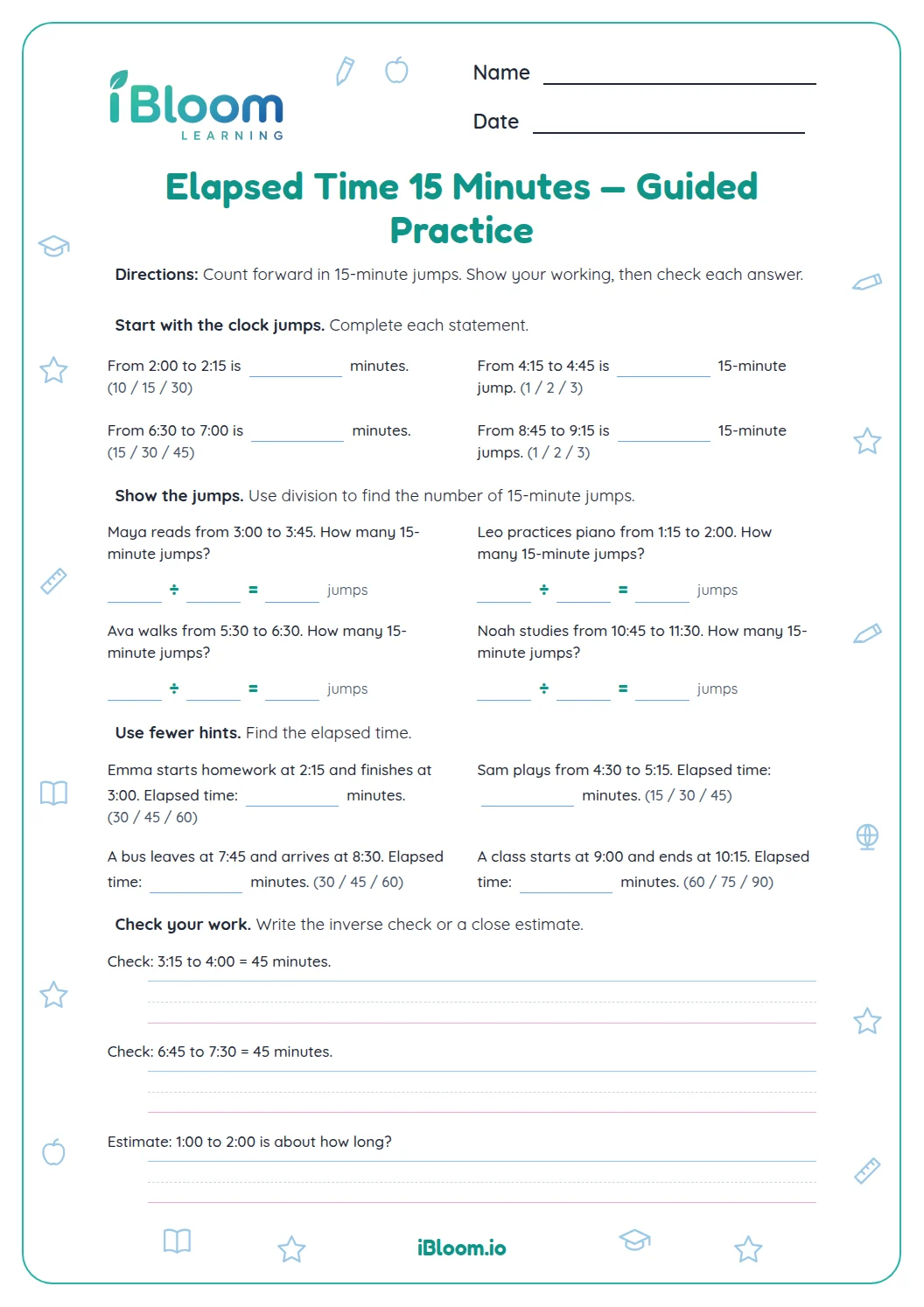
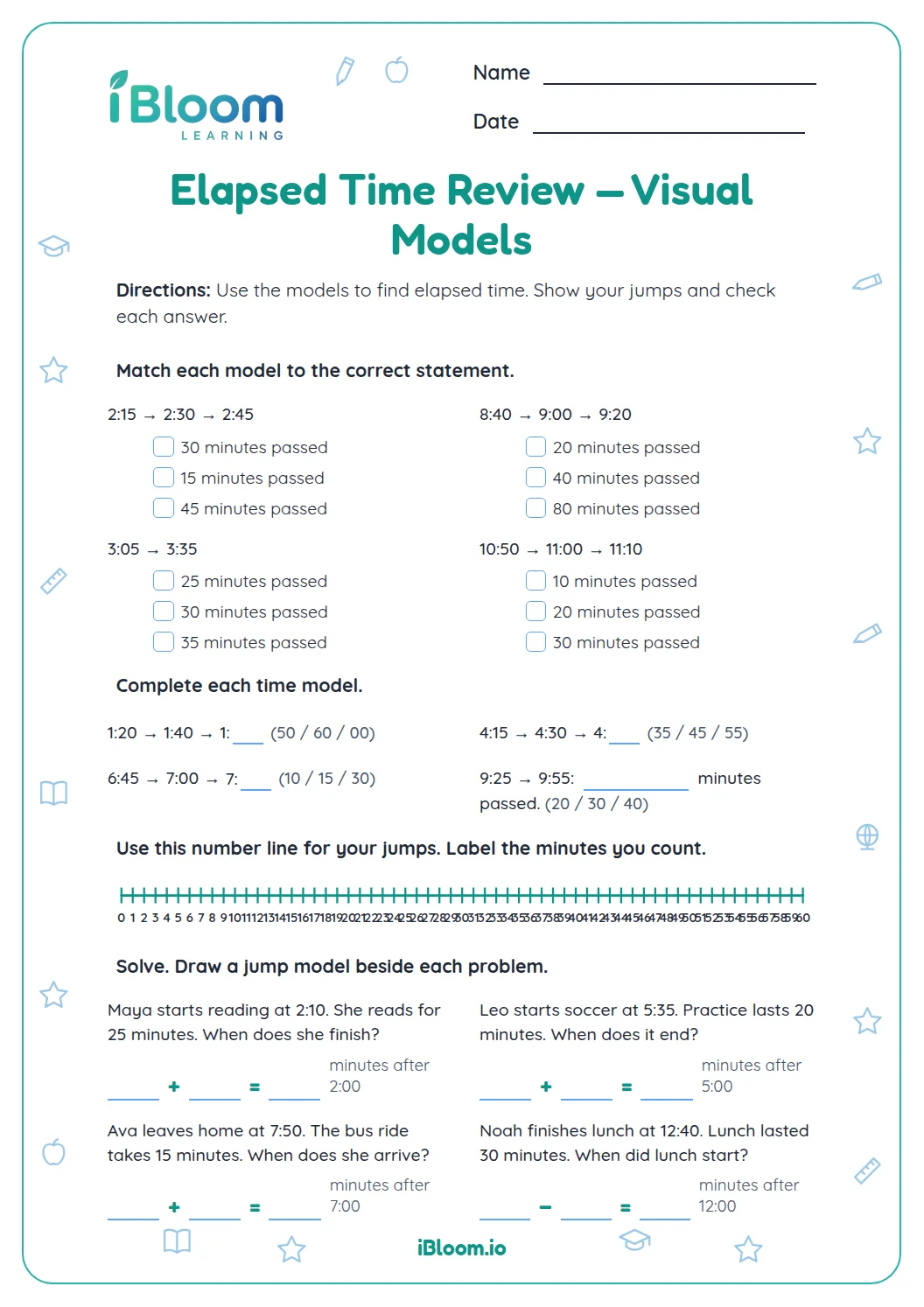
For the next questions, count forward from the start time to the end time. Use friendly chunks such as 10 or 15 minutes, then add the chunks. From 6:05 to 6:50, for example, 45 minutes pass.
What if the interval crosses an hour?
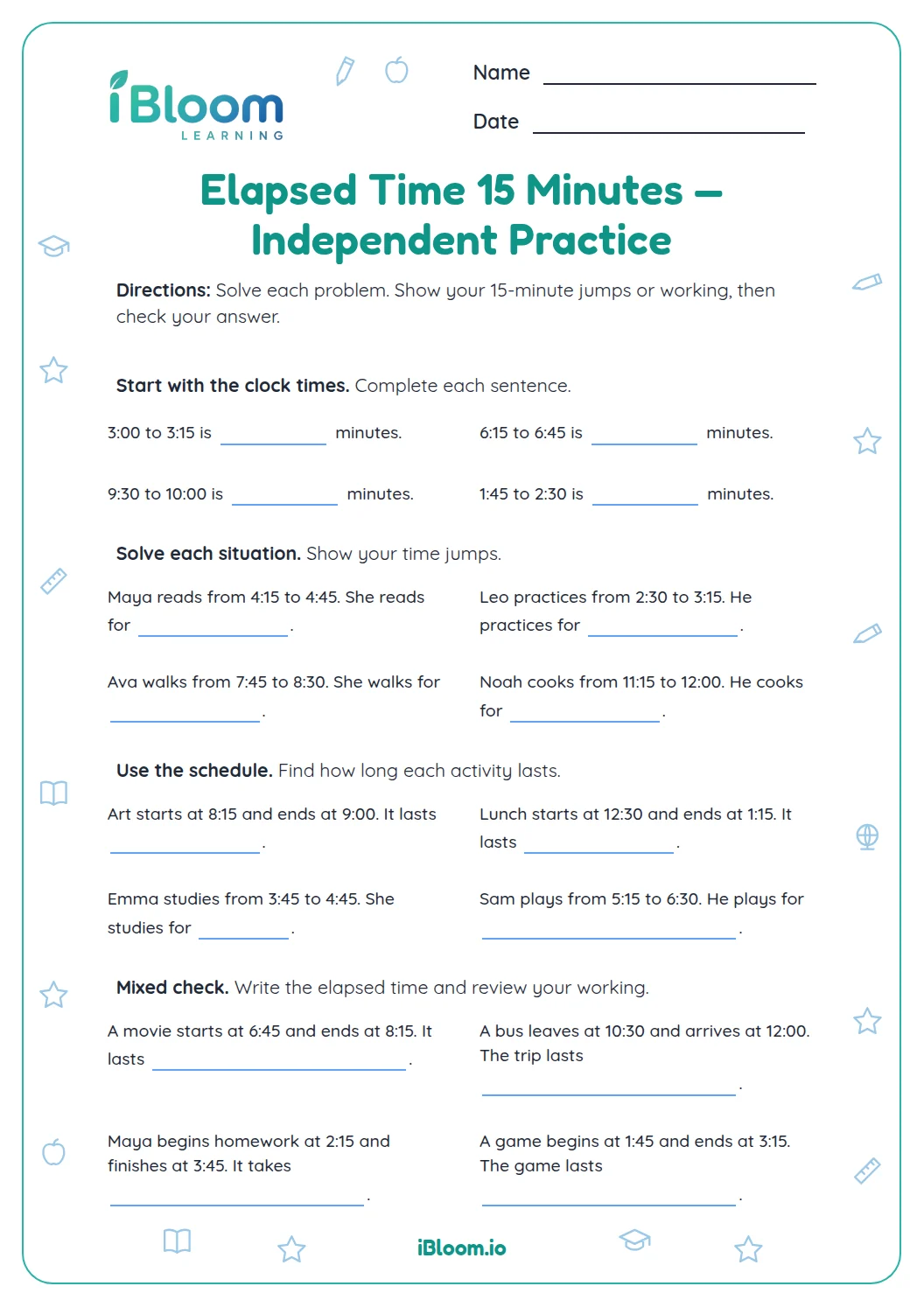
In Part C, reach the next hour first and then count the remaining minutes. From 10:45 to 11:10, 15 minutes reaches 11:00 and 10 more minutes reaches 11:10, for 25 minutes total.
How can you check the elapsed minutes?
Add the duration to the start time. If the result is the stated end time, the interval is consistent. Remember to answer with minutes when the question asks how long an interval lasts.
How to use this worksheet at home or in class
- 1Read the start time and note the minute hand.
- 2Count forward in five-minute jumps for the first part.
- 3When crossing an hour, count to the hour before continuing.
- 4For a start and end pair, count on from the earlier time to the later time.
- 5Add the minute chunks and check that they reach the end time.
Common mistakes and quick fixes
The mistake
Counting the starting time as one of the minutes passed.
The fix
Start with zero elapsed minutes at the start time, then count each jump.
The mistake
Forgetting to change the hour after passing :55.
The fix
Say the next hour aloud as the minute hand passes 12.
The mistake
Writing an ending clock time when asked for duration.
The fix
Check the question: duration is a number of minutes, while an ending time includes an hour and minute.
Common Core alignment
This worksheet gives Grade 3 learners focused practice with telling and solving elapsed time intervals in minutes. The listed standard describes that work.
Tell and write time to the nearest minute and solve time interval problems in minutes.
On this sheet: The worksheet questions directly practice the action named in this standard.
Show the official wordingHide the official wording
Tell and write time to the nearest minute and measure time intervals in minutes. Solve word problems involving addition and subtraction of time intervals in minutes, e.g., by representing the problem on a number line diagram.
What to practice next
Make more practice
Further reading
Questions parents and teachers ask
What is elapsed time?
Elapsed time is the amount of time between a start and an end. This worksheet begins with four analog clock readings, then asks learners to find durations in minutes between two stated times. Read the wording to see whether the answer should be a clock time or a duration.
How many questions use clocks?
The first four questions show analog clocks and ask for the time displayed. The remaining 12 questions ask learners to find elapsed time between stated start and end times. The answer key gives the clock readings and durations. Each answer matches the wording of its prompt.
Do any questions cross an hour?
Yes. Part C contains four intervals that pass the hour, such as 10:45 to 11:10. Count first to the next hour, then add the remaining minutes. This makes the hour crossing visible as two smaller jumps. Learners can check their total by adding those two parts.
What is the difference between end time and elapsed time?
An end time tells when an event finishes, such as 4:05. Elapsed time tells how long the event lasted, such as 25 minutes. On this worksheet, the clock questions ask for times, while the interval questions ask for minutes passed.
How can an adult help without giving away the answer?
Ask the learner to name the start time and end time, then decide whether the next hour is crossed. They can count forward in 5-, 10-, or 15-minute chunks and add the chunks. Ask whether the question requests a clock reading or a duration.