



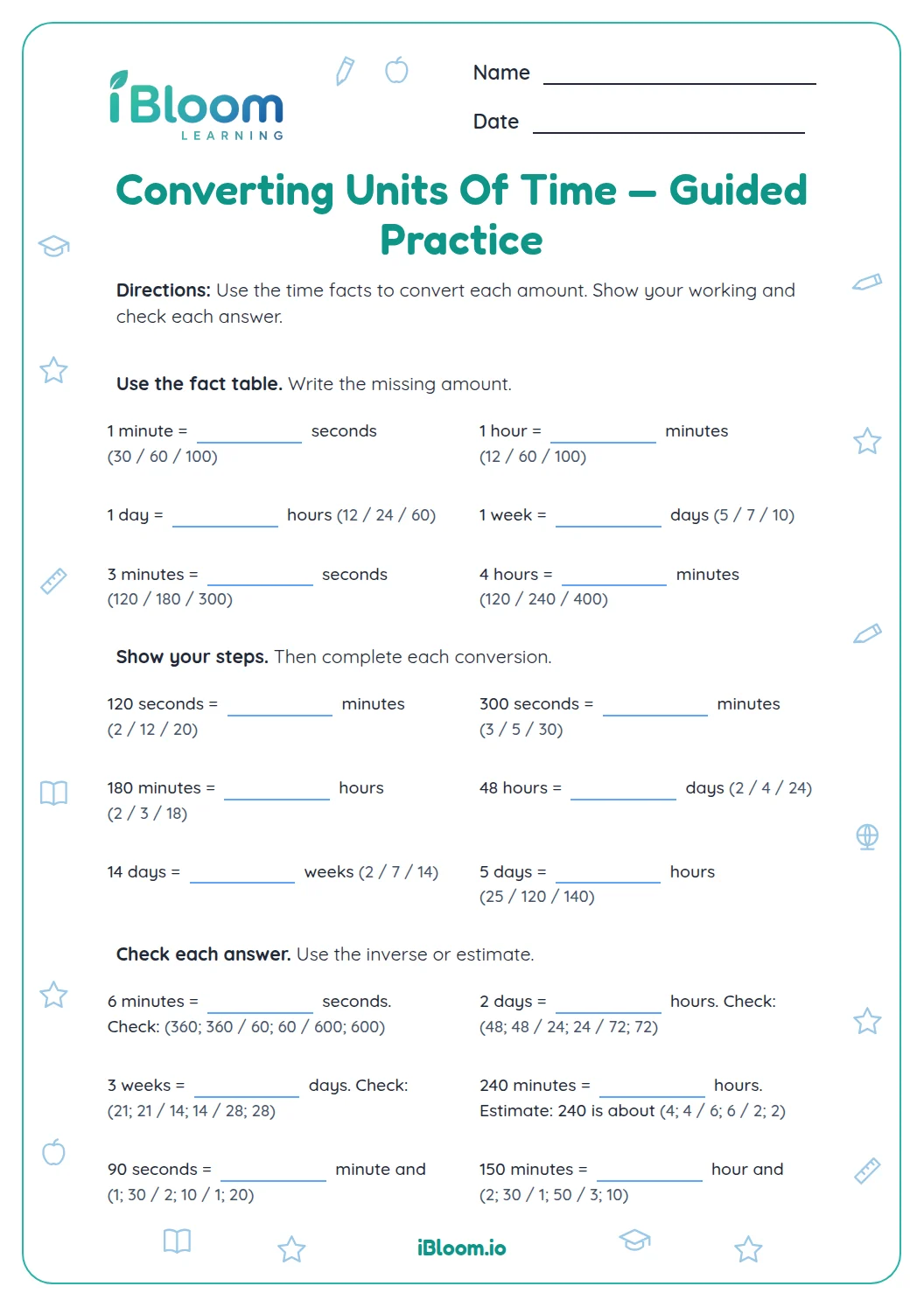

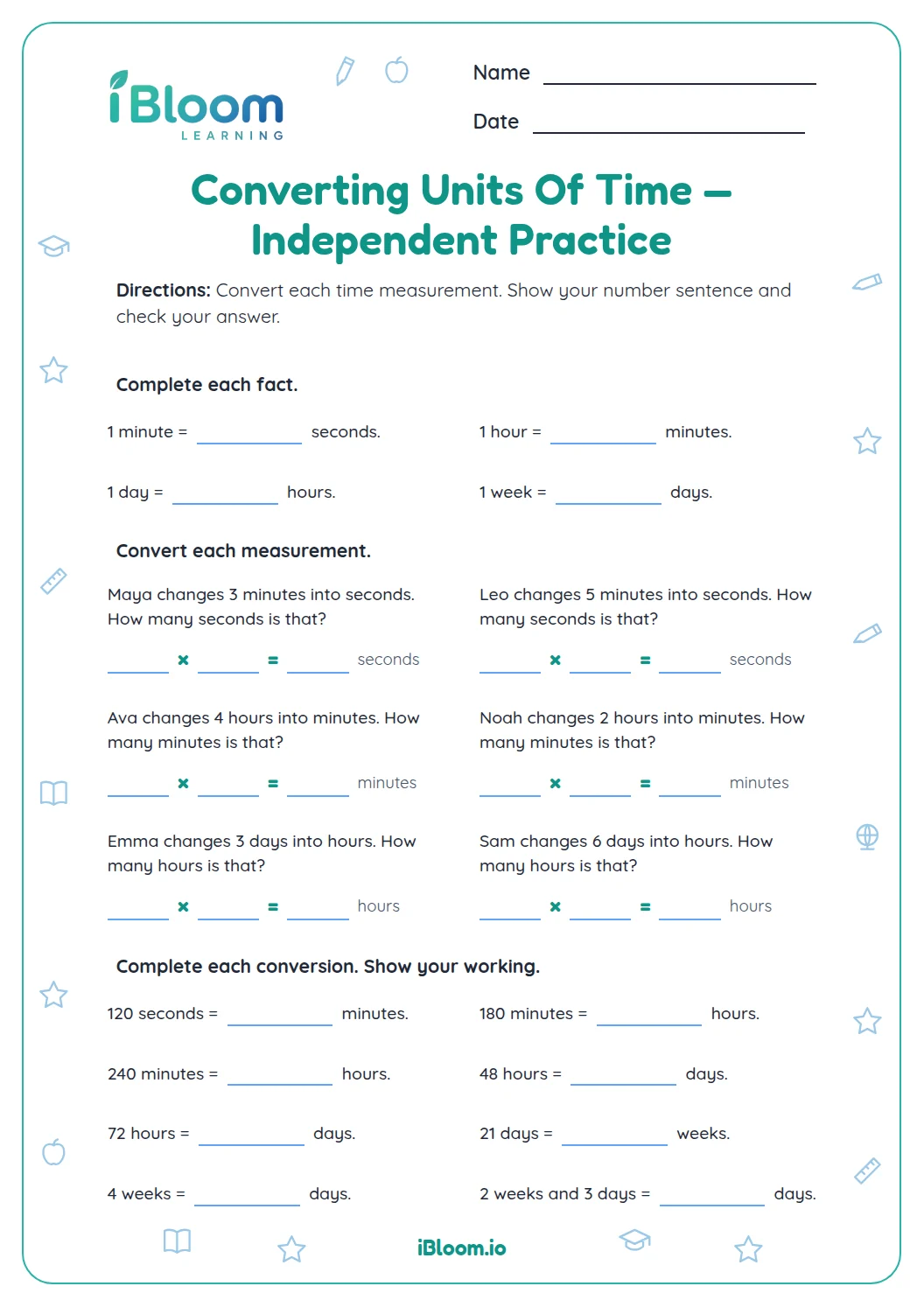
About this worksheet
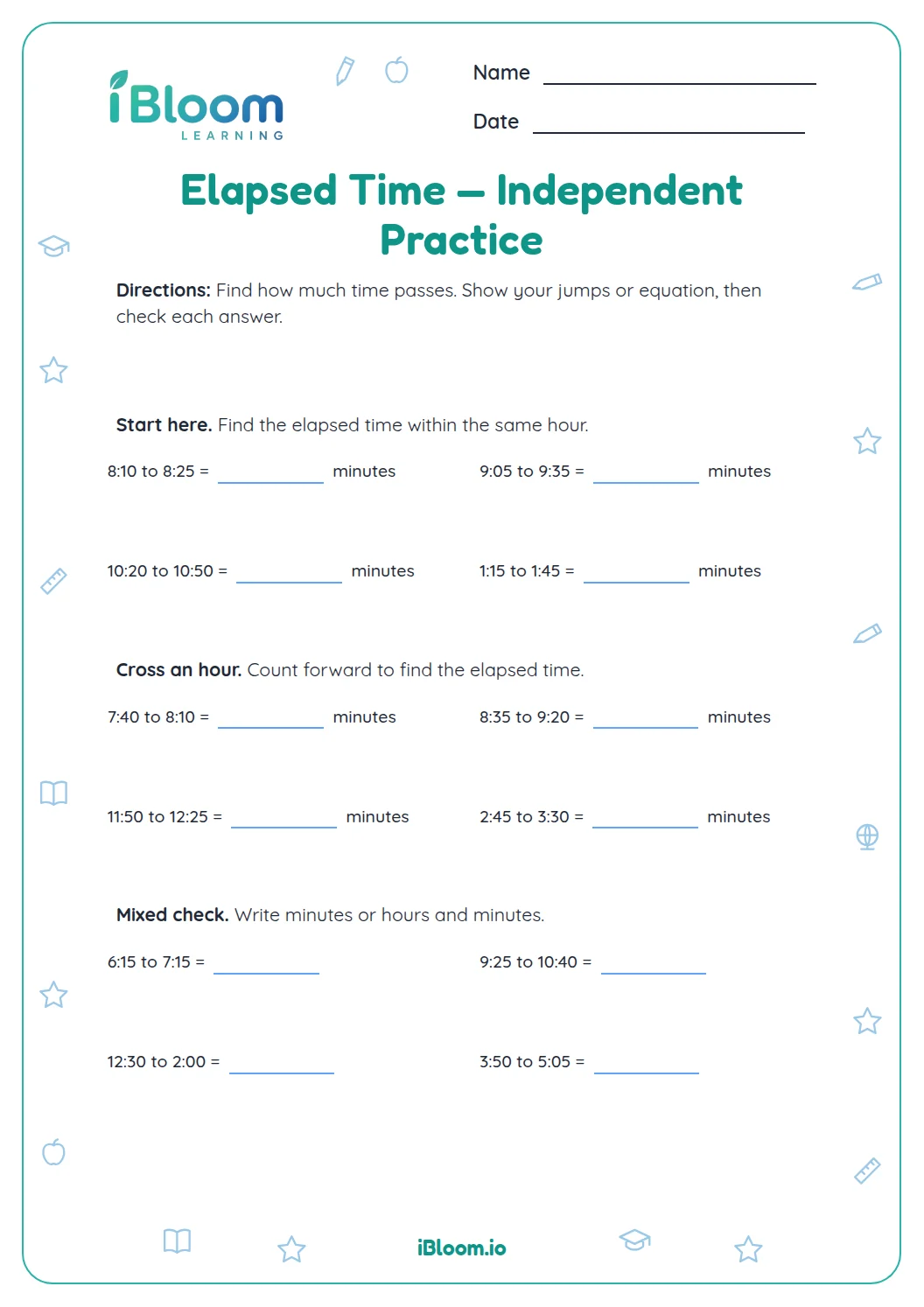
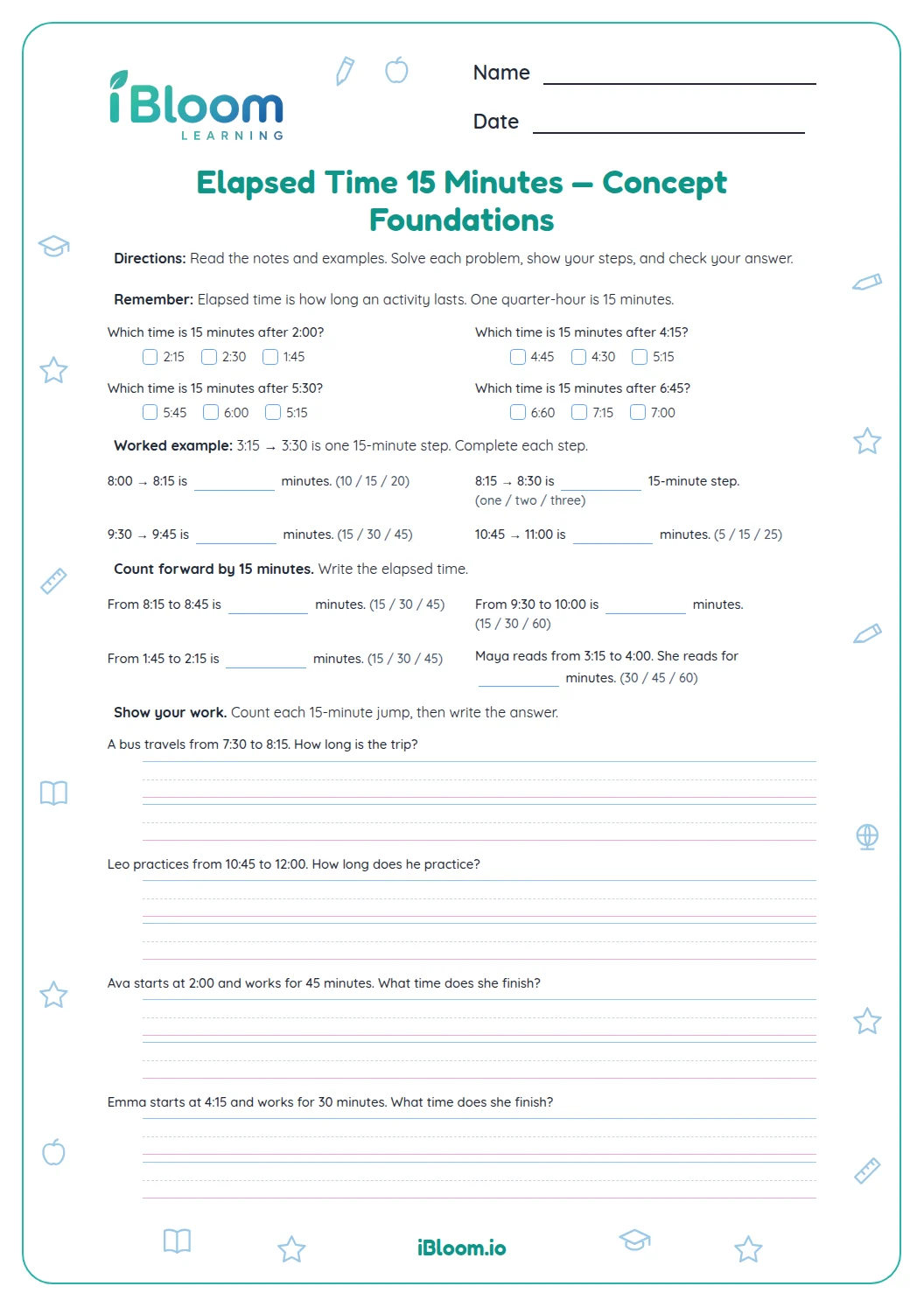
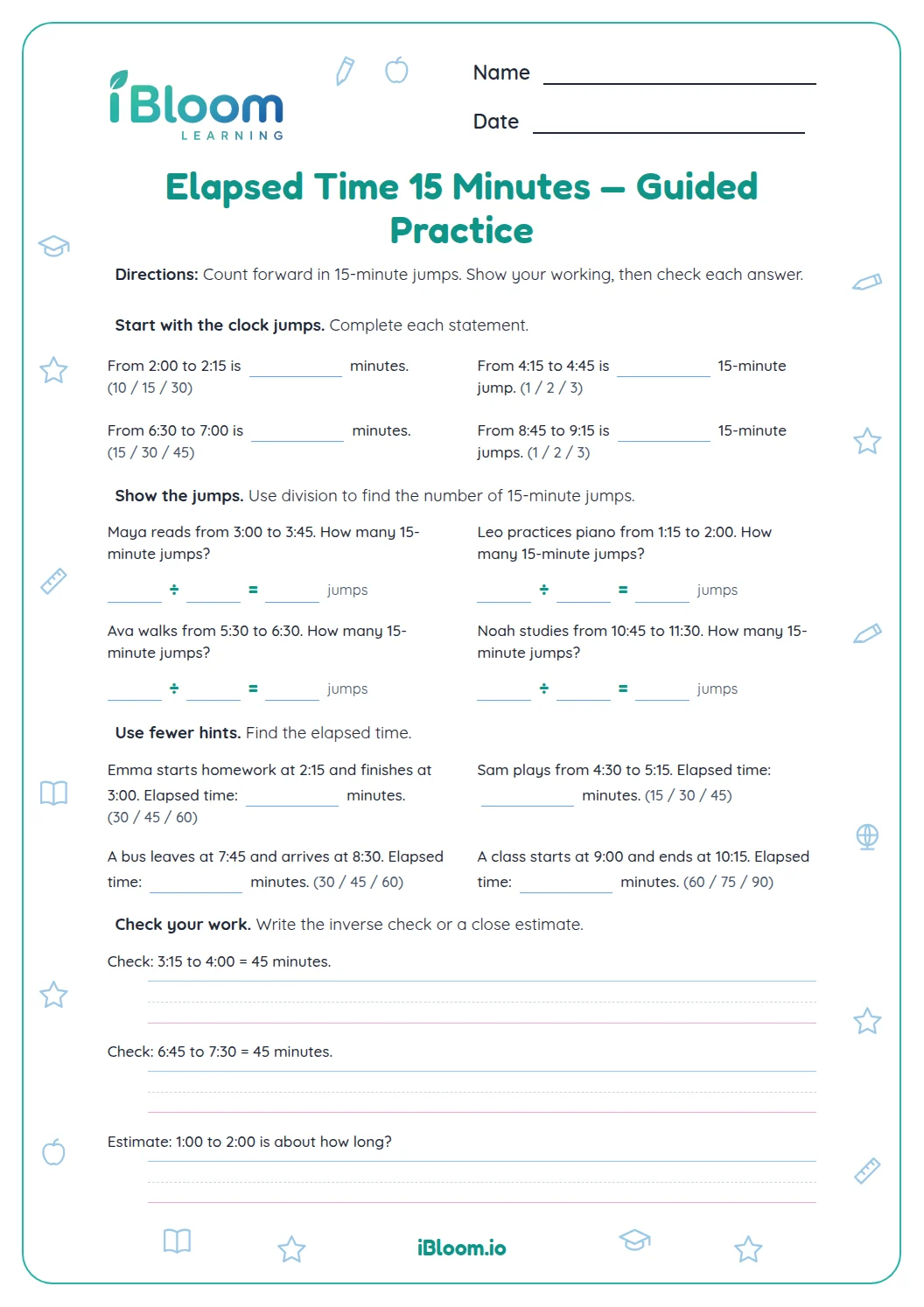
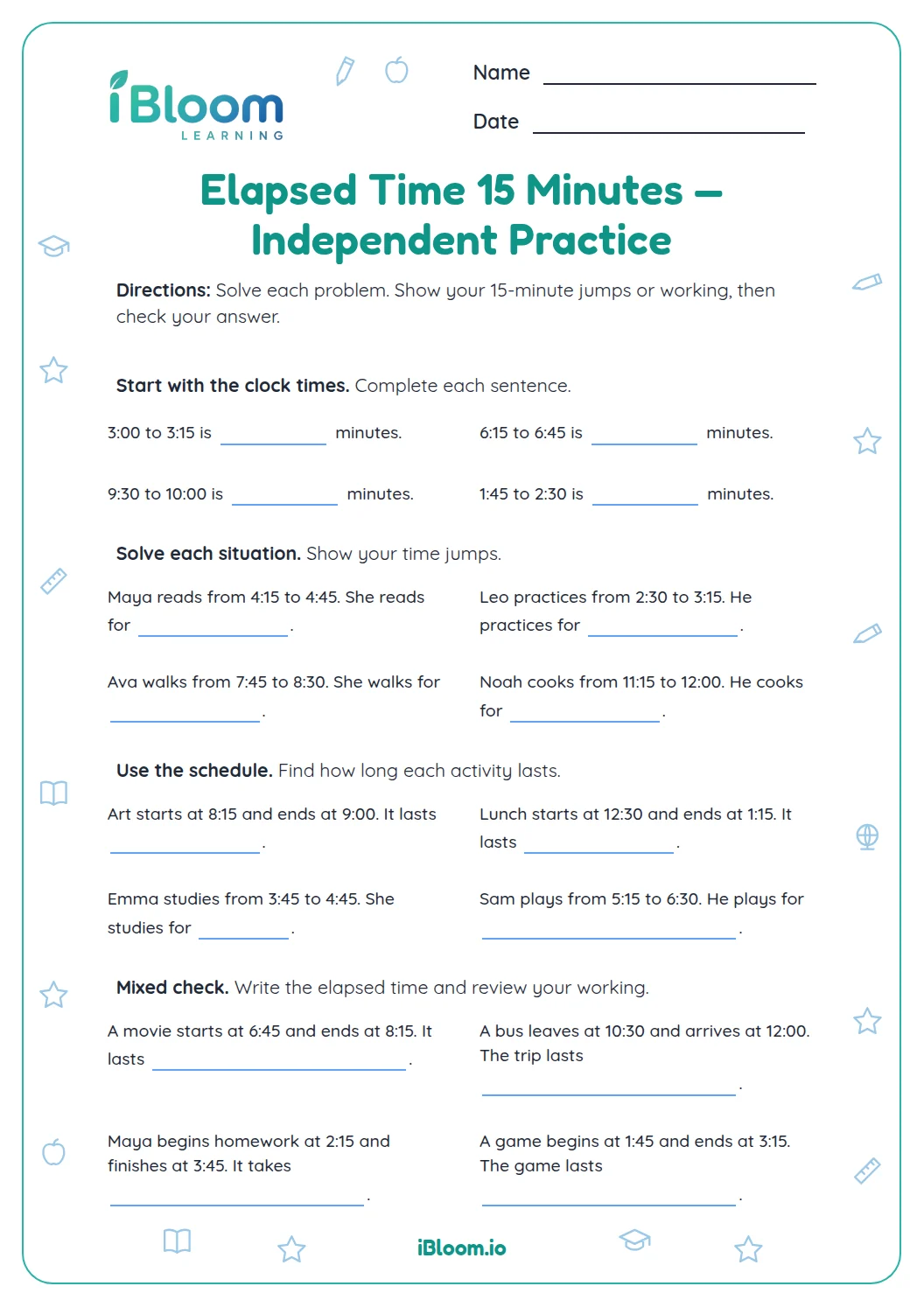
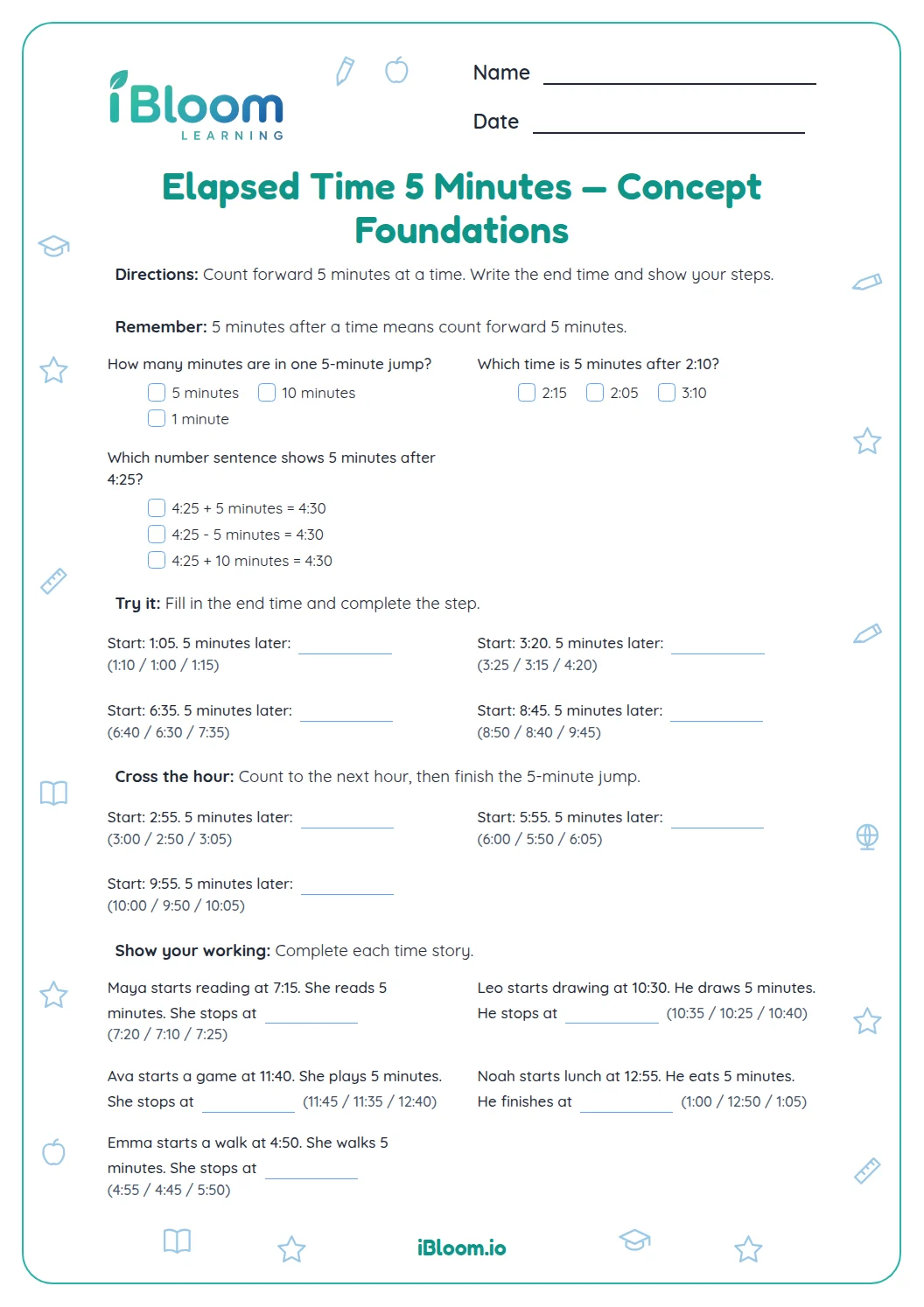
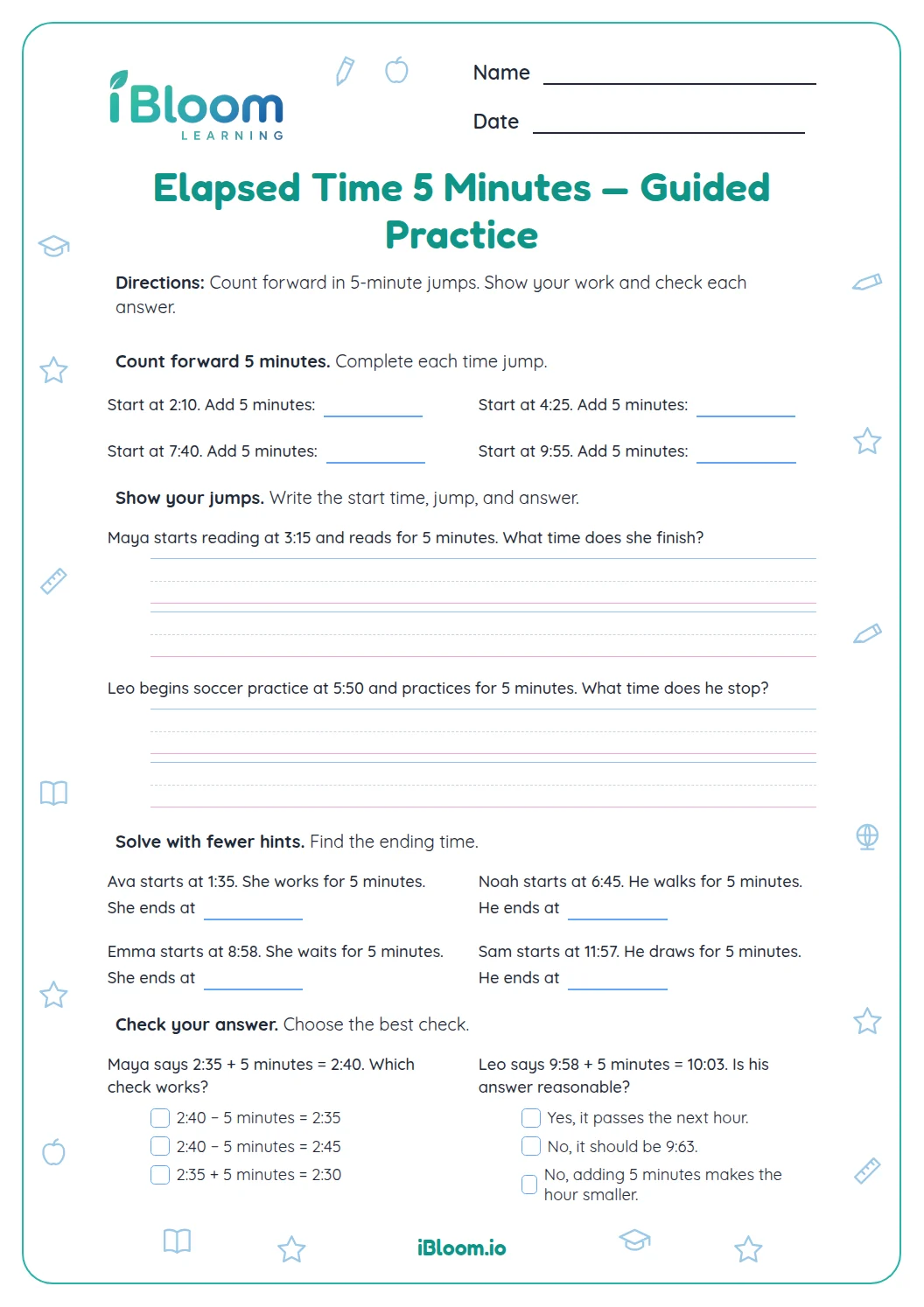
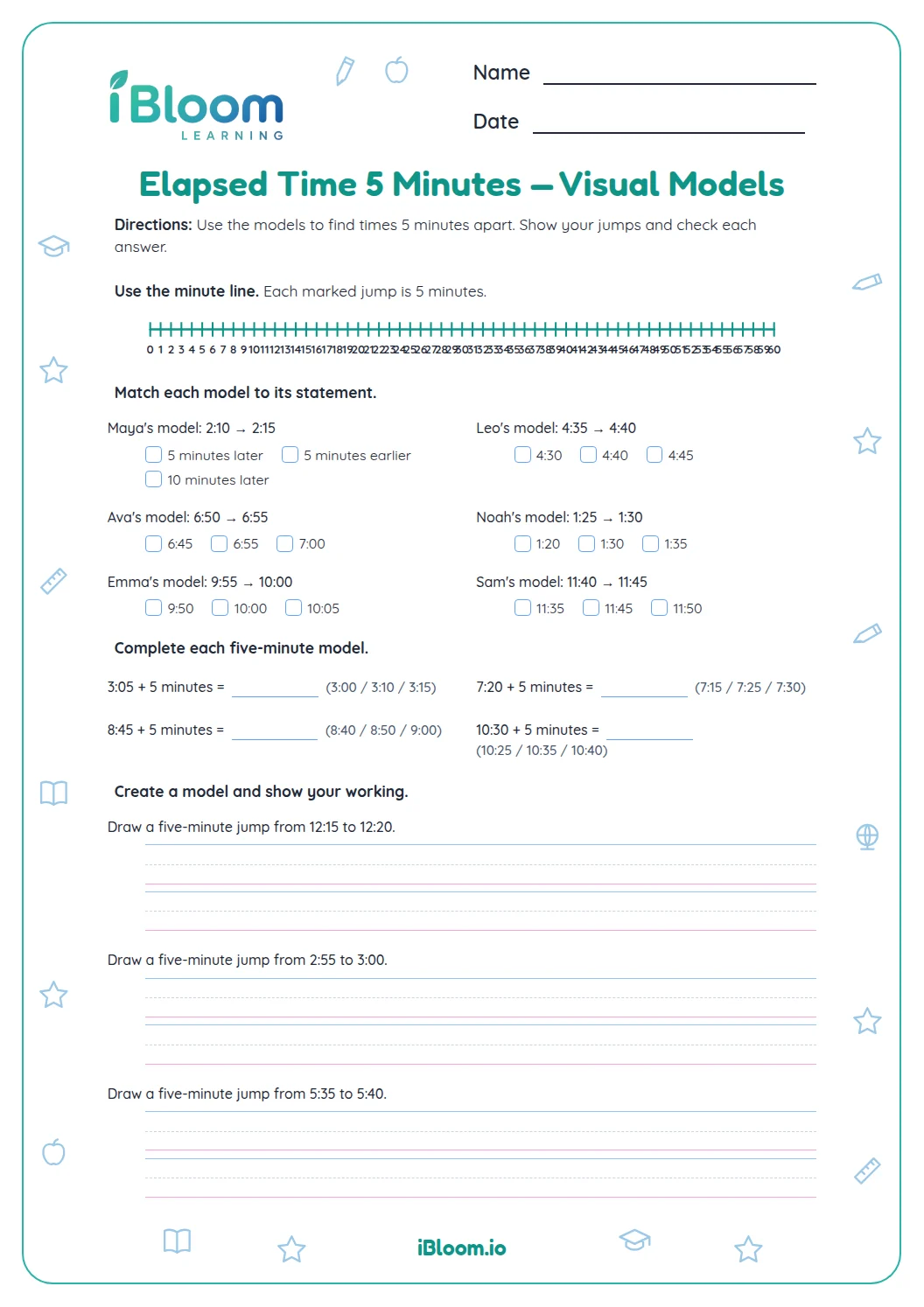
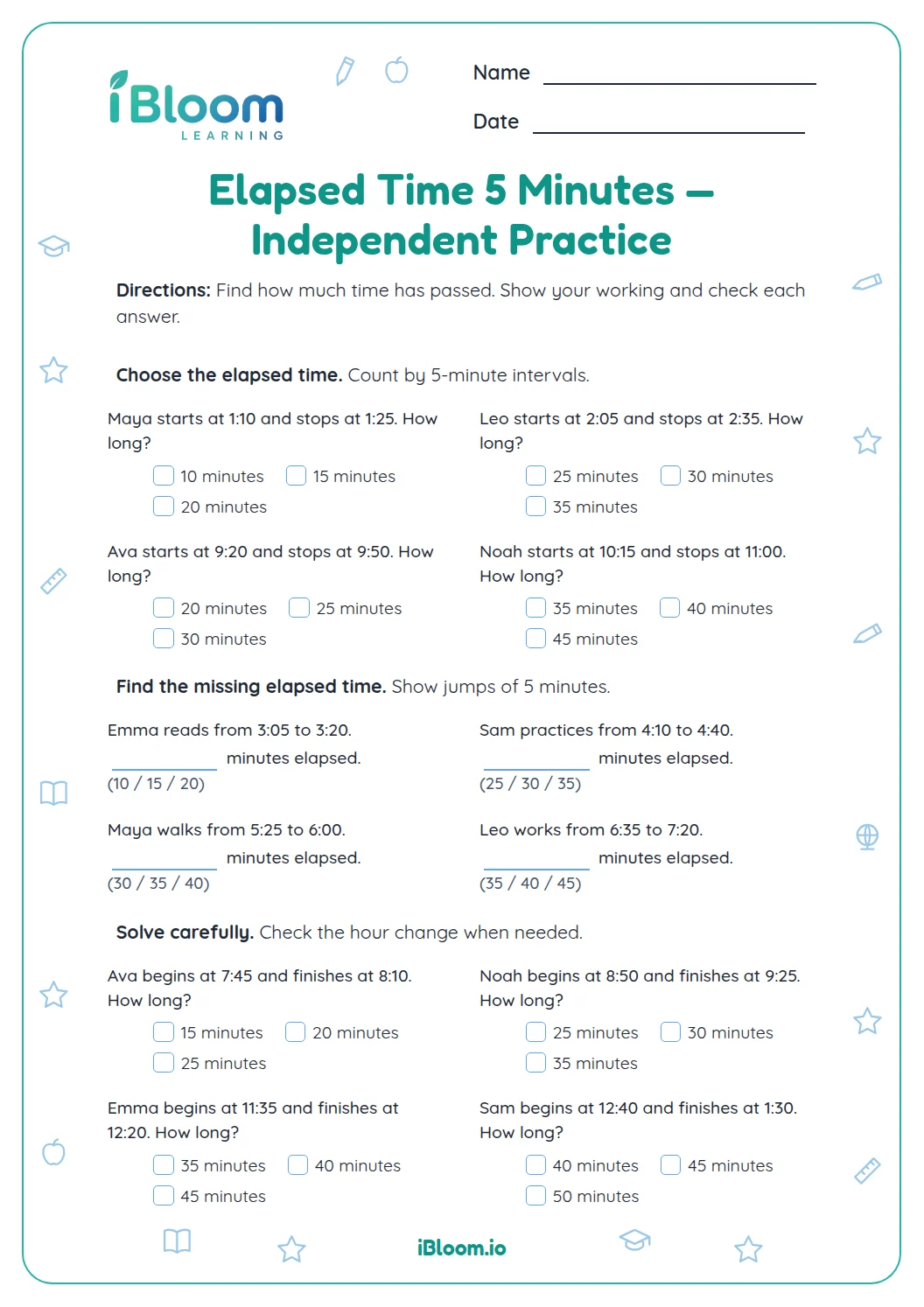
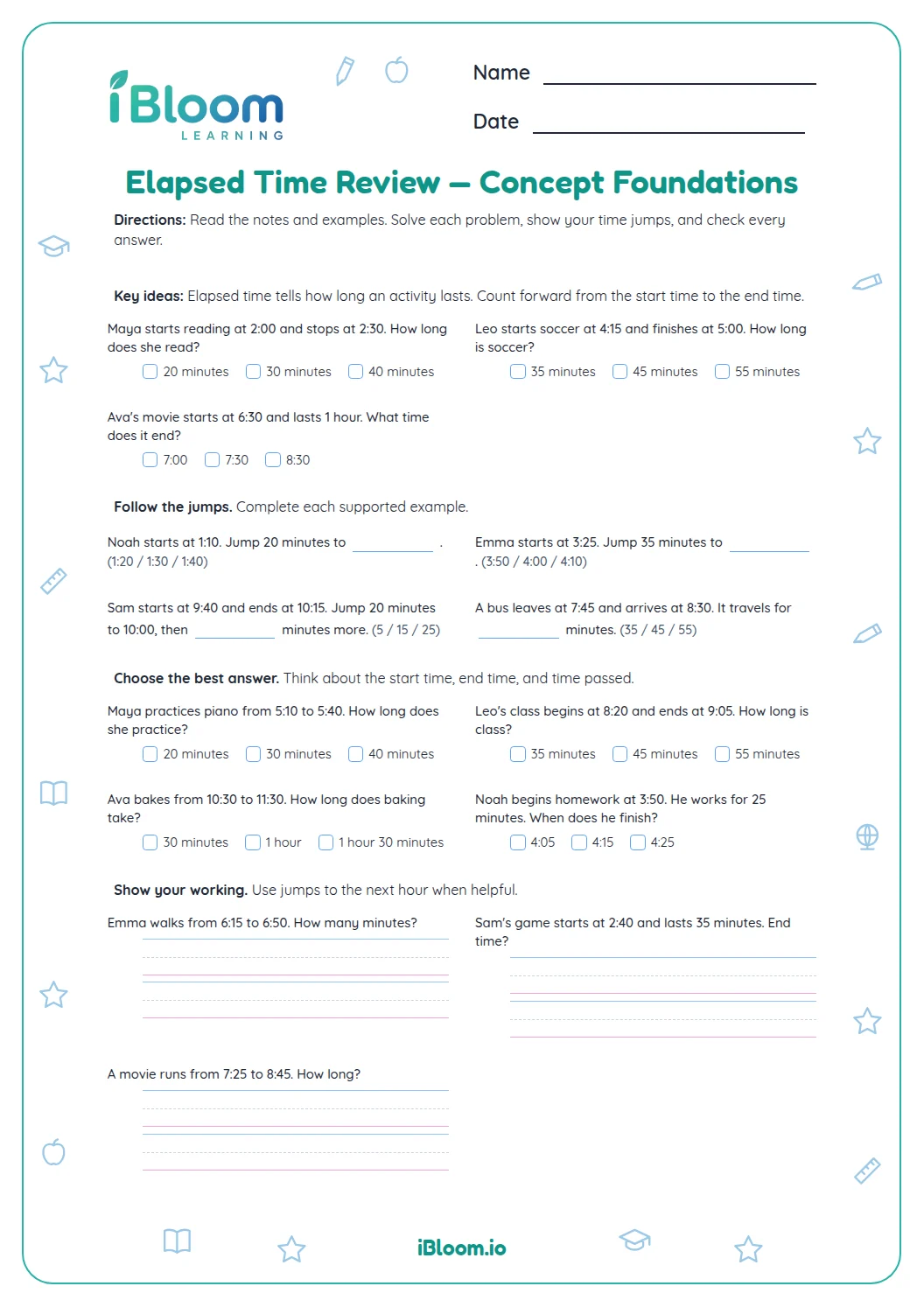
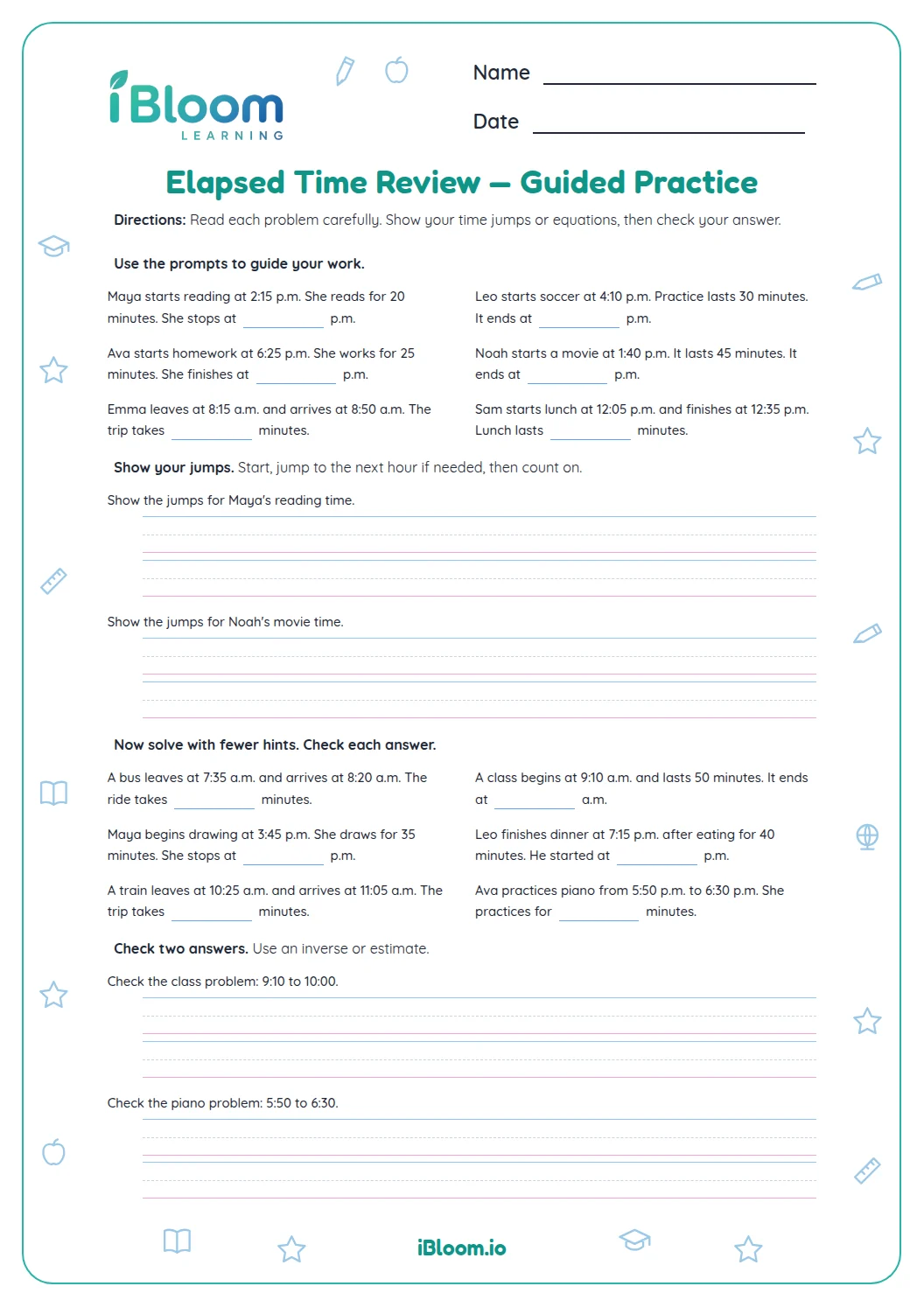
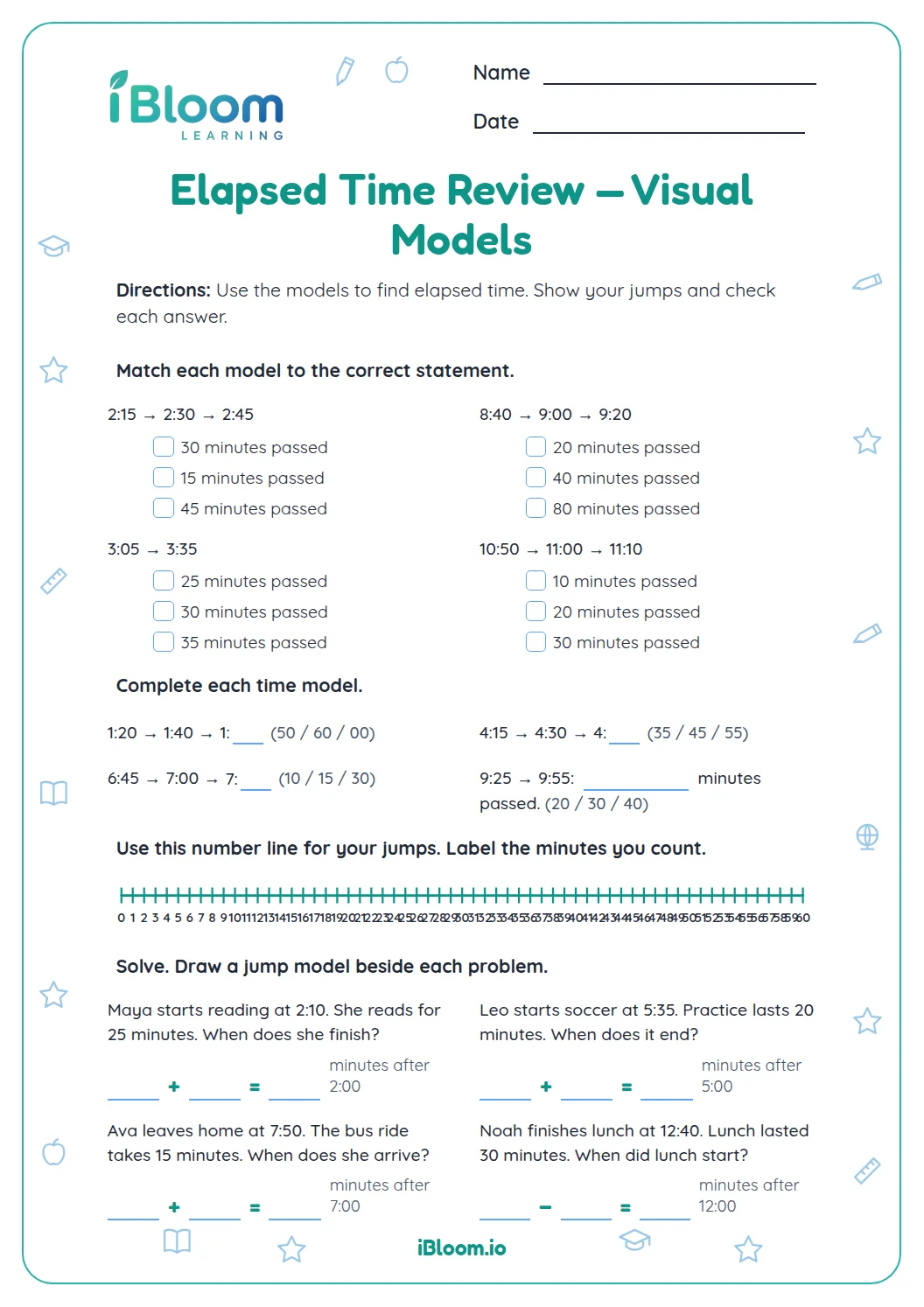
This free printable Grade 3 worksheet practices elapsed time by moving forward or backward across clock times. Four choices compare intervals and plans; six problems find a duration, start time, end time, or remaining minutes; two written responses explain a calculation and a deadline. Two analog clocks give start times to the minute. The questions practice Common Core 3.MD.A.1, including addition and subtraction of time intervals. A separate answer key supplies the calculations and model explanations.
Aligned to 3.MD.A.1
Why split the interval at the next hour?
A clock changes hours after 60 minutes. Splitting at an hour gives two small calculations that can be checked separately. Children may mark the jumps on the working grid or write the two intervals as a sum.
- 1The clock shows 3:38 p.m.
- 23:38 to 4:00 is 22 minutes.
- 34:00 to 4:07 is 7 minutes.
- 422 + 7 = 29 minutes.
How do you find a missing start time?
Start at the known ending time and move backward by the full duration. In question 7, art ends at 2:15 p.m. and lasts 38 minutes. Moving back 15 minutes reaches 2:00; moving back the remaining 23 reaches 1:37 p.m.
Check by moving forward from the proposed start. From 1:37 to 2:00 is 23 minutes, and 15 more minutes reaches 2:15. The two jumps total 38.
What makes the last questions reasoning challenges?
Question 11 gives a plausible error from treating clock digits like ordinary base-ten numbers. Children correct 70 minutes to 30 minutes and show the two jumps that prove it.
Question 12 asks whether a task fits before a deadline. Children can find the finish time, 5:15 p.m., or compare the 35-minute task with the 30 minutes available. Both methods lead to the same decision: it finishes 5 minutes late.
Work through the time challenges
- 1Recall that one hour contains 60 minutes.
- 2For Part A, find each interval before choosing an answer.
- 3Read both hands on each Part B clock and write the start time in the grid.
- 4Decide whether to move forward, backward, or subtract time already used.
- 5Label every answer with minutes or a.m./p.m.
- 6Read each final explanation aloud and compare it with the key.
Time errors to watch for
The mistake
Subtracting 1:50 from 2:20 as if an hour held 100 minutes.
The fix
Count 10 minutes to 2:00, then 20 more to 2:20.
The mistake
Adding the duration when the start time is missing.
The fix
Move backward from the end time, then check forward.
The mistake
Reading the hour hand as the next hour when it is close to that number.
The fix
Name the hour it has already passed, then count the minute marks.
Common Core alignment
Read clocks to the minute and solve problems about time intervals.
On this sheet: Children calculate durations, missing start and end times, and minutes remaining, then justify two decisions.
Show the official wordingHide the official wording
Tell and write time to the nearest minute and measure time intervals in minutes. Solve word problems involving addition and subtraction of time intervals in minutes, e.g., by representing the problem on a number line diagram.
What to practice next
Make more practice
Further reading
Questions parents and teachers ask
Does this sheet include analog clocks?
Yes, two Part B problems start with analog clocks. Children read 3:38 and 9:26, then use the ending times in the prompts to find the intervals. The remaining questions give written times or durations, so children also practice choosing an operation from the situation.
Can my child solve by counting up instead of subtracting?
Yes, counting up is a useful way to find a duration. Children can split an interval at the next hour and add the jumps. For a missing start time, they can count backward, then check forward. The work grid can hold jumps or a number sentence.
How does the worksheet handle a.m. and p.m.?
Each clock problem states whether the starting time is in the morning or afternoon, and the written clock times include a.m. or p.m. Children should keep that label when writing a start or end time. For a duration, the answer should use minutes instead.
What should the explanation for question 11 include?
It should say that 30 minutes pass and give a valid reason. One clear explanation is 10 minutes from 1:50 to 2:00 plus 20 minutes from 2:00 to 2:20. The answer key models this reasoning; children can use their own words or labeled jumps.
How can I tell whether my child understands the deadline question?
Ask your child to compare the available time with the task length. From 4:40 to 5:10 there are 30 minutes, but the task takes 35. A complete answer says it cannot finish on time and supports that decision with the five-minute shortfall or the 5:15 finish.