





About this worksheet
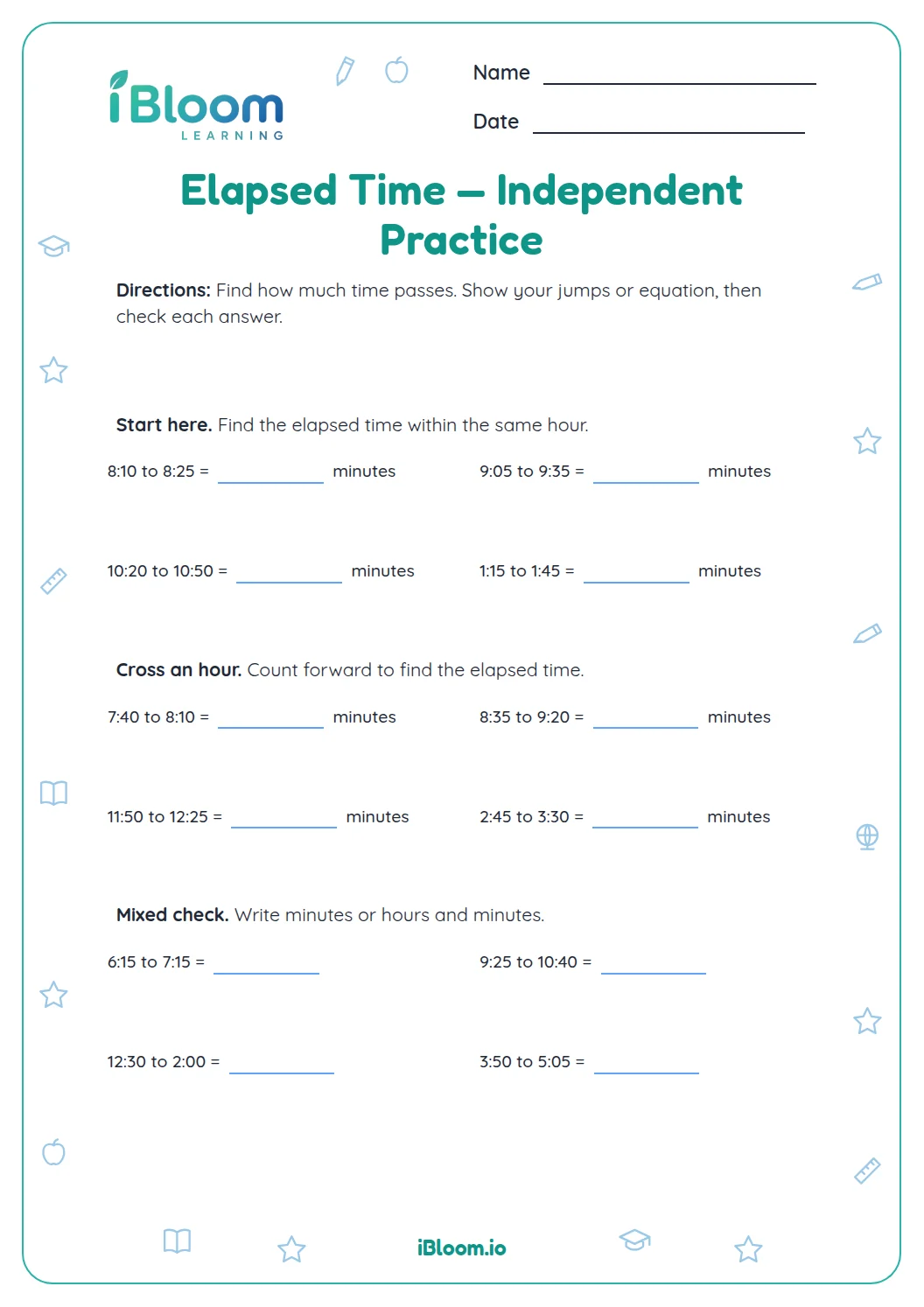
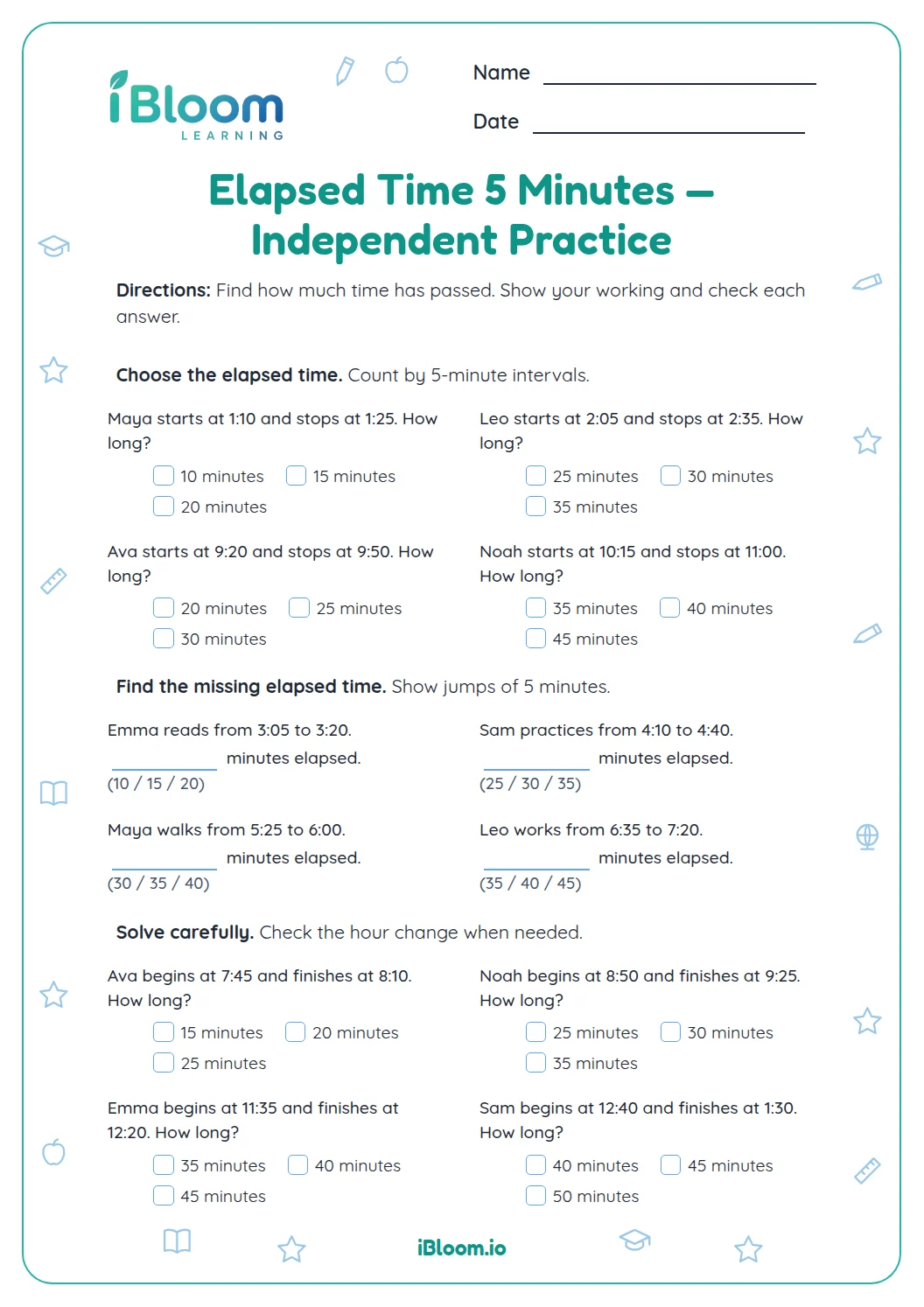
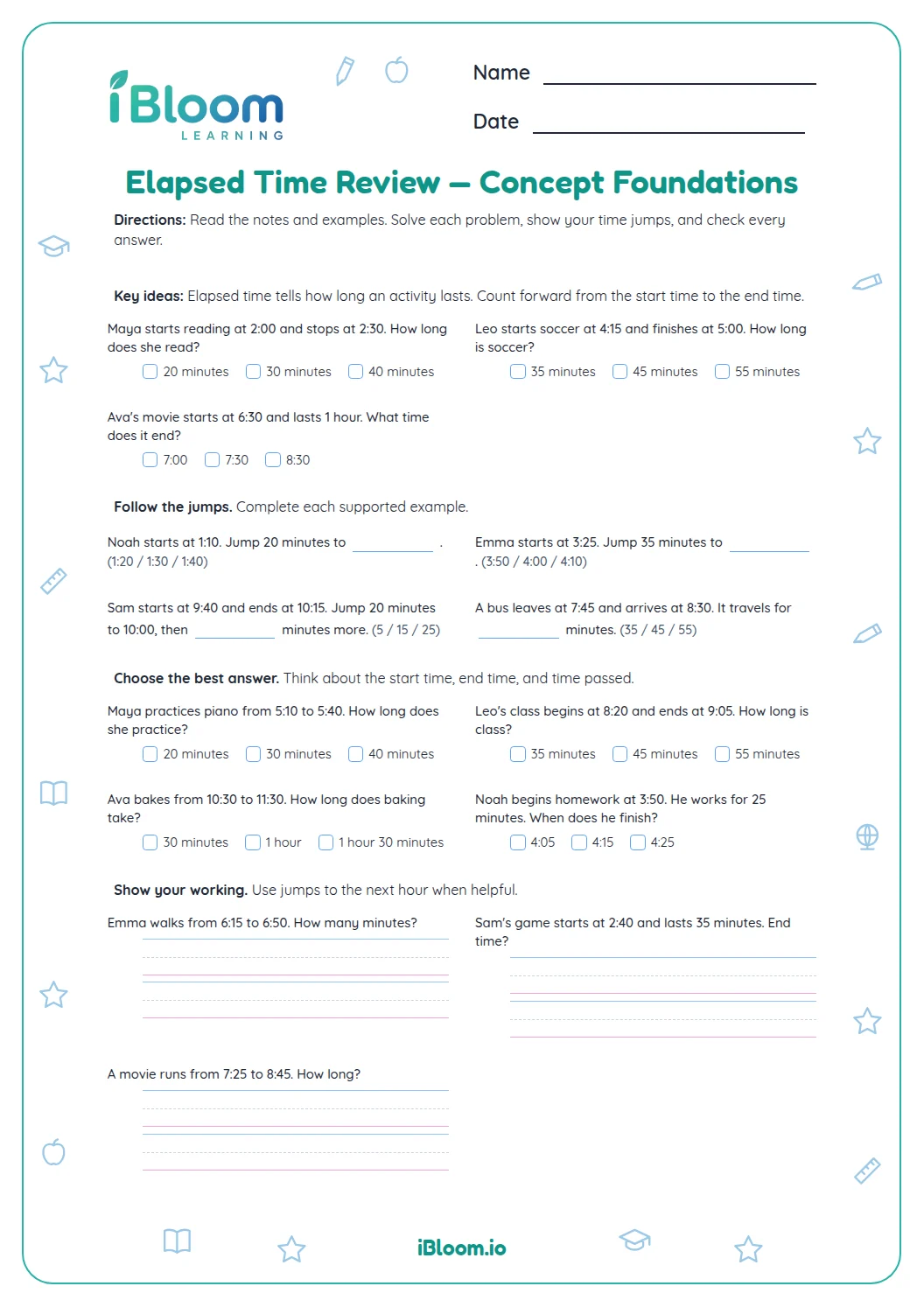
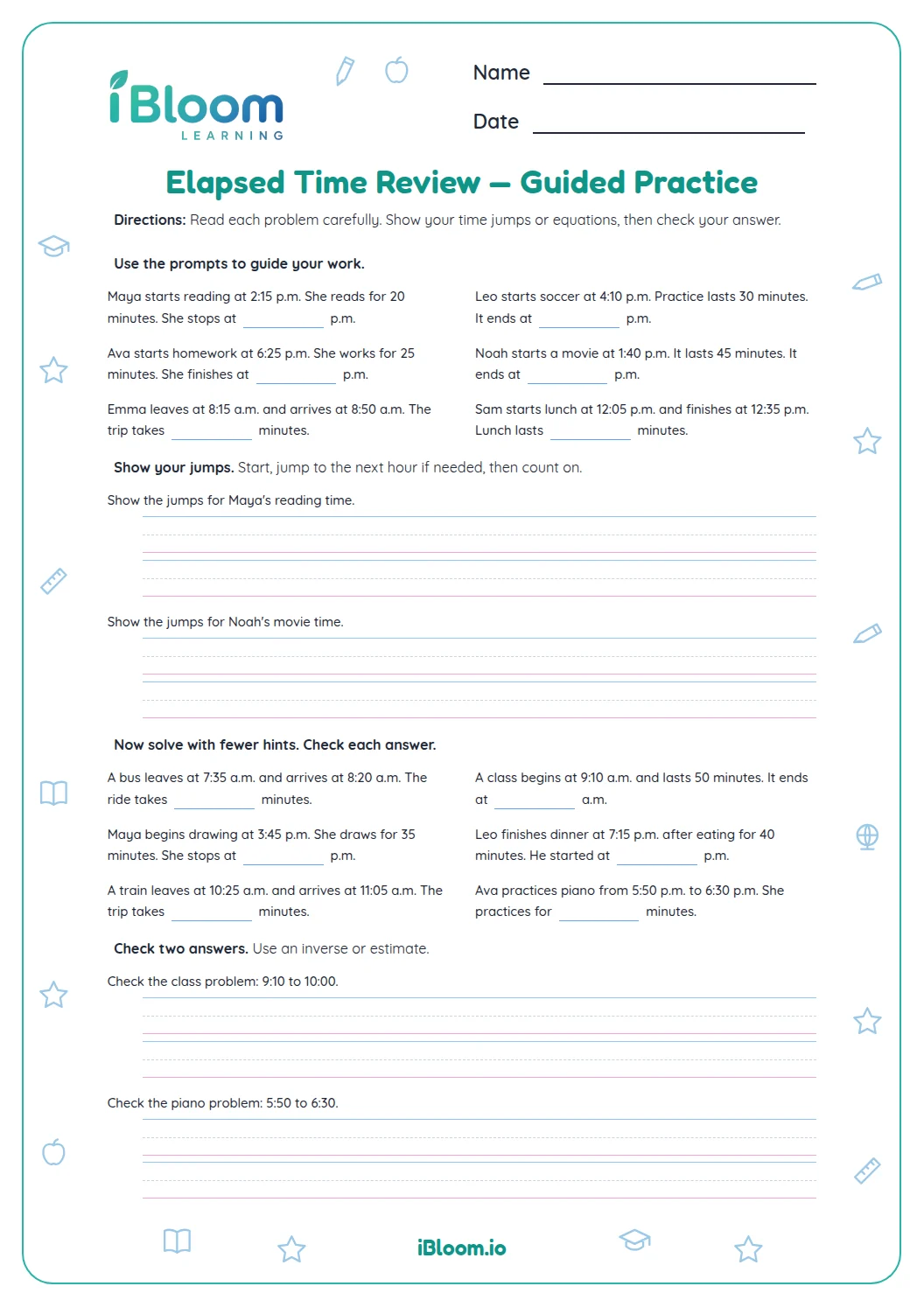
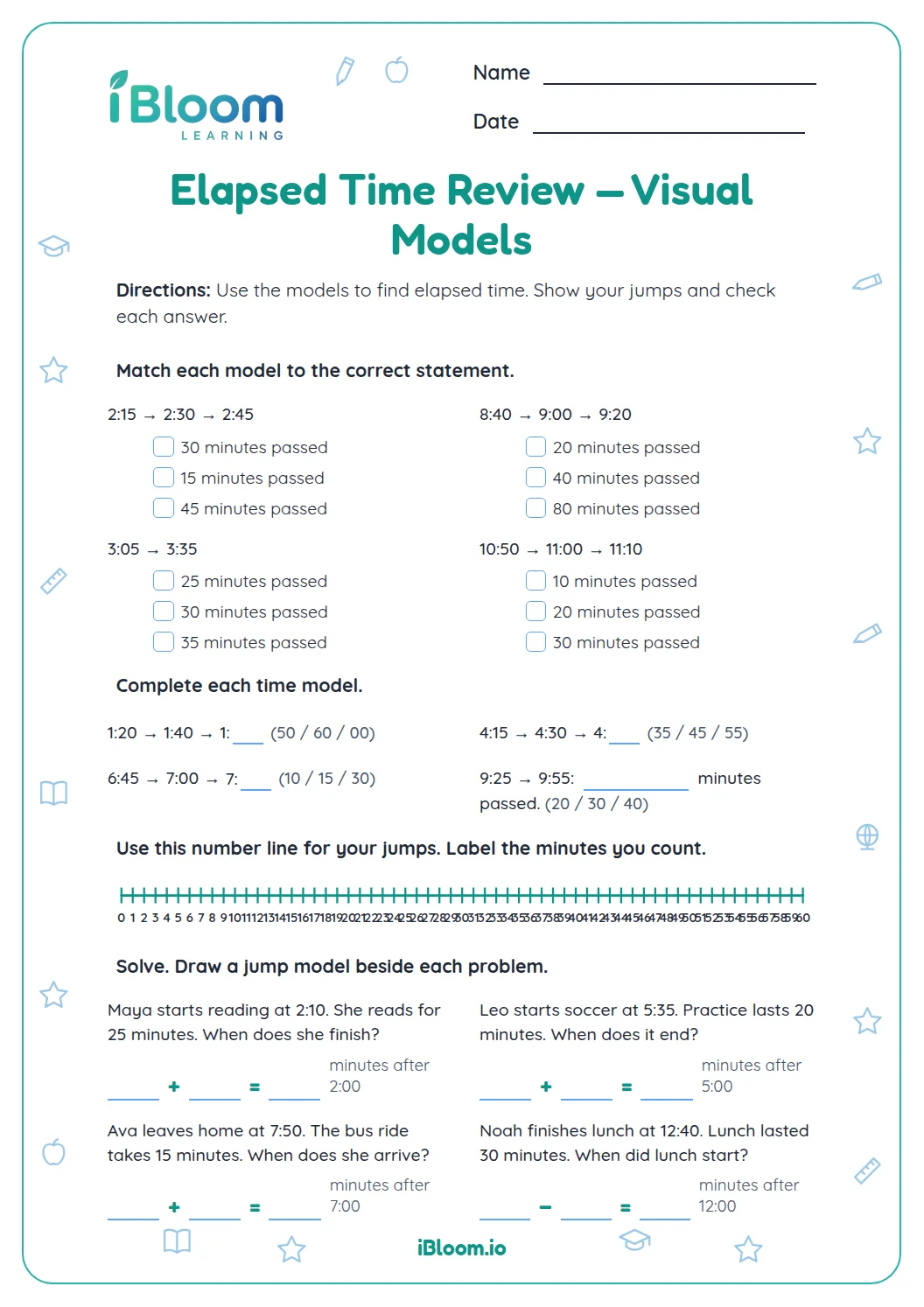
This Grade 3 worksheet has 14 real-world elapsed-time problems to the minute. Learners find durations, start and end times, and time remaining, including intervals that cross an hour. They can use time jumps to check answers with CCSS.MATH.CONTENT.3.MD.A.1.
Aligned to 3.MD.A.1
What does elapsed time measure?
Elapsed time is the amount of time between a start and an end. A time jump breaks that interval into manageable parts.
- 1From 2:46 to 3:00 is 14 minutes.
What situations appear on the page?
Questions use events and routines to ask for duration, end time, or start time. Some cross an hour, so careful minute jumps matter.
How can a learner check a time answer?
Add the elapsed minutes to the start or subtract them from the end. Check both the minutes and whether the hour changes.
How to use this worksheet
- 1Mark the start time and identify what the question asks.
- 2Jump to the next hour when that makes the minutes easier to count.
- 3Count the remaining minutes and combine the jumps.
- 4Write a.m. or p.m. when the situation provides it.
- 5Check by adding or subtracting the elapsed time.
Mistakes to watch for
The mistake
Forgetting to change the hour at 60 minutes.
The fix
Count to the hour first, then continue with the leftover minutes.
The mistake
Subtracting clock numbers without tracking minutes.
The fix
Use a time line with jumps rather than subtracting each display digit.
The mistake
Giving an end time when asked for a duration.
The fix
Circle the question’s target: duration, start time, or end time.
Common Core alignment
This page supports classroom practice in solve elapsed-time story problems.
Measure and solve time intervals in minutes
On this sheet: Measure and solve time intervals in minutes
Show the official wordingHide the official wording
Tell and write time to the nearest minute and measure time intervals in minutes. Solve word problems involving addition and subtraction of time intervals in minutes, e.g., by representing the problem on a number line diagram.
What to practice next
Make more practice
Further reading
Questions parents and teachers ask
What kinds of elapsed-time problems are included?
The 14 problems ask learners to find a duration, an end time, a missing start time, or remaining time. Several intervals cross an hour. The final items ask learners to correct an end-time error or compare an interval with a stated number of minutes.
How can a time jump help with elapsed time?
Start at the earlier time and count forward in useful steps. From 2:46 to 3:00 is 14 minutes; 13 more minutes reaches 3:13. Combining the jumps gives 27 minutes. Counting to the next hour first can make minute intervals easier to track.
How can I check an end-time answer?
Add the elapsed minutes to the start time using a time line or jumps. Check whether the minutes pass 60 and increase the hour when they do. For a duration question, count from the start to the end and combine the jumps.
What does the worksheet mean by “time remains”?
Subtract the time already used from the total time available. In the project problem, 50 minutes are available and 33 minutes have passed from 12:35 to 1:08, so 17 minutes remain. The answer key also shows sample reasoning for explanation questions.
Can a learner solve these without a clock picture?
Yes. Each problem provides the start time, end time, or duration needed, and the equations space is available for showing time jumps. A learner may sketch a number line or write intermediate times such as the next hour to keep the minutes organized.