



About this worksheet
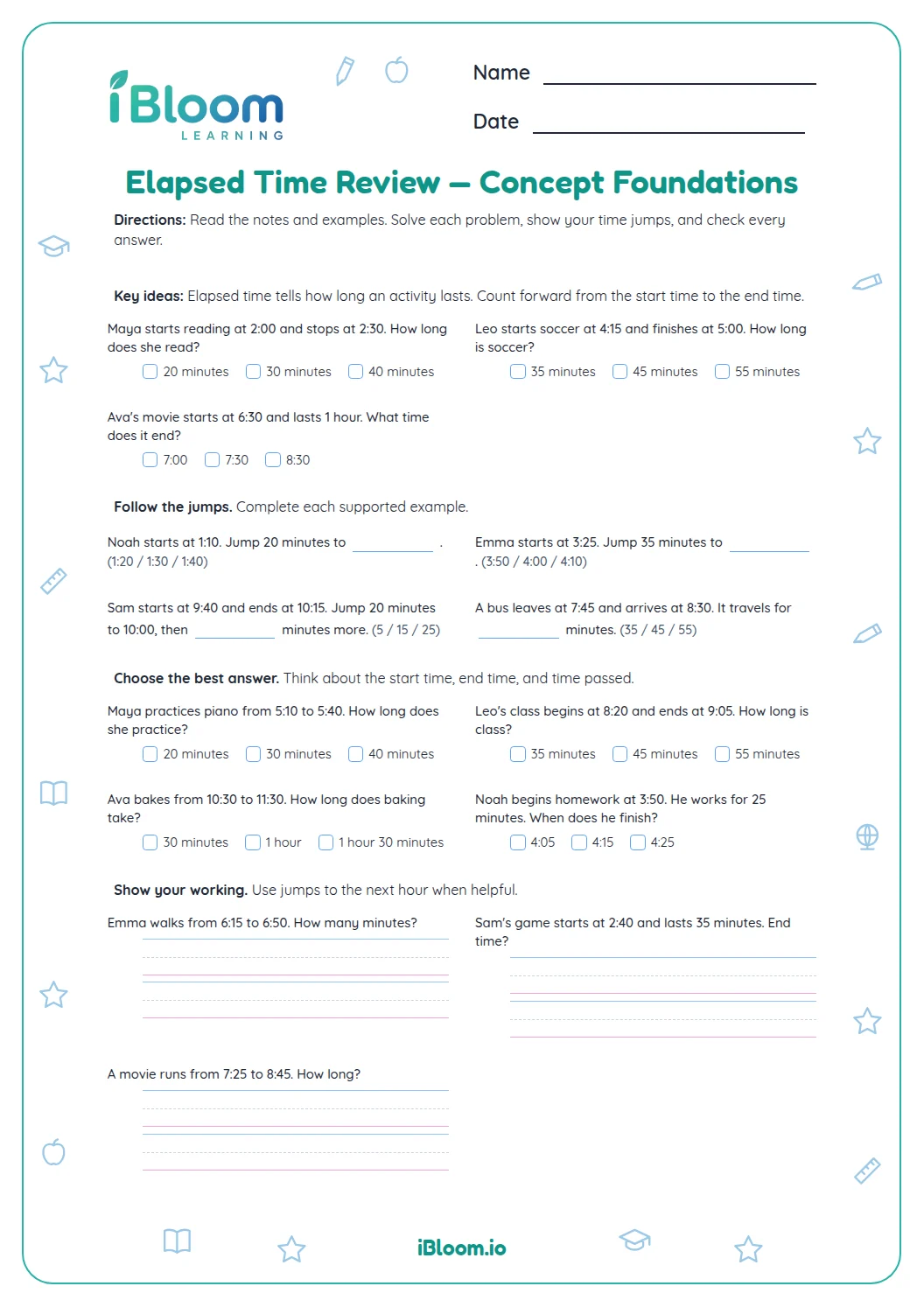
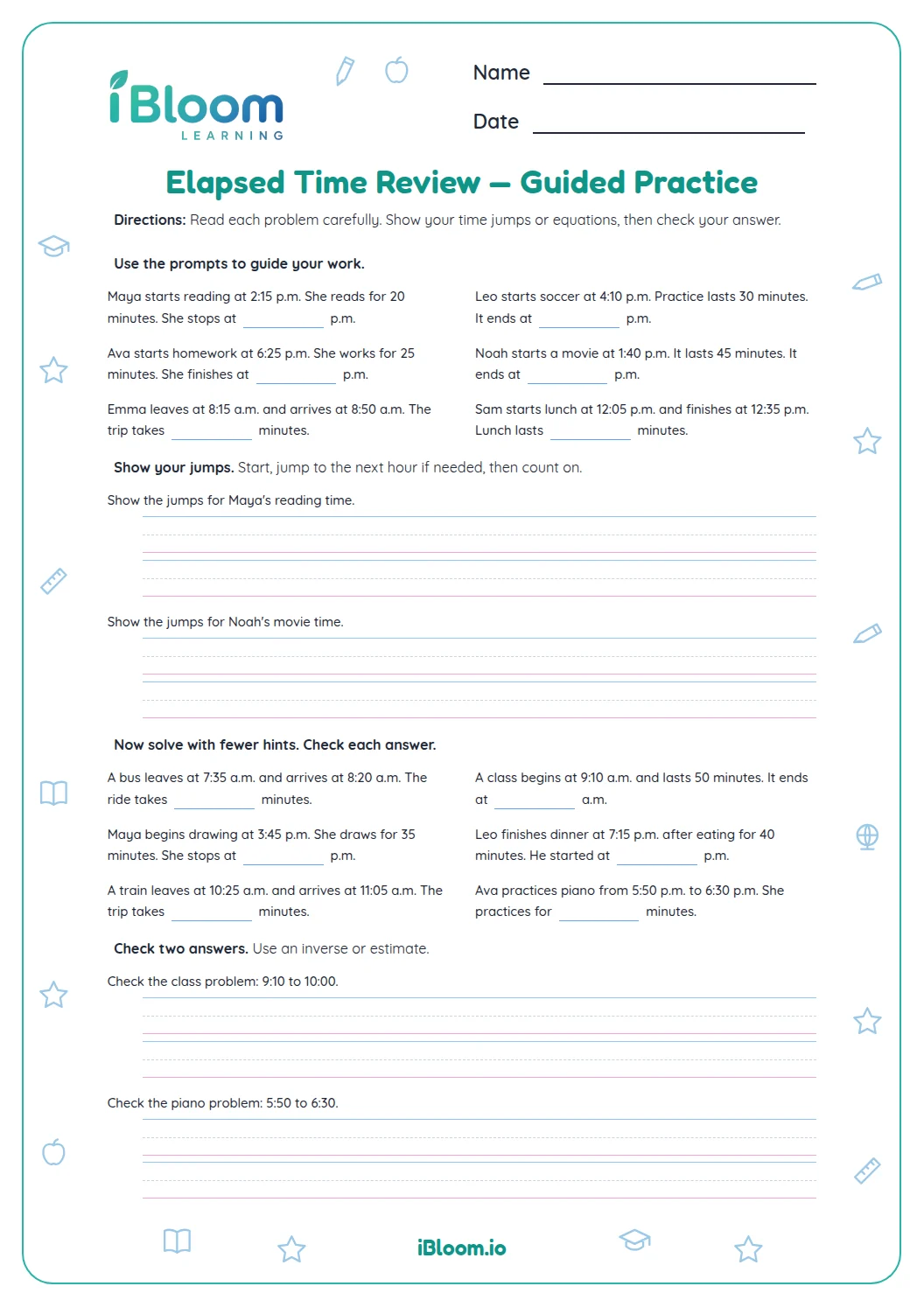
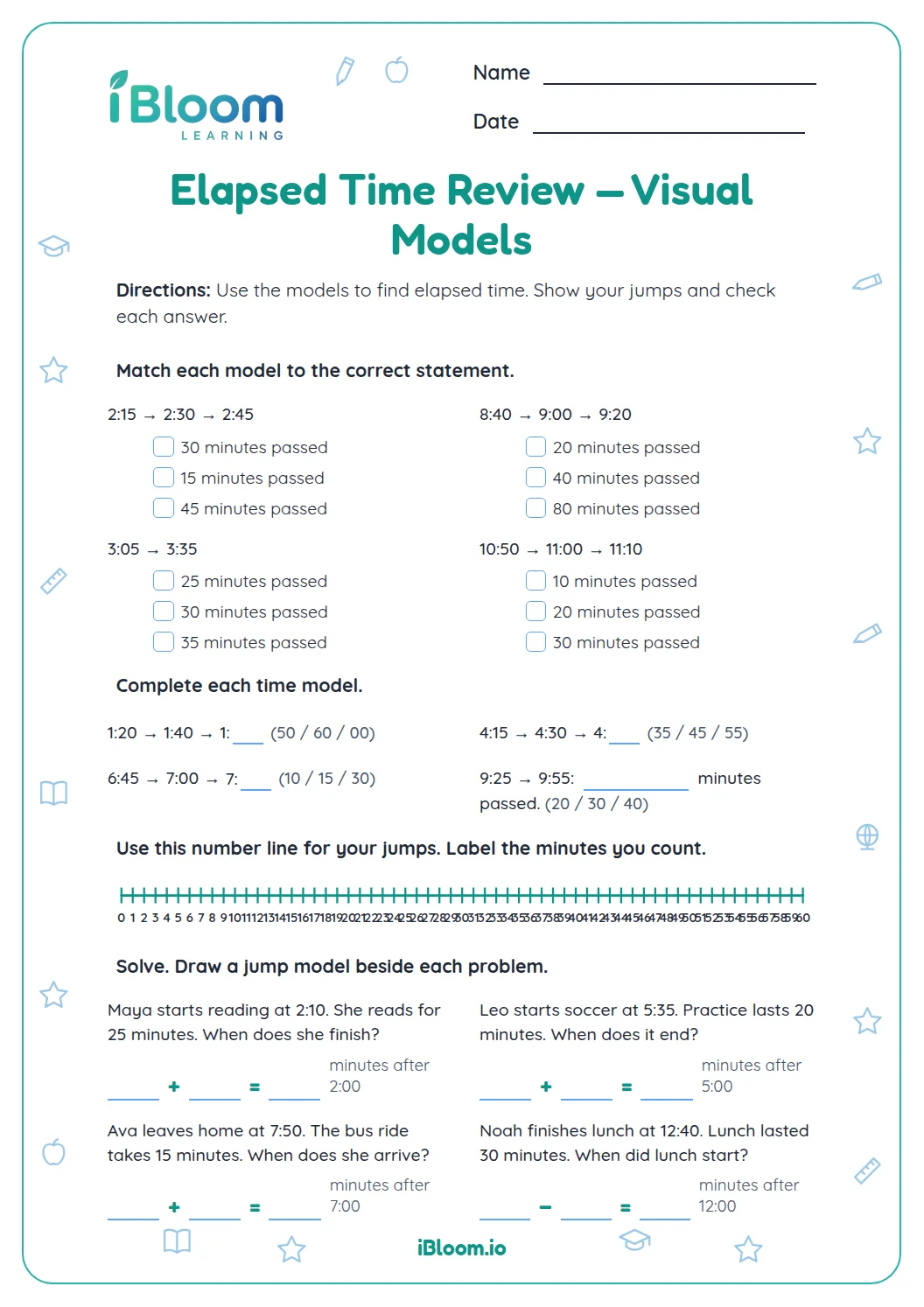
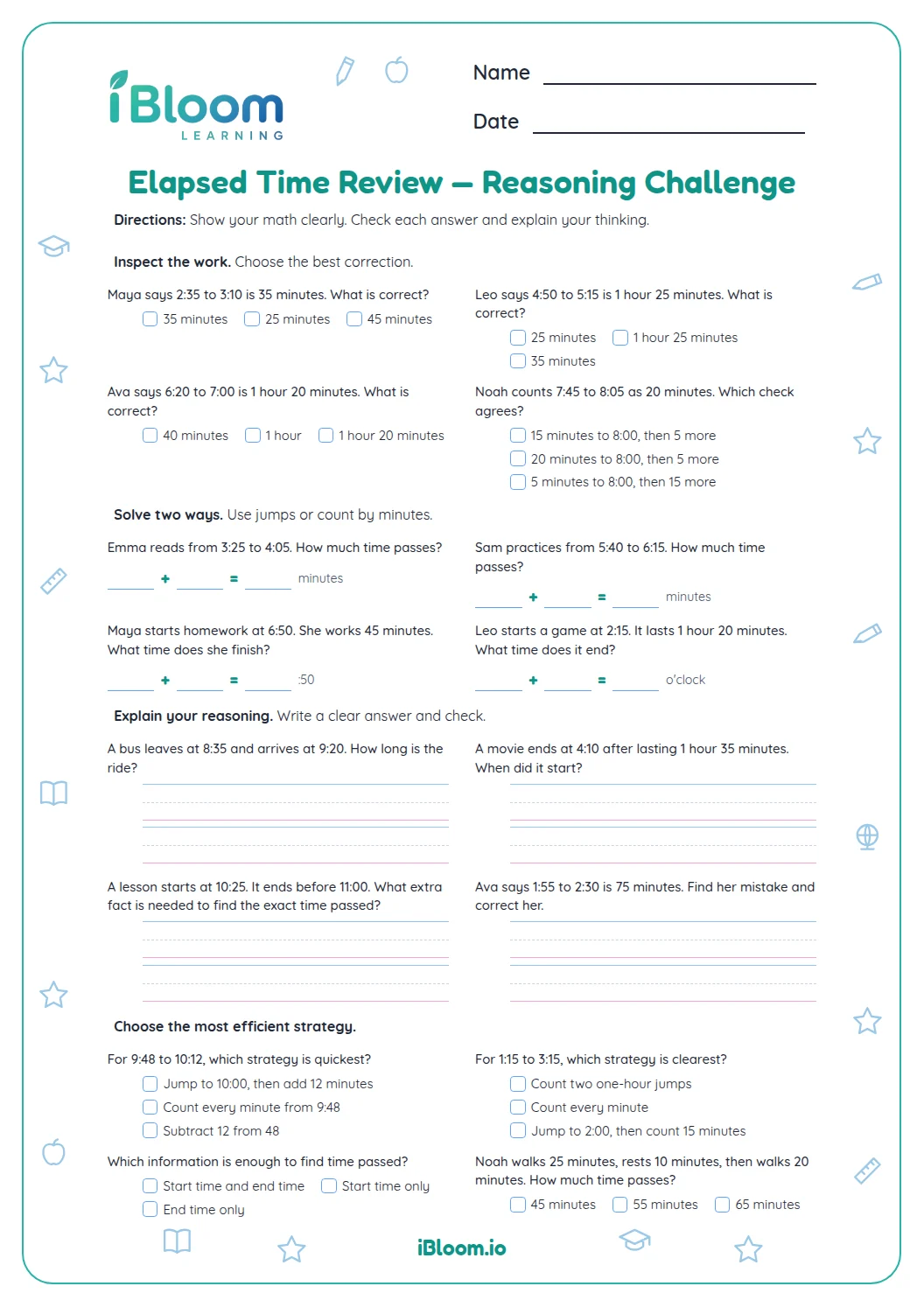
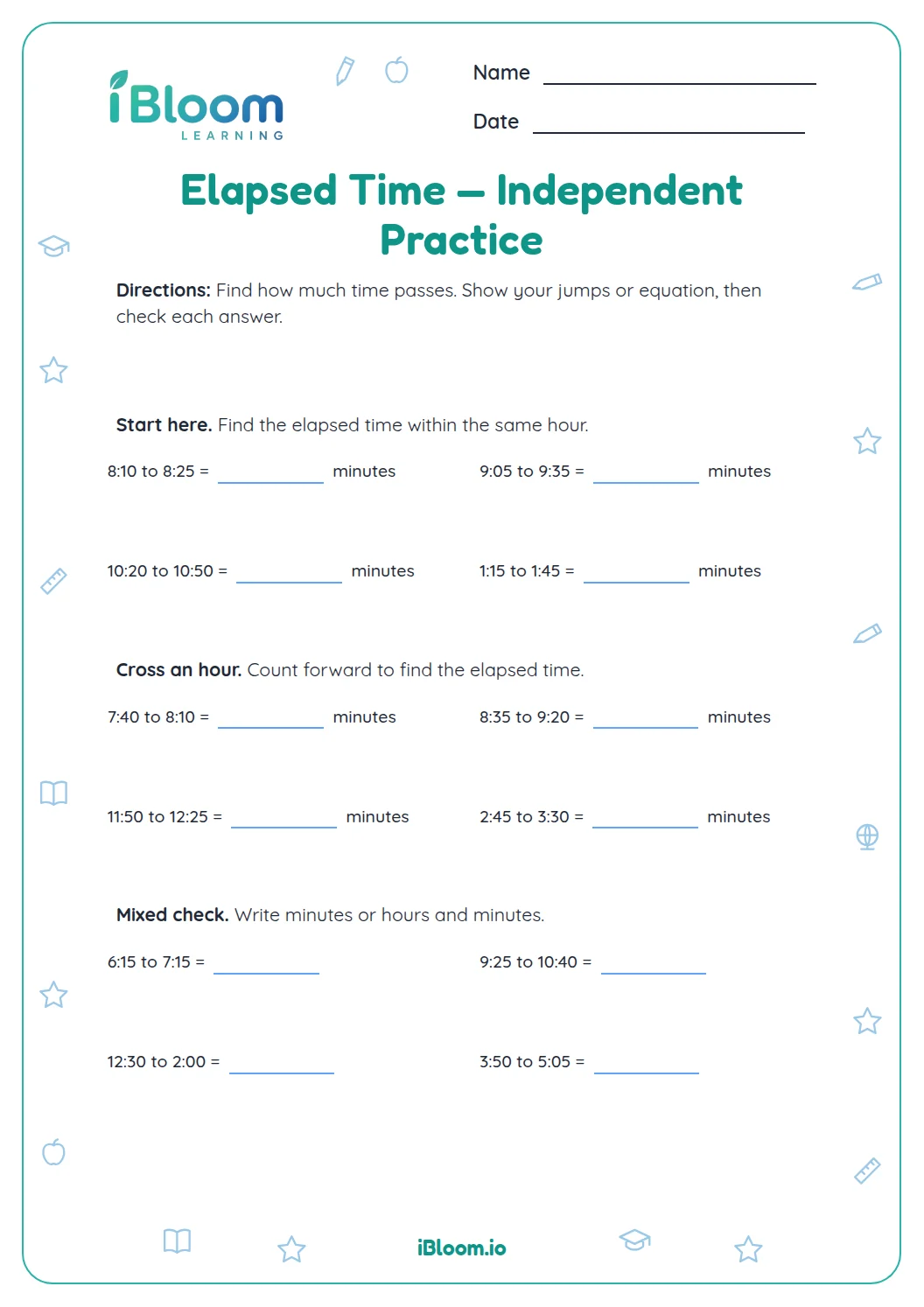
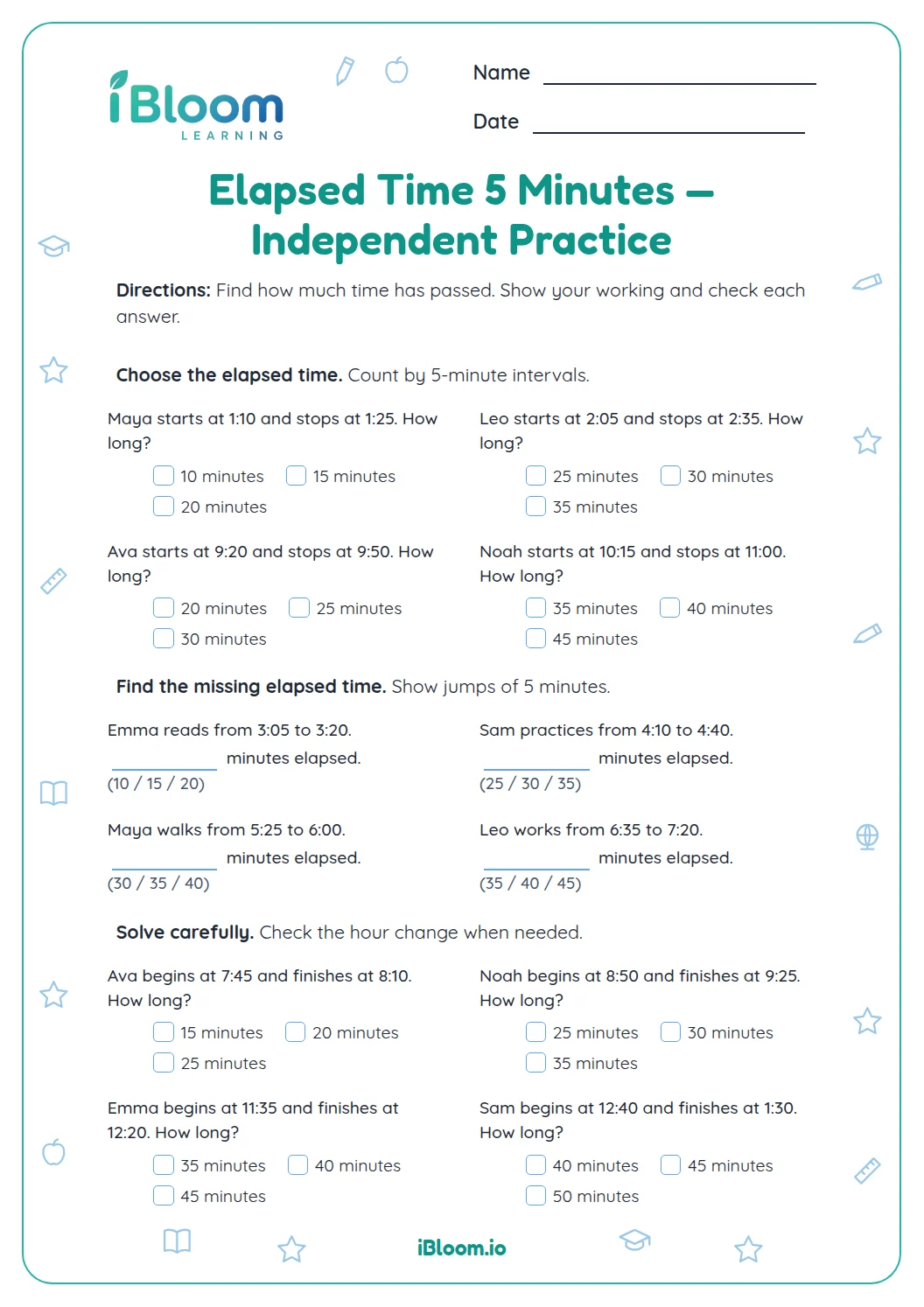
The questions read clocks and solve time intervals in minutes, including jumps across an hour.
Aligned to 3.MD.A.1
What does this worksheet practice?
The questions read clocks and solve time intervals in minutes, including jumps across an hour.
Read analog clocks, find ending times, and calculate elapsed minutes in everyday situations.
- Analog clock readings
- Ending times from a start and duration
- Elapsed minutes from start and end
How can students approach the questions?
Review how the minute hand moves around the clock.
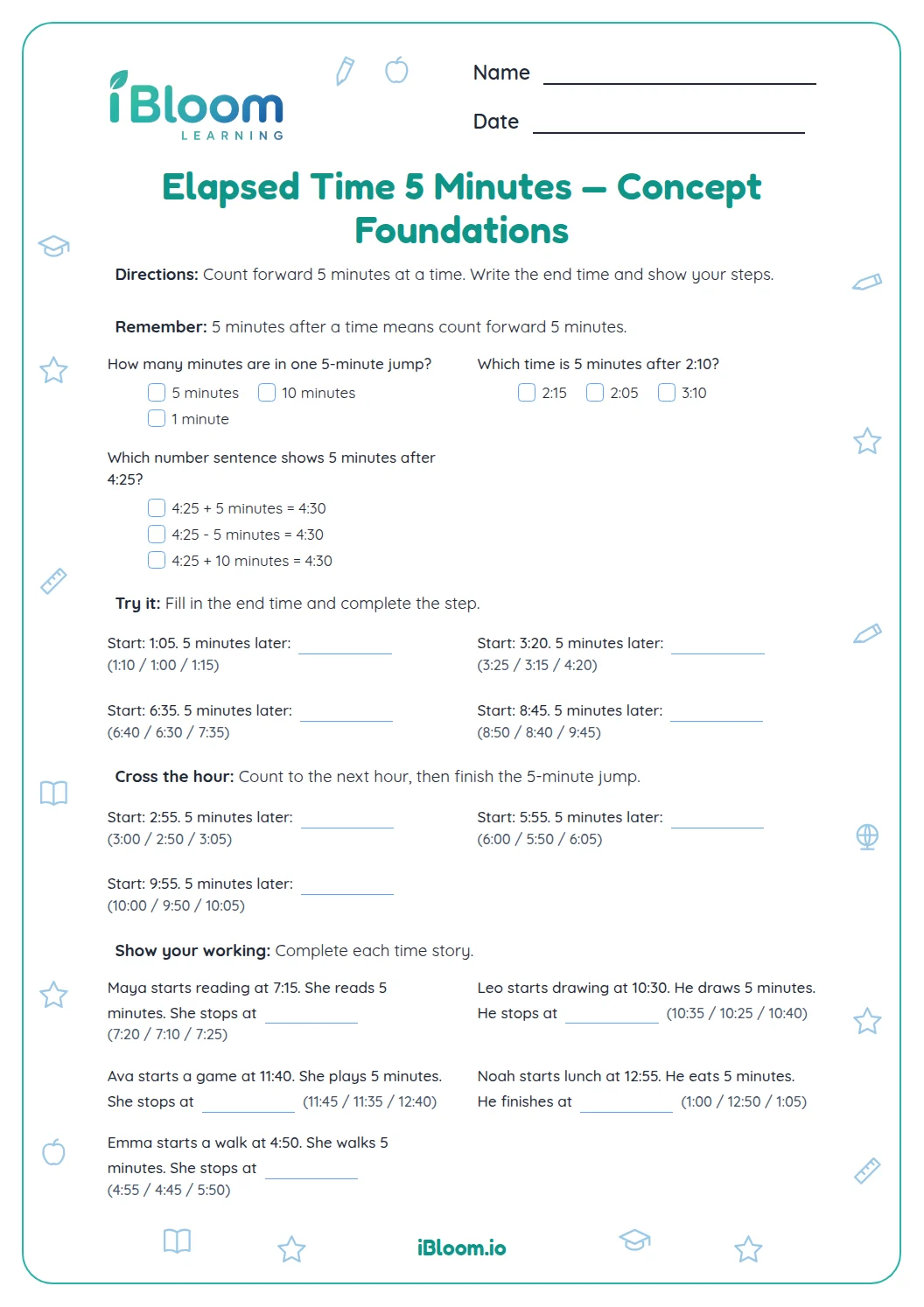
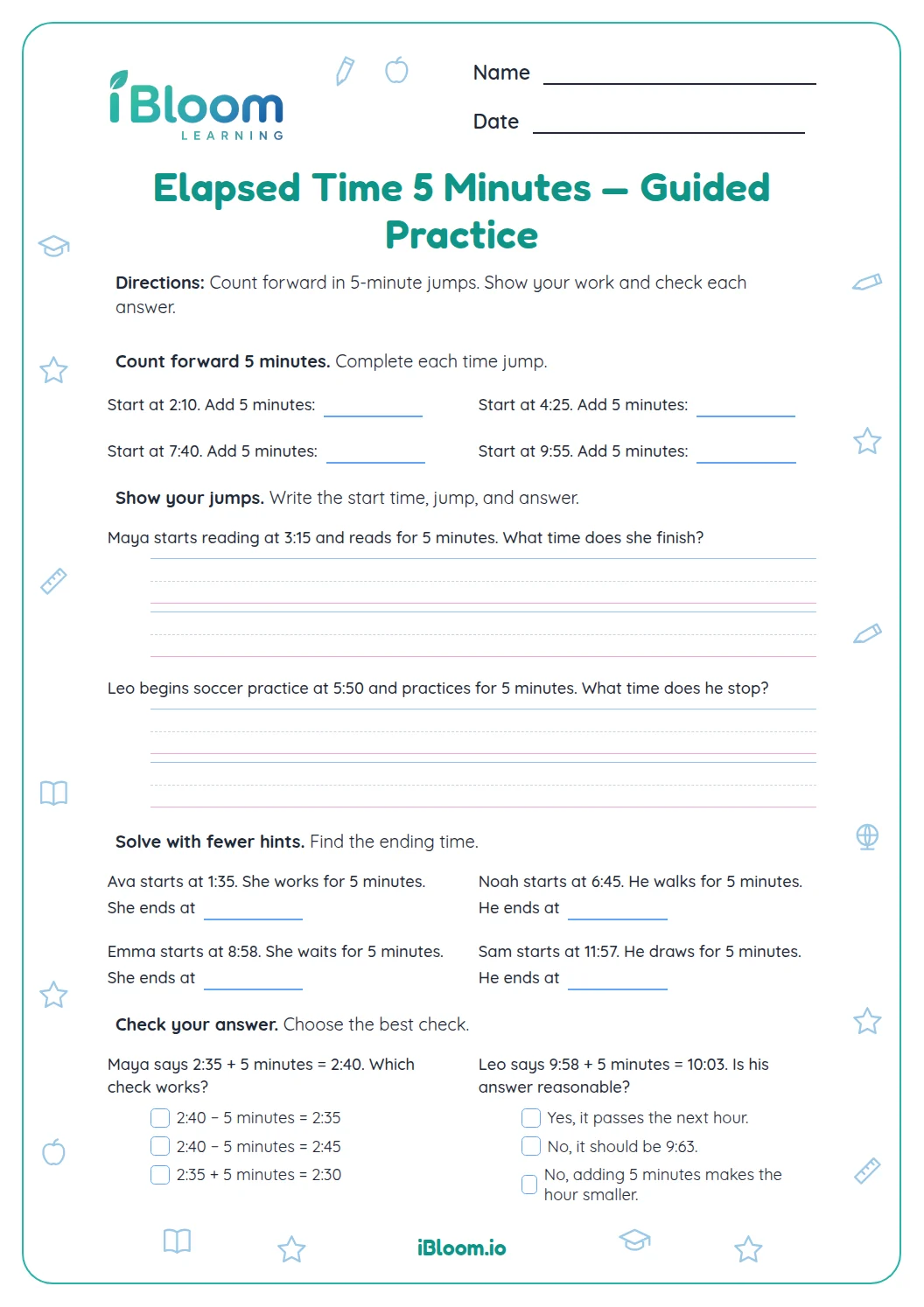
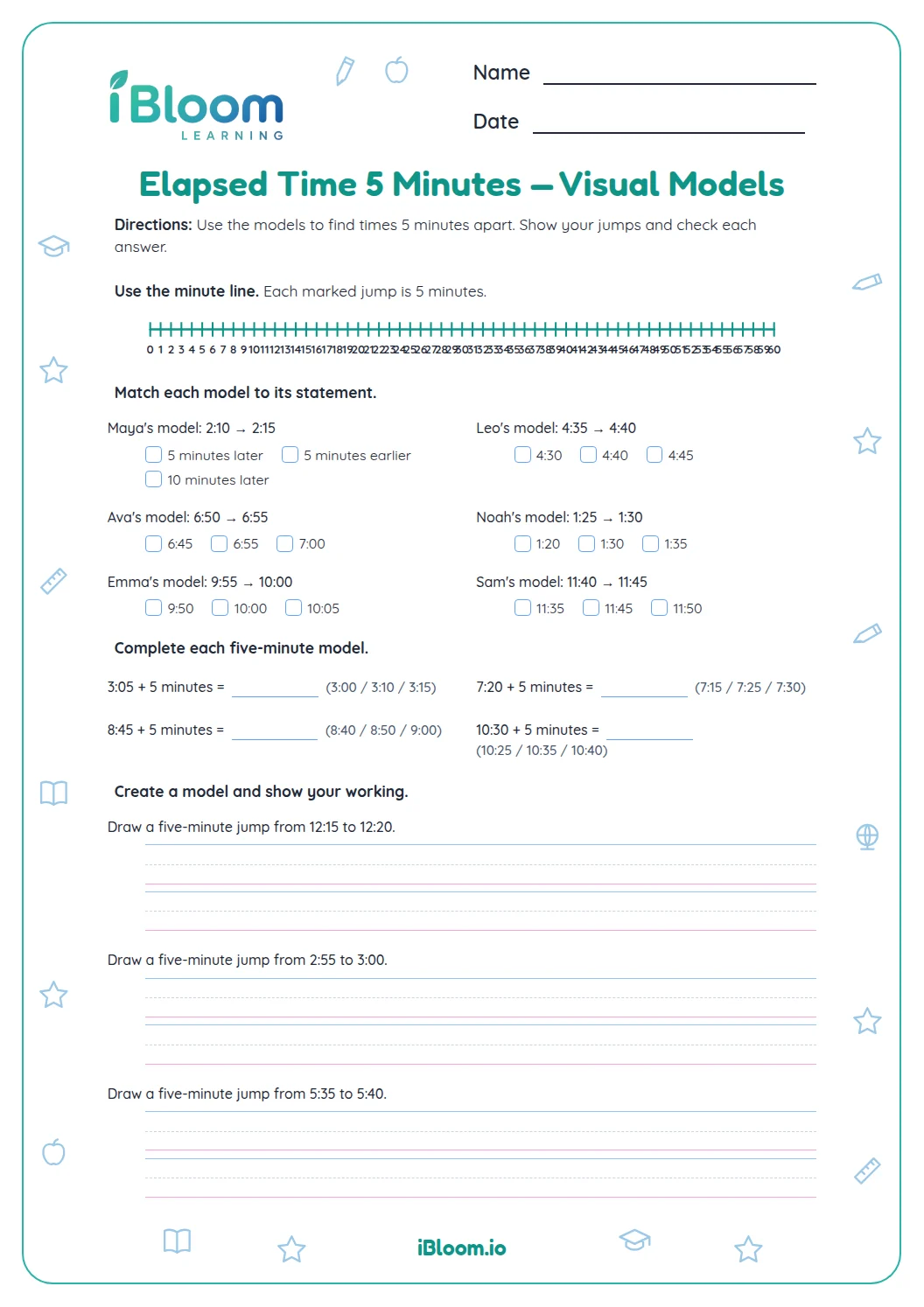
For ending times, mark the start and count forward by the given minutes.
How can students check their work?
For elapsed time, count to the next hour, then add the remaining minutes.
How to use this worksheet at home or in class
- 1Review how the minute hand moves around the clock.
- 2For ending times, mark the start and count forward by the given minutes.
- 3For elapsed time, count to the next hour, then add the remaining minutes.
Common mistakes and quick fixes
The mistake
Reading the short hour hand as the minute hand.
The fix
Find the short hour hand first, then read the long minute hand.
The mistake
Treating 1:50 plus 20 minutes as 1:70.
The fix
Count 10 minutes to 2:00, then 10 more to 2:10.
The mistake
Writing elapsed minutes as a clock time.
The fix
Check whether the question asks for an interval or an ending time.
Curriculum alignment
This page practices the named skill at the listed grade level.
Read analog clocks, find ending times, and calculate elapsed minutes in everyday situations.
On this sheet: Read analog clocks, find ending times, and calculate elapsed minutes in everyday situations.
Show the official wordingHide the official wording
Tell and write time to the nearest minute and measure time intervals in minutes. Solve word problems involving addition and subtraction of time intervals in minutes, e.g., by representing the problem on a number line diagram.
What to practice next
Further reading
Questions parents and teachers ask
What kinds of time problems are included?
Students read four analog clocks, find ending times from a start time and duration, and calculate elapsed minutes when both a start and end are given. The word problems use minute intervals and include examples that cross into the next hour.
What grade is this worksheet for?
This page is written for Grade 3 and aligns with CCSS 3.MD.A.1. That standard includes telling time to the nearest minute and solving addition and subtraction problems about time intervals in minutes. The worksheet practices both reading a clock and reasoning about how many minutes pass.
How can students count across an hour?
Count the minutes from the start time to the next hour first. Then count the remaining minutes to the end time and add both jumps. For example, from 2:45 to 3:20 is 15 minutes to 3:00 plus 20 more minutes, or 35 minutes.
Is an answer key included?
Yes. A separate answer key lists each clock reading, ending time, and elapsed-time answer. Students can check an interval by adding those minutes to the start time and making sure they reach the given end time. This reverse check helps catch counting slips across an hour.