

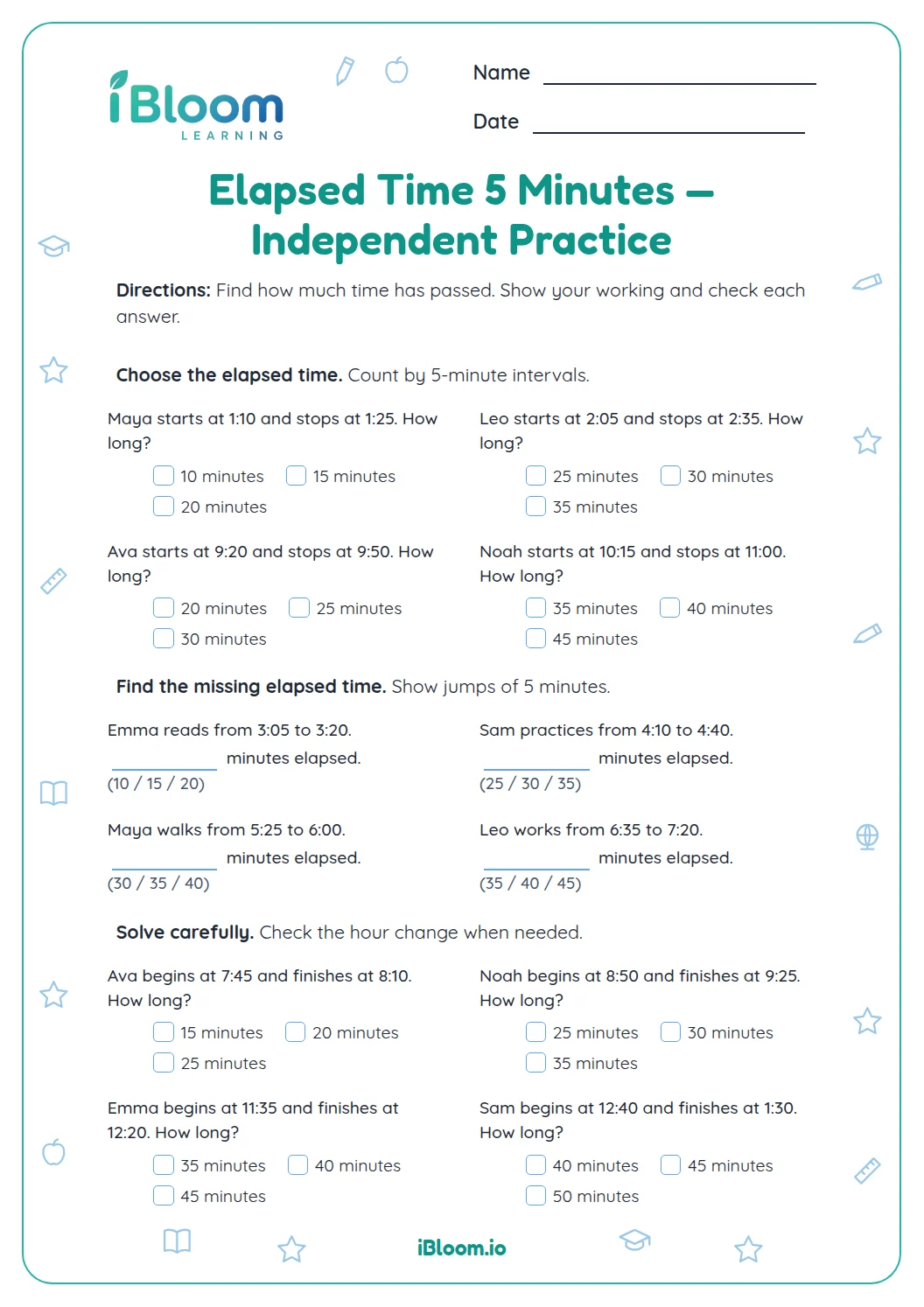


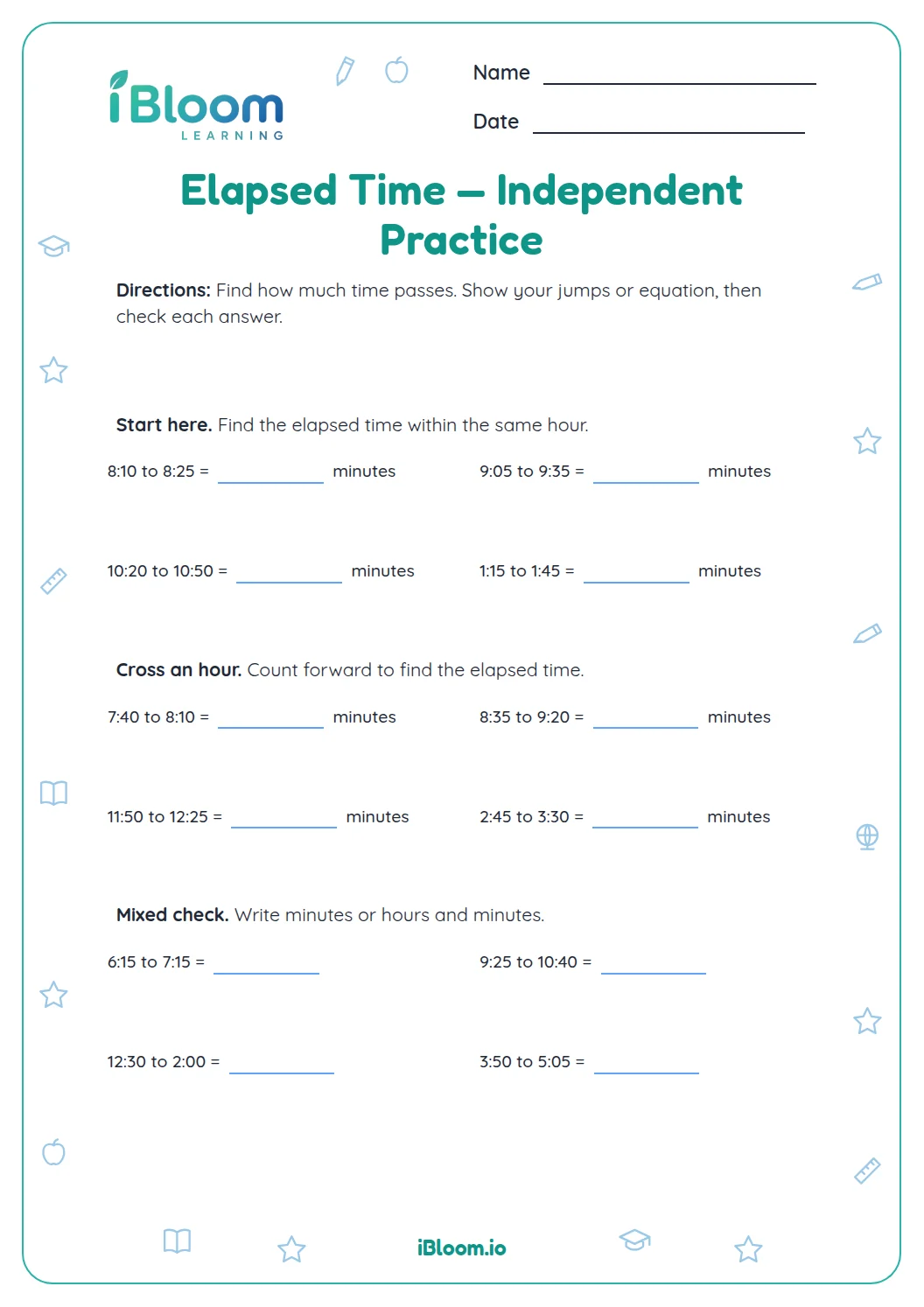
About this worksheet
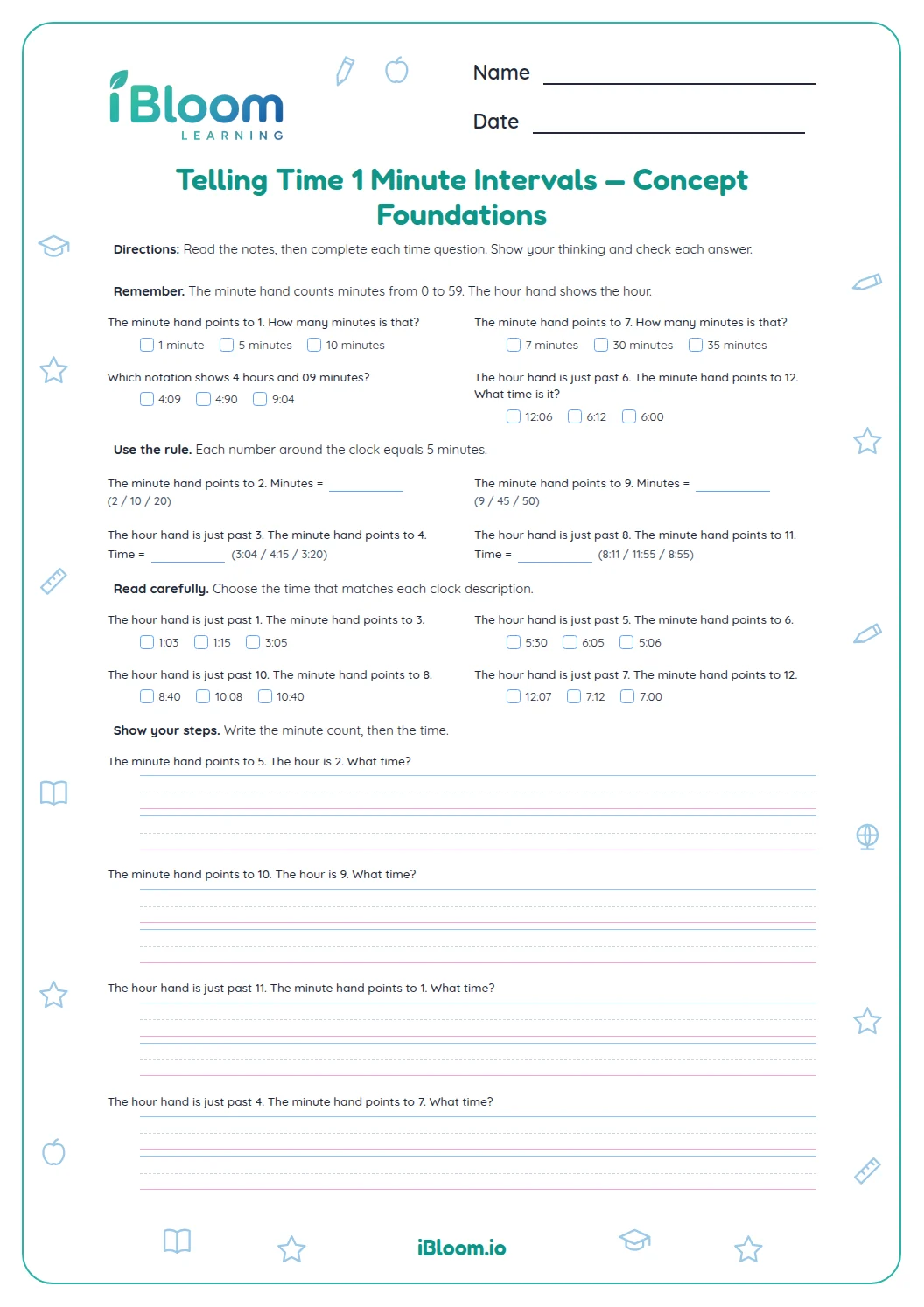
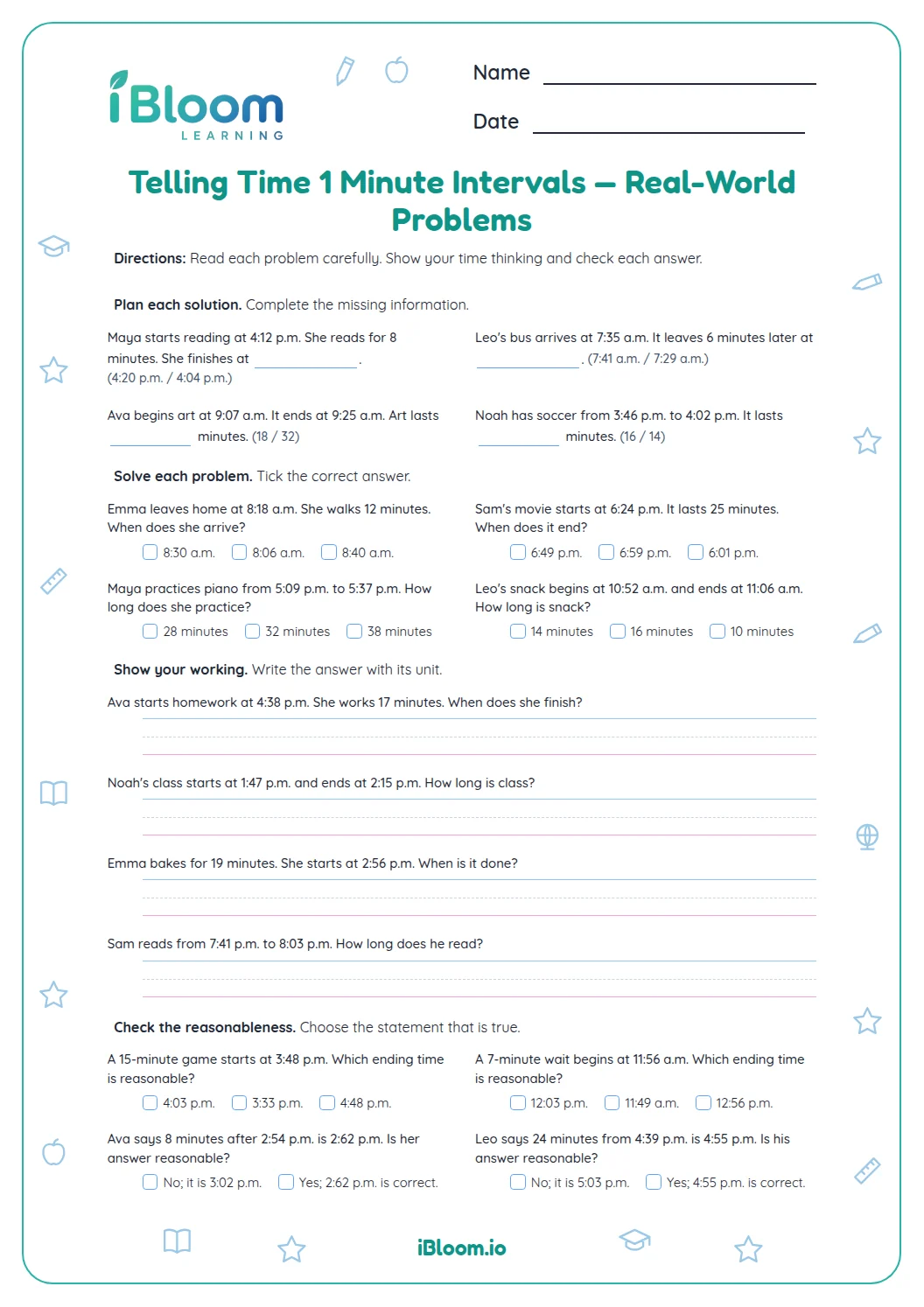
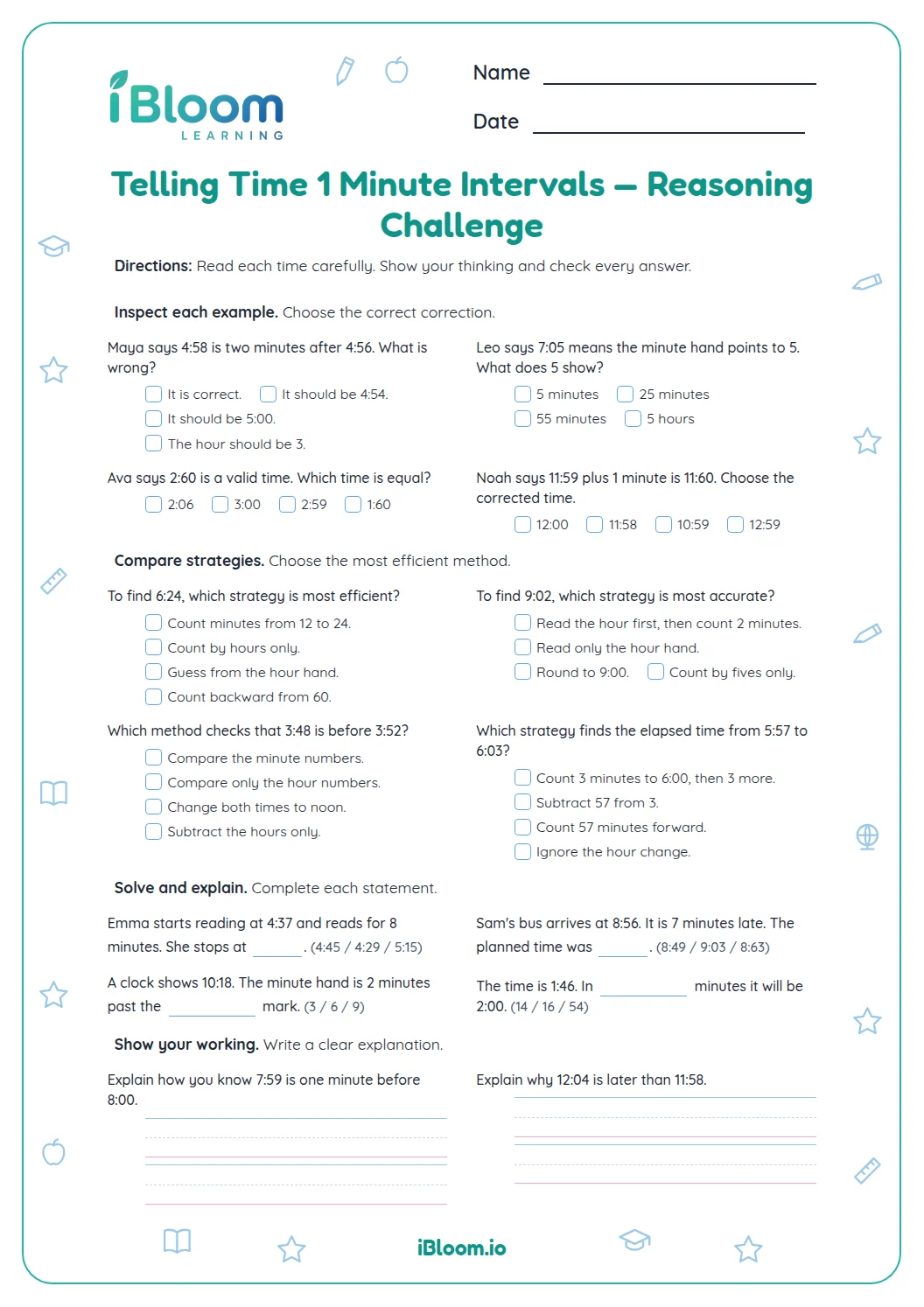
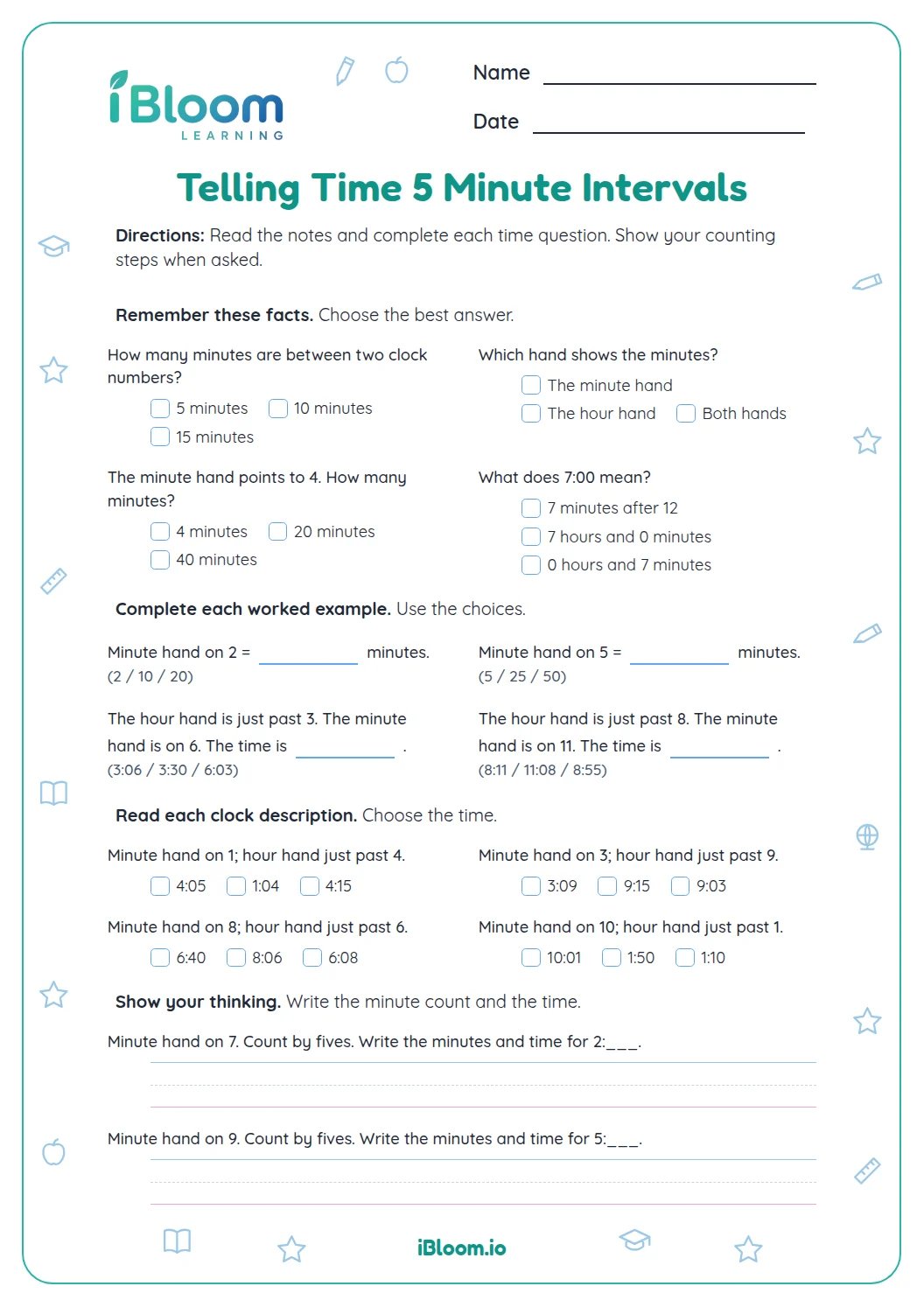
This Grade 3 worksheet practices reading analog clocks to the nearest minute and reasoning about minute intervals. Learners read clock models, interpret exact hand clues, and solve six concise time-change or elapsed-minute questions. The answer key lists each time and interval.
Aligned to 3.MD.A.1
How do you read an analog clock to the minute?
The long hand points to the minute. Count each numbered interval by five, then count the small marks between numbers one at a time. The short hand tells which hour is underway. For example, at 2:17, the minute hand is two marks past the 3.
How can a clock help with adding minutes?
Move forward one minute at a time, or count to a helpful landmark such as the next hour. If a clock reads 3:18 and 7 minutes pass, count 2 minutes to 3:20, then 5 more to 3:25.
- 1Clock reads 3:18; find 7 minutes later.
- 2Count 2 minutes to 3:20.
- 3Count 5 more minutes: 3:25.
- 4Answer: 3:25
What is in each part?
Part A shows clock models and exact hand clues. Part B has six short time changes or elapsed-minute questions. Each clock model displays its minute hand for direct reading.
How to use this worksheet
- 1Find the short hand to identify the hour.
- 2Start at 12 and count by fives around the clock for the long hand.
- 3Count individual minute marks between numbered positions.
- 4For a time change, count forward or backward and cross the hour carefully.
- 5Write the time with a colon or state an interval with minutes.
Common mistakes and quick fixes
The mistake
Reading the number under the minute hand as the minute count.
The fix
Count by fives from 12, then add any single marks.
The mistake
Mixing up the hour and minute hands.
The fix
Use the shorter hand for the hour and the longer hand for minutes.
The mistake
Stopping at 60 minutes instead of changing the hour.
The fix
After 5:59 comes 6:00; continue counting with the new hour.
Curriculum alignment
This practice connects the worksheet tasks with the listed learning standard.
Tell and write time to the nearest minute and work with minute intervals.
On this sheet: Learners read minute-marked clocks and solve short addition and subtraction problems with minutes.
Show the official wordingHide the official wording
Tell and write time to the nearest minute and measure time intervals in minutes. Solve word problems involving addition and subtraction of time intervals in minutes, e.g., by representing the problem on a number line diagram.
What to practice next
Make more practice
Further reading
Questions parents and teachers ask
What does “to the nearest minute” mean?
To the nearest minute means reading the minute hand at an individual minute mark rather than rounding to five-minute steps. This sheet includes exact-minute clues such as 2:17 and 4:43. Have the learner count from 12 and explain how the minute hand shows the exact minute. Learners count the individual marks between the numbered positions.
How many questions are on the page?
There are 14 questions: eight clock readings and six time changes or elapsed-minute questions. Learners read minute ticks on clock models, interpret precise hand clues, then count forward, backward, or between two times. The answer key lists each result for checking.
How do I read the minute hand?
Each numbered position represents five minutes, and the small marks between numbers count one minute each. The long hand shows minutes; the short hand shows the hour underway. Start at 12, count by fives, and then count individual marks to the long hand.
How should a child count across an hour?
Count to the next hour, then continue with the remaining minutes. For example, 12 minutes after 8:53 is 9:05: seven minutes reach 9:00 and five more reach 9:05. Keep track of the hour as the minutes pass 60.
What is a common clock-reading mistake?
A common slip is using the short hour hand to read minutes or reading the number at the long hand as the minute count. Check which hand is longer, count by fives around the clock, and add the single marks between numbered positions.
Is an answer key included?
Yes. The separate answer key gives the time shown by each analog clock and the results of the time-change questions. It can help identify whether a missed response came from reading a hand or counting the elapsed minutes.