







About this worksheet
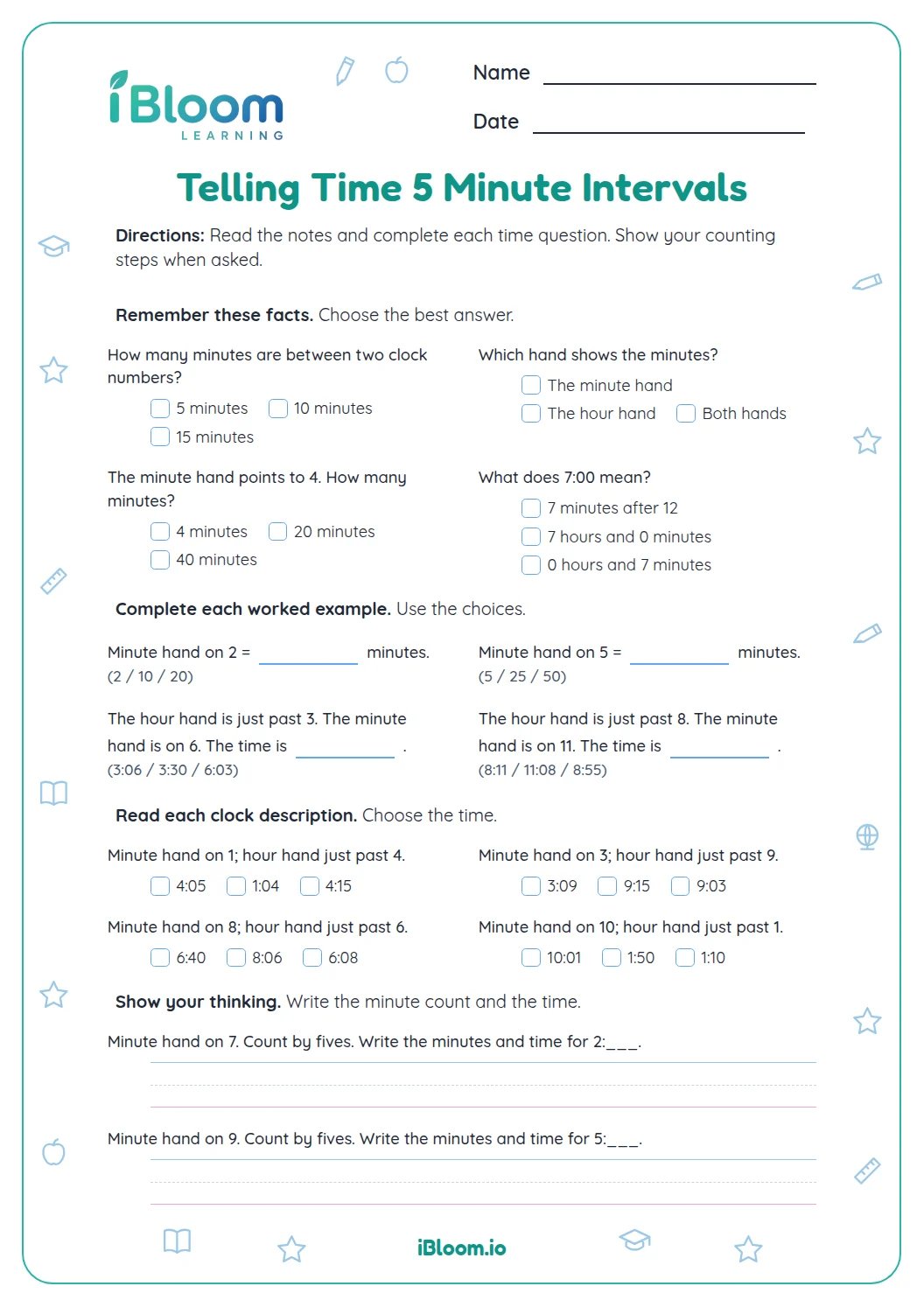
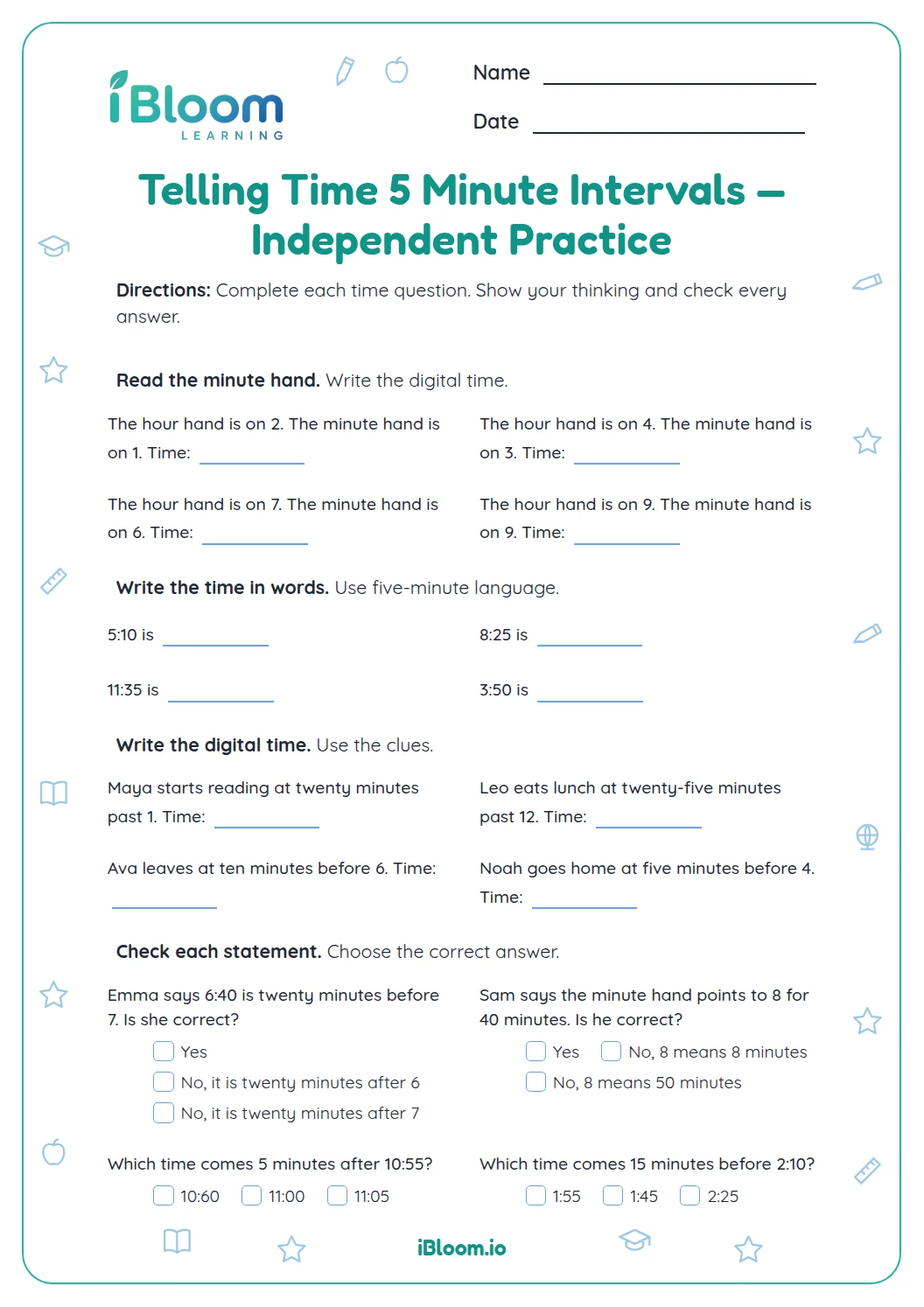
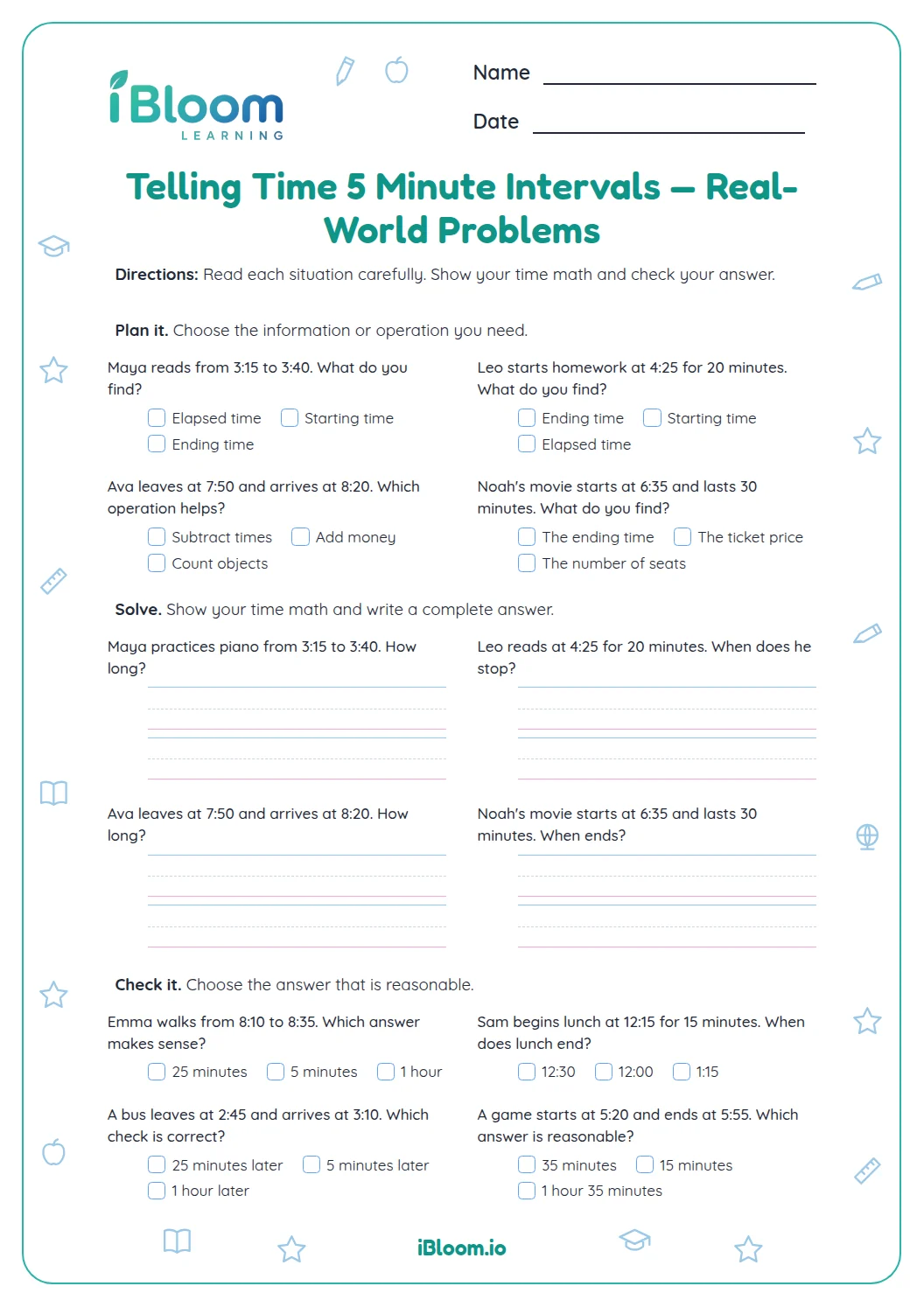
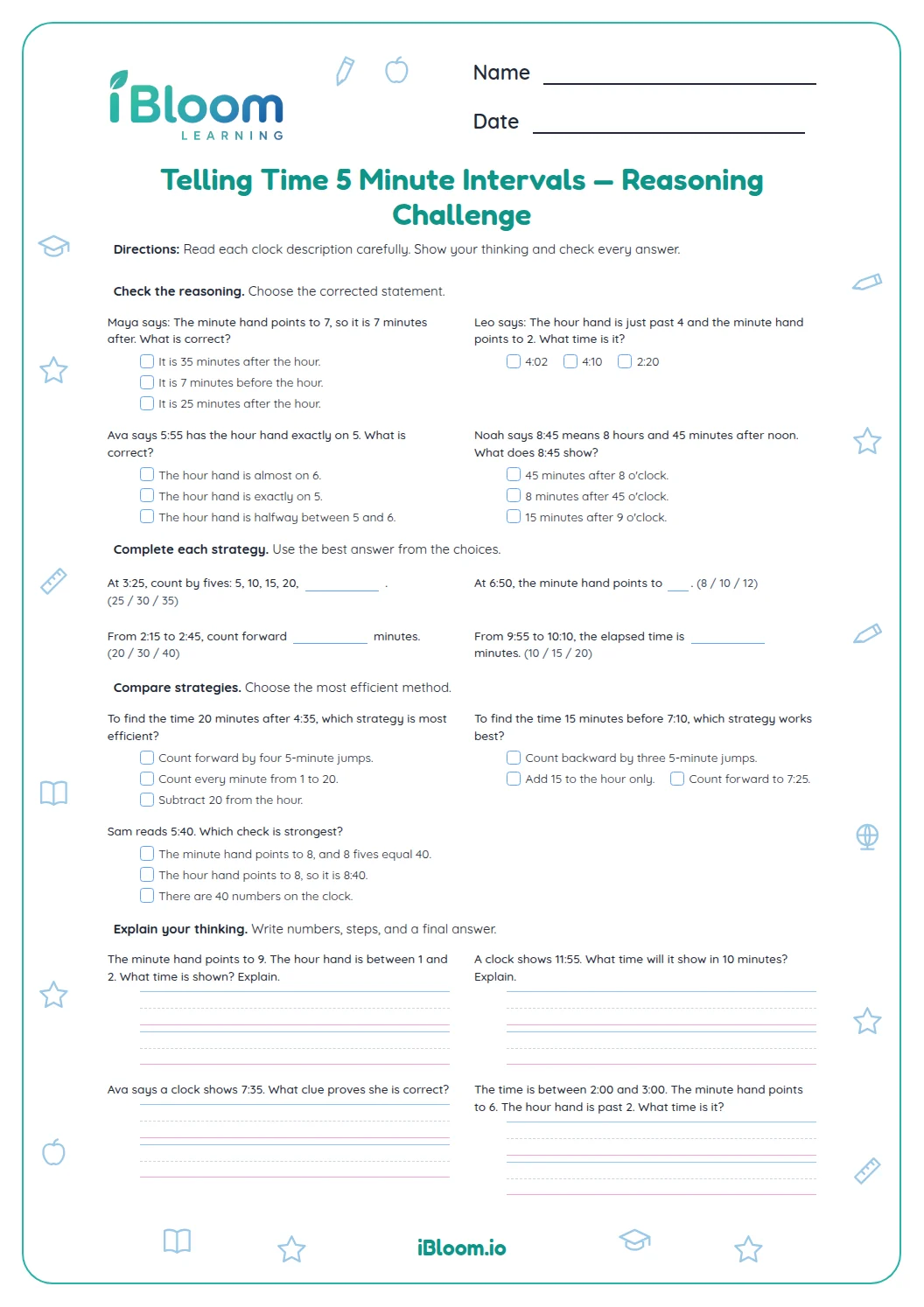
This free printable worksheet is for Grade 3 learners practicing read analog clocks in five-minute intervals. It has 14 questions in 2 parts and a separate answer key. The twelve clock questions show analog clock faces, and the final two ask learners to add minutes to a time and find an elapsed interval. Read the hour hand first, then count the minute hand by fives. The prompts follow the same skill focus as the original sheet, with clear steps for independent practice.
Aligned to 3.MD.A.1
How does this worksheet practice read analog clocks in five-minute intervals?
The twelve clock questions show analog clock faces, and the final two ask learners to add minutes to a time and find an elapsed interval. Read the hour hand first, then count the minute hand by fives. The questions are arranged from read the clock toward independent use of the skill.
- 1Write the time.
- 2Answer: 2:10
- 3For example, when the minute hand points to 2, it shows 10 minutes; pair that with the hour hand to write the full time.
What is in each part?
The 14 questions are grouped into 2 parts: Read the clock: 12; Think about minutes: 2.
How can I use the answer key?
For example, when the minute hand points to 2, it shows 10 minutes; pair that with the hour hand to write the full time. Check the answer after attempting the item. If it differs, return to the exact clue or operation and try again; for questions with more than one reasonable response, compare the child’s reasoning with the model answer.
How to use this worksheet
- 1Find the hour the short hand has reached.
- 2Count by fives around the clock to read the minute hand.
- 3Write the time with a colon, such as 4:25.
- 4For the last two questions, track the minutes from the starting time.
- 5Check whether the hour changes during the interval.
Common mistakes and quick fixes
The mistake
Reading the number the minute hand points to as minutes.
The fix
Count by fives: a hand at 4 means 20 minutes.
The mistake
Naming the next hour too soon.
The fix
The hour hand moves gradually; use the hour it has passed, not the next number.
The mistake
Subtracting clock labels instead of elapsed minutes.
The fix
Count forward on the clock or split the interval at the next hour.
Common Core alignment
This worksheet practices the following Common Core standard.
Tell and write time to the nearest minute and solve elapsed-time problems.
On this sheet: The worksheet reads clock faces in five-minute increments and solves two time-interval problems.
Show the official wordingHide the official wording
Tell and write time to the nearest minute and measure time intervals in minutes. Solve word problems involving addition and subtraction of time intervals in minutes, e.g., by representing the problem on a number line diagram.
What to practice next
Make more practice
Further reading
Questions parents and teachers ask
What does this worksheet teach?
It teaches learners to read analog clocks to the nearest five minutes. Twelve clock faces provide reading practice, followed by one question about a time 15 minutes later and one elapsed-time question. The key includes the time or duration for every item.
How do I read the minute hand?
Each number on the clock represents five minutes for the long minute hand. Start at 12 and count by fives until you reach the hand. For example, the hand at 8 indicates 40 minutes past the hour. Point to the clock numbers while counting each five-minute step.
Why read the short hand first?
The short hand tells which hour is in progress. It may sit between two numbers, especially when the minute hand has moved past the hour. Use the number it has passed, then add the minutes from the long hand.
How is elapsed time practiced?
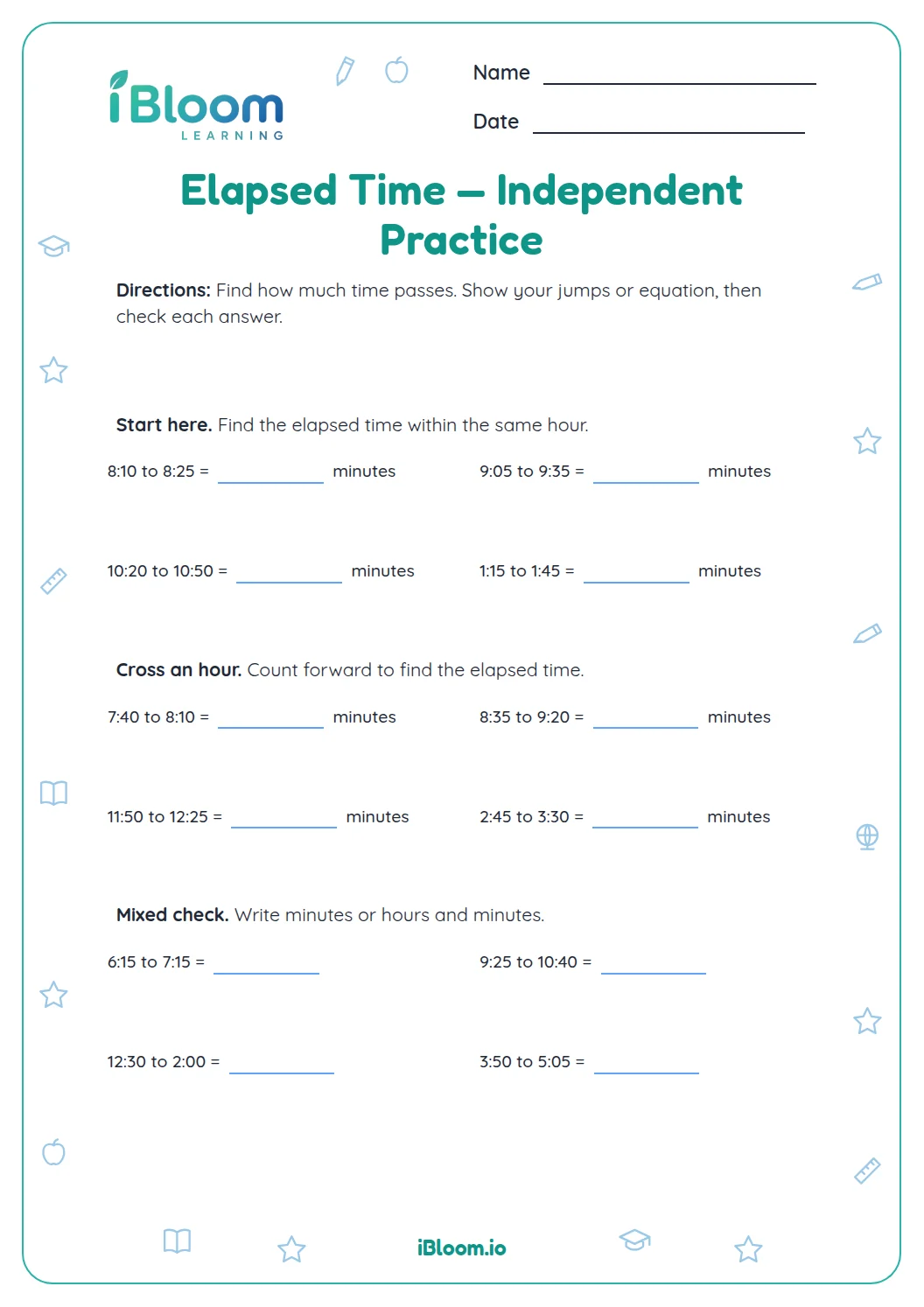
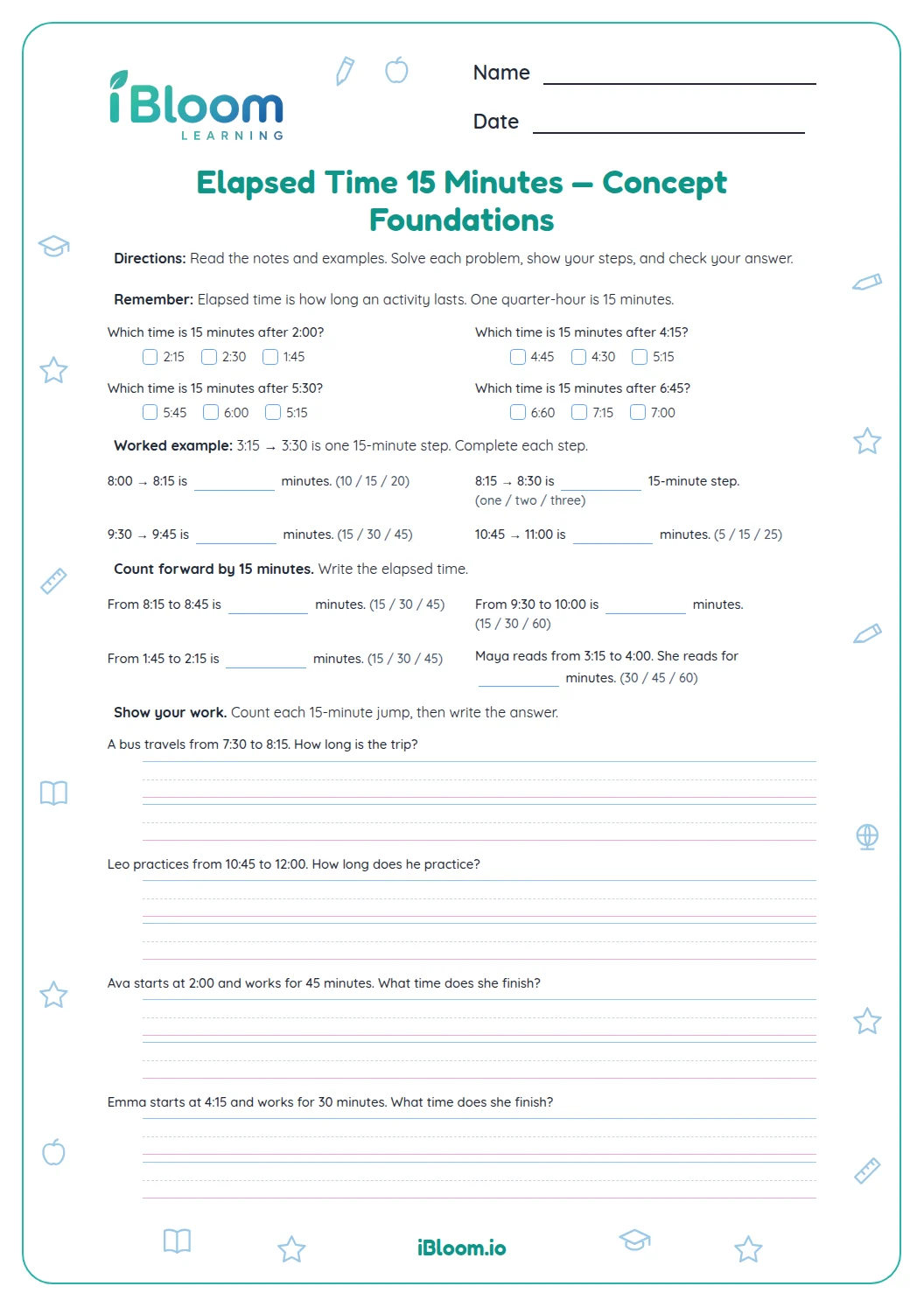
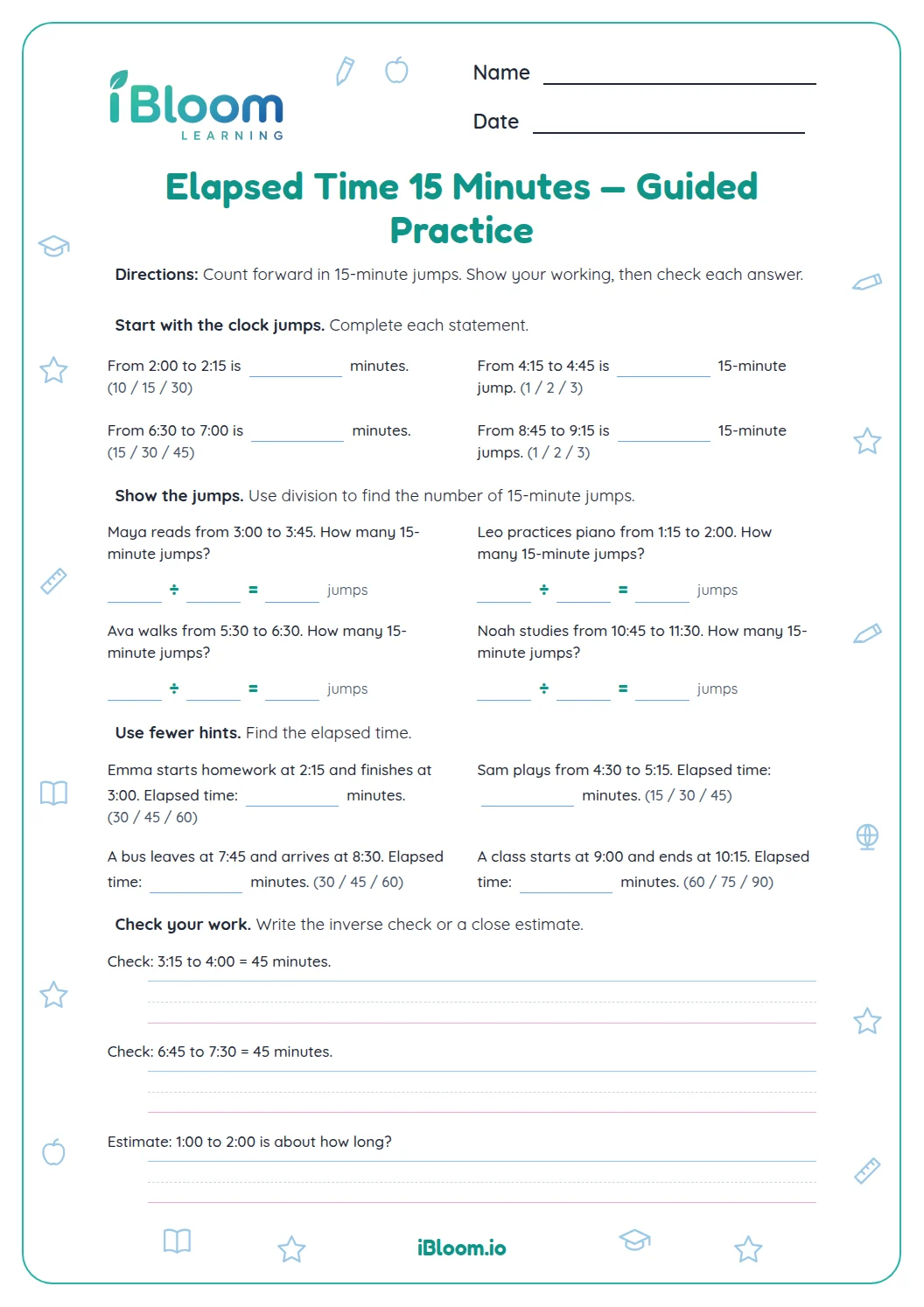
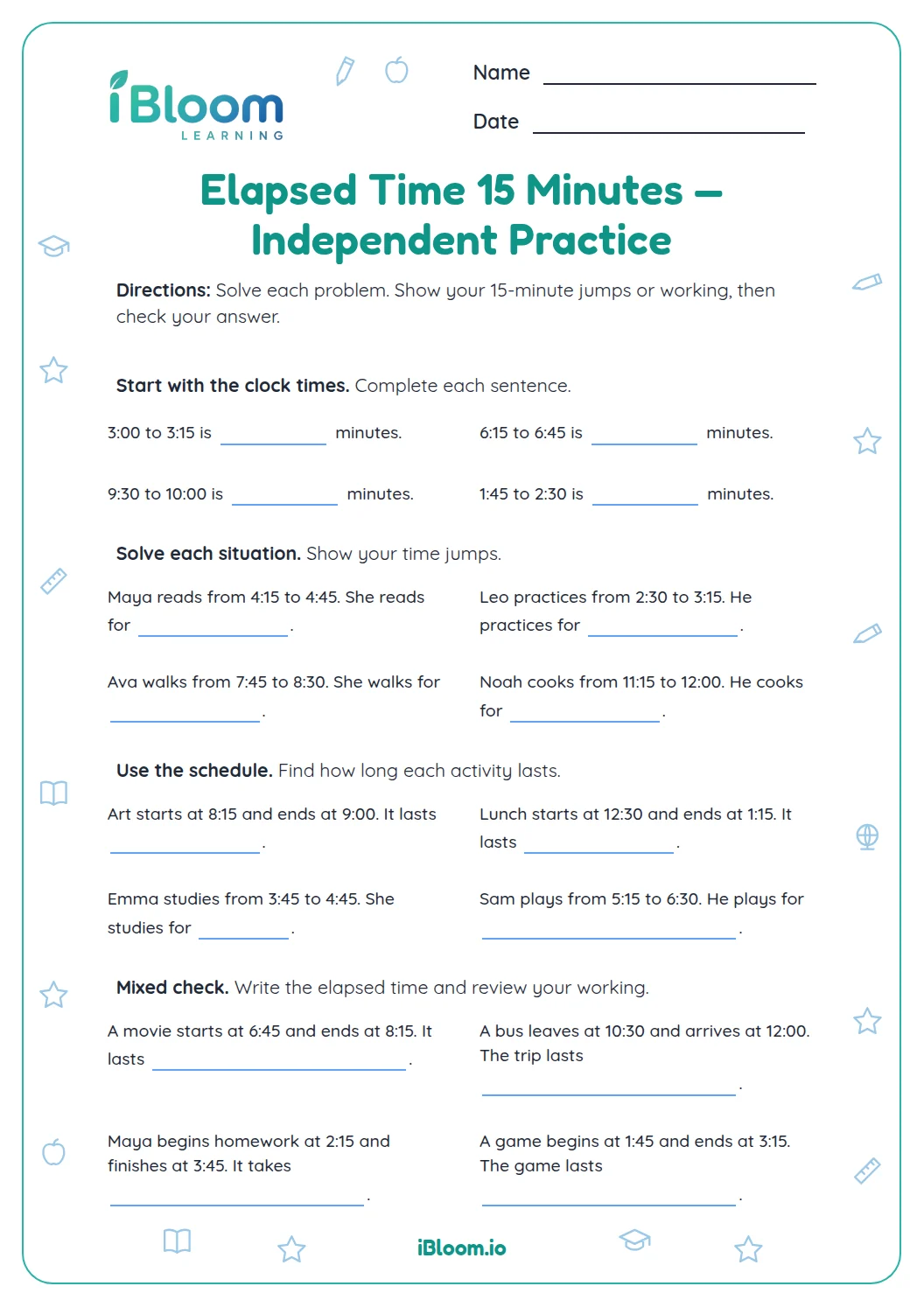
The last two questions ask learners to move forward from a start time. One adds 15 minutes to 4:20, and the other finds the minutes between 2:35 and 3:00. Counting on helps track the hour boundary clearly. Count on in two chunks when the starting time crosses an hour.
How long should this worksheet take?
Allow about 14 minutes for the 14 questions, adjusting for the learner’s familiarity with analog clocks. A child can point to each hand and count aloud before writing the time, then check the final two problems separately. The answer key can help identify a hand-reading error.