

About this worksheet
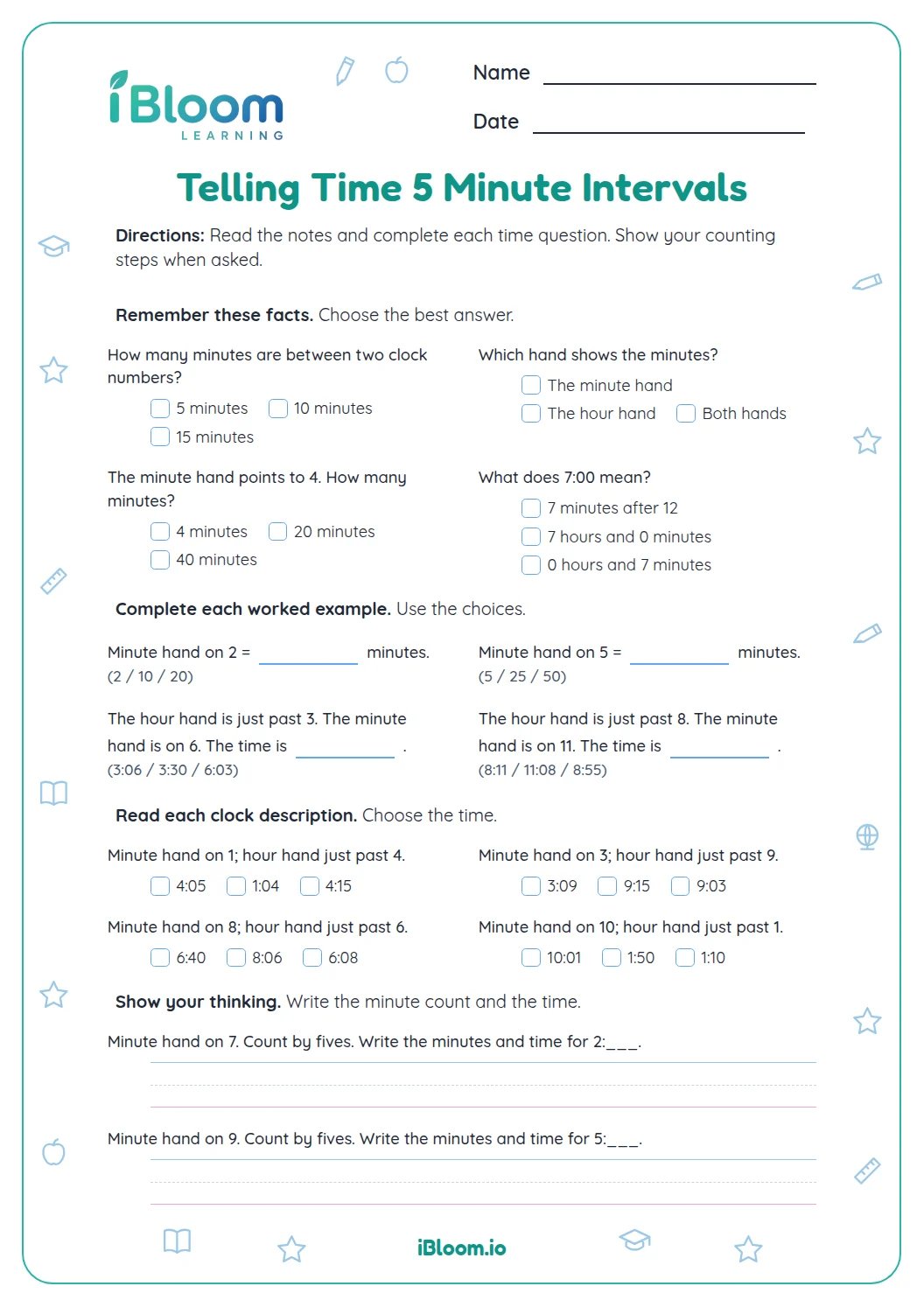
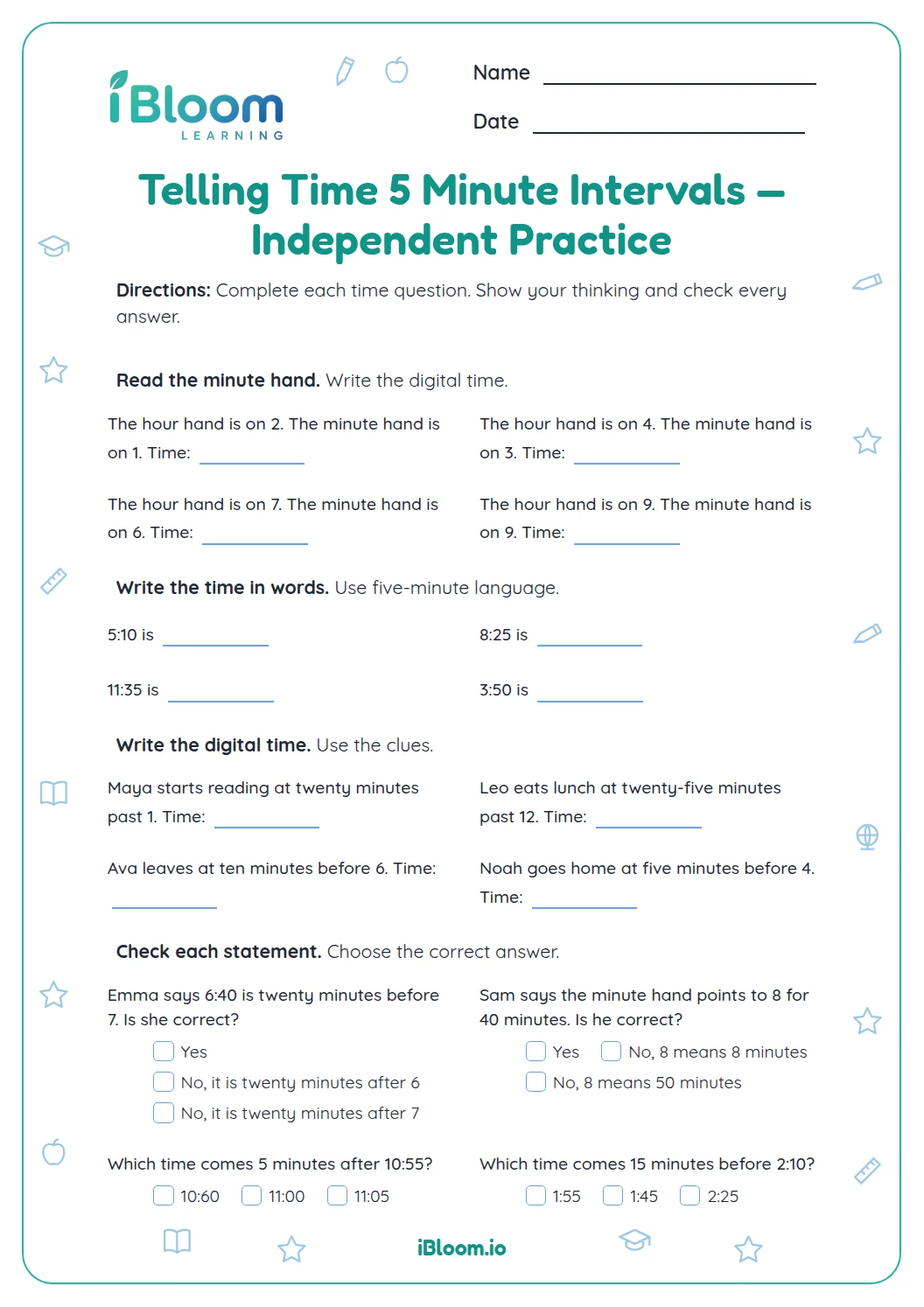
This Grade 3 printable gives students practice reading analog clocks in five-minute intervals. Each of the 14 questions includes a clock face, with minute hands at five-minute marks and hour hands placed between numbers when needed. Students write the digital time, paying attention to both hands. The separate answer key makes it easy to check each clock. The page practices reading and writing time to the nearest five minutes.
Aligned to 3.MD.A.1
How does the minute hand show five-minute intervals?
Each number marks another five minutes: 1 is :05, 2 is :10, and 6 is :30. Read the long hand first, then locate the hour the short hand has reached.
- 1The minute hand points to 3: 3 × 5 = 15 minutes.
- 2The hour hand is just past 3.
- 3The clock reads 3:15.
What happens to the hour hand between numbers?
The hour hand moves gradually toward the next number. At 3:45 it is between 3 and 4, so the time is still in the 3 o’clock hour.
What does this page include?
Fourteen analog clocks show five-minute intervals, including times before and after the half hour and a noon clock.
How can you use this worksheet?
- 1Read the long minute hand and multiply its number by five.
- 2Look at the short hand to see which hour has begun.
- 3Write the time with a colon and two minute digits.
- 4Check that the hour did not advance before the short hand reached it.
Mistakes to watch for
The mistake
Reading 4 on the clock as 4 minutes.
The fix
Count by fives: the 4 mark means 20 minutes.
The mistake
Calling 3:45 four o’clock because the hour hand is near 4.
The fix
The hour stays 3 until the hand reaches 4.
The mistake
Mixing up the short and long hands.
The fix
Find the longer minute hand first, then the shorter hour hand.
Common Core alignment
This page practices the standard listed below.
Read and write times from analog clocks to five-minute intervals.
On this sheet: Students read analog clock faces and write the time.
Show the official wordingHide the official wording
Tell and write time to the nearest minute and measure time intervals in minutes. Solve word problems involving addition and subtraction of time intervals in minutes, e.g., by representing the problem on a number line diagram.
What to practice next
Make more practice
Further reading
Questions parents and teachers ask
How do I read an analog clock in five-minute steps?
Read the long minute hand first. Each number counts five minutes, so a hand on 3 means :15; then read the shorter hand to identify the hour that has started. The worksheet gives 16 clock faces for this routine. That routine works on every clock in the practice set.
Why is the hour hand between two numbers?
The hour hand moves gradually as the minute hand travels around the clock. At 3:45 it lies between 3 and 4, but the time remains in the 3 o’clock hour until the hand reaches 4. The minute hand’s position helps explain why the time is still in the earlier hour.
How many clock faces are on the page?
The sheet has 14 clock-reading questions in two parts. Students read a sequence of clock faces, including times before and after the half hour and a clock at 12:00. Each response is written as a digital time, and the separate key lists the time shown on each face.
How should students write each answer?
Write the hour, a colon, and two minute digits, such as 3:15. Checking the minute hand by counting fives and then checking the hour hand helps catch a common mix-up. The two-digit minute format makes answers easy to compare with the separate key.
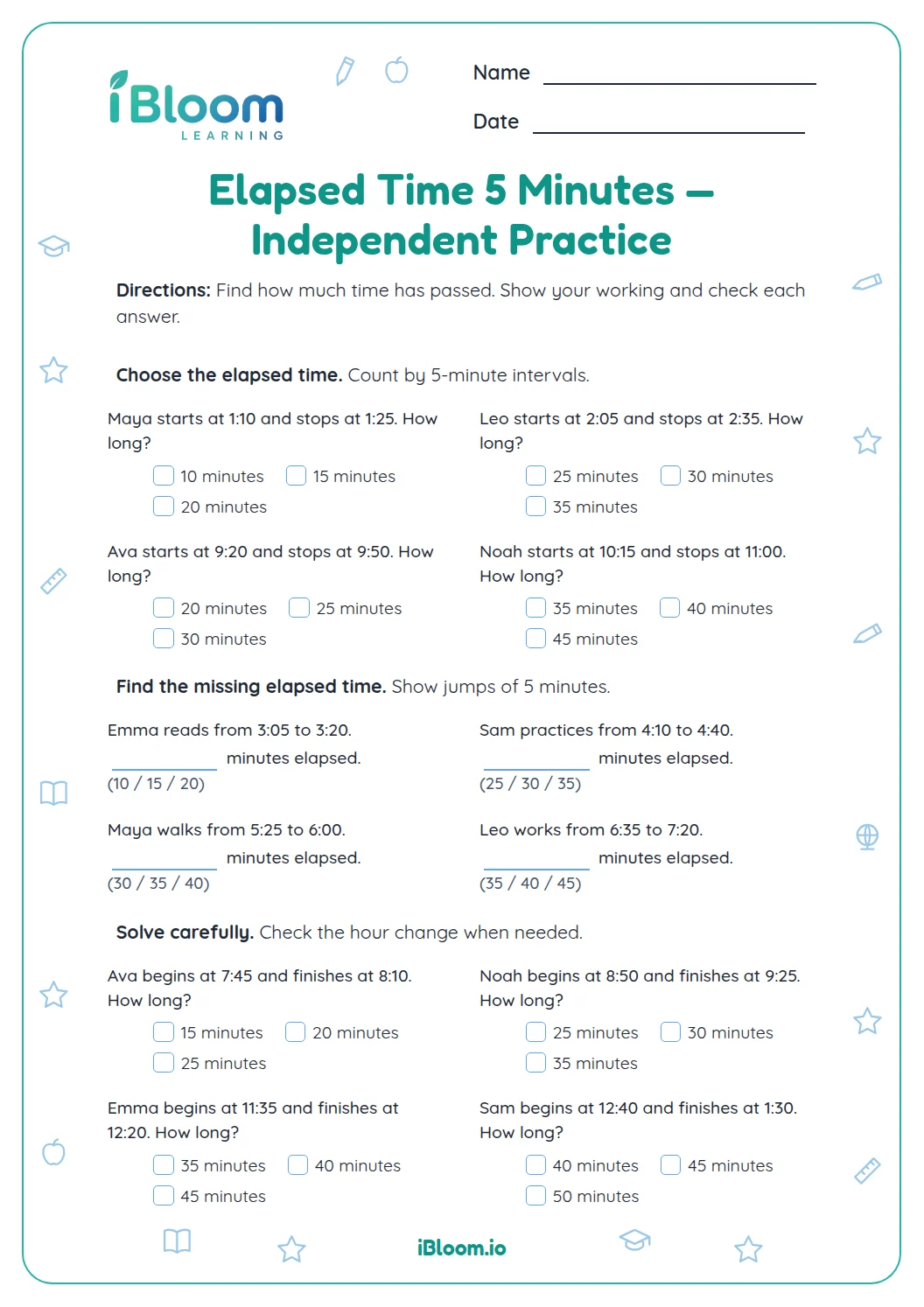
What related practice can come next?
After this page, a student can try clocks marked to one-minute intervals or work on elapsed time in five-minute steps. The related links below provide both kinds of practice. Both next steps build on clock reading in a focused way.