

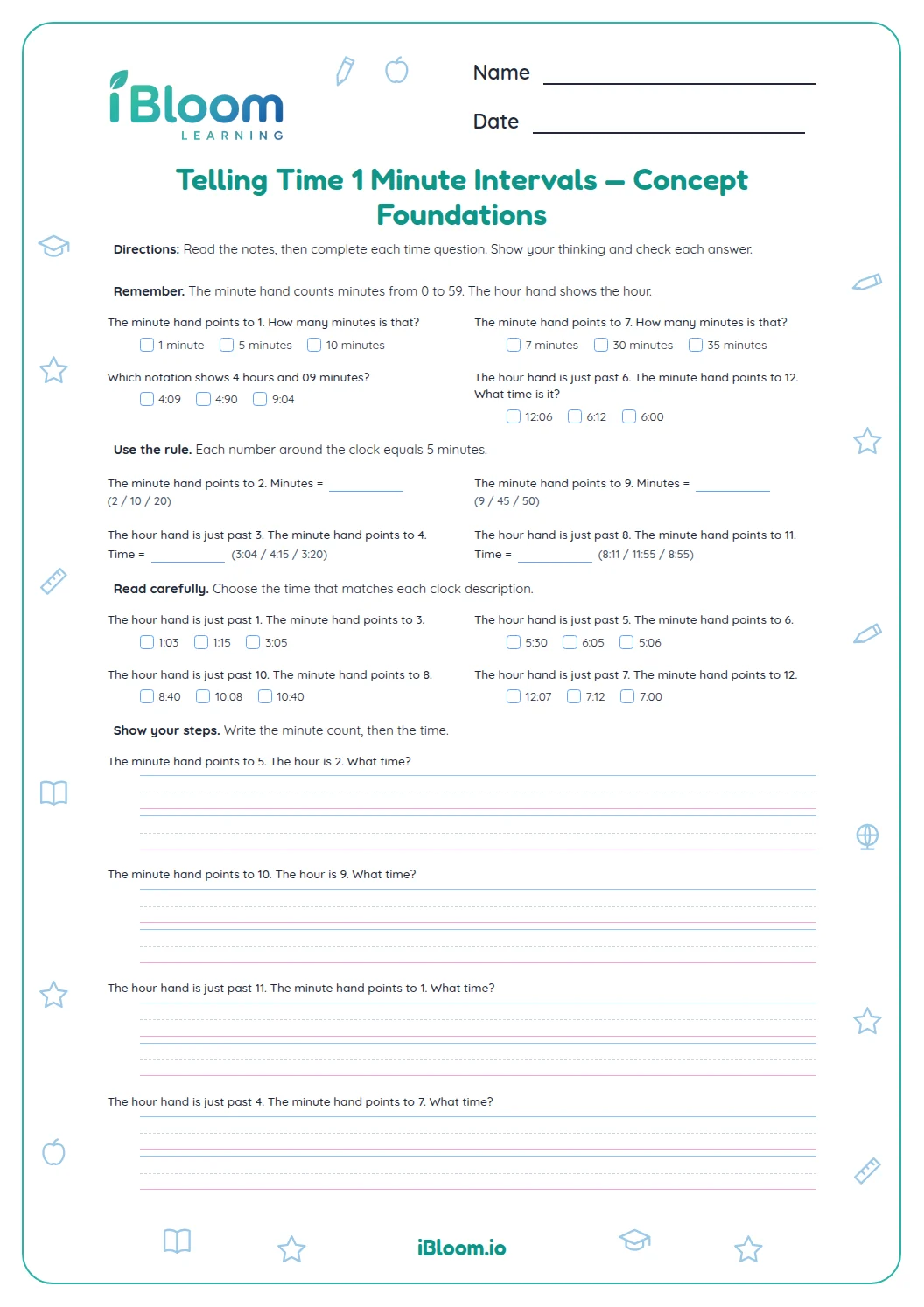

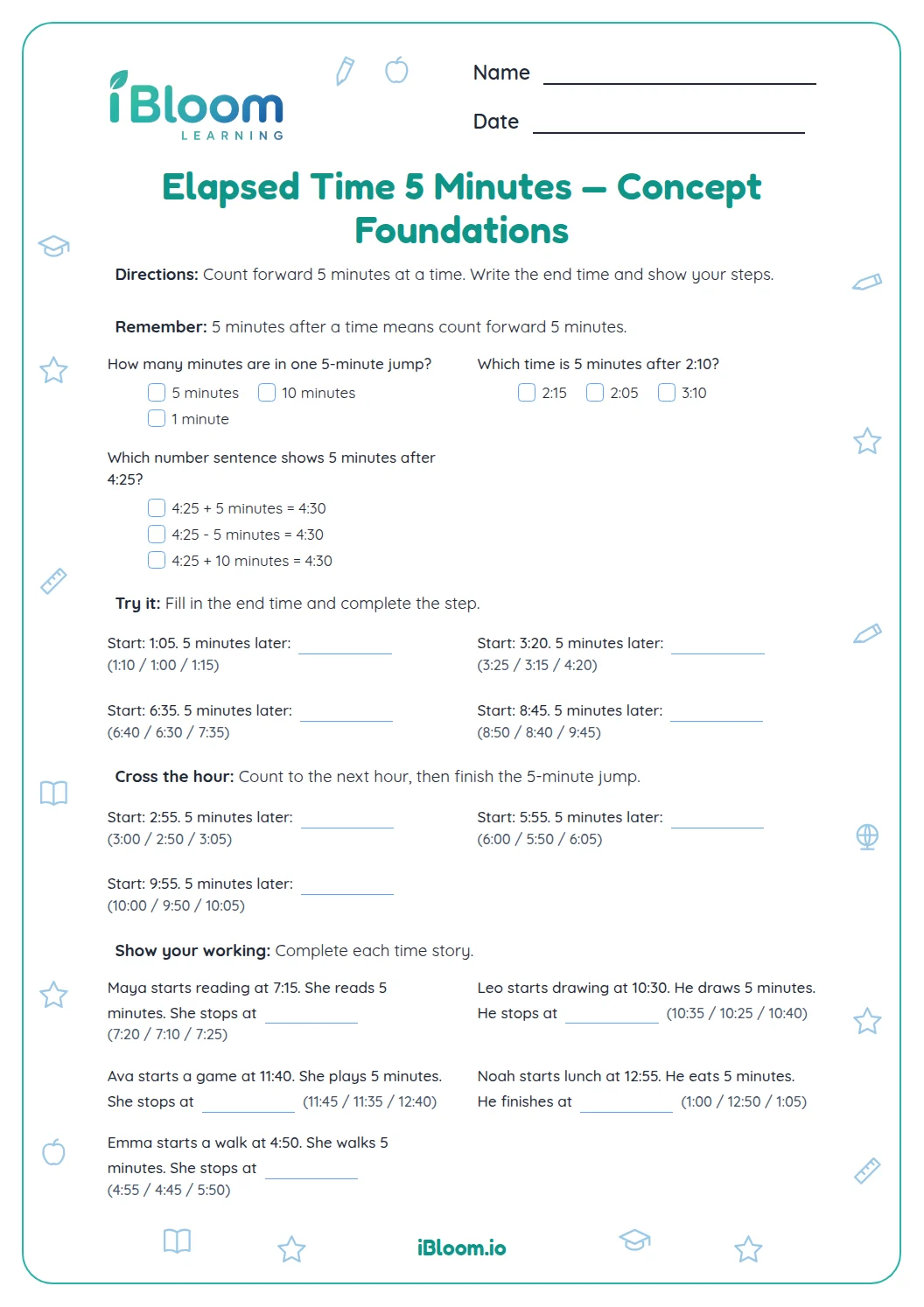
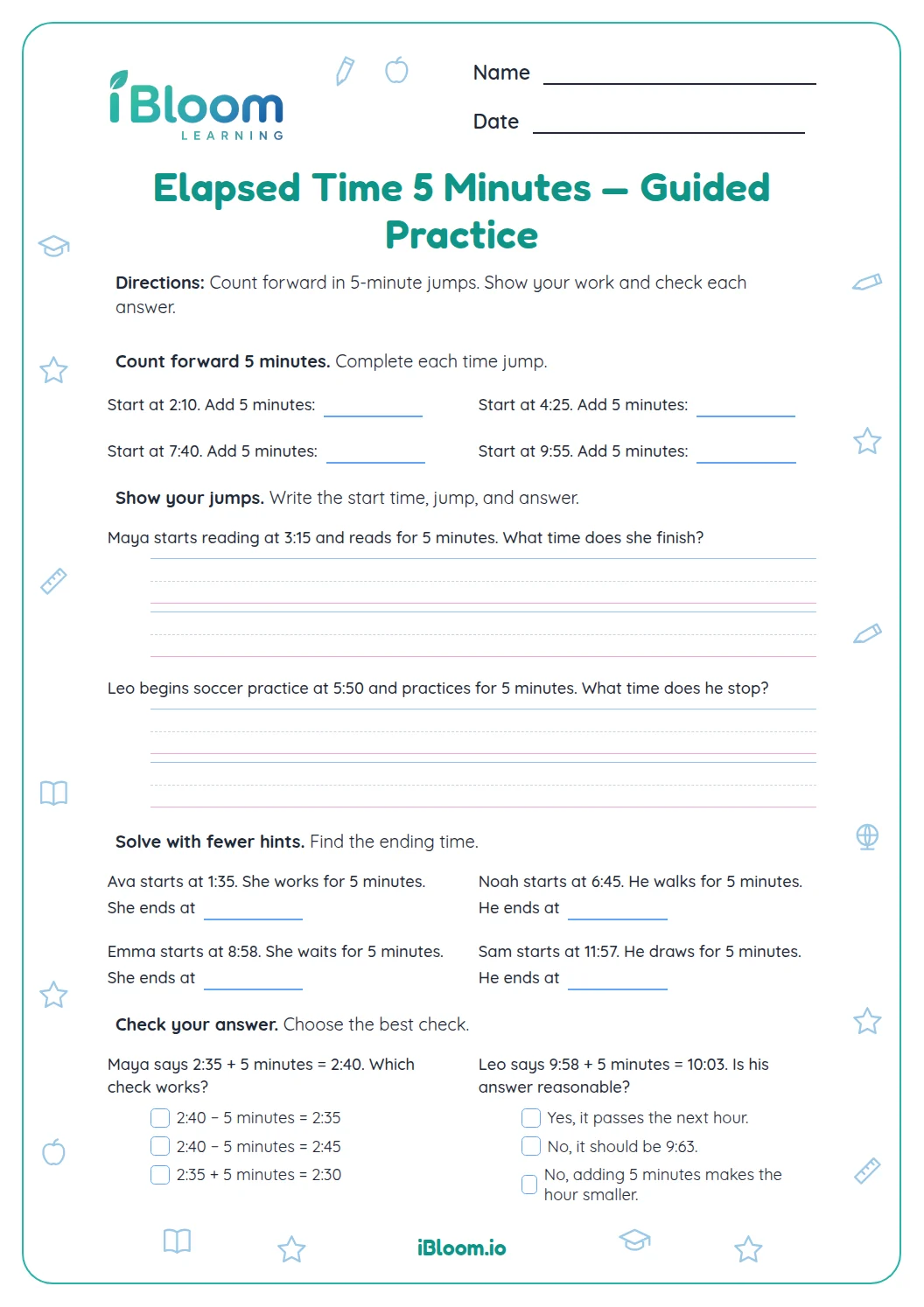
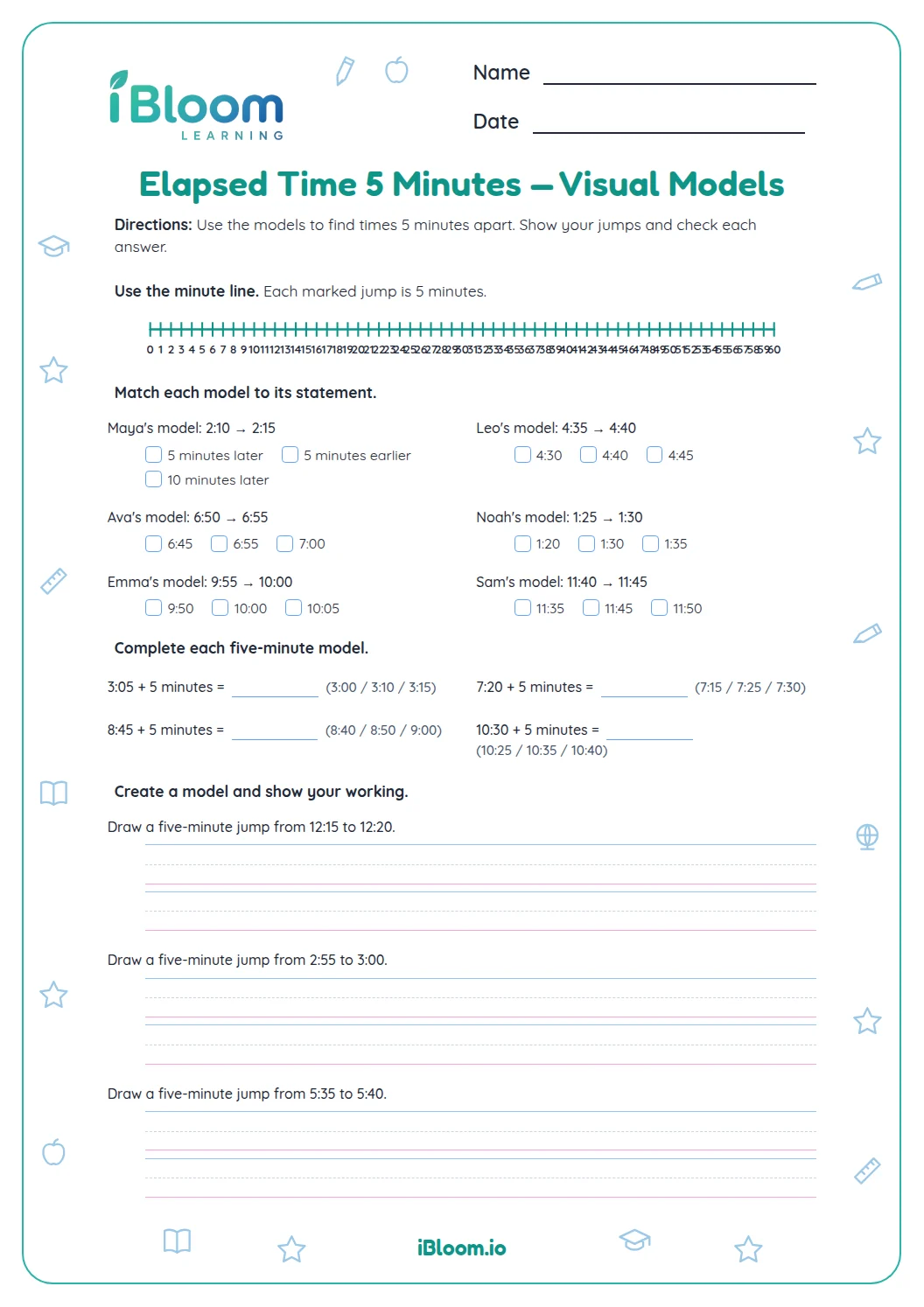
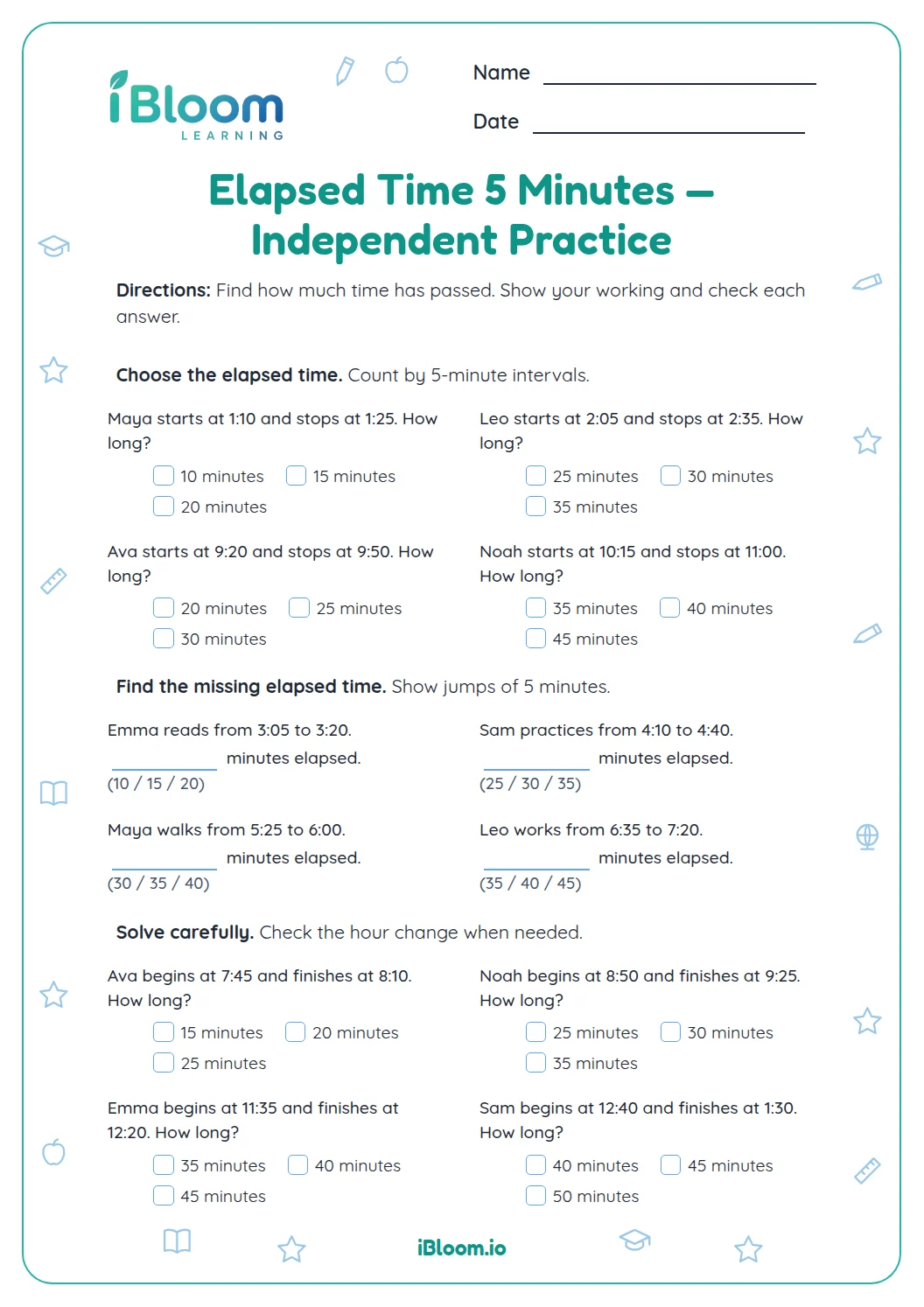


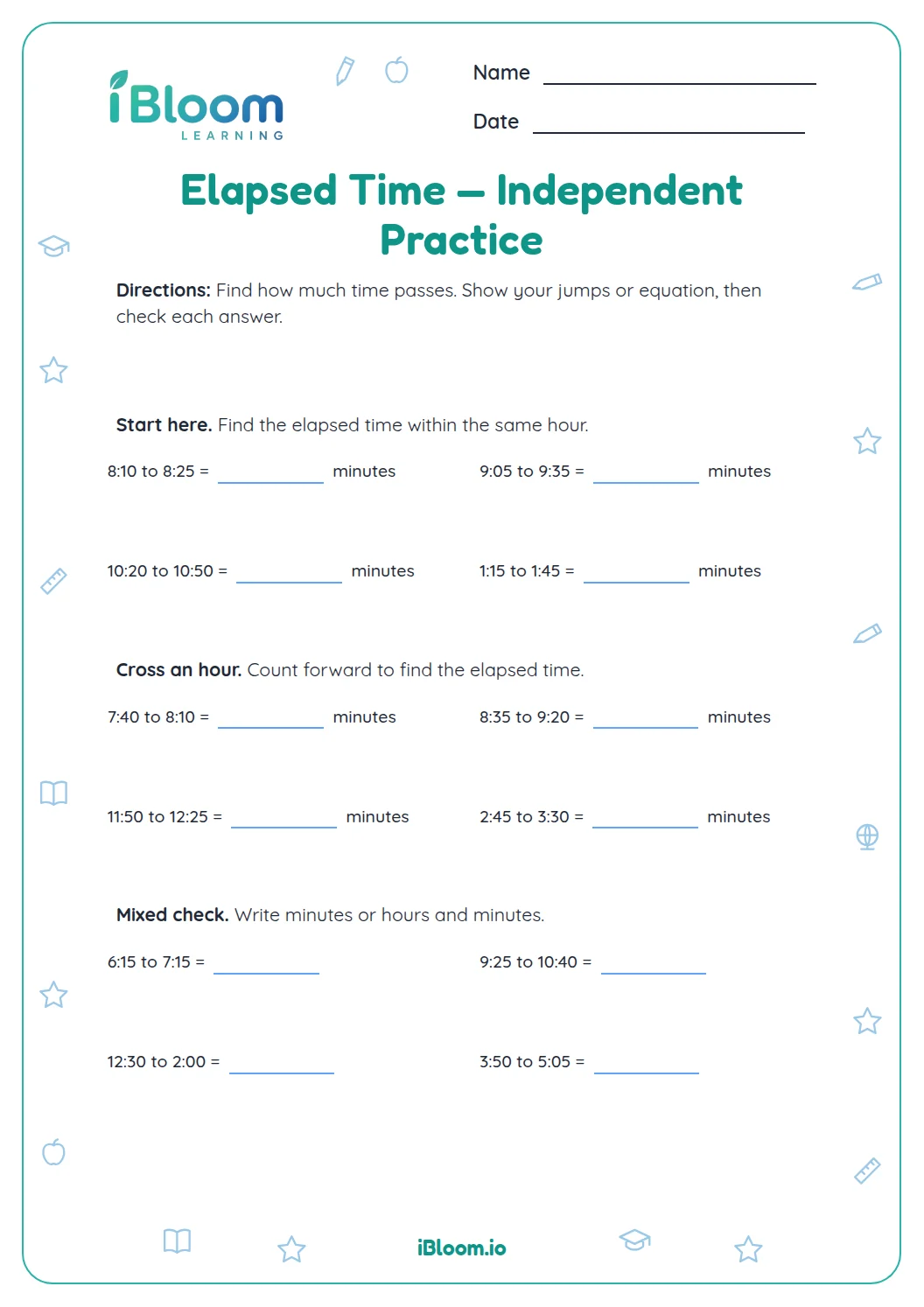
About this worksheet
This printable worksheet is for Grade 3 learners practicing clock times, time phrases, and minute intervals. It offers 18 carefully sequenced questions, plus a separate answer key. It aligns with 3.MD.A.1.
Aligned to 3.MD.A.1
How do the clock hands show the time?
Read the long hand for minutes and the short hand for hours. In question 3, the minute hand points to 3, which means 15 minutes, and the hour hand is just past 9: the time is 9:15.
What does a time phrase tell us?
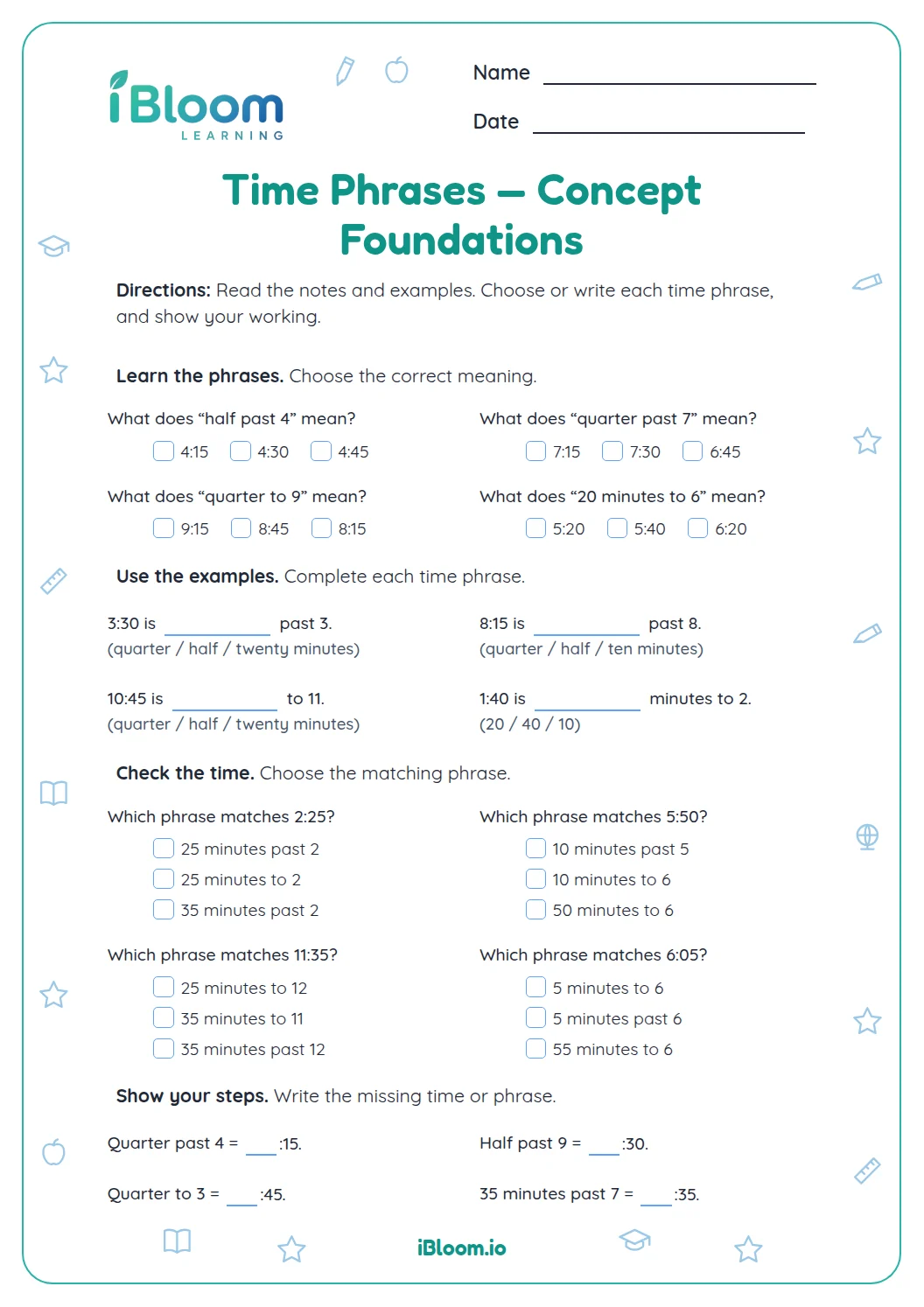
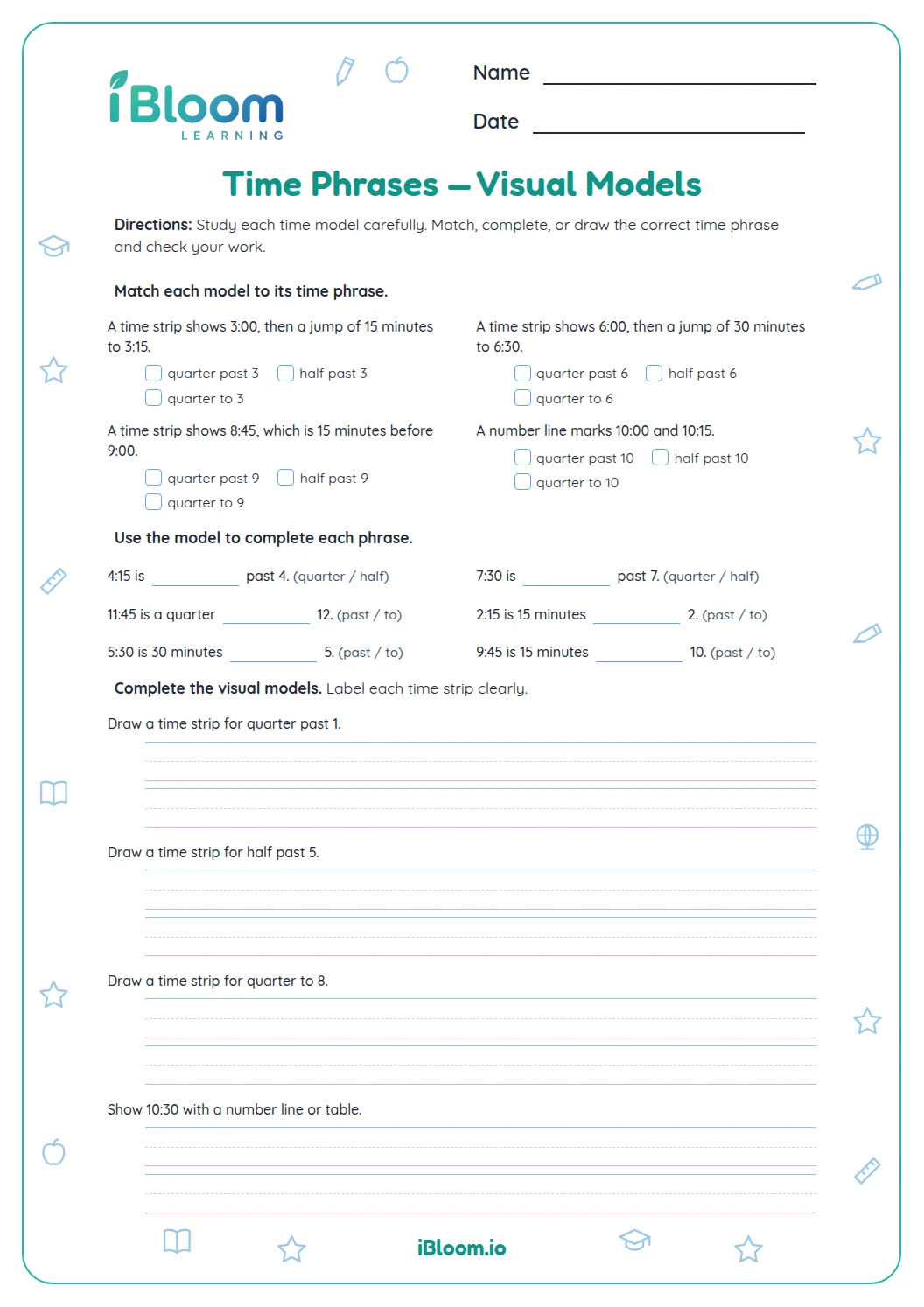
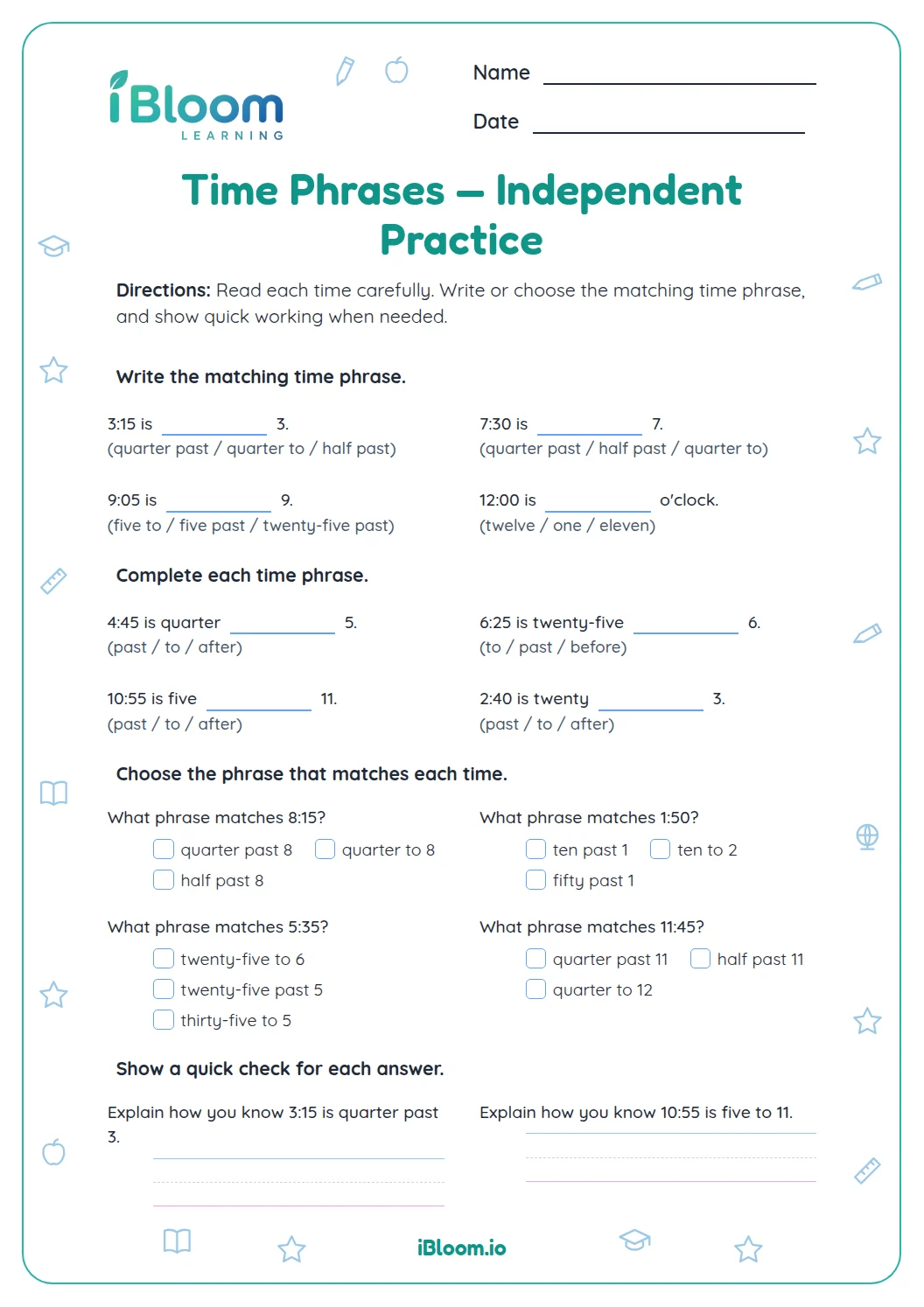
“Quarter after” means 15 minutes past the hour; “quarter to” means 15 minutes before the next hour. So quarter to 6 is 5:45, as practiced in question 11.
How can learners solve a time interval?
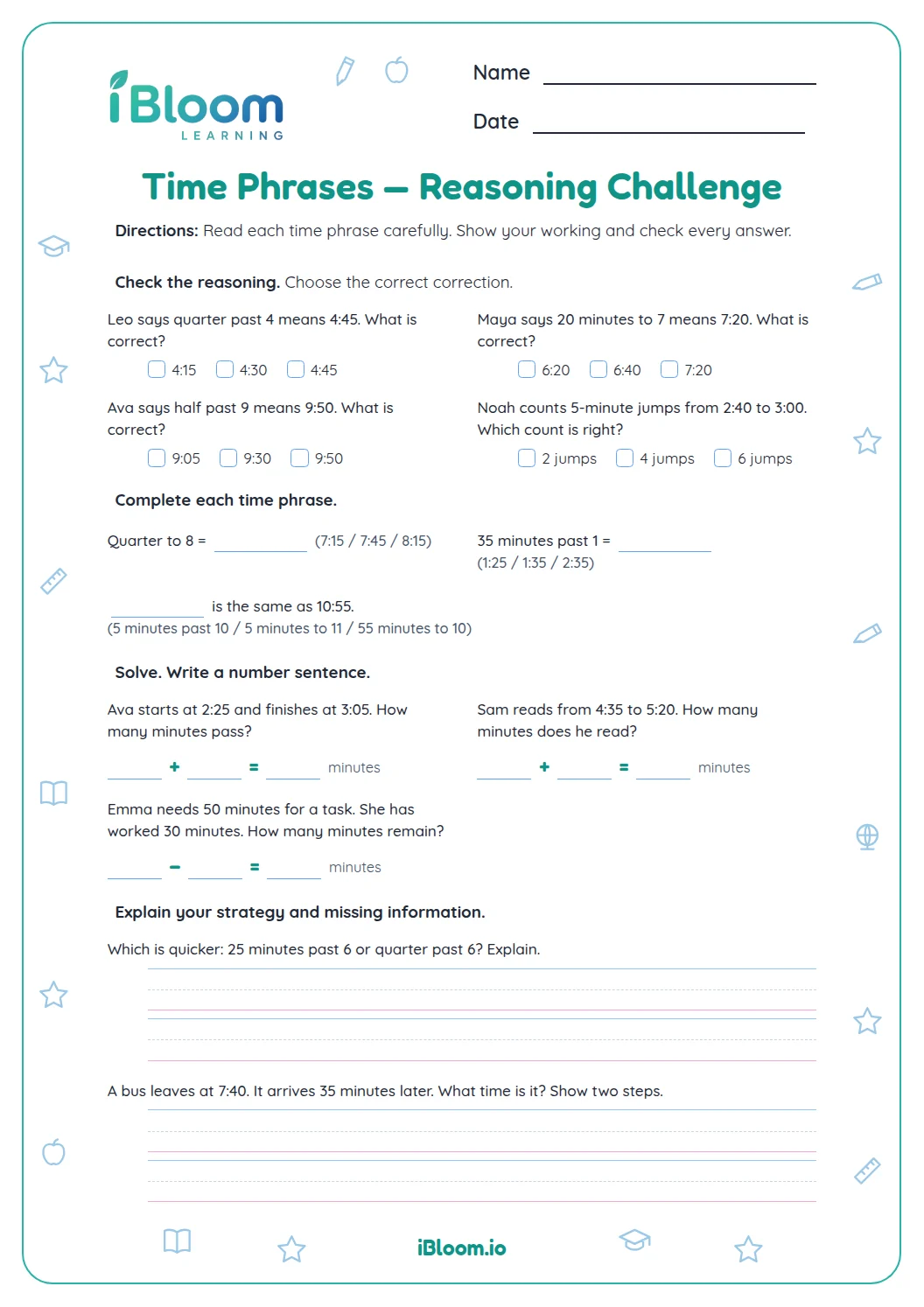
Count forward by the stated minutes, crossing the hour when needed. For the game starting at 3:25 and lasting 20 minutes, 3:25 plus 20 minutes is 3:45.
How to use this worksheet
- 1Read all directions before beginning.
- 2Complete each question in order and show the requested unit or evidence.
- 3Check each response against the separate key.
Common mistakes and quick fixes
The mistake
Reading the hour hand as the minute hand.
The fix
Find the longer minute hand first, then check the shorter hour hand.
The mistake
Treating “quarter to six” as 6:15.
The fix
Count 15 minutes backward from 6:00 to get 5:45.
The mistake
Forgetting to change the hour after 60 minutes.
The fix
Count the minutes in parts and advance the hour when you pass :59.
Curriculum alignment
This worksheet practices the measurement and reasoning standard through its problems.
Read minute-level clocks and solve short time-interval problems.
On this sheet:
Show the official wordingHide the official wording
Tell and write time to the nearest minute and measure time intervals in minutes. Solve word problems involving addition and subtraction of time intervals in minutes, e.g., by representing the problem on a number line diagram.
What to practice next
Make more practice
Further reading
Questions parents and teachers ask
What do “half past” and “quarter to” mean?
“Half past” means 30 minutes after the hour, so half past 1 is 1:30. “Quarter to 6” means 15 minutes before 6:00, which is 5:45. Use the worked relationship from the page to check the units and calculation.
What kind of clock practice is included?
The first six questions show analog clock drawings to read to the minute. The remaining items use time phrases, minutes before or after a time, and short situations involving a start time and duration. Use the worked relationship from the page to check the units and calculation.
How do I solve a minutes-after question?
Add the stated minutes to the starting time, keeping track when the minutes pass 60. For example, 30 minutes after 9:35 is 10:05 because 25 minutes reaches 10:00 and 5 more minutes gives 10:05. Use the worked relationship from the page to check the units and calculation.
How many questions are on the worksheet?
There are 18 questions in four parts: six clock readings, six phrase or interval items, four phrase translations, and two short time situations. A separate key gives the matching times. Use the worked relationship from the page to check the units and calculation.
Does the worksheet include an answer key?
Yes. The printable has a separate answer key. It lists clock times, phrase translations, and end times for the two short situations. Use the worked relationship from the page to check the units and calculation. The examples name the unit so learners can see what the final answer should include.