




About this worksheet
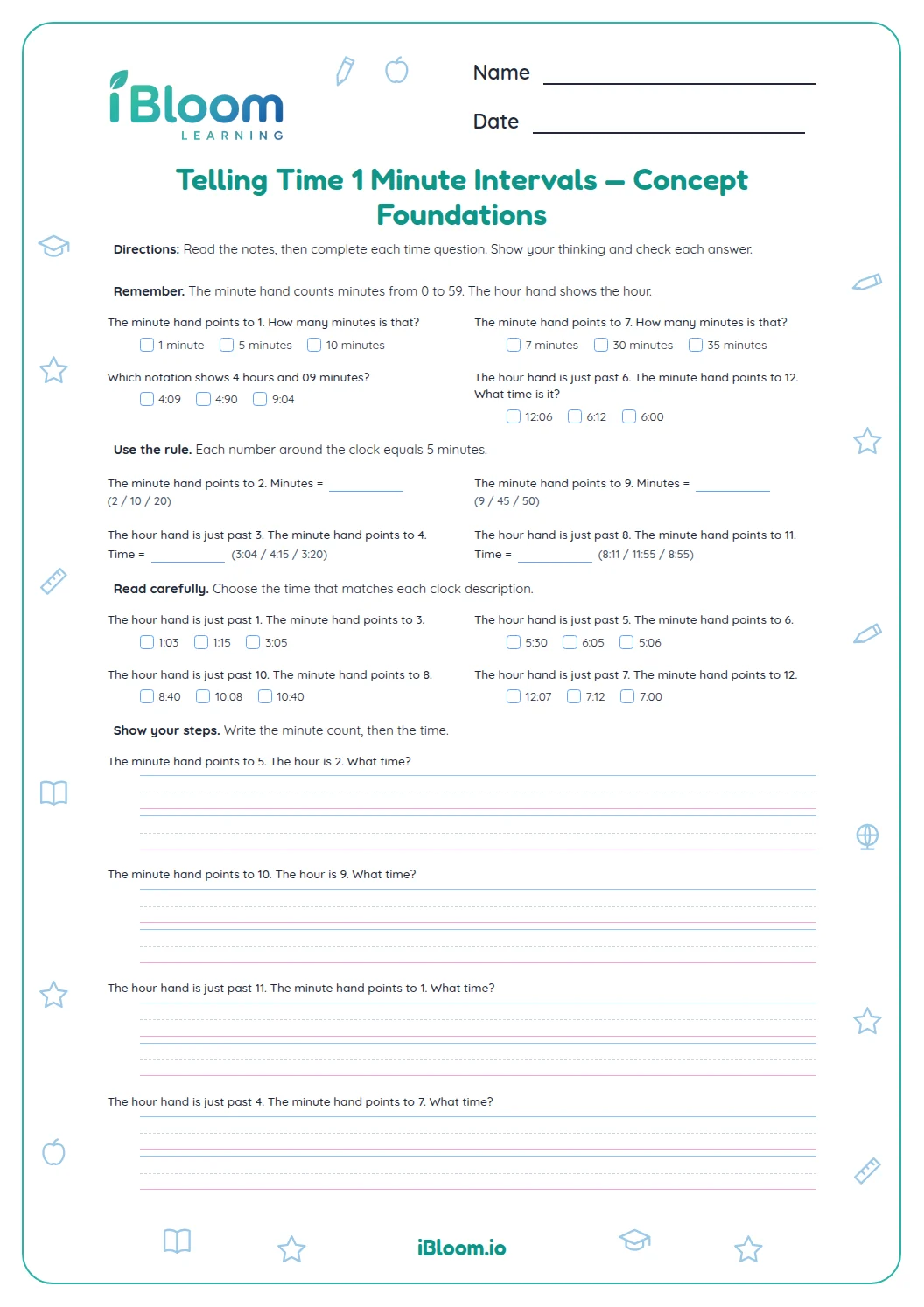
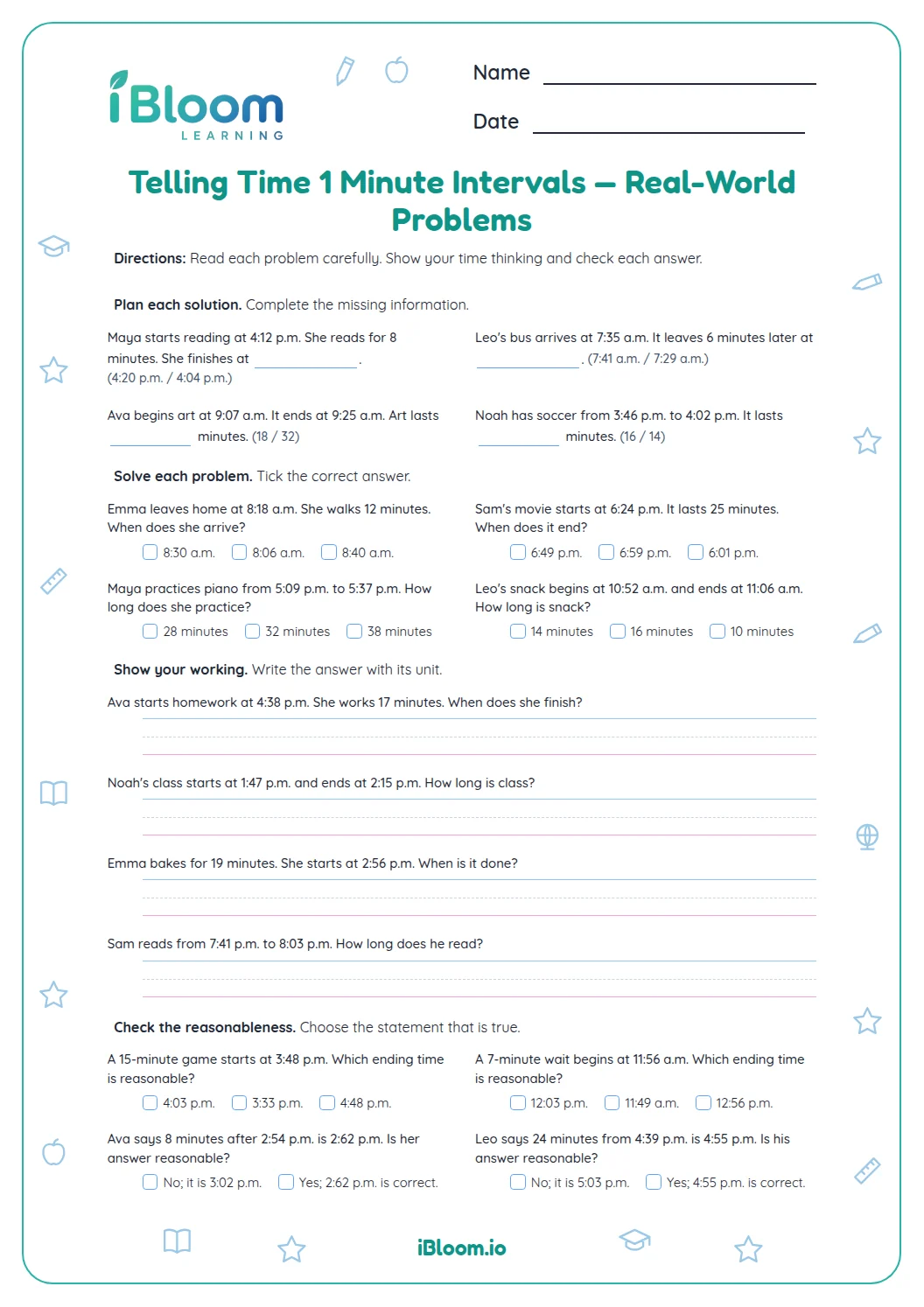
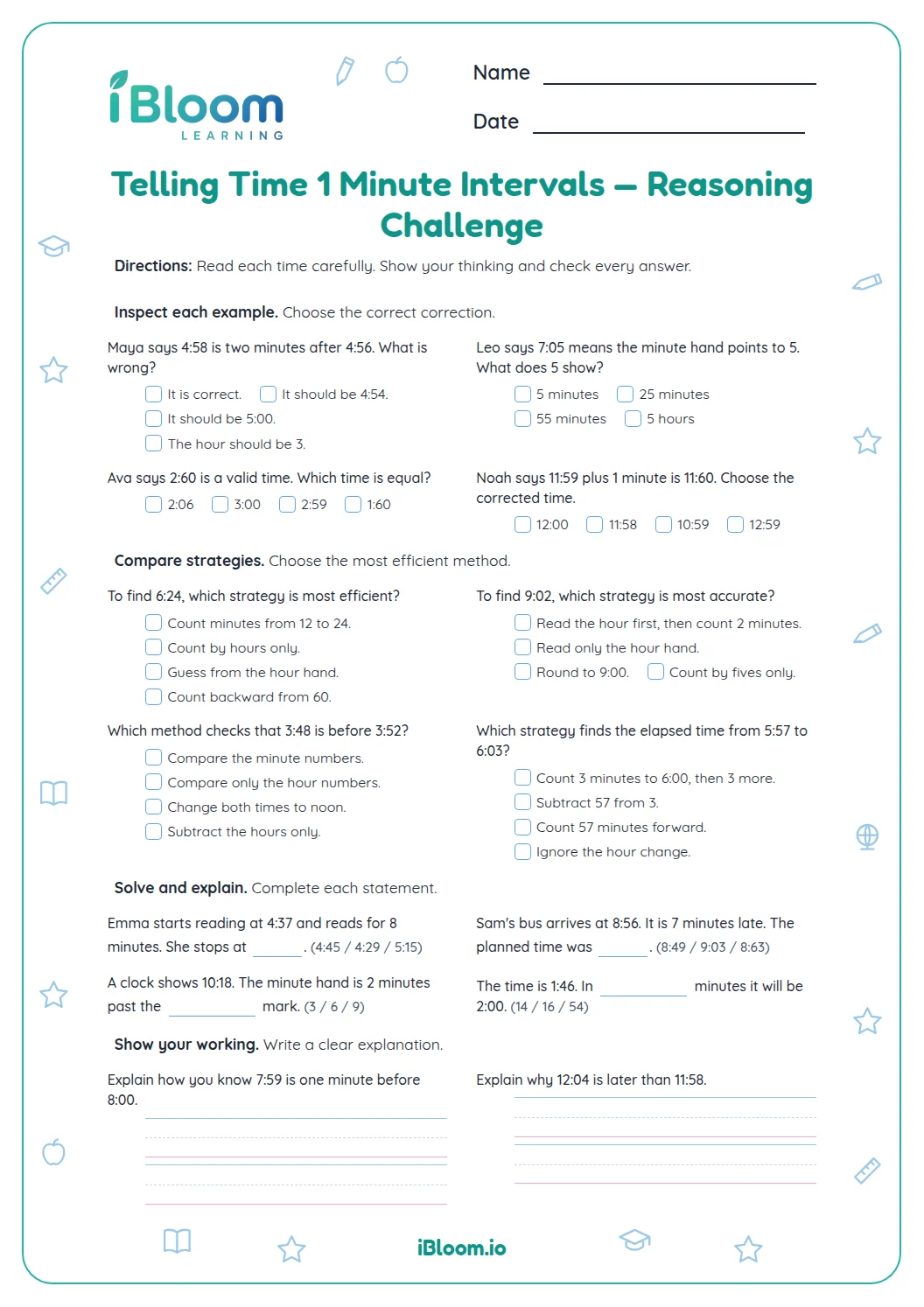
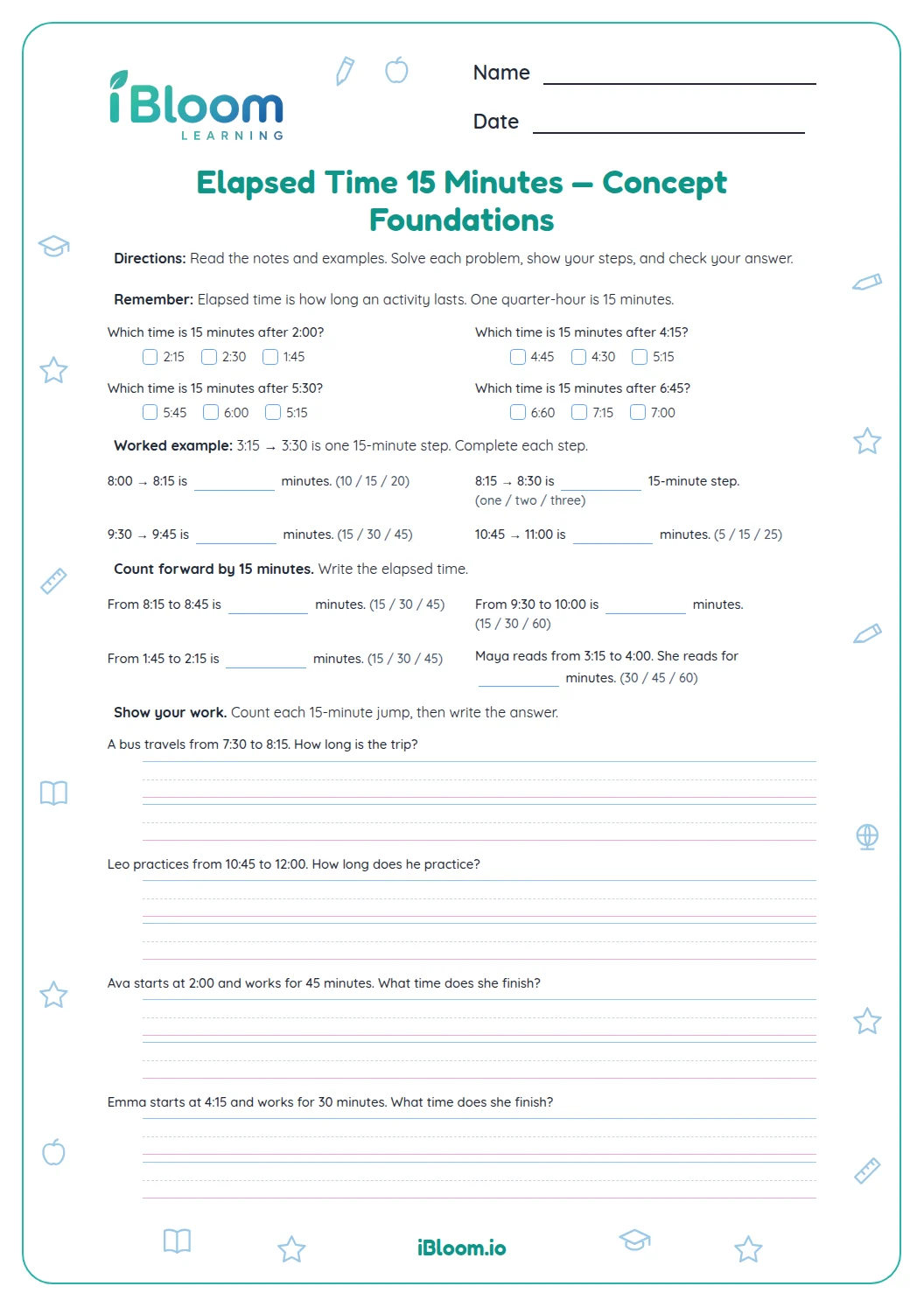
This Grade 3 printable gives learners six analog clocks to read to the nearest minute, followed by eight questions about moving one minute forward or back. Students identify the hour the short hand has passed and count each minute mark, then write digital times. A separate answer key supports checking. The clock-reading practice connects to CCSS 3.MD.A.1.
Aligned to 3.MD.A.1
What should a learner read first?
Start with the hour hand, which is shorter. If it sits between two numbers, use the number it has passed. Then read the longer minute hand around the dial.
How do the small marks show minutes?
Each small mark stands for one minute. Count by fives at the numbered marks, then count any extra single marks.
- 1For 4:23, the short hand has passed 4.
- 2The long hand is three marks past the 4, or 20 + 3 minutes.
- 3Write 4:23.
How can the answer be checked?
Make sure the hour is the one already passed, not the next number. Check the minute hand’s position between labeled five-minute marks.
How to use this worksheet
- 1Name the hour the short hand has passed.
- 2Count by fives to the long hand’s nearest number.
- 3Count the remaining single marks.
- 4Write the time with a colon.
- 5Use the answer key to check both digits.
Common mistakes and quick fixes
The mistake
Using the next hour when the short hand is between numbers.
The fix
Use the hour number the hand has already passed.
The mistake
Reading the numbered dial as minutes one by one.
The fix
Count each labeled number as five minutes, then add single marks.
The mistake
Stopping at the closest five-minute number.
The fix
Count the small marks after that number to reach the exact minute.
Common Core alignment
Read analog clocks to the nearest minute and solve time intervals.
On this sheet: Each clock asks students to read and record the displayed time to the minute.
Show the official wordingHide the official wording
Tell and write time to the nearest minute and measure time intervals in minutes. Solve word problems involving addition and subtraction of time intervals in minutes, e.g., by representing the problem on a number line diagram.
What to practice next
Make more practice
Further reading
Questions parents and teachers ask
What does “to the minute” mean?
To the minute means reading the exact minute shown, including marks between numbered positions. Each numbered interval represents five minutes and each small mark is one minute. Six clock questions include single-minute offsets; eight more ask learners to move one minute before or after a digital time. The key gives a time for every item.
How many clocks are on the sheet?
There are 14 questions: six analog clocks to read and eight short-answer questions about the time one minute before or after a given time. A separate two-page answer key lists the answers in question order. The clock faces include times such as 2:07 and 9:58, so students must count single marks.
How should a child find the hour?
Look at the short hand and use the number it has passed. When the short hand sits between two numbers, the earlier number names the current hour. Then read the long hand for the minutes. For example, if the short hand is past 4 and the minute hand points to 23, the time is 4:23.
How should a child read minutes between numbered marks?
First count five minutes for each numbered mark the long hand passes. Then count the small marks after the last numbered mark one at a time. This gives the exact minute. At the 4, for example, the minute count is 20; three more marks make 23 minutes.
Is there an answer key?
Yes. The two-page answer key gives the digital time for each clock and each one-minute change. Ask the learner to explain one answer by identifying the hour first and then counting the minute hand. Comparing the written time with the key can also catch a missed zero in minutes such as 07.