







About this worksheet
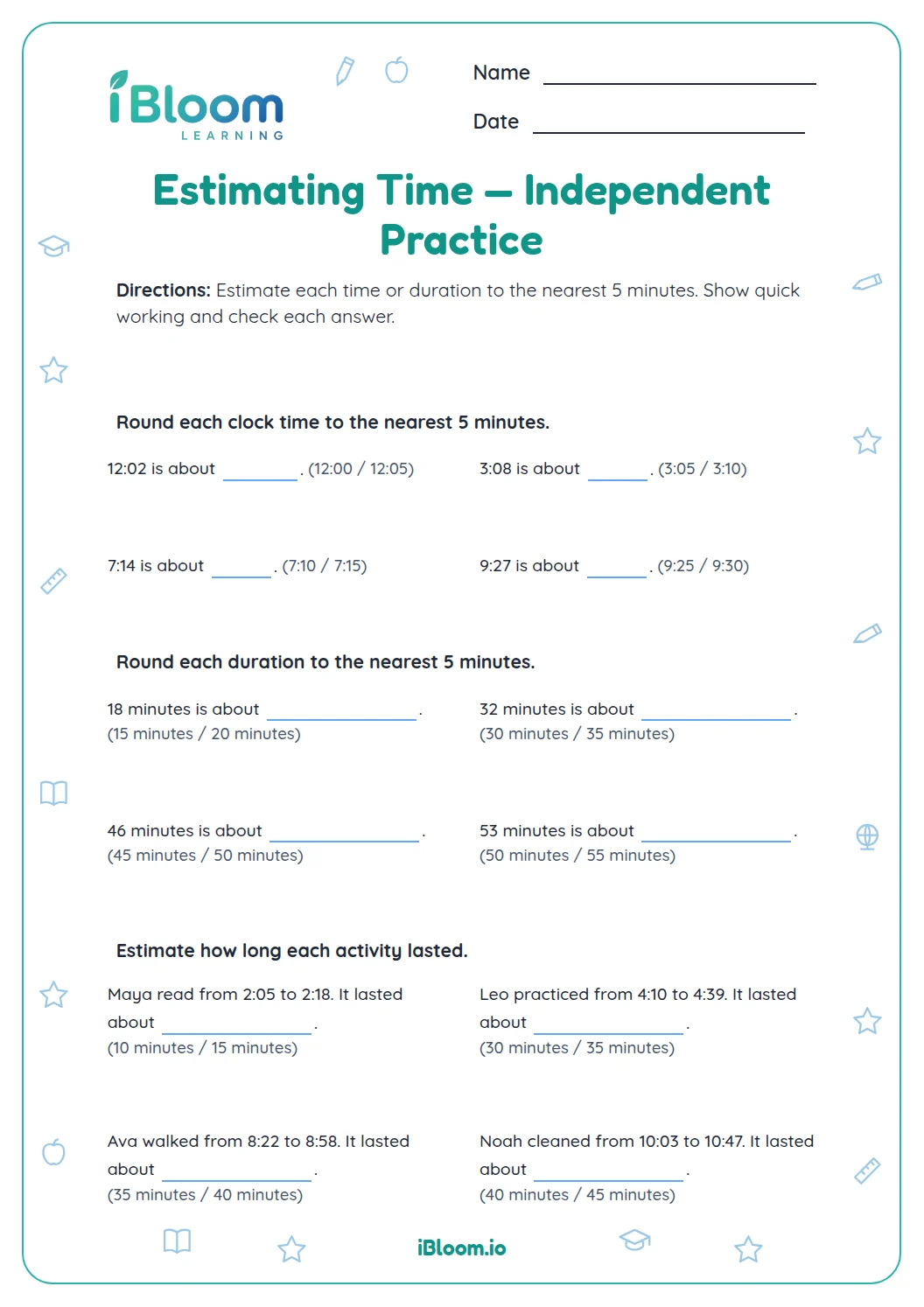
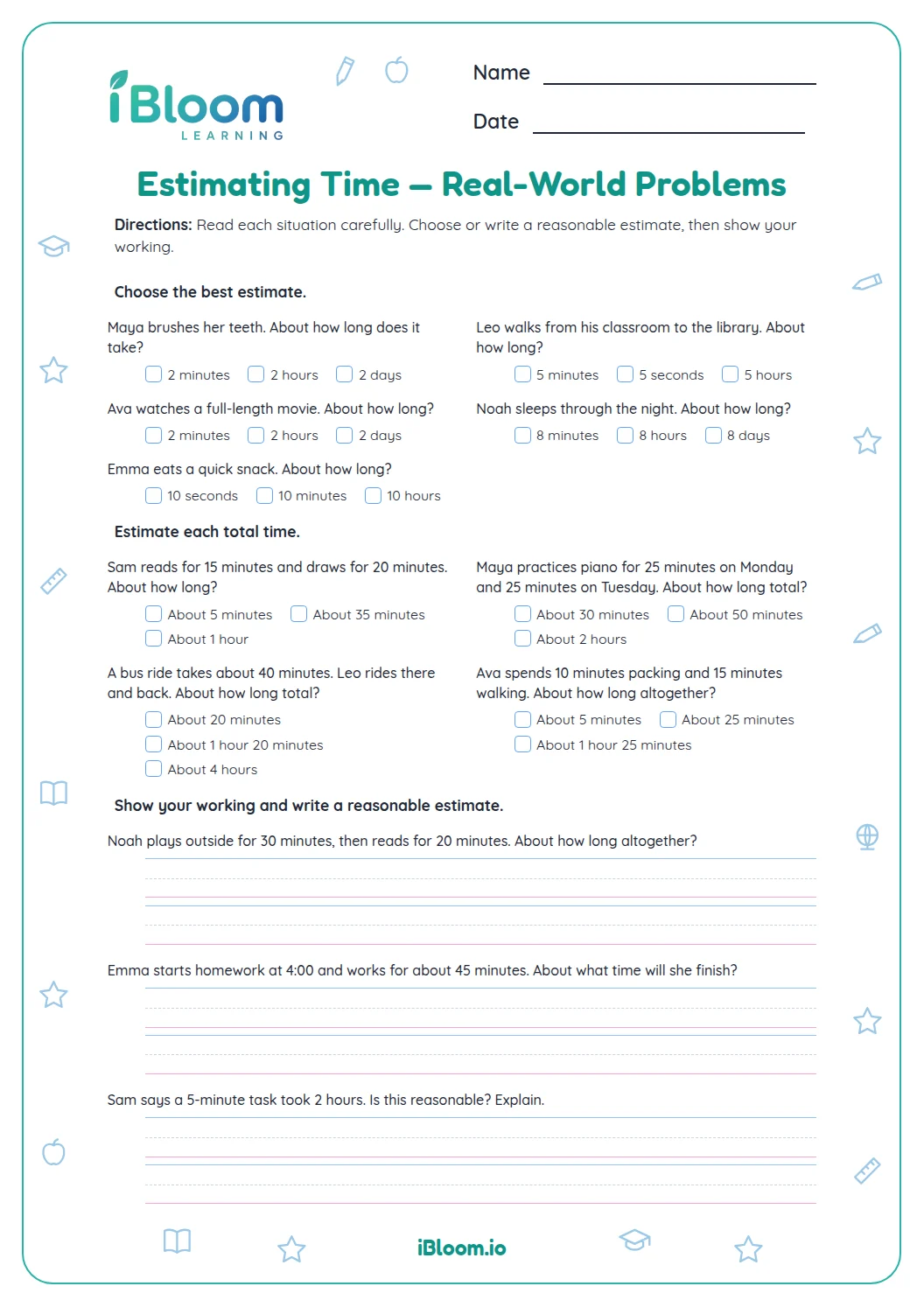
This Grade 3 time worksheet asks students to judge familiar durations, correct an unreasonable estimate, compare rounding strategies, and estimate how long an activity lasted. The final questions use start and end times, such as 8:12 to 8:47, and ask students to explain why a nearby estimate makes sense. It has 14 questions across two worksheet pages and a separate answer key. The elapsed-time problems connect to Common Core 3.MD.A.1.
Aligned to 3.MD.A.1
How do you spot an unreasonable estimate?
Compare the estimate with a familiar benchmark. Thirty-eight minutes is closer to 30 minutes than to 1 hour, so “about 30 minutes” is the stronger estimate.
- 138 minutes → about 30 minutes, not 1 hour
How can students choose a useful time benchmark?
Round to a nearby amount that is easy to work with. For 47 minutes, rounding to 50 is efficient; counting every minute takes longer, and rounding all the way to 10 loses useful detail.
How can start and end times support an estimate?
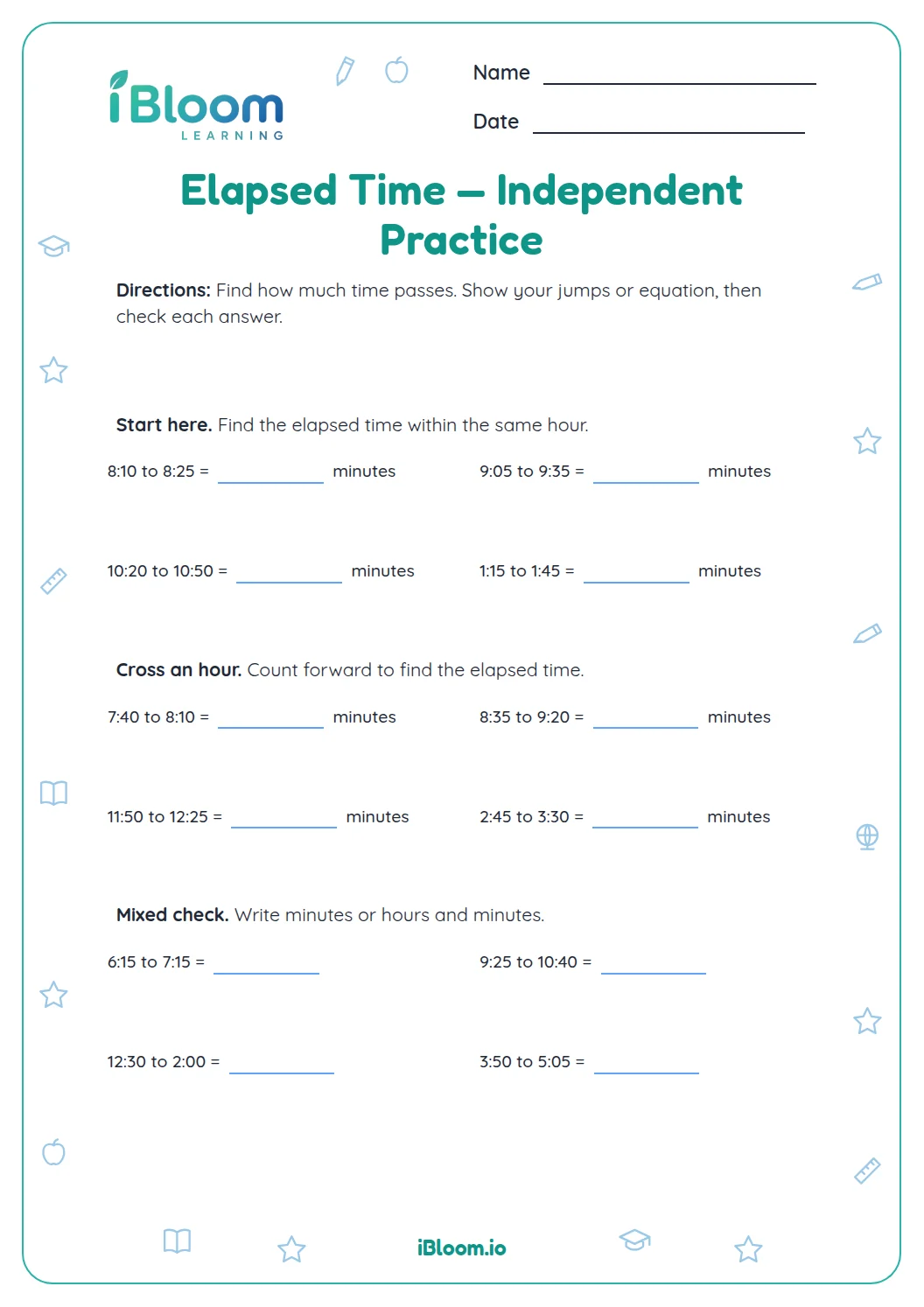
Find or reason about the interval, then compare it with a familiar duration. From 8:12 to 8:47 is 35 minutes, or about 30 minutes to the nearest quarter hour.
- 18:12 to 8:47 = 35 minutes, or about 30 minutes.
How to use this worksheet
- 1Read the duration and unit before choosing or estimating.
- 2Compare it with familiar amounts such as 30 minutes or 1 hour.
- 3Round to a nearby benchmark when the exact time is not needed.
- 4For a start and end time, find the minutes between them.
- 5Check whether your estimate is close to the exact interval.
Common mistakes and quick fixes
The mistake
Choosing hours for a brief activity.
The fix
Ask whether the activity could really continue that long.
The mistake
Adding minutes without changing the hour at 60.
The fix
Count to the next hour, then count the remaining minutes.
The mistake
Giving a number without a unit.
The fix
Write minutes or hours so the estimate is clear.
Common Core alignment
The elapsed-time questions apply minute intervals to familiar situations.
Measure intervals in minutes and use elapsed-time reasoning in story problems.
On this sheet: Students estimate intervals between stated start and end times and explain their reasoning.
Show the official wordingHide the official wording
Tell and write time to the nearest minute and measure time intervals in minutes. Solve word problems involving addition and subtraction of time intervals in minutes, e.g., by representing the problem on a number line diagram.
What to practice next
Make more practice
Further reading
Questions parents and teachers ask
What kinds of time questions are on the page?
Students correct an estimate, choose useful rounding strategies, fill in nearby time amounts, and explain elapsed-time estimates. The examples use minutes and hours, including durations found from a start and end time. The separate key gives the intended estimate for each item.
How long is the bus ride from 8:12 to 8:47?
The exact interval is 35 minutes. For an estimate, 30 minutes is a nearby benchmark and is closer than 20 or 40 minutes. Students explain that choice by noting that 35 minutes is about half an hour. It is close to half an hour.
Why does 38 minutes round to about 30 minutes?
Thirty-eight minutes is closer to 30 minutes than to 60 minutes: it is 8 minutes from 30 and 22 minutes from 60. So “about 30 minutes” is the better estimate than “about 1 hour.” The first question asks students to identify that correction.
What does it mean to compare strategies?
Students choose an efficient method for making a close estimate. For 47 minutes, rounding to 50 is quicker than counting each minute and more useful than rounding all the way to 10. Comparing methods helps learners select a reasonable benchmark for the situation.
Does this worksheet ask students to read clock drawings?
The time questions state the start and end times in numerals, so students can focus on comparing durations and estimating elapsed time. They do not need to infer a time from a clock face. The given times still let them reason about intervals to the minute.
How long does this Grade 3 worksheet take?
Plan for about 15 minutes. Students can complete the duration choices, time benchmarks, and estimate completions first. The last two questions ask them to match an estimate with a simple reason, such as noting how many minutes away it is from the exact interval.