
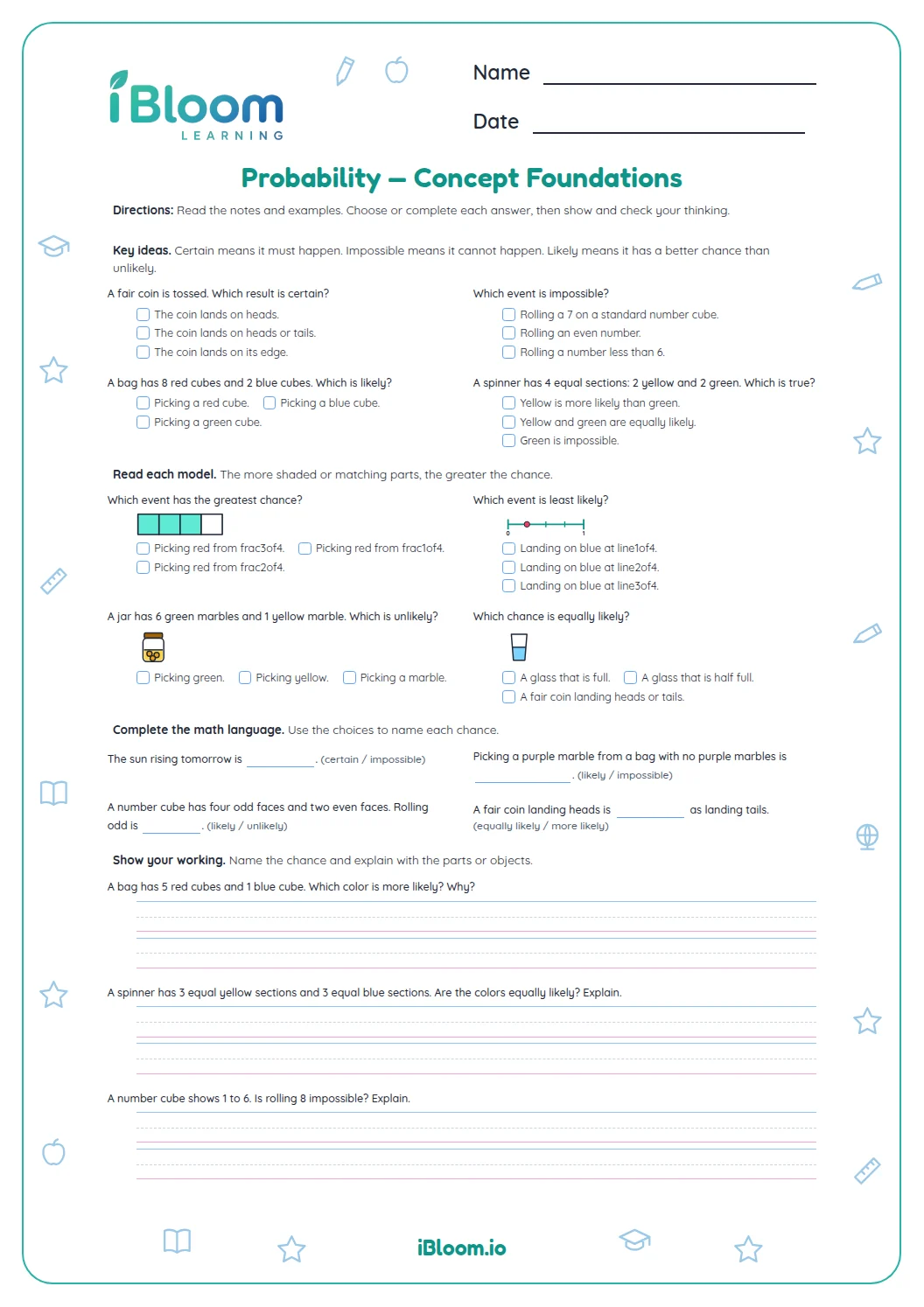
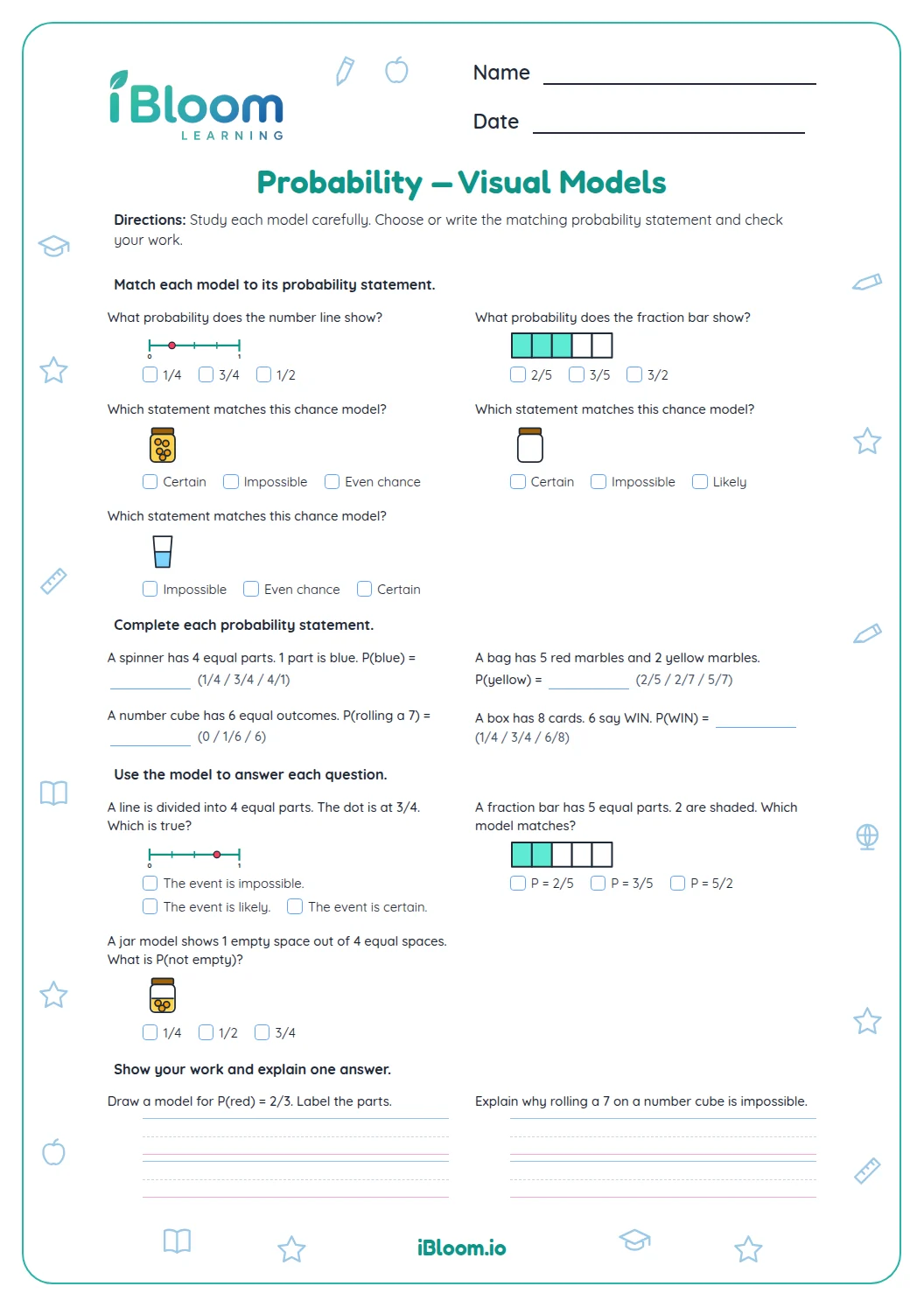
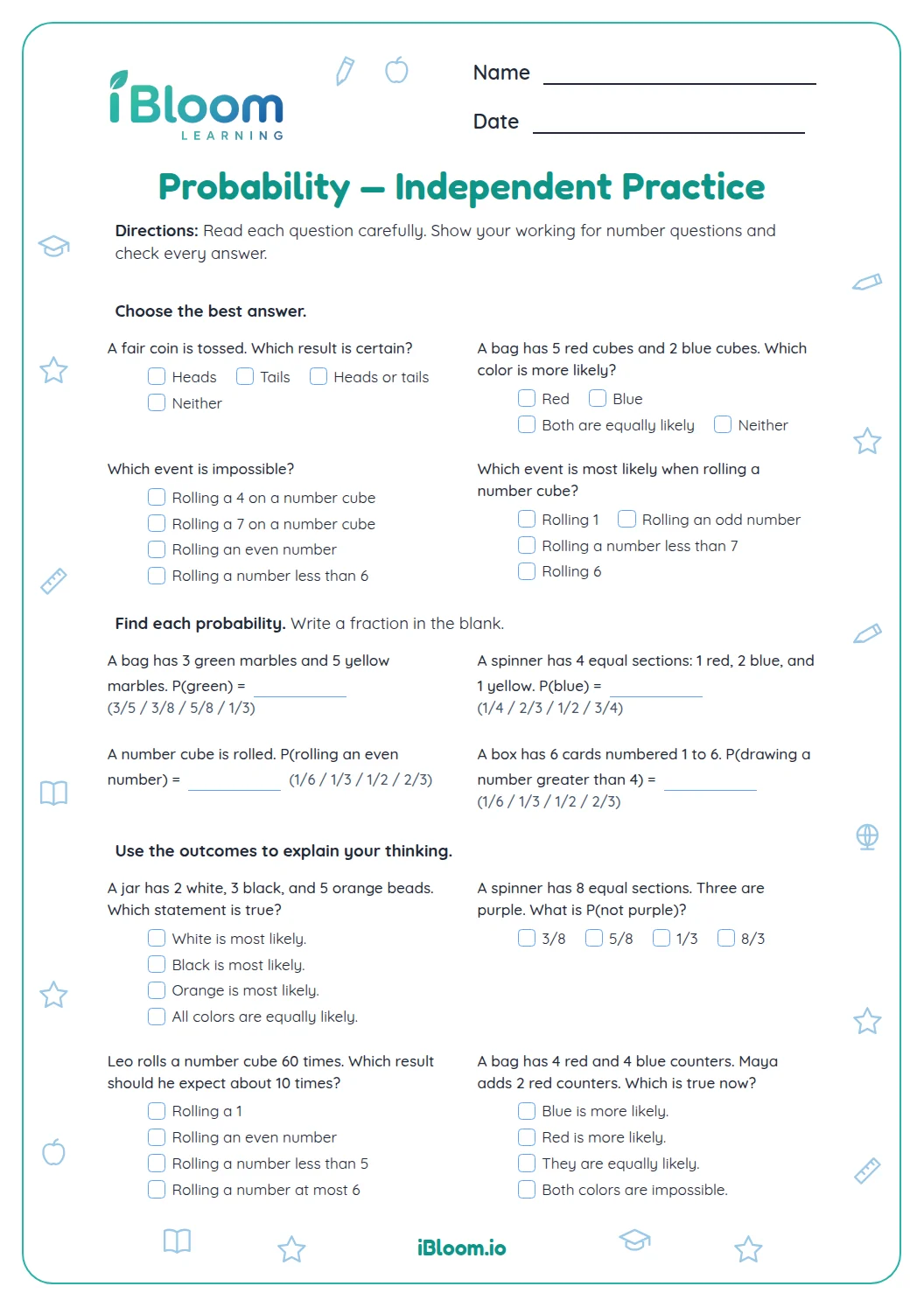
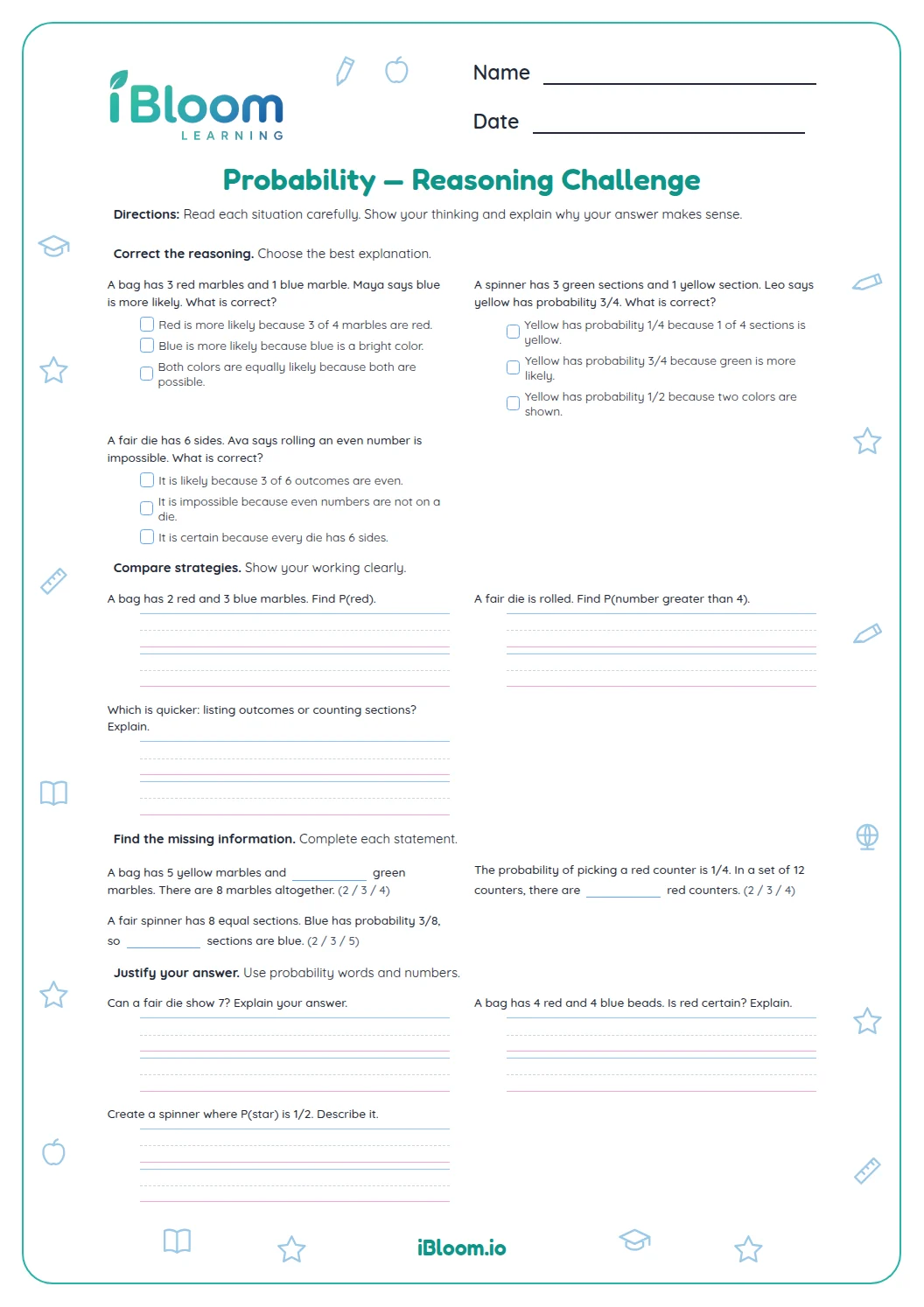
About this worksheet
Children first compare visible counts and use certain, likely, unlikely, and impossible. They then count favorable outcomes over all equally likely outcomes, before explaining comparisons.
What do probability words mean?
Probability describes how likely an event is. Certain means it must happen; impossible means it cannot happen. Likely and unlikely compare the number of favorable outcomes with the other outcomes.
Part A compares outcomes. Part B names chances with probability words. Part C uses fractions and comparisons to describe the outcomes.
- Certain: every possible outcome works
- Impossible: no possible outcome works
- Likely: more outcomes work than do not
- Unlikely: fewer outcomes work than do not
How do you write a chance as a fraction?
Count the outcomes that match the event, then place that count over the total number of equally likely outcomes. A fair number cube has three even results (2, 4, 6) out of six, so the chance of an even number is 3/6, or 1/2.
Use the counts printed in each question. A larger number of favorable outcomes does not always mean a greater chance unless the total number of outcomes is the same.
What does each part practice?
Part C counts favorable and total outcomes, then compares chances. Question 11 asks for the chance of an even roll: three of the six faces are even, so the fraction is 3/6, or 1/2.
A simple way to solve each question
- 1Read how many of each outcome there are.
- 2For a chance word, compare the favorable count with the other outcomes.
- 3For a fraction, count favorable outcomes first and all outcomes second.
- 4For a comparison, check that the choices have the same total before comparing counts.
- 5Review each answer with the counts in the prompt.
Common probability mix-ups
The mistake
Calling an event likely just because it can happen.
The fix
Compare favorable outcomes with all equally likely outcomes.
What to practice next
Questions parents and teachers ask
How do children find a probability fraction?
Count the outcomes that match the event, then put that count over the total number of equally likely outcomes. In question 9, three of five tiles are red, so the probability is 3/5. The answer key includes equivalent forms where a fraction can be simplified.
What does equally likely mean?
Equally likely outcomes have the same chance of happening. Question 2 uses two blue beads and two orange beads, so neither color has an advantage. The chance is the same for each color because the counts match in the prompt.
What do certain, likely, unlikely, and impossible mean?
Certain means an event must happen; impossible means it cannot happen. Likely means more outcomes make it happen than not, while unlikely means fewer outcomes do. Questions 5 through 8 use these words with small sets and familiar events.
What is the answer to the even-number question?
A fair number cube has three even faces: 2, 4, and 6. Out of six total faces, that is 3/6, which simplifies to 1/2. The worksheet asks children to count favorable outcomes and compare them with the full set.
How can I use the answer key?
Have the learner finish a part before checking the key. For any missed answer, return to the counts in the prompt and ask which outcomes fit the event. That keeps the review connected to the actual probability reasoning instead of memorizing a label.