

About this worksheet
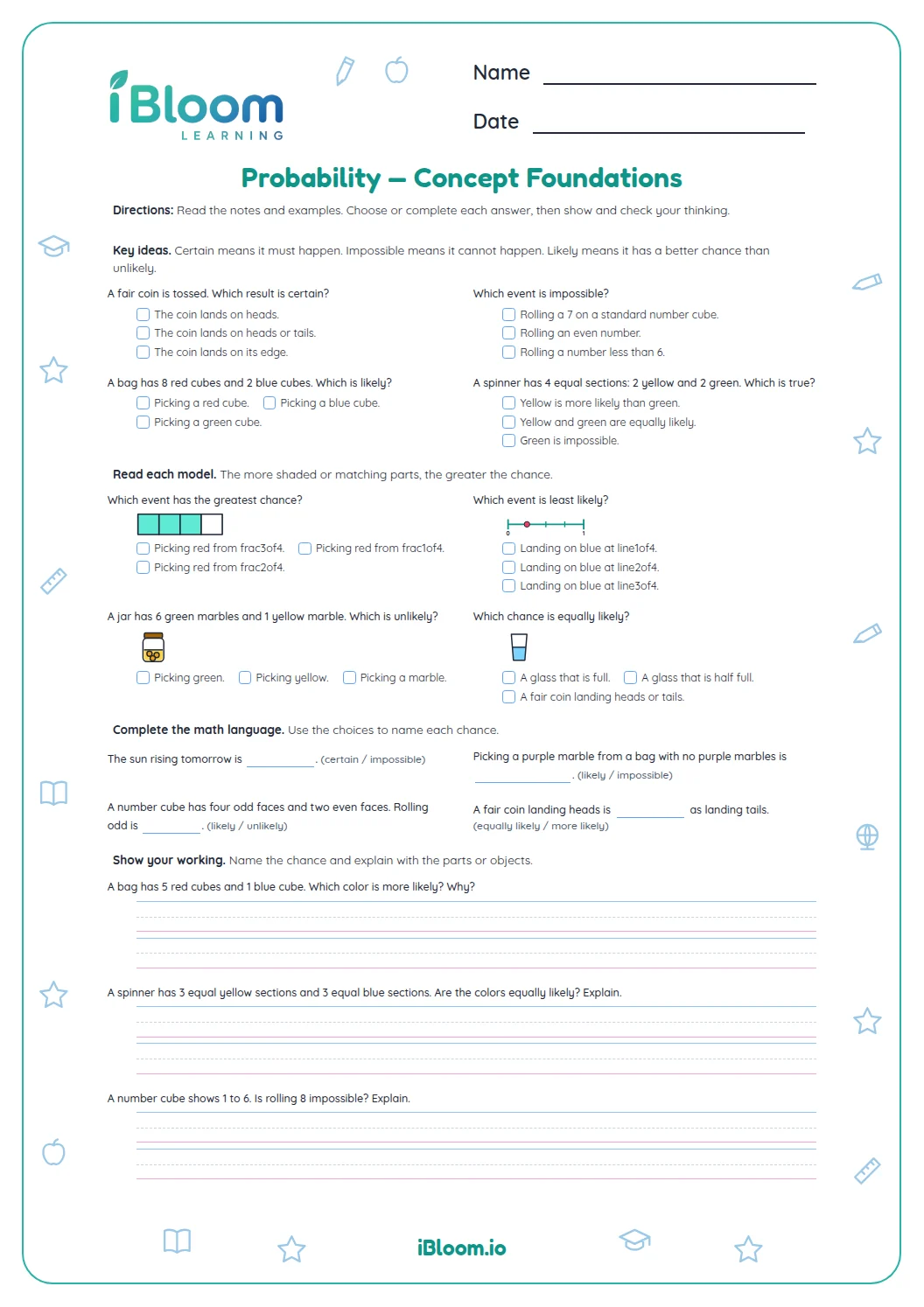
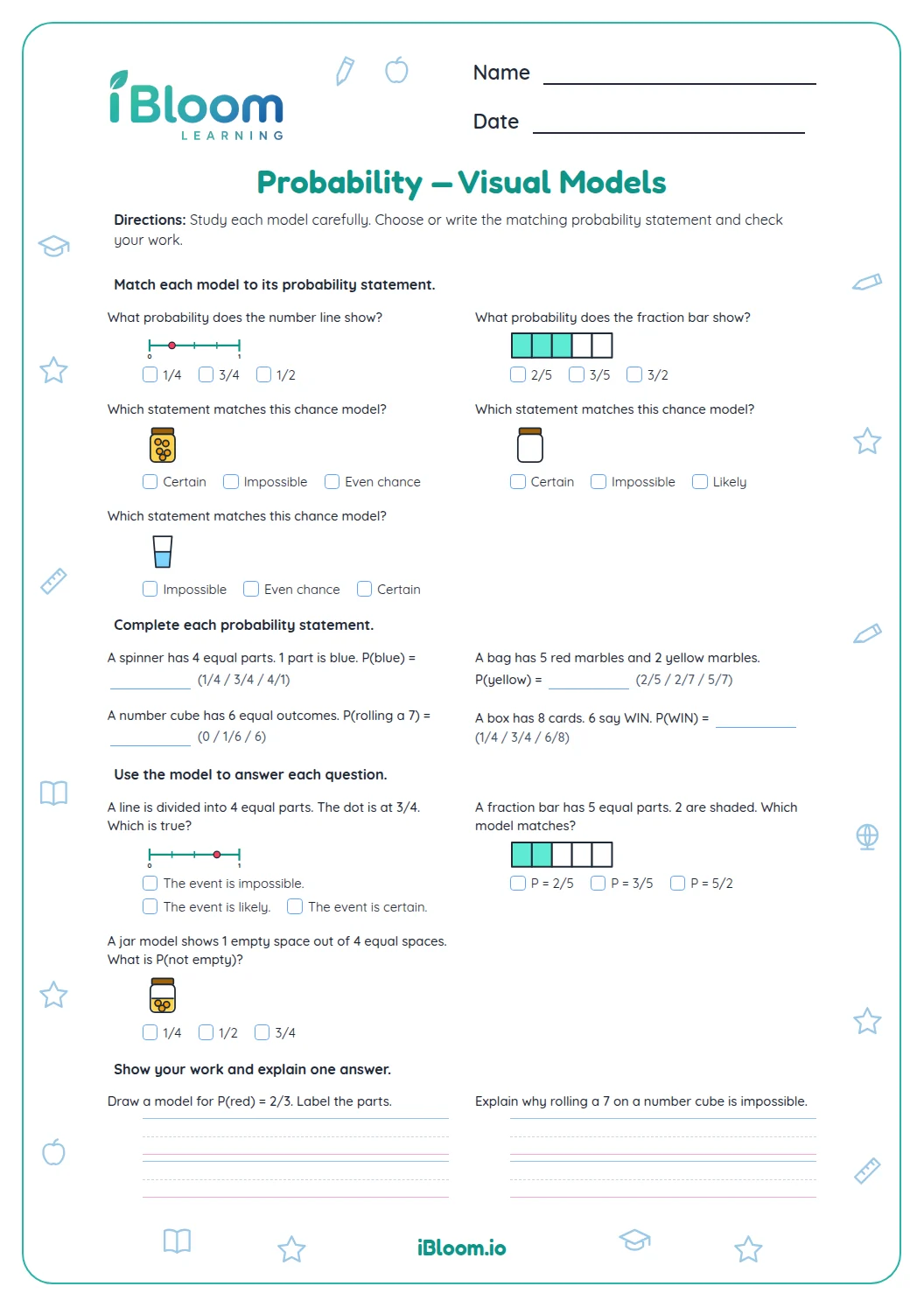
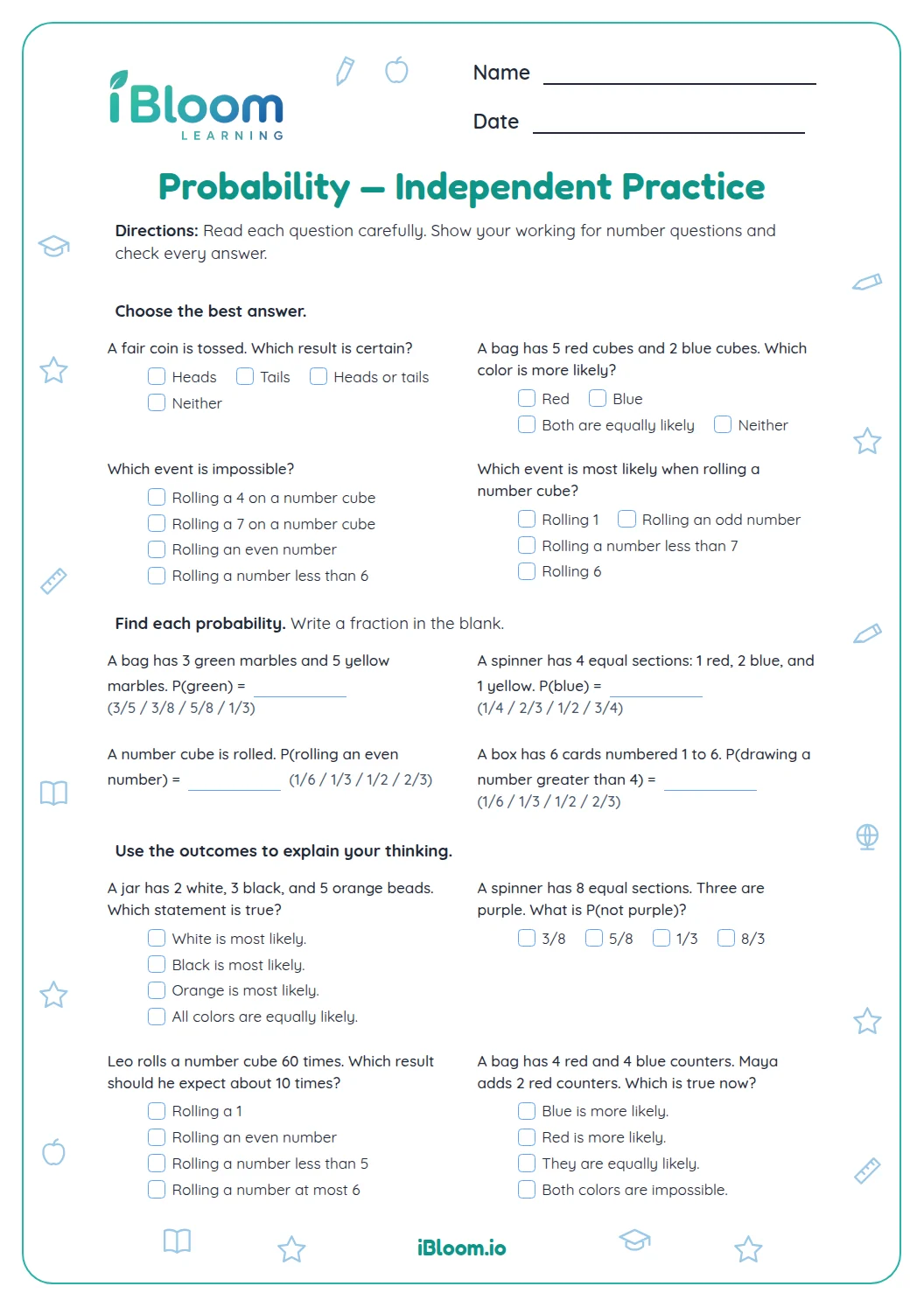
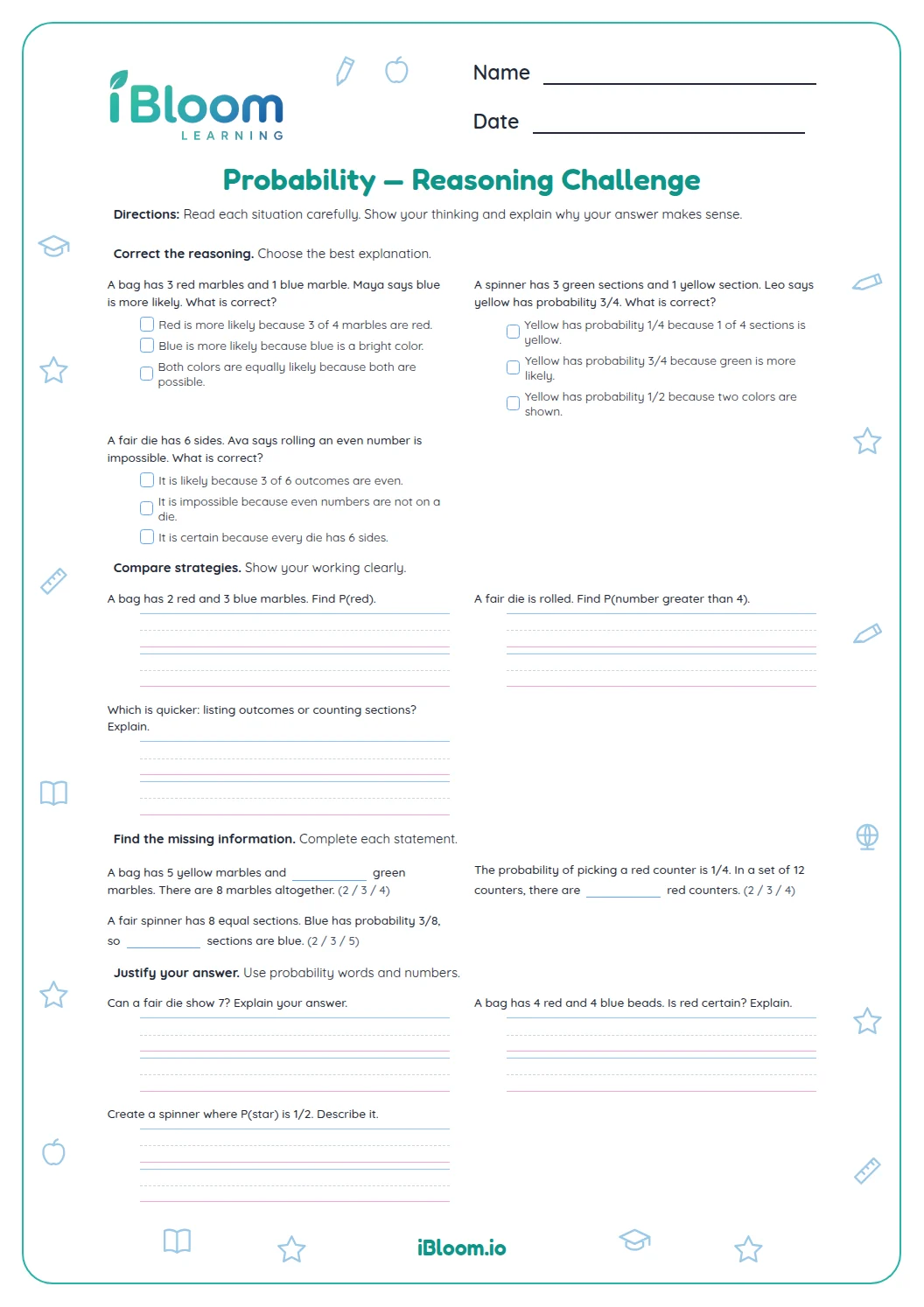
This Grade 4 worksheet connects probability to familiar situations with beads, counters, spinners, tickets, and treats. Students first write a chance word: certain, likely, equally likely, unlikely, or impossible. Then they count favorable outcomes, compare them with the total, and simplify the resulting fraction. All 16 questions include enough information to identify the sample space. The separate answer key lists the chance word or fraction for each item.
How do chance words describe an event?
Certain means the event must happen; impossible means it cannot happen. Likely and unlikely describe events with more and fewer favorable outcomes than unfavorable ones. Equally likely means the outcomes have the same chance, as in question 3 with five counters of each color.
- 15 purple counters out of 10 total
- 2Purple and yellow have the same number of outcomes, so purple is equally likely.
How do you write a probability as a fraction?
Count the outcomes that match the event, then place that count over the total number of outcomes. Simplify when numerator and denominator share a factor. In question 9, two of eight tiles are green, so 2/8 simplifies to 1/4.
How can students check a probability?
The favorable count cannot be greater than the total. For “not blue,” subtract the blue outcomes from all spinner spaces first; question 11 has three nonblue spaces out of eight.
A reliable way to solve each problem
- 1List or count the possible outcomes described.
- 2Mark which outcomes match the event.
- 3For a chance word, compare the favorable and unfavorable counts.
- 4For a fraction, write favorable outcomes over all outcomes.
- 5Simplify the fraction and check that it represents the same whole.
Common probability mistakes
The mistake
Calling an event likely when its outcomes are tied.
The fix
Compare both sides; when there are equally many favorable and unfavorable outcomes, choose equally likely.
The mistake
Using unfavorable outcomes as the numerator.
The fix
Underline the event asked about and count only outcomes that make it happen.
The mistake
Forgetting outcomes that do not match “not” in the question.
The fix
Subtract the matching outcomes from the total, then use that remainder as favorable outcomes.
What to practice next
Make more practice
Questions parents and teachers ask
What does “equally likely” mean?
Equally likely means the outcomes have the same chance. In question 3, the jar has five yellow and five purple counters, so either color is just as likely on one draw. This is different from “likely,” which means an event has more favorable than unfavorable outcomes.
How do students calculate a probability fraction?
Count how many outcomes match the event and write that count over the total. For two green tiles among eight tiles, the probability is 2/8, which simplifies to 1/4. Keep the same whole in the denominator for the full situation.
Why do some questions ask about “not” an outcome?
A question such as “not blue” asks for every outcome except blue. Count the total choices, remove the blue ones, and use what remains as the favorable count. For the spinner with five blue spaces out of eight, three spaces are not blue.
Are the situations based on equal chances?
The fraction questions treat each listed item or spinner space as equally likely to be chosen. That makes counting outcomes a useful way to find each probability. Read the quantities carefully before writing the fraction so the numerator and total describe the same group.
Does this worksheet include an answer key?
Yes. The separate key gives the chance word for questions 1–8 and the simplified probability fraction for questions 9–16. Students can check both the outcome count and the final fraction, especially when a question asks for outcomes that are not a named category.