

About this worksheet
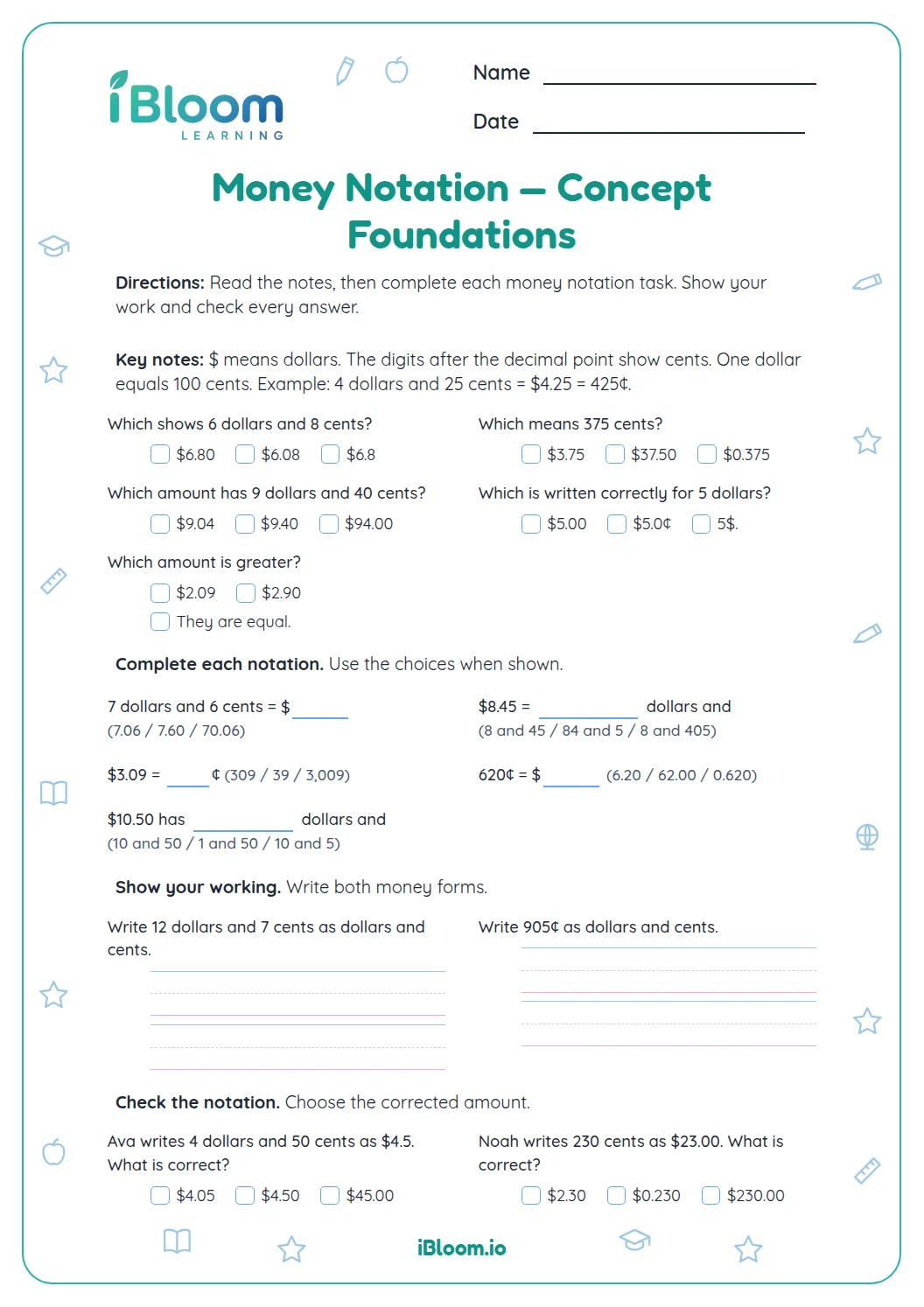
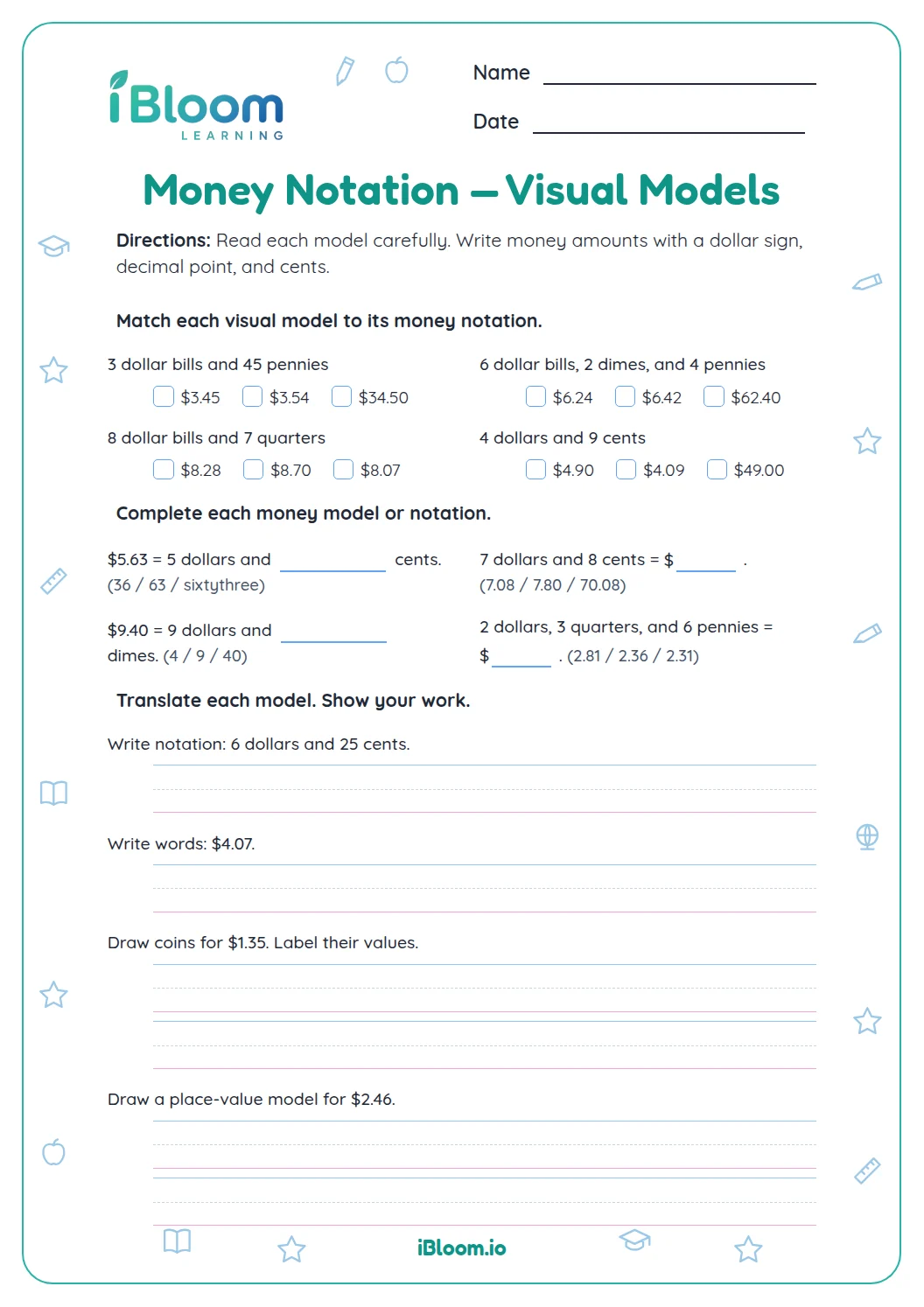
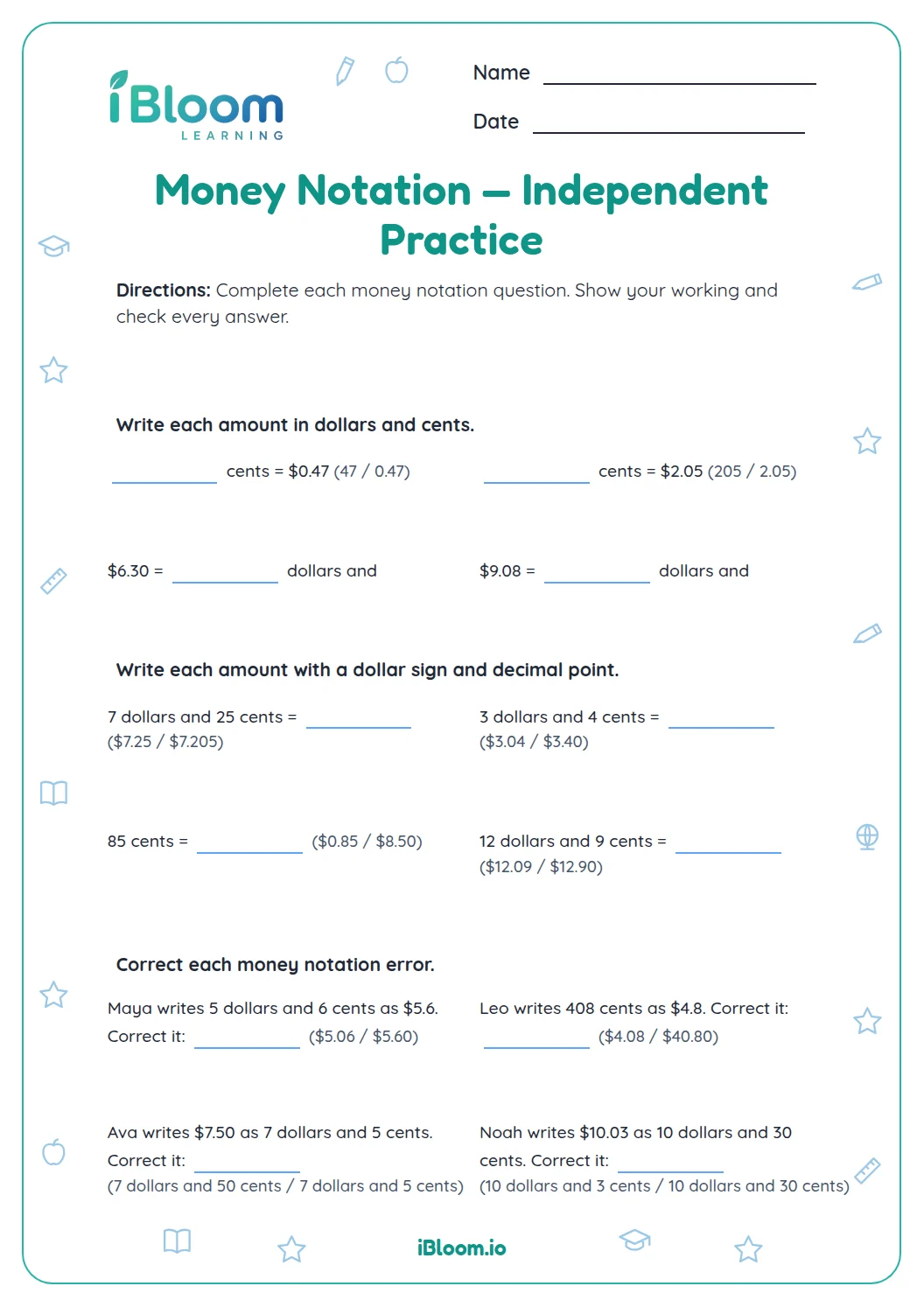
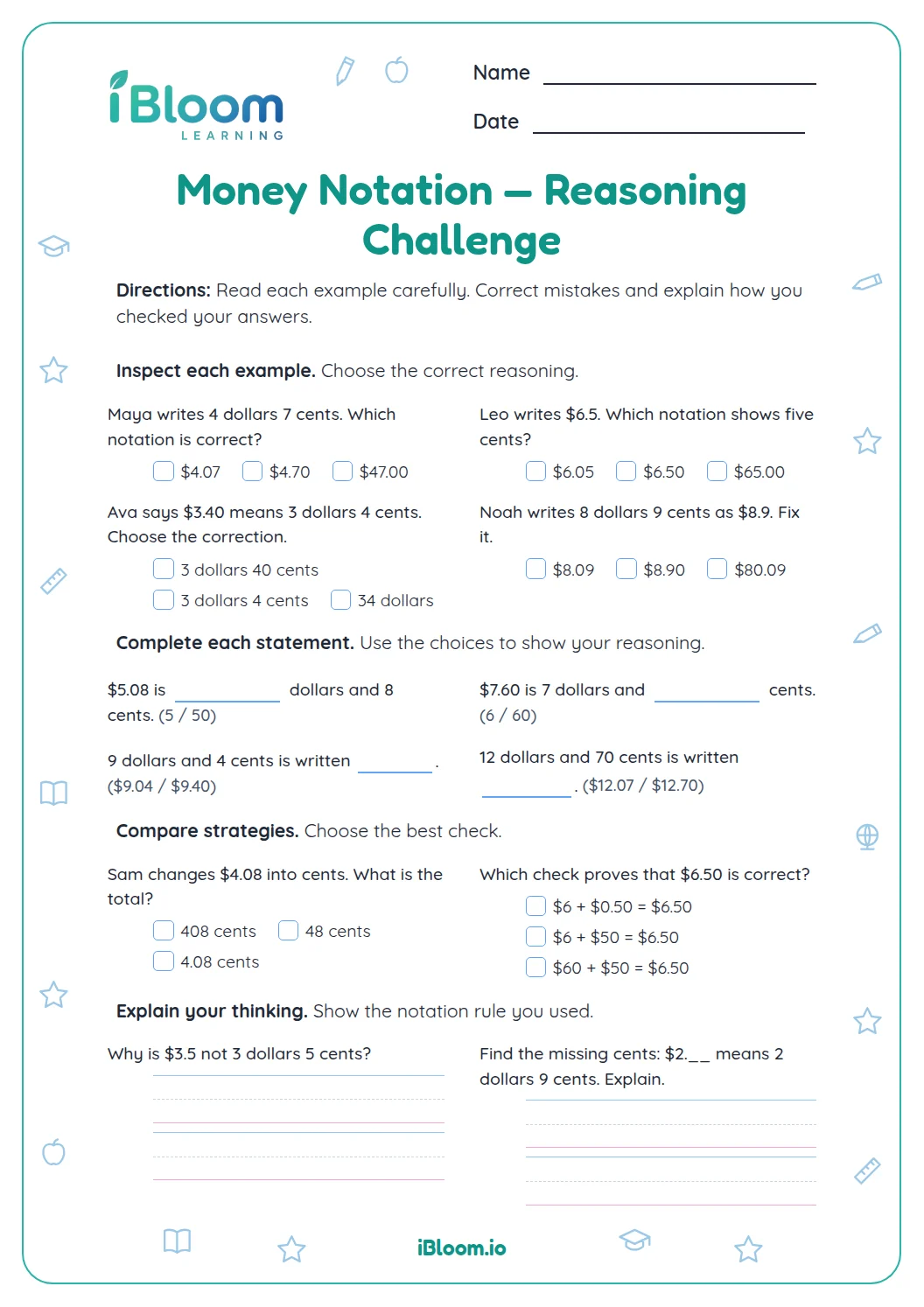
This Grade 4 printable practices decimal notation for money, conversions, comparisons, and everyday money calculations. Students write dollar amounts and solve short price questions in 14 fill-in items, with a separate two-page answer key. The questions connect money notation and problem solving to Common Core 4.MD.A.2.
Aligned to 4.MD.A.2
How do you write dollars and cents?
Write dollars before the decimal point and cents in two places after it. Seven cents is 0.07 dollars, so $3 and 7 cents is $3.07.
- 1$3 and 7 cents
- 2Answer: $3.07
How do you convert dollars and cents?
There are 100 cents in a dollar. Multiply dollars by 100 to find cents, or divide cents by 100 to write dollars. Keep two decimal places when recording a money amount.
How do you solve a money story?
Choose the operation from the situation: add prices for a total, subtract payment from the cost for change, or multiply when several items cost the same amount.
How to use this worksheet
- 1Read the directions before starting each part.
- 2Complete the first item together and explain the reasoning aloud.
- 3Let the learner try the remaining questions independently.
- 4Pause to check signs, labels, and units where they appear.
- 5Use the answer key to find one item to review.
Money notation checks
The mistake
Writing 7 cents as $3.7 for $3 and 7 cents.
The fix
Use two places for cents: seven cents is $0.07.
The mistake
Treating 375 cents as $375.
The fix
Divide cents by 100 to get $3.75.
The mistake
Comparing only the digits after the decimal.
The fix
Compare the full dollar amounts, including dollars and cents.
Common Core alignment
This worksheet practices the skills described in the standard below.
Use decimal notation for money and solve problems involving money.
On this sheet: Use decimal notation for money and solve problems involving money.
Show the official wordingHide the official wording
Use the four operations to solve word problems involving distances, intervals of time, liquid volumes, masses of objects, and money, including problems involving simple fractions or decimals, and problems that require expressing measurements given in a larger unit in terms of a smaller unit. Represent measurement quantities using diagrams such as number line diagrams that feature a measurement scale.
What to practice next
Make more practice
Further reading
Questions parents and teachers ask
How many questions are included?
There are 14 questions in two parts. Students write dollar amounts, compare prices, and calculate totals or change in short fill-in statements. The separate two-page answer key gives the expected amount for each item, so learners can check decimal notation as well as arithmetic.
Why does $3 and 7 cents become $3.07?
The decimal part of a dollar records cents in hundredths. Seven cents is seven hundredths of a dollar, so it is written as 0.07; together with three dollars, the amount is $3.07. The zero holds the tenths place and keeps the cents in the correct position.
How do learners convert cents to dollars?
Divide the number of cents by 100. For example, 425 cents is $4.25. To convert dollars to cents, multiply by 100. These conversions appear in both directions in the worksheet, including writing cents as a decimal amount with a dollar sign.
What kinds of word problems appear?
The final questions use prices to find change, the total cost of repeated items, whether a balance is enough, and the combined cost of two items. Each problem asks for a money amount or a yes-or-no conclusion with reasoning.
Does the answer key include sample explanations?
Yes. The key gives the expected numerical results and a sample explanation for the question about whether 375 cents is enough to buy a $3.80 toy. Equivalent clear wording can also show the comparison and the five-cent difference.