



About this worksheet
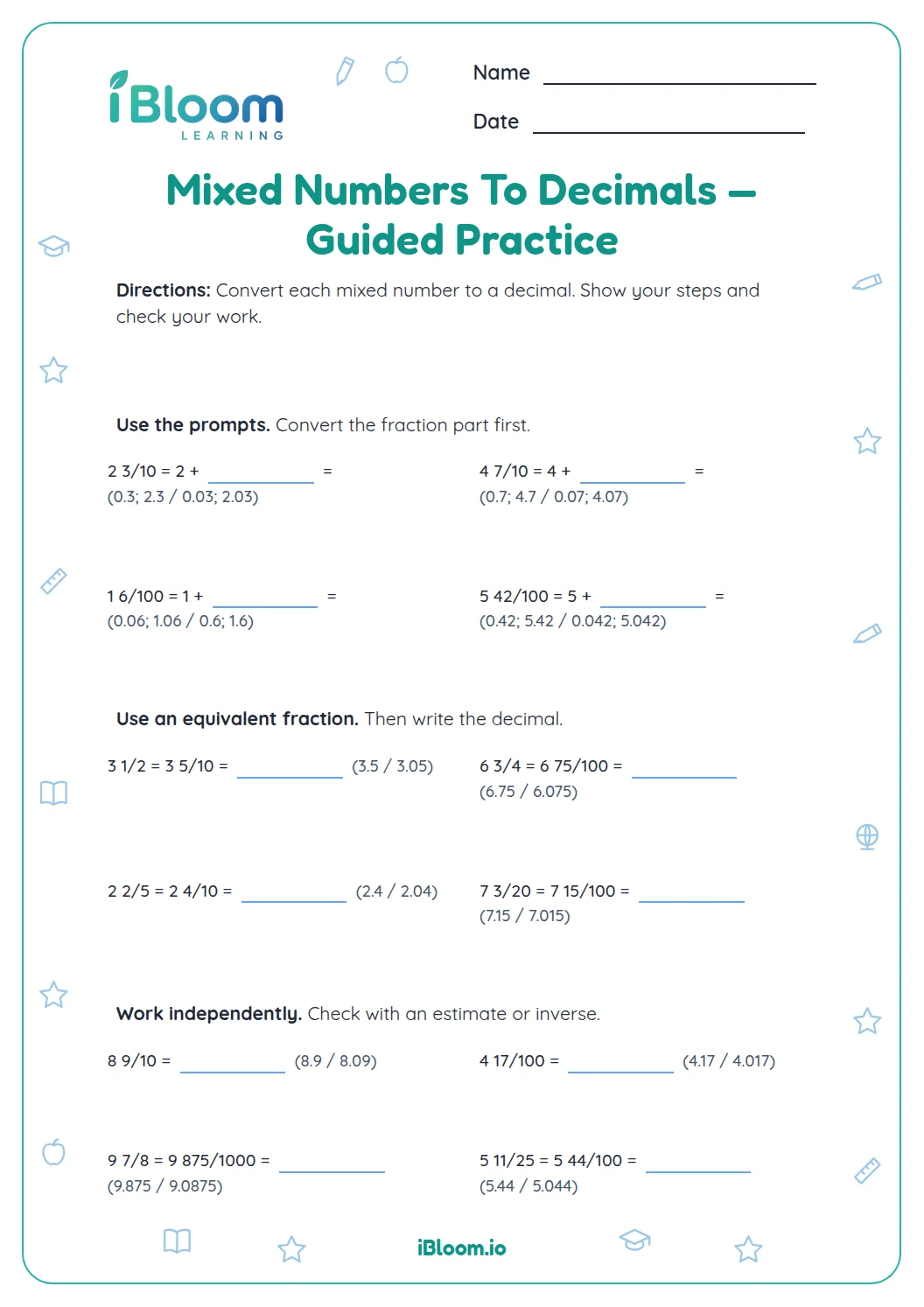
This Grade 4 worksheet gives 16 questions on converting mixed numbers with tenths and hundredths to decimal notation. Students also convert decimals back to mixed numbers, compare values, and order decimals. A separate answer key lists the responses.
Aligned to CCSS.MATH.CONTENT.4.NF.C.6
How do tenths become decimals?
Keep the whole-number part and write the tenths digit after the decimal point. For example, 2 7/10 is 2.7.
Why does a hundredths decimal need two places?
Hundredths use two places after the decimal. In 4 5/100, there are zero tenths and five hundredths, so the decimal is 4.05.
How can you compare the values?
Rename values with the same number of decimal places. For example, 3 7/10 is 3.70, which is greater than 3.65.
How can students convert and compare?
- 1Keep the whole-number part of the mixed number.
- 2For tenths, write the numerator in the tenths place.
- 3For hundredths, use two decimal places, adding a zero when needed.
- 4For a decimal-to-mixed-number item, read the decimal places as tenths or hundredths.
- 5When comparing, line up decimal places and compare from left to right.
What should students check?
The mistake
Writing 4 5/100 as 4.5.
The fix
Use 4.05: the zero marks zero tenths and 5 is in the hundredths place.
The mistake
Dropping a zero in a hundredths answer.
The fix
Keep both decimal places when the fraction is in hundredths.
The mistake
Comparing digits without aligning place values.
The fix
Write equivalent decimals with the same number of places, such as 3.70 and 3.65.
Curriculum alignment
This worksheet practices the grade-level skill named in its title.
Write a mixed number's fractional part in decimal notation for denominators 10 and 100.
On this sheet: The activities directly practice this skill.
Show the official wordingHide the official wording
Use decimal notation for fractions with denominators 10 or 100.
What to practice next
Make more practice
Further reading
Questions parents and teachers ask
How do you convert a mixed number with tenths to a decimal?
Keep the whole number and write the numerator in the tenths place. For example, 3 4/10 is 3.4. The worksheet includes tenths conversions and asks students to read decimal values back as mixed numbers. Students can point to the clue or place-value step they used so the check also reinforces the skill.
Why is 4 5/100 written as 4.05?
The fraction 5/100 means five hundredths. There are no tenths, so the tenths place is zero and the hundredths place is 5. Writing 4.5 would mean four and five tenths, which is a different value. Students can point to the clue or place-value step they used so the check also reinforces the skill.
Which denominators appear?
The conversion questions use tenths and hundredths: denominators 10 and 100. Students convert values in both directions and use the decimal forms to compare and order numbers. Students can point to the clue or place-value step they used so the check also reinforces the skill.
How do students compare 3 7/10 and 3 65/100?
Rename 3 7/10 as 3.70 so both values are in hundredths. Since 70 hundredths is greater than 65 hundredths, 3.70 is greater. The worksheet includes comparison and ordering items after the conversion practice. Students can point to the clue or place-value step they used so the check also reinforces the skill.
Is an answer key included?
Yes. A separate answer key lists the expected decimal, mixed-number, or comparison response for each question. Equivalent decimal forms such as 6.4 and 6.40 name the same value when the requested form allows them. Students can point to the clue or place-value step they used so the check also reinforces the skill.