


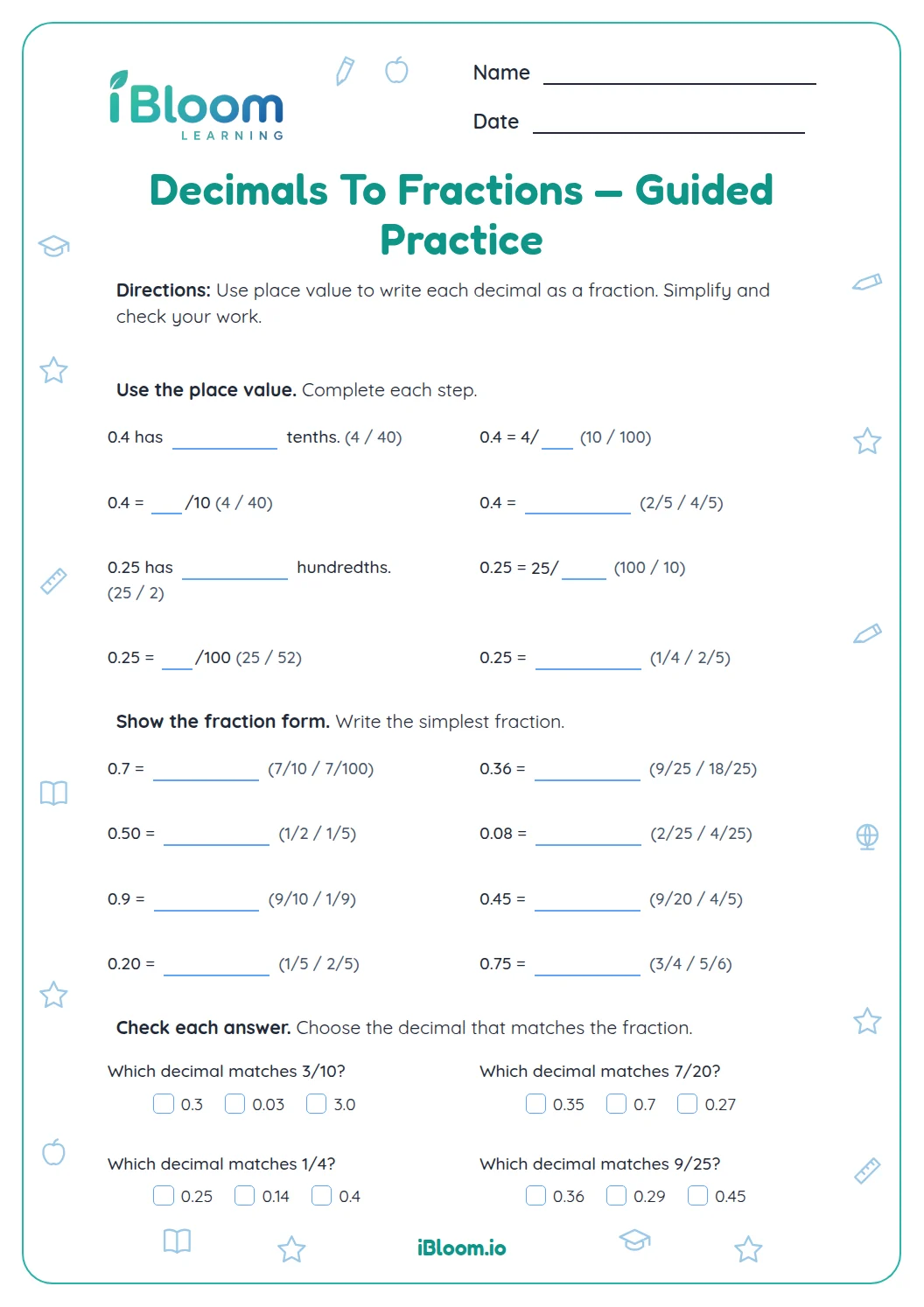
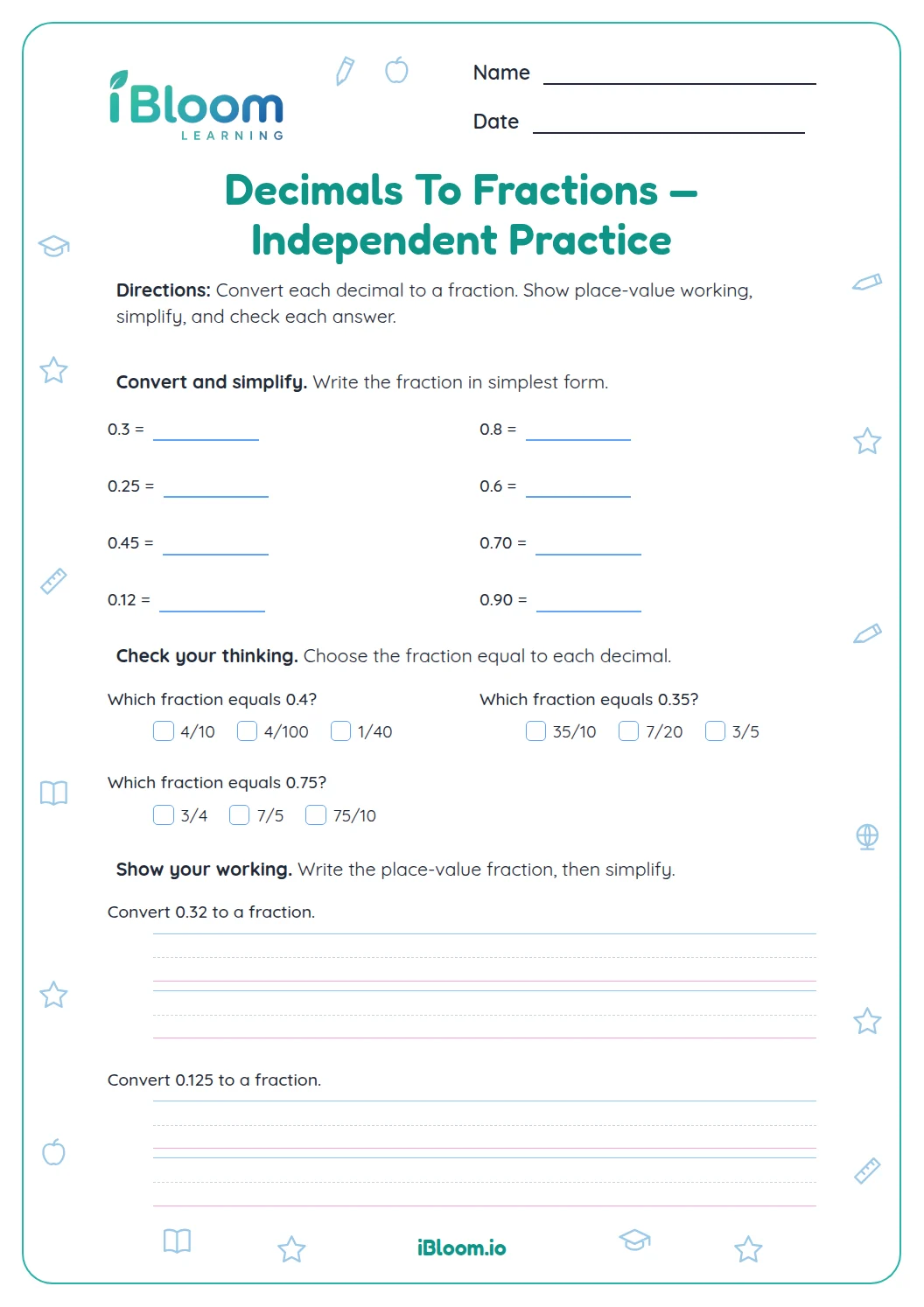
About this worksheet
This Grade 4 printable has 16 decimal-to-mixed-number conversions using tenths and hundredths. Several values include a zero that holds a place, such as 4.08. Students keep the whole-number part and name the decimal digits by place value; the work supports CCSS 4.NF.C.6.
Aligned to 4.NF.C.6
How do you read the decimal part?
Digits to the left of the decimal name the whole-number part. One place to the right is tenths; two places are hundredths. So 3.25 is 3 wholes and 25 hundredths, written 3 25/100.
A zero can hold a place. In 4.08, the 8 is in the hundredths place, so the mixed number is 4 8/100, not 4 8/10.
How do you choose the denominator?
Use 10 for tenths and 100 for hundredths to show the decimal place value. For example, 2.7 is 2 7/10, while 6.09 is 6 9/100. The worksheet key keeps these denominators visible, even when a fraction could be simplified.
How can you check the conversion?
Read the mixed number back as a decimal. The whole number stays to the left of the decimal, and tenths or hundredths stay in the matching places. For 9.04, 9 4/100 returns to 9.04.
Convert each decimal
- 1Read the digits before the decimal as the whole-number part.
- 2Name the fractional digits by place value: tenths or hundredths.
- 3Write both parts together as a mixed number and check the denominator.
Common mix-ups
The mistake
Writing 4.08 as 4 8/10 because the fractional part has one nonzero digit.
The fix
Look at the digit’s place, not how many digits are nonzero. The 8 is two places right of the decimal, so it means 8 hundredths.
The mistake
Leaving out the whole number when a decimal is greater than 1.
The fix
Keep the digits to the left of the decimal as the mixed number’s whole part.
Common Core alignment
This practice connects decimal place value through hundredths with equivalent fractions.
Write fractions with denominators 10 or 100 as decimals.
On this sheet: Learners use tenths and hundredths to express each decimal as a mixed number.
Show the official wordingHide the official wording
Use decimal notation for fractions with denominators 10 or 100.
What to practice next
Make more practice
Further reading
Questions parents and teachers ask
How do I write a decimal as a mixed number?
Read the digits to the left of the decimal as the whole-number part. Read the digits to the right by place value. For example, 2.7 means 2 wholes and 7 tenths, so it is 2 7/10. Keep the decimal digits in their original place-value order.
How do I know whether to use tenths or hundredths?
Look at the place of the last digit. One place right of the decimal is tenths, so 5.3 is 5 3/10. Two places right is hundredths, so 5.36 is 5 36/100. The denominator names the number of equal parts in one whole.
Why does 4.08 use hundredths?
The 8 is in the second place to the right of the decimal point. That place is hundredths, even though the tenths digit is zero. So 4.08 is 4 8/100. The zero holds the tenths place and keeps the 8 in hundredths.
Can the fraction part be simplified?
Yes, some fractions such as 25/100 can be simplified to 1/4. This worksheet practices matching the decimal place value, so its key keeps the denominator 10 or 100 to make the connection clear. Equivalent simplified fractions also name the same amount.
Should I simplify the fraction part?
The answer key keeps denominators of 10 or 100 so the decimal place value stays visible. For example, 25/100 could be simplified to 1/4, but 25/100 makes the hundredths in 0.25 explicit. Follow the format requested by the worksheet or teacher.