





About this worksheet
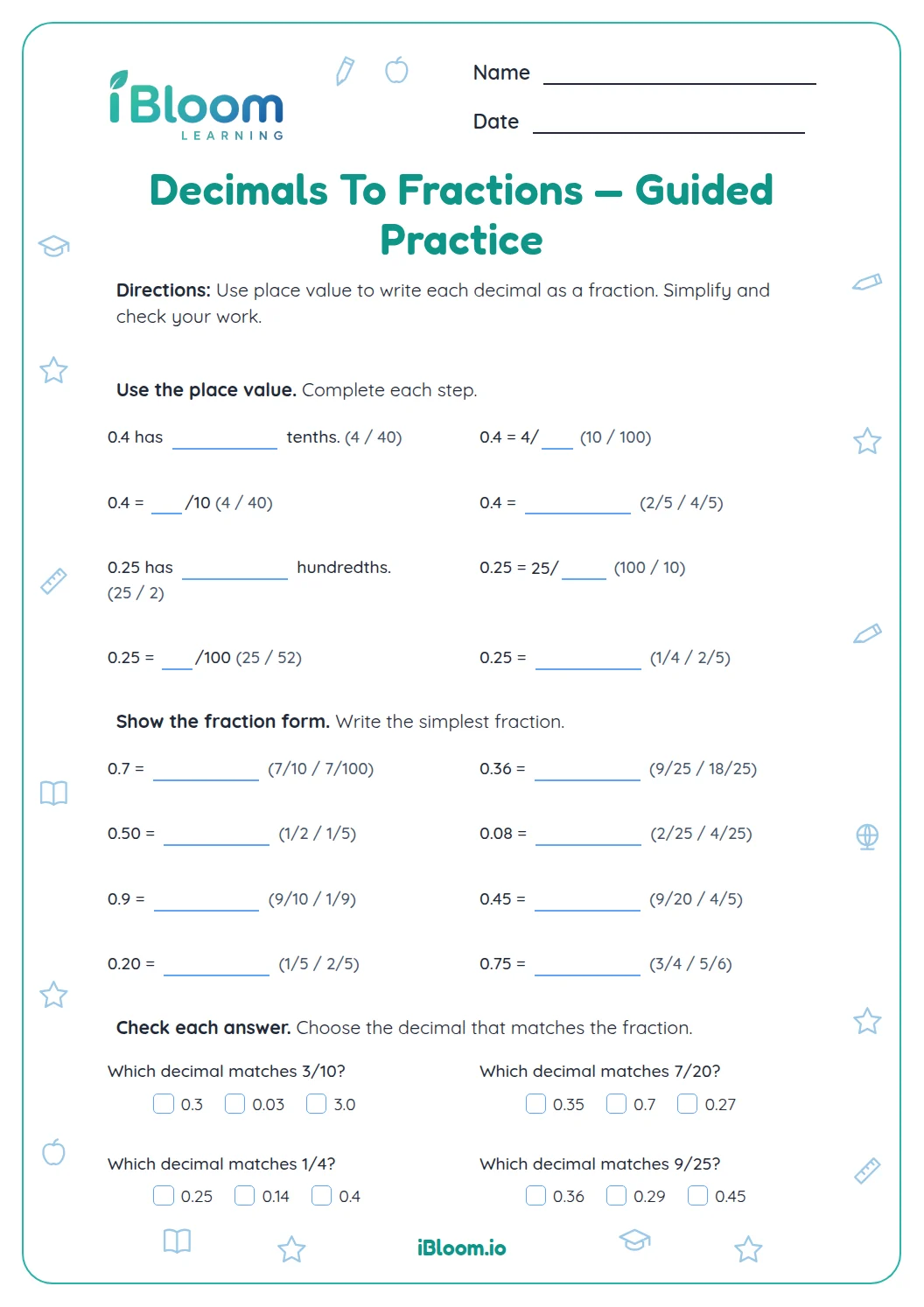
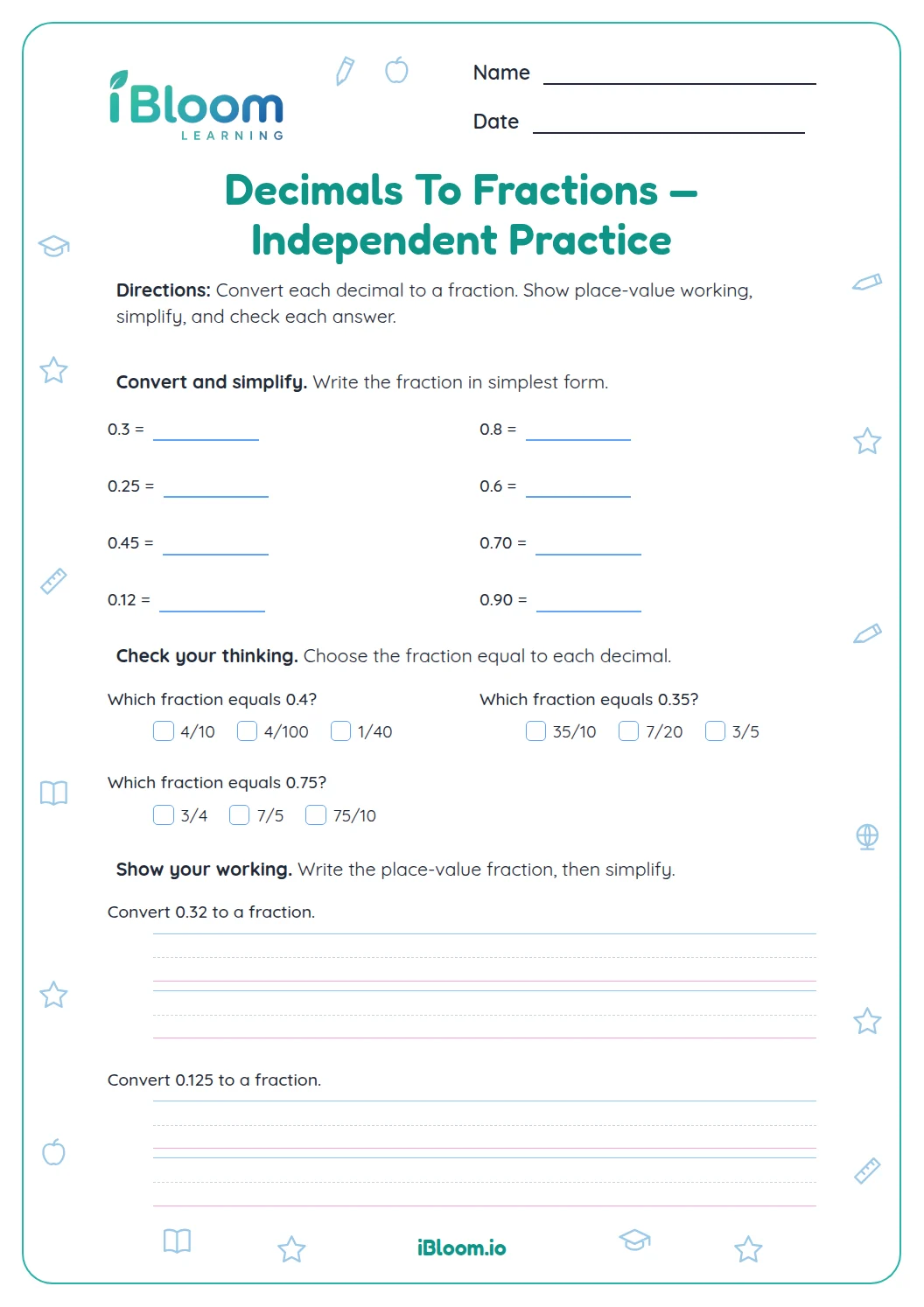
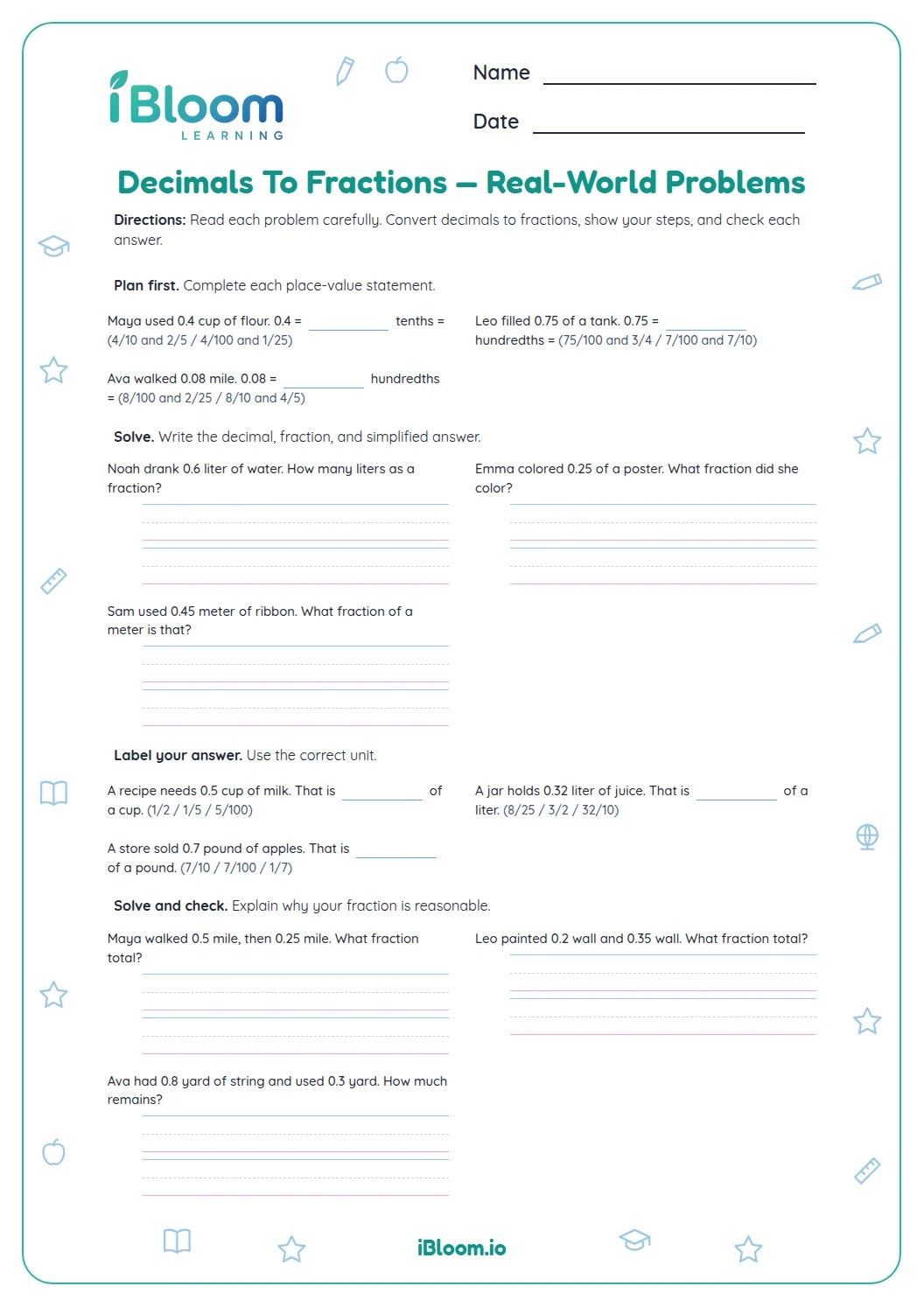
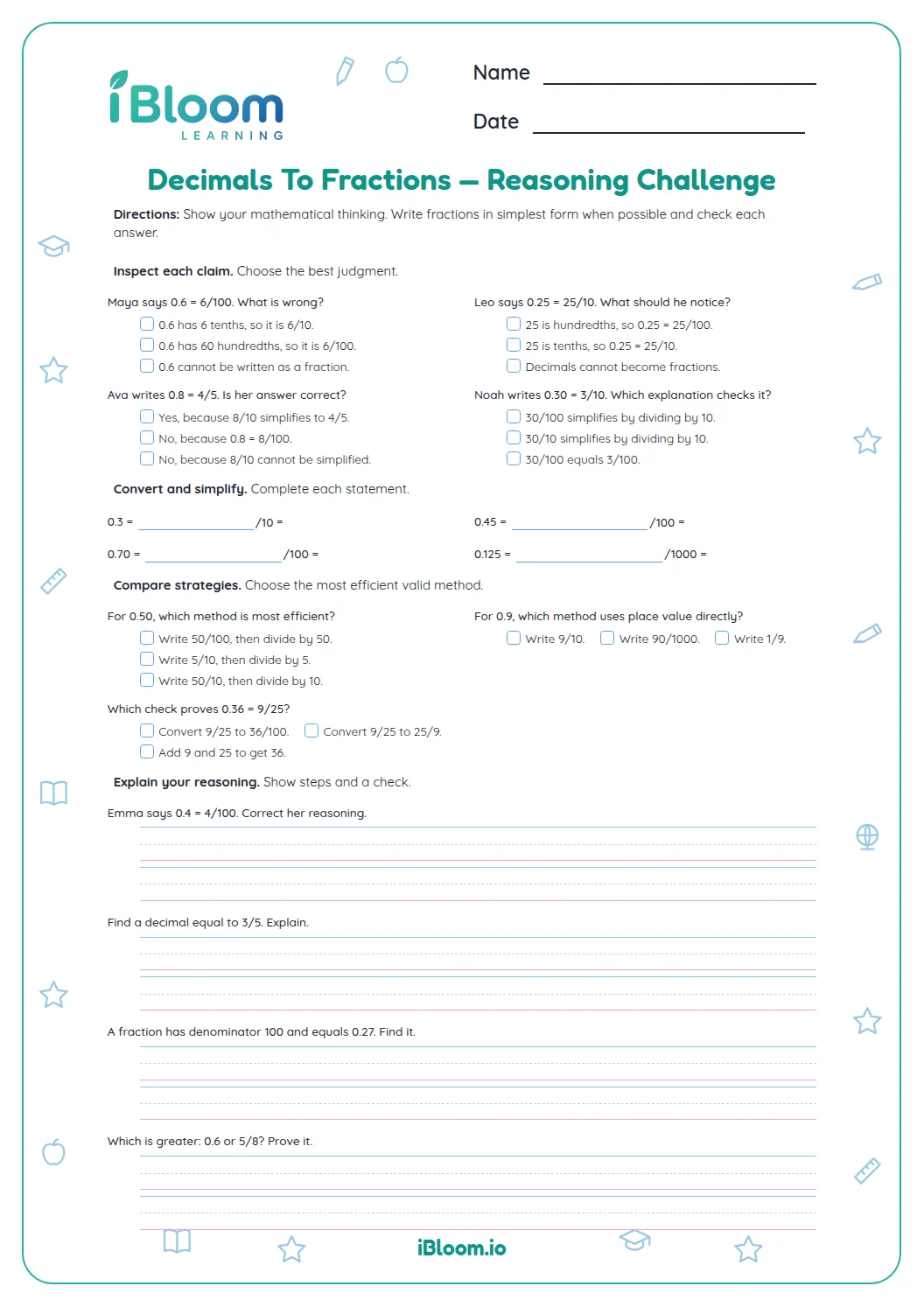
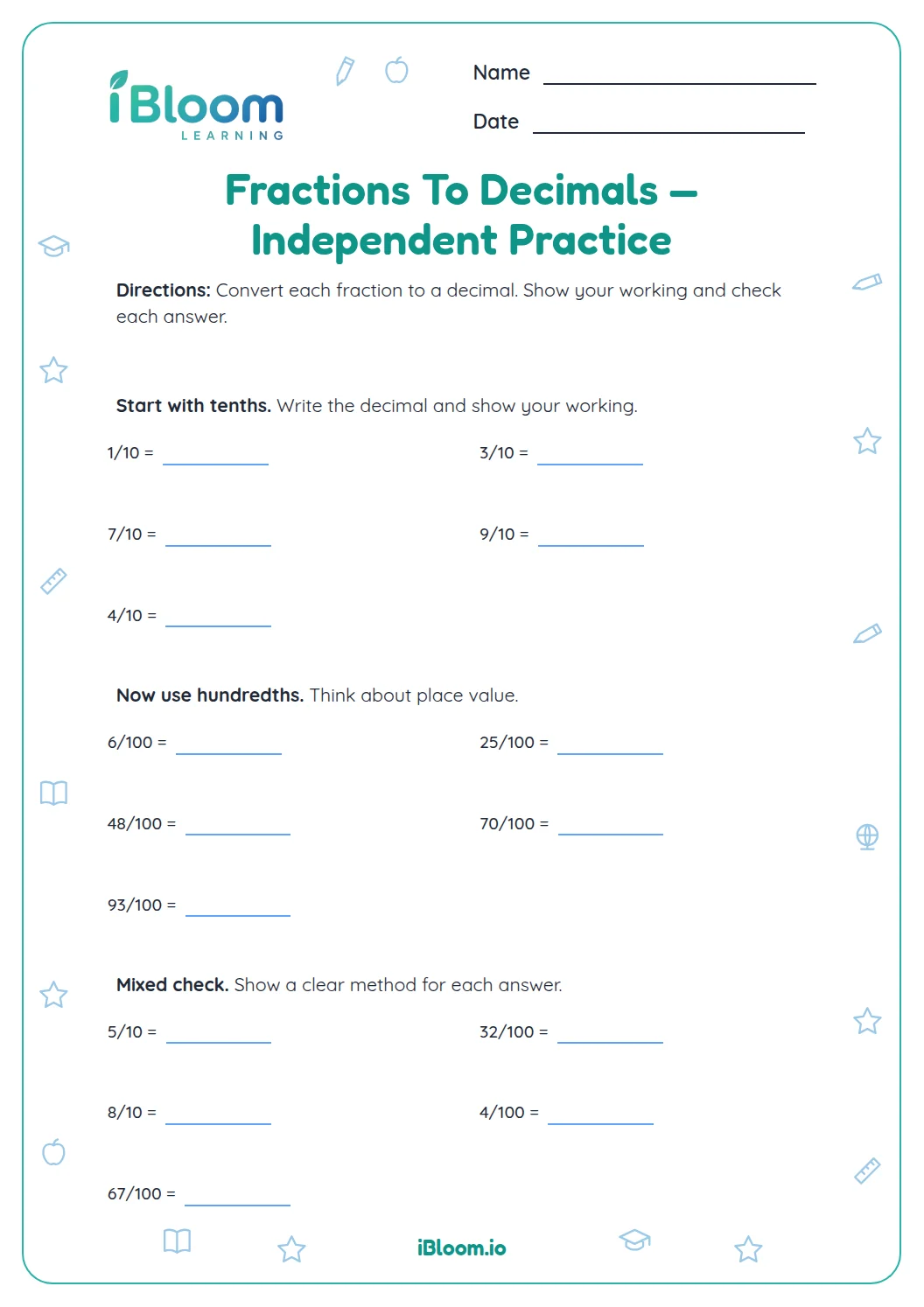
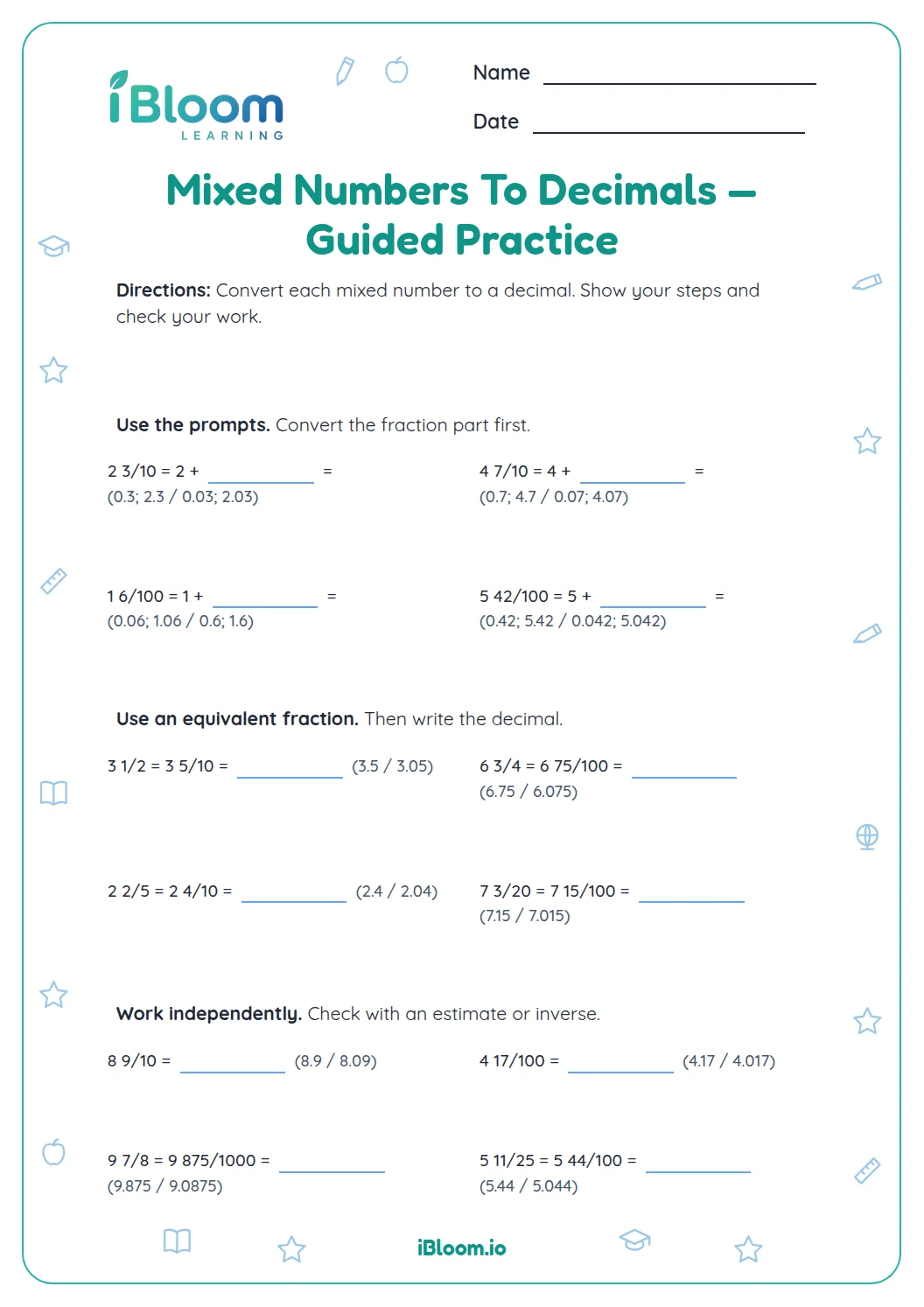
This Grade 4 printable builds connections between decimals and fractions with 17 questions on tenths and hundredths. Children convert in both directions, fill missing digits, and complete equivalent-fraction challenges. It practices CCSS 4.NF.C.6 and includes a separate answer key.
Aligned to 4.NF.C.6
How do tenths connect to decimals?
One tenth is written 1/10 as a fraction and 0.1 as a decimal. The digit 1 is in the tenths place. Six tenths is 6/10, or 0.6.
Question 1 asks for 3/10. Since the denominator is 10, write 3 in the tenths place: 0.3.
- 13/10
- 2Denominator 10 means tenths
- 33/10 = 0.3
How do hundredths connect to decimals?
A fraction with denominator 100 counts hundredths. The two places after the decimal point show tenths and hundredths, so 25/100 is 0.25 and 8/100 is 0.08. A zero keeps the 8 in the hundredths place.
How do you write a decimal as a fraction?
Look at the last decimal place used. One place means tenths, and two places means hundredths. Write the digits after the decimal as the numerator over 10 or 100, then check the place value.
How to convert decimals and fractions
- 1Read the denominator or decimal places.
- 2Name the unit: tenths or hundredths.
- 3Write the matching digits over 10 or 100.
- 4For a decimal, place digits in the matching places.
- 5Check the requested denominator in the answer.
Common mistakes and quick fixes
The mistake
Drop the zero in 0.08 and write 0.8.
The fix
Keep the hundredths digit in the second decimal place.
The mistake
Use denominator 10 for a hundredths decimal.
The fix
Count both decimal places and use 100.
The mistake
Read 0.70 as seven hundredths.
The fix
The 7 is in the tenths place, so 0.70 is 70 hundredths.
Common Core alignment
This worksheet gives children practice with the following Common Core skill.
Write tenths and hundredths as decimals and connect them to fractions.
On this sheet: Each conversion writes a tenths or hundredths fraction in decimal form or back.
Show the official wordingHide the official wording
Use decimal notation for fractions with denominators 10 or 100.
What to practice next
Make more practice
Further reading
Questions parents and teachers ask
How do tenths look as decimals?
Tenths occupy the first place to the right of the decimal point. For example, 6/10 is 0.6. The denominator tells the unit, and the numerator tells how many tenths. The worksheet practices both directions of this conversion. For example, 3/10 is three tenths, so its decimal is 0.3.
Why is 0.08 eight hundredths?
The 8 is two places to the right of the decimal point, in the hundredths place. So 0.08 represents 8/100. A zero in the tenths place keeps the 8 in the correct place. Keep the zero placeholder when no tenths are present, as in 0.08.
Should fractions be simplified on this worksheet?
The prompts specify denominators of 10 or 100 so children can focus on place value. Write the requested denominator as shown. For example, when asked for hundredths, express 0.70 as 70/100. Follow the requested denominator to keep attention on decimal place value.
How can place value help with a hundredths fraction?
A fraction with denominator 100 counts hundredths. In 0.36, the 3 is in the tenths place and the 6 is in the hundredths place, so 0.36 is 36/100. The written conversions on this sheet connect each decimal digit to its place-value fraction.
What is a common decimal place-value error?
A child may write 0.8 for eight hundredths. Remind them that hundredths use two places after the decimal; 0.08 keeps the 8 in the second place. Reading it aloud as “eight hundredths” reinforces the position. The decimal point separates whole units from tenths and hundredths.
How can the answer key be used?
After solving a few conversions, compare each response with the separate key. Ask the learner to name the place value in one decimal and explain how its denominator matches. This checks understanding in addition to checking the notation. The key helps check both the written fraction and the decimal place.