





About this worksheet
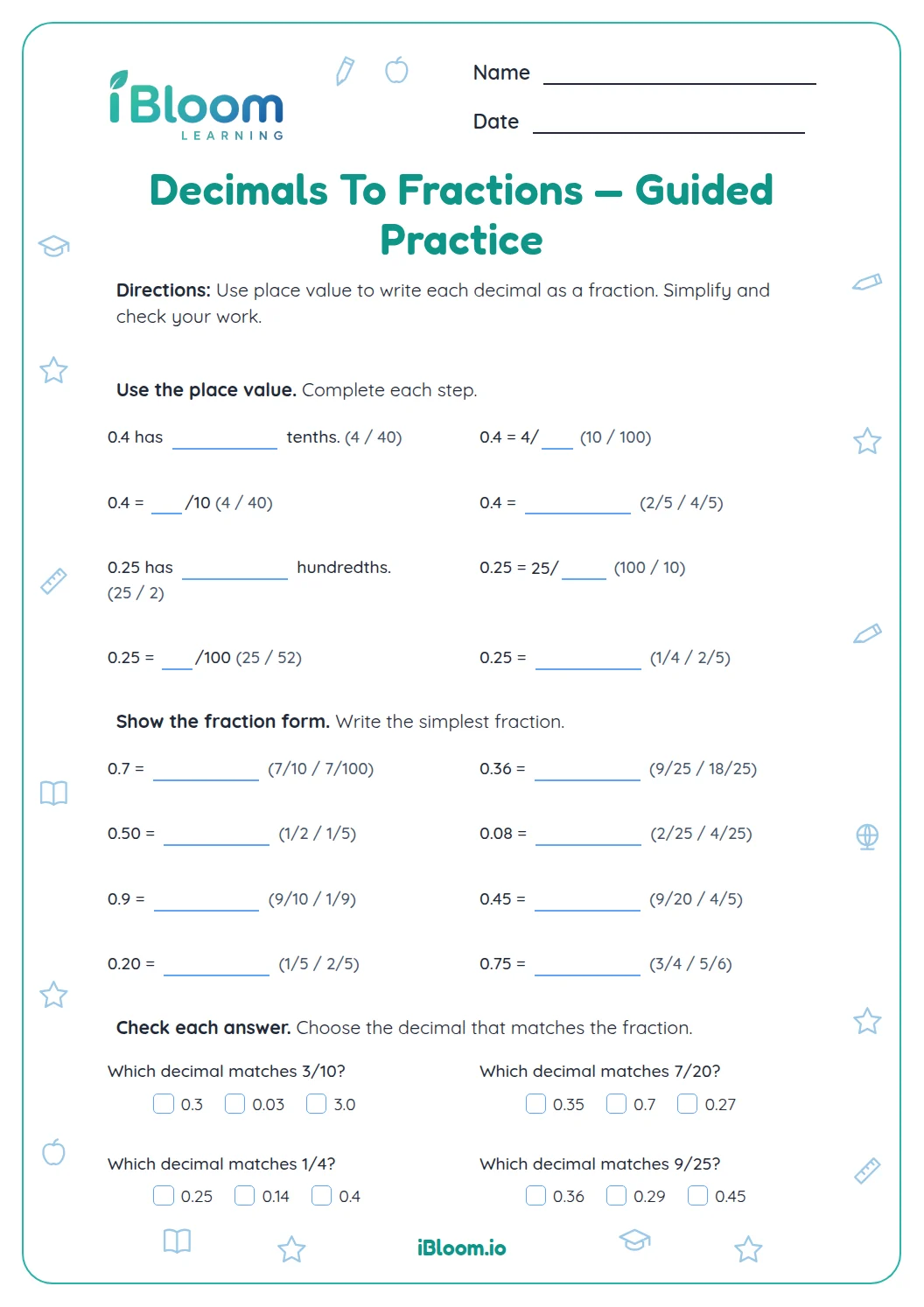
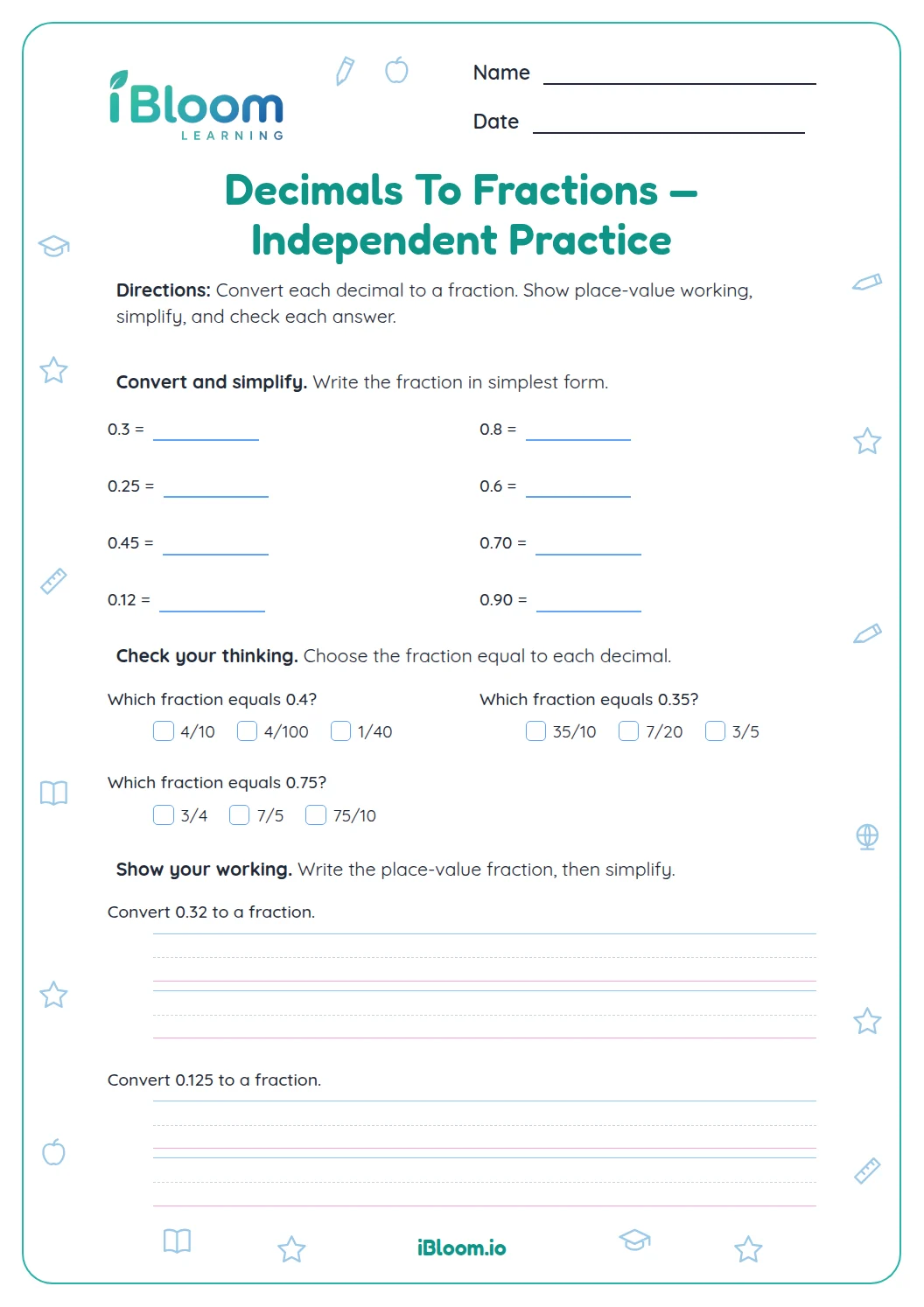
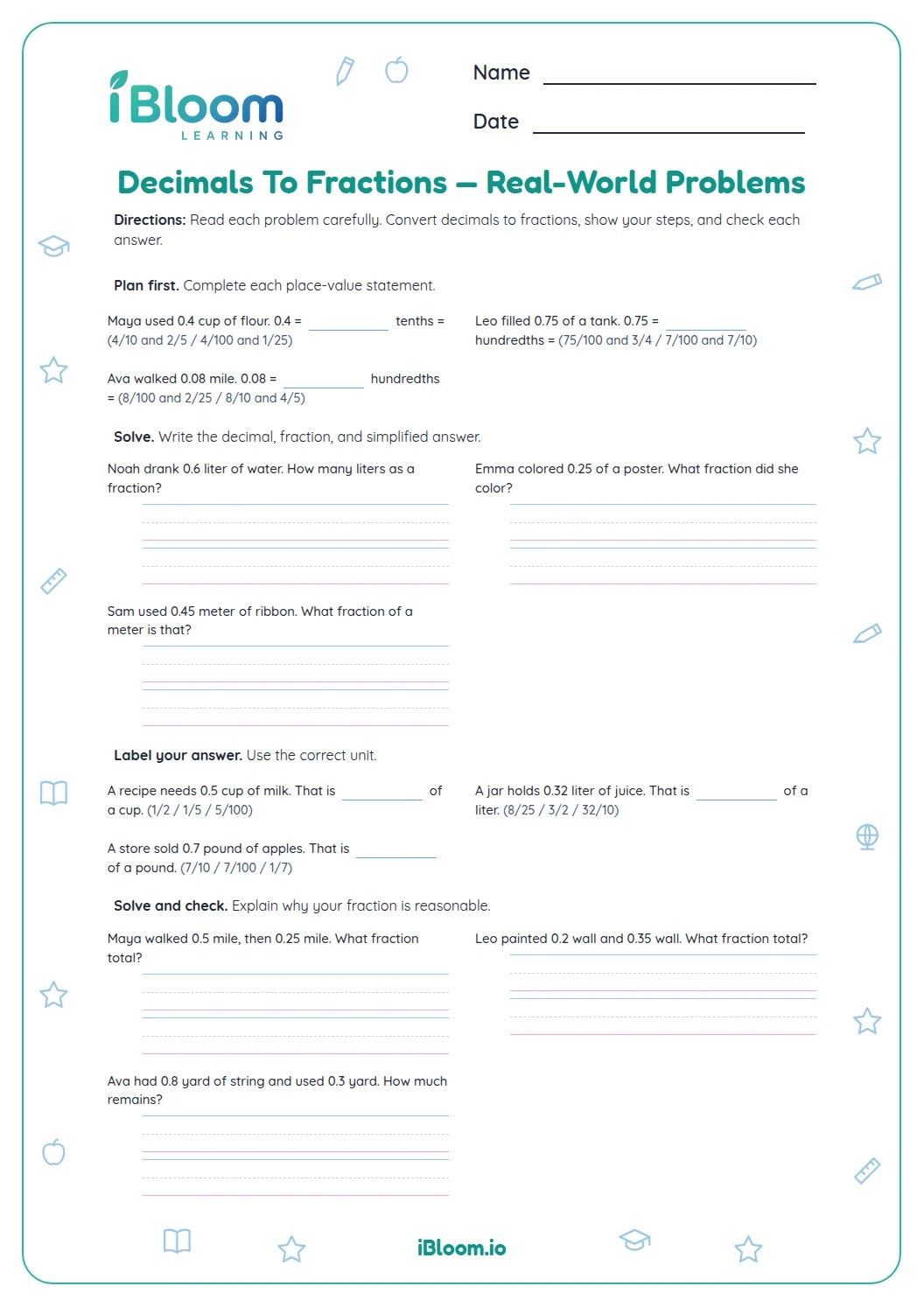
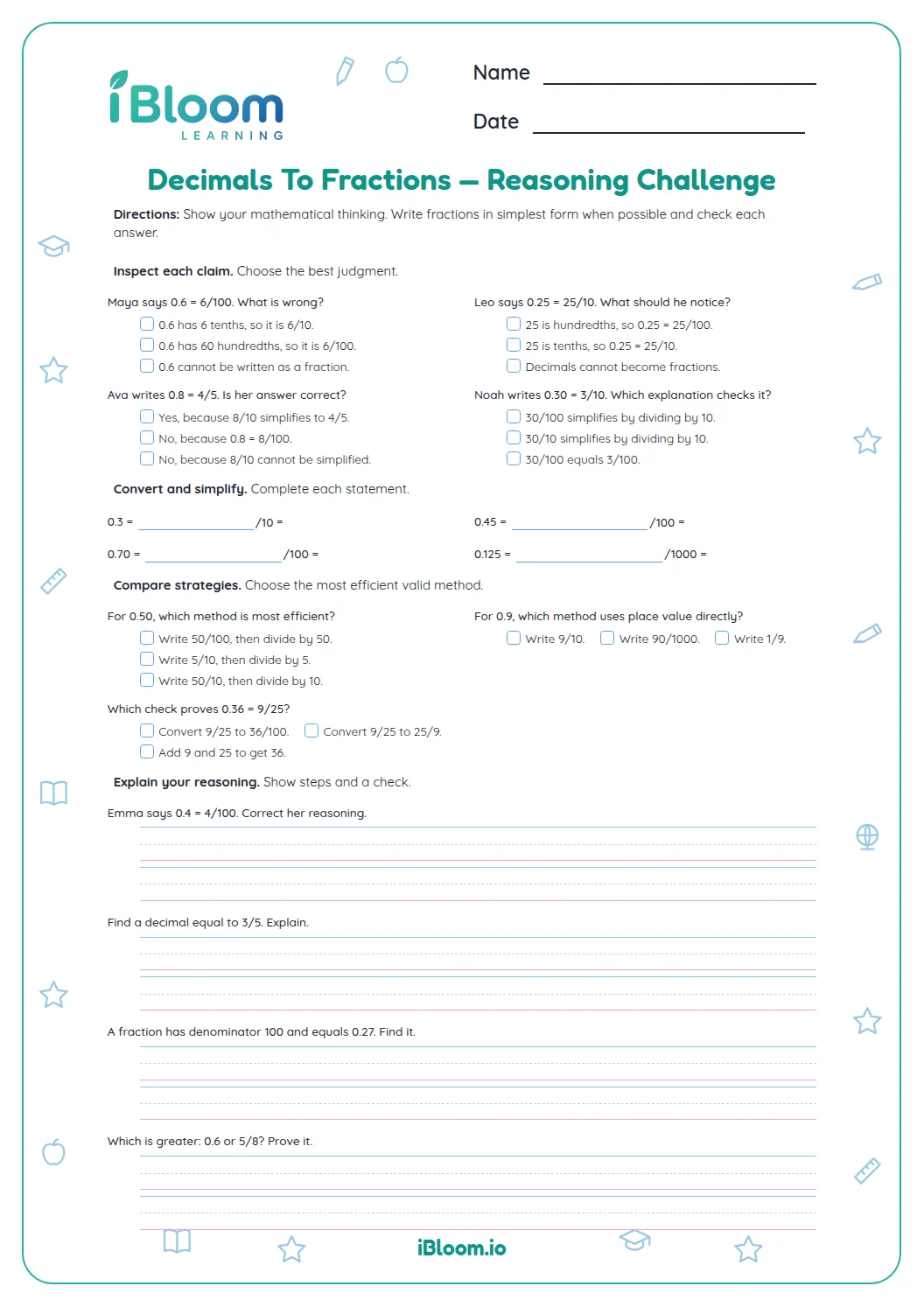
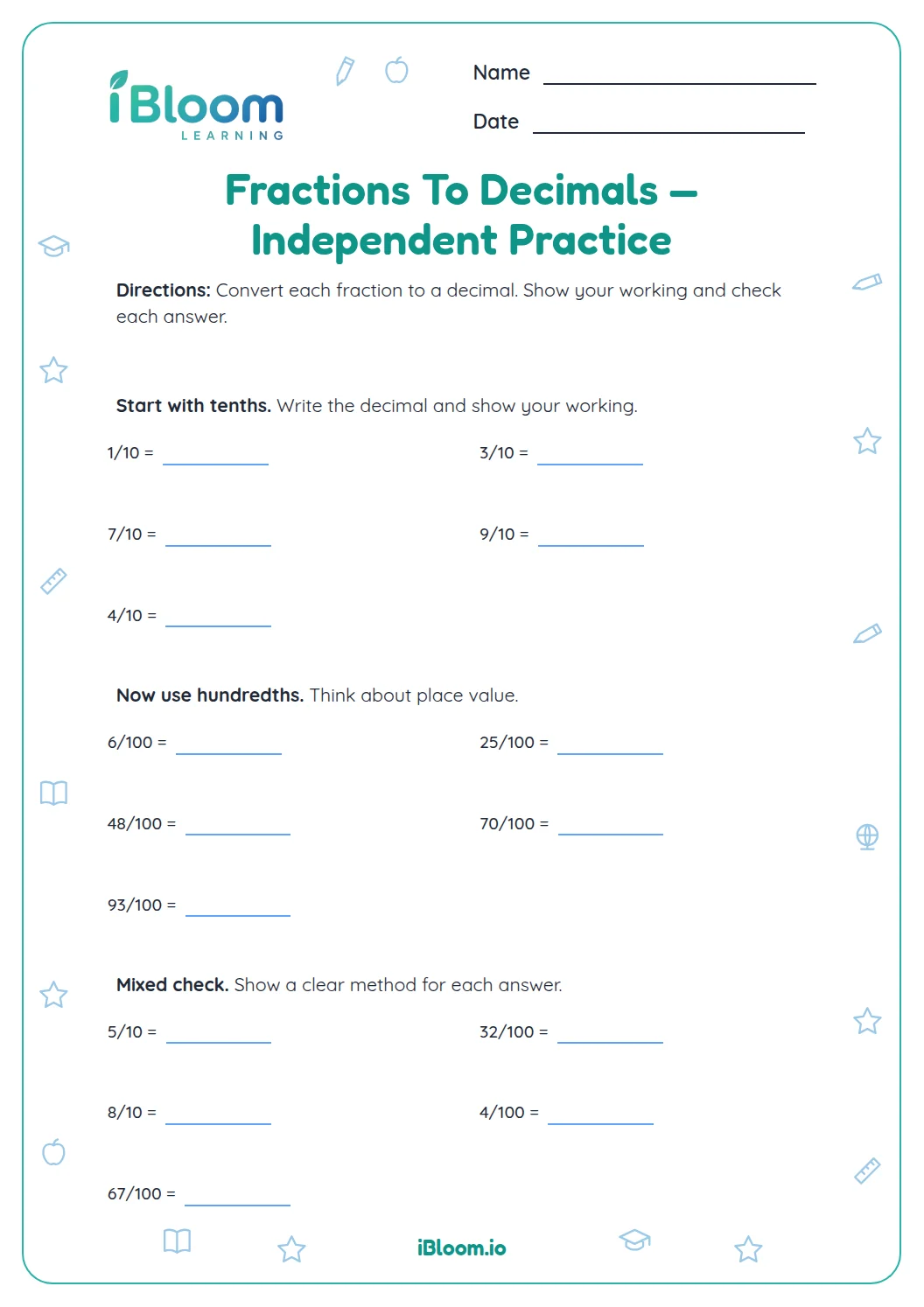
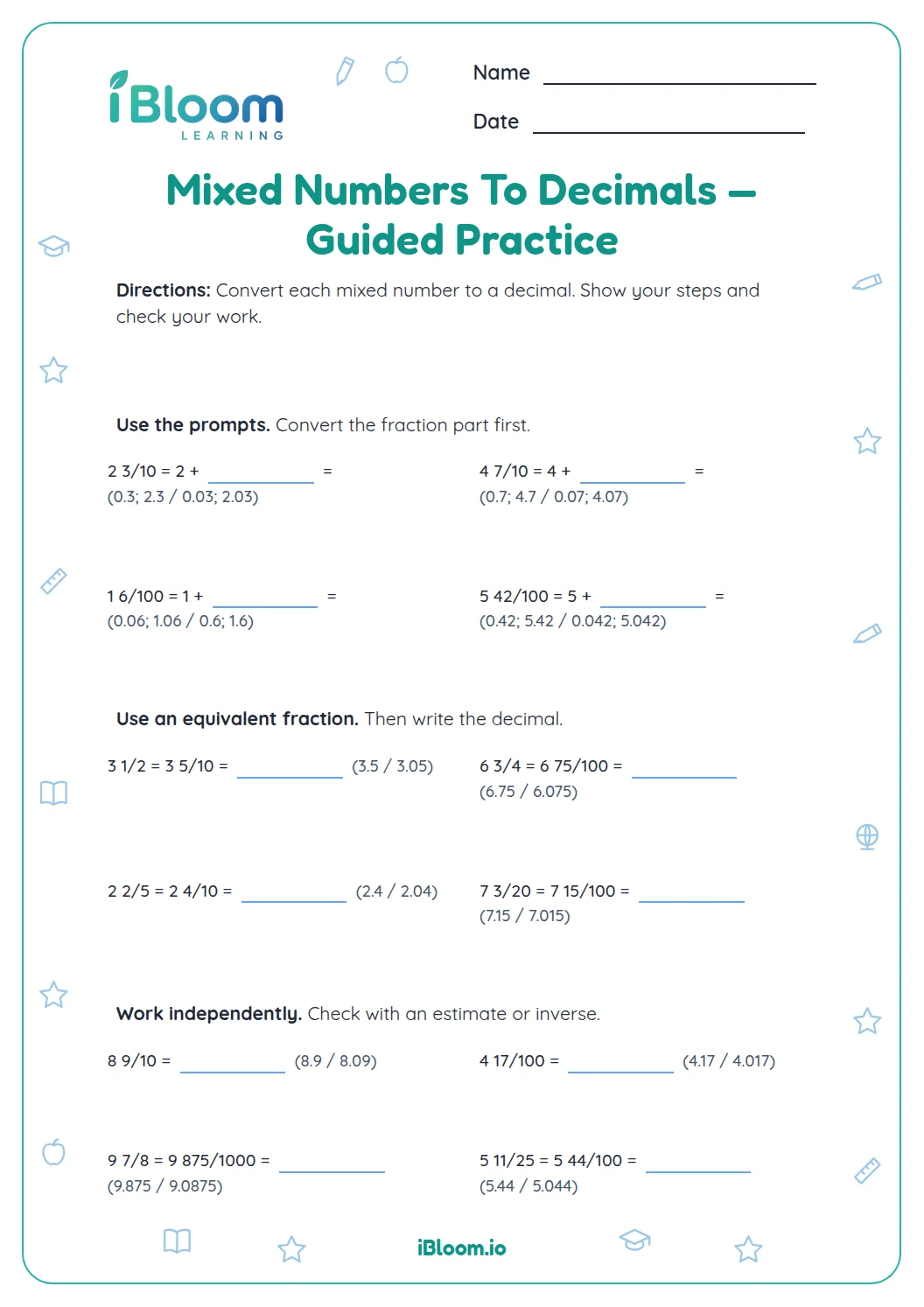
This Grade 4 printable connects decimals to fractions with denominators of 10 or 100. Students read shaded hundredths grids and tenths strips, write decimal amounts as fractions, and complete number sentences in both directions. The 14 questions include visual models and a separate answer key. It practices CCSS 4.NF.C.6.
Aligned to 4.NF.C.6
How does a grid show hundredths?
A hundredths grid has 100 equal squares. If 25 squares are shaded, the shaded part is 25/100, which is written 0.25 as a decimal. Question 3 asks students to name the shaded amount as a fraction.
- 125 shaded squares out of 100
- 2Fraction: 25/100
- 3Decimal: 0.25
How do tenths and hundredths appear in decimal notation?
One digit to the right of the decimal point names tenths; two digits name hundredths. So 0.4 is 4/10, while 0.32 is 32/100. Keep the denominator matched to the place value shown.
Can students convert in both directions?
Yes. Questions include decimal-to-fraction and fraction-to-decimal number sentences. For 8/10, the numerator shows eight tenths, so the decimal is 0.8.
How to use this worksheet
- 1Count the shaded parts and identify whether the model shows tenths or hundredths.
- 2Write the shaded parts over 10 or 100.
- 3For a decimal, read the digits by place value.
- 4Keep tenths and hundredths aligned when converting.
- 5Check that the fraction and decimal describe the same amount.
Common mistakes and quick fixes
The mistake
Writing 0.4 as 4/100.
The fix
One decimal digit means tenths, so 0.4 is 4/10.
The mistake
Writing 0.06 as 6/10.
The fix
Two decimal digits mean hundredths, so 0.06 is 6/100.
The mistake
Reading the number of shaded squares as the denominator.
The fix
The hundredths grid always has 100 equal squares; the shaded count is the numerator.
Common Core alignment
Visual models and number sentences connect decimal notation to fractions with tenths and hundredths.
Write fractions with tenths or hundredths in decimal notation and convert decimals to those fractions.
On this sheet: Students read tenths and hundredths models and write equivalent fractions or decimal notation.
Show the official wordingHide the official wording
Use decimal notation for fractions with denominators 10 or 100. For example, rewrite 0.62 as 62/100; describe a length as 0.62 meters; locate 0.62 on a number line diagram.
What to practice next
Make more practice
Further reading
Questions parents and teachers ask
What is the difference between tenths and hundredths?
A tenth is one of 10 equal parts, and a hundredth is one of 100 equal parts. The first digit to the right of the decimal point names tenths; the second names hundredths. The denominator names the equal parts in the model.
Why does 0.4 equal 4/10?
The 4 is in the tenths place, so 0.4 means four tenths. That amount can be written as 4/10. The denominator names the size of the equal parts. Point to the decimal place that matches the denominator. Look at each place value carefully.
What does a hundredths grid help students see?
It shows 100 equal squares, so students can count shaded squares as hundredths. For example, 25 shaded squares represent 25/100, which is 0.25 in decimal notation. Counting the shaded squares gives the numerator. Count all equal squares, not only empty ones.
Does every fraction in the sheet need to be simplified?
The questions ask for fractions with denominator 10 or 100, matching the decimal place values. Keep that denominator so the relationship between the decimal digits and the fraction stays visible. The worksheet keeps denominators 10 and 100 visible for comparison.
What does the answer key include?
The separate key lists the fraction or decimal for each item. For model questions, students can compare the answer with the number of shaded tenths or hundredths shown on the worksheet. Students can verify a model answer by counting its shaded parts.