




About this worksheet
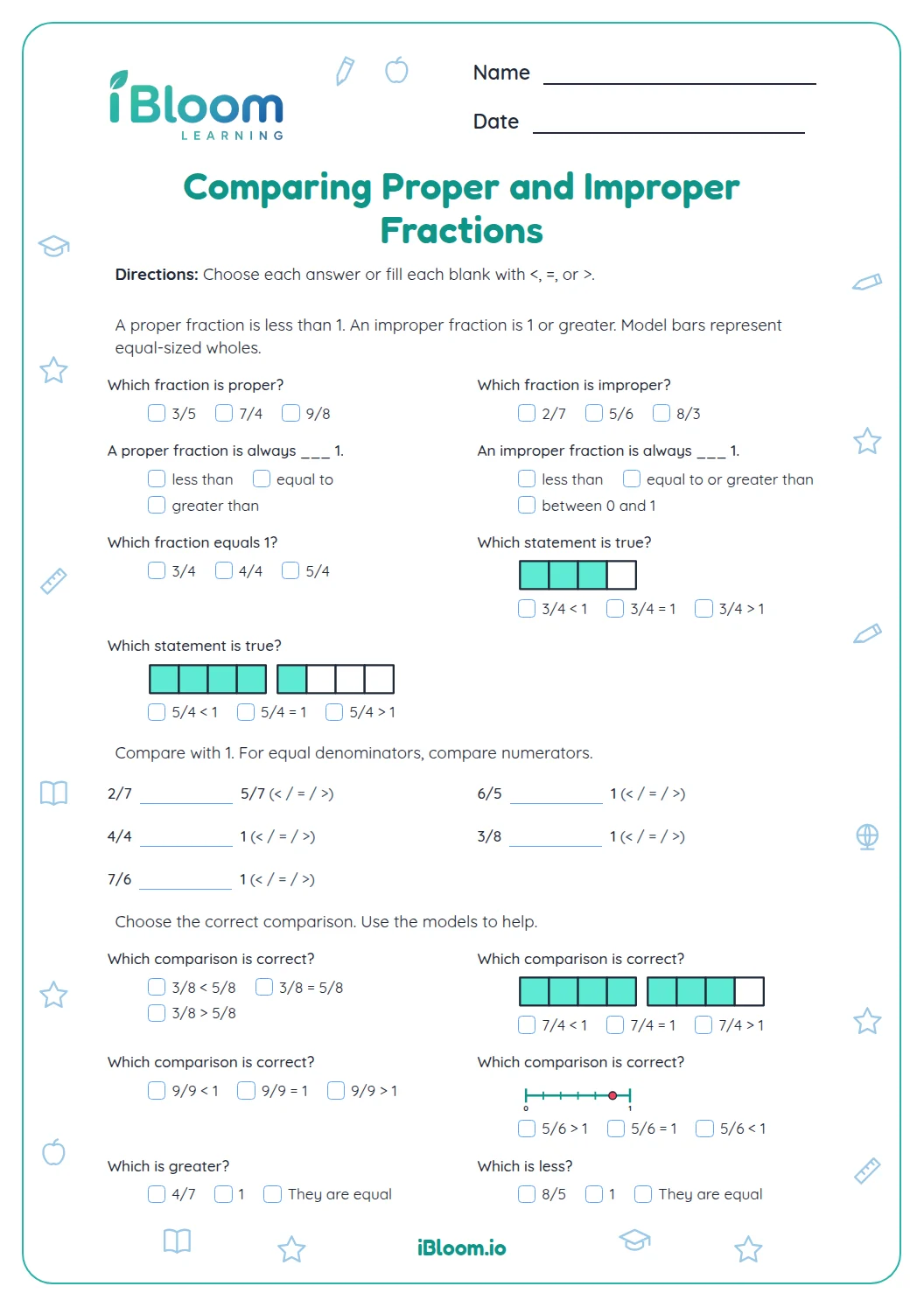
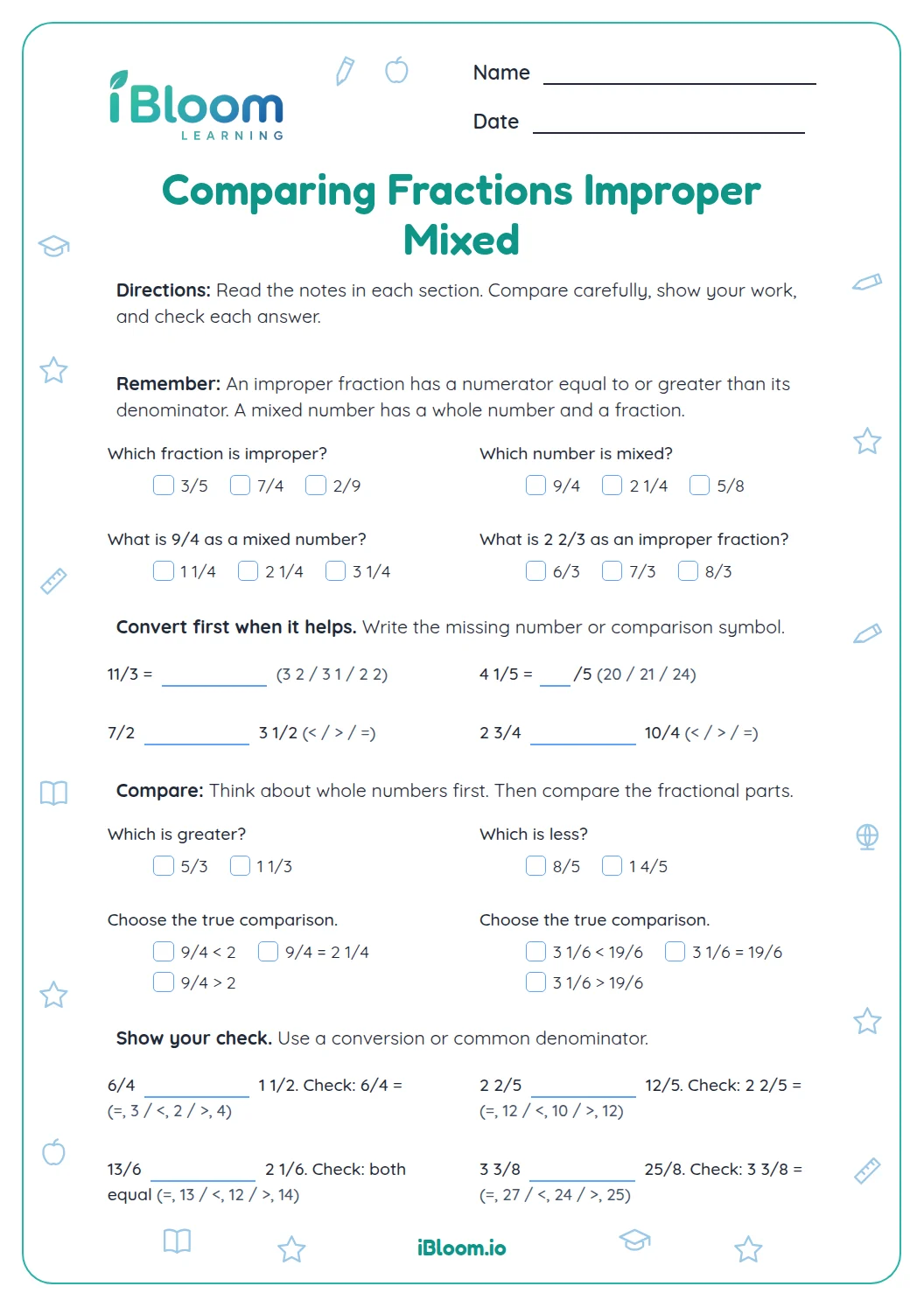
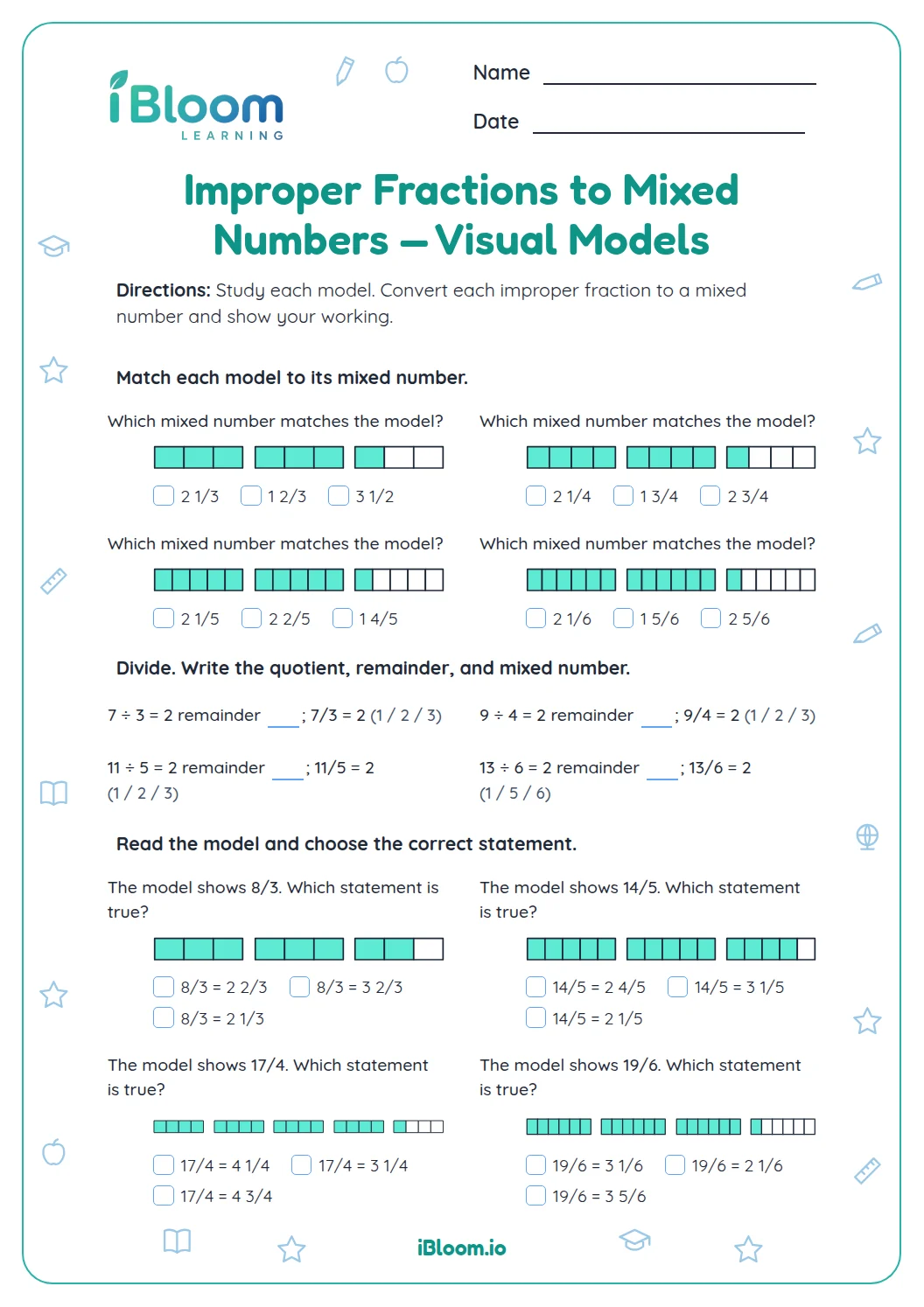
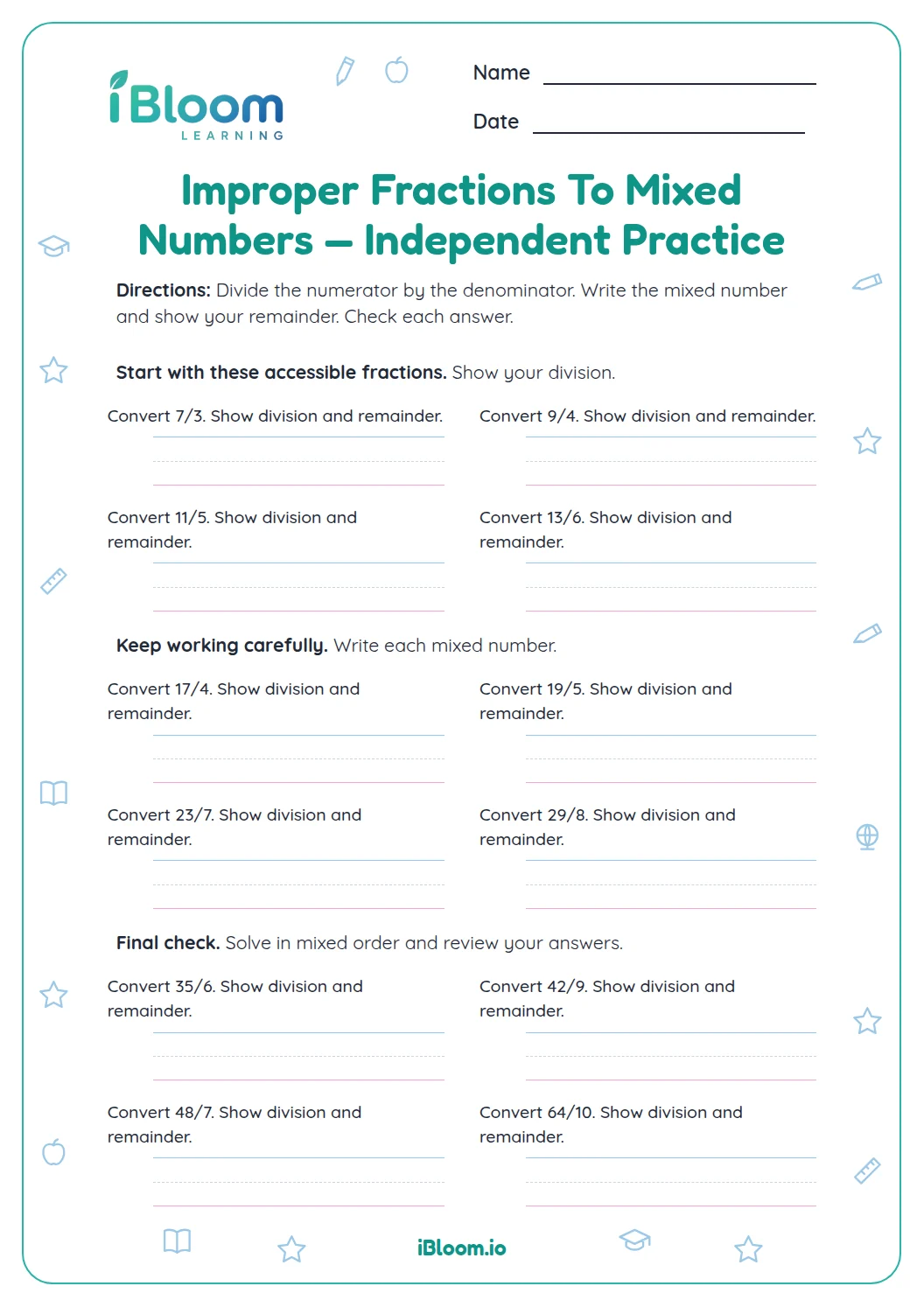
This free Grade 4 worksheet uses fraction bars to compare proper and improper fractions with whole-number benchmarks. Each of the sixteen questions shows shaded equal parts and asks children to choose <, >, or = when comparing the model with 1, 2, or 3. The models include fractions below one, values above one, and whole-valued fractions. The practice supports CCSS 4.NF.A.2, comparing fractions by reasoning about their size. A separate answer key includes each comparison sign.
Aligned to 4.NF.A.2
How can whole numbers help compare fractions?
A whole bar is the benchmark 1. A bar shaded only partway is less than 1; one or more full bars with extra shaded parts is greater than 1. In question 2, the model shows one whole and one fourth, so it is greater than 1.
The denominator tells how many equal parts make each bar. Count full bars first, then inspect the remaining pieces.
How do you compare a fraction with 2 or 3?
The model makes larger values visible too. Two full bars and no extra pieces equal 2, while one full bar and several pieces are still less than 2. Question 7 shows two full bars, so it equals 2.
Read the comparison number, inspect all shaded wholes and partial bars, then choose the sign that matches their size.
What is included on the pages?
Sixteen items each include a fraction-bar model. The first group compares fractions with 1; the second compares with 1, 2, or 3. Every item asks for the comparison sign.
- Part A: eight visual comparisons with 1
- Part B: eight visual comparisons with whole numbers
- Models include proper, improper, and whole-valued fractions
- Four worksheet pages and a separate four-page key
How to use this worksheet
- 1Identify the denominator by counting equal pieces in each bar.
- 2Count full shaded wholes before counting any extra parts.
- 3Compare the model’s value with the number printed in the question.
- 4Select the matching comparison sign.
- 5Use the key to check and explain one model aloud.
Common fraction comparison slips
The mistake
Treating a larger denominator as a larger fraction.
The fix
Use the shaded area and the number of full bars to compare actual values.
The mistake
Ignoring a fully shaded whole before the partial bar.
The fix
Count complete wholes first, then include any remaining shaded pieces.
The mistake
Choosing a sign without checking equality.
The fix
If the model shows exactly the stated number of full bars, use =.
Common Core alignment
Fraction bars make fraction size and whole-number benchmarks visible.
Compare each fraction model with a whole-number benchmark.
On this sheet: Each question compares a visual fraction model with a whole-number benchmark and records a comparison symbol.
Show the official wordingHide the official wording
Compare two fractions with different numerators and different denominators, e.g., by creating common denominators or numerators, or by comparing to a benchmark fraction such as 1/2. Recognize that comparisons are valid only when the two fractions refer to the same whole. Record the results of comparisons with symbols >, =, or <, and justify the conclusions, e.g., by using a visual fraction model.
What to practice next
Make more practice
Further reading
Questions parents and teachers ask
How can a model show whether a fraction is proper or improper?
A proper fraction has a value less than one whole, while an improper fraction has a value of one whole or more. The worksheet uses fraction bars to compare shaded amounts with whole numbers and identify whether they are below, at, or above a benchmark.
How do the bars help compare a fraction with 1?
One full bar represents 1. If the model has an unfilled part, it is less than 1; a full bar equals 1; a full bar plus extra shaded pieces is greater than 1. Each item asks children to compare the model with a stated whole number.
What does a mixed model such as 1 3/4 mean?
It means one whole bar and three of four parts in another bar are shaded. The total is greater than one whole. The models on this page use bars so children can see the complete whole and any additional fraction pieces.
Why are some questions compared with 2 or 3?
Some models show more than one whole, so benchmarks of 2 or 3 help compare the total shaded amount. For instance, two complete bars equal 2, while a complete bar with extra parts is greater than 1 but may remain below 2.
Is there an answer key?
Yes. The separate answer key marks the comparison sign for each illustrated fraction. Every item includes a fraction-bar model, and the key follows the same order as the worksheet so families can check each comparison. Families can compare each shaded bar with the benchmark printed in the prompt.