





About this worksheet
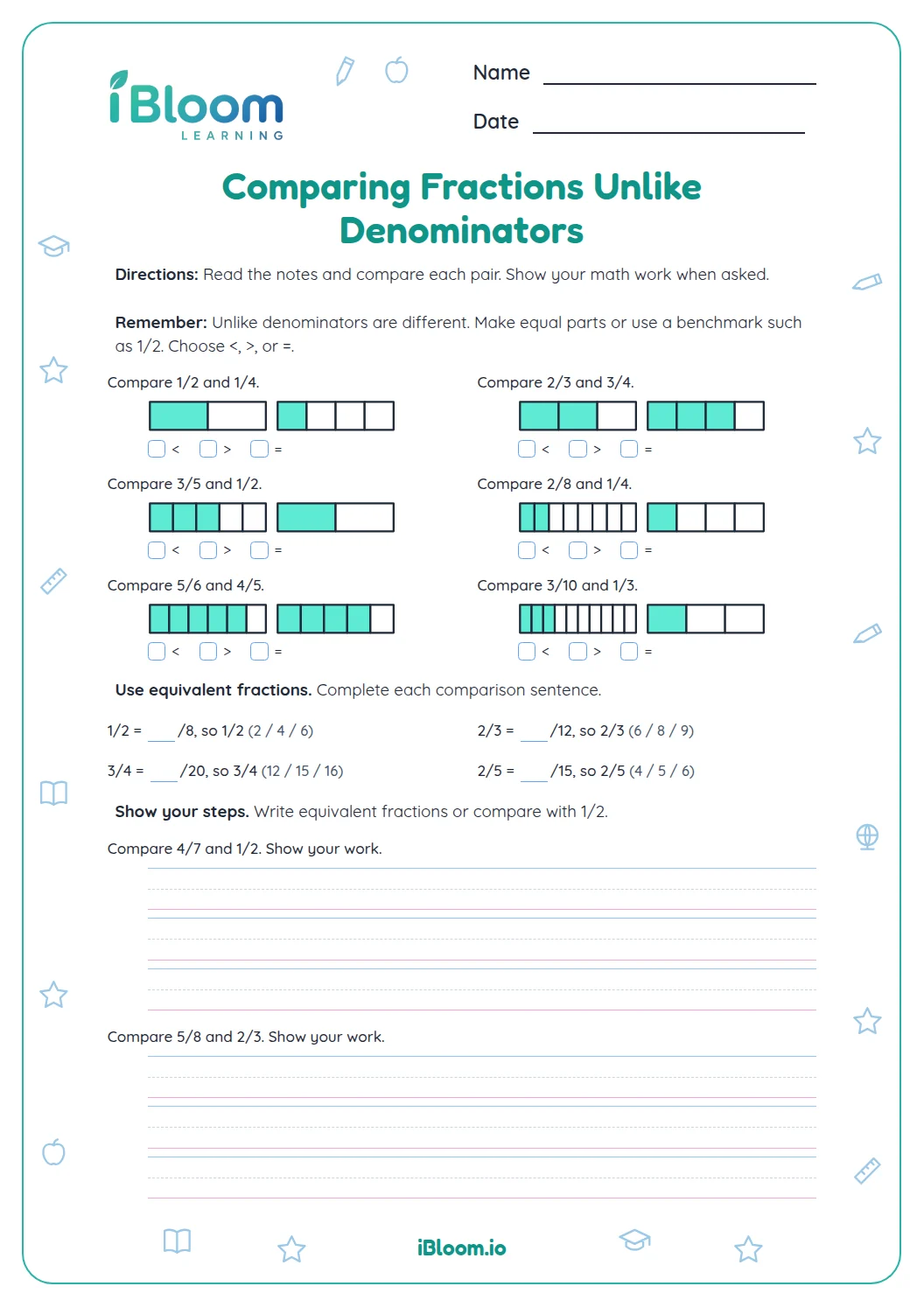
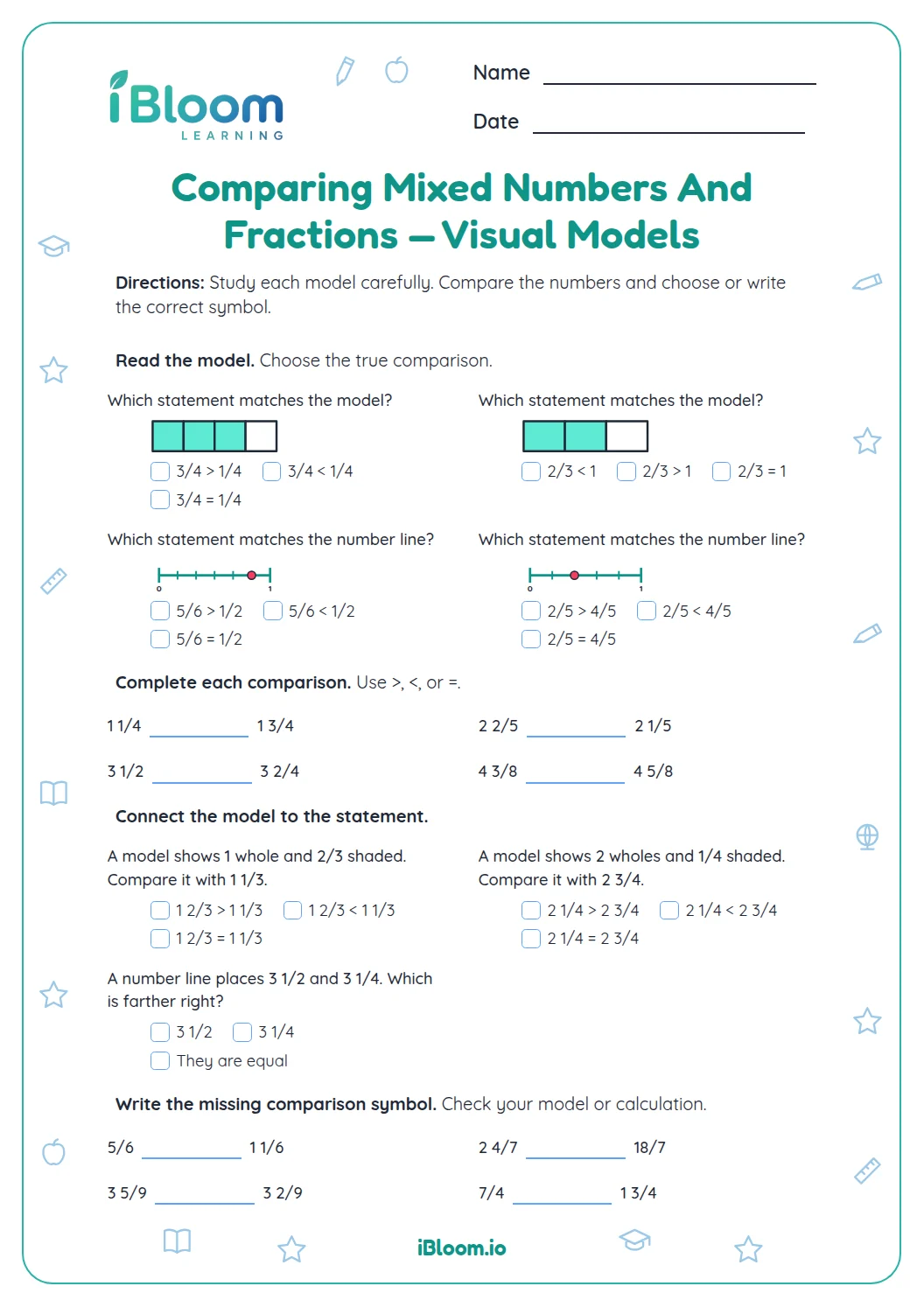
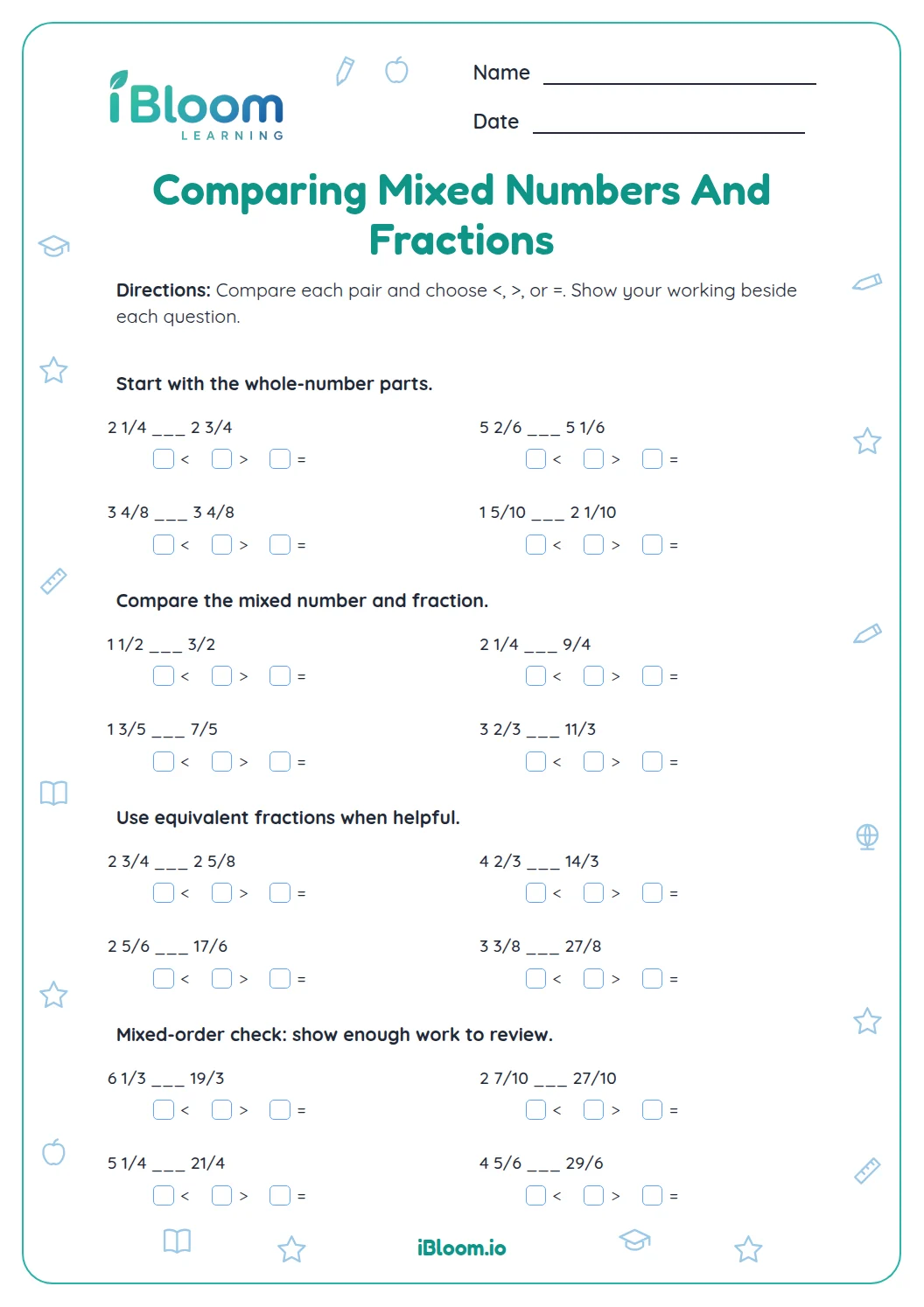
This free Grade 4 printable practices comparing proper fractions with like and unlike denominators. Across 16 questions, learners compare pairs, order fractions, interpret shaded bars, and apply comparison to a meter measurement. The examples use equal wholes and the answer key is separate. The page practices CCSS 4.NF.A.2 by asking learners to compare, record results, and use equivalent fractions or benchmarks.
Aligned to 4.NF.A.2
What skill does this sheet practice?
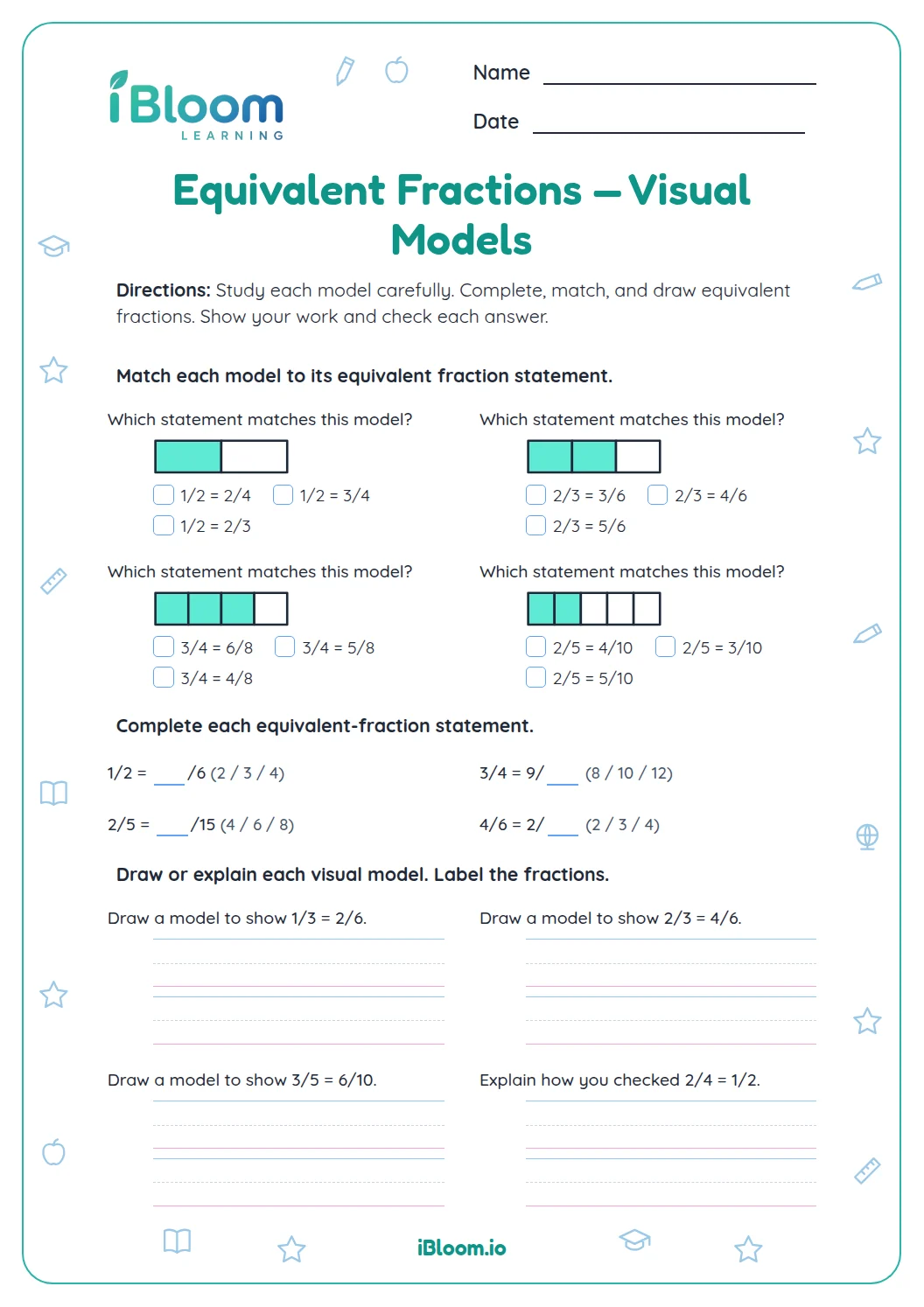
The pizza theme echoes equal parts of one whole; each bar model is divided into equal pieces.
Work one item at a time, then check the result with a second method when possible.
What is on the worksheet?
Sixteen questions build from direct fraction comparisons to ordering, shaded models, and a difference in meters.
- Part A compares fraction pairs with answer choices.
- Part B orders fractions and reads shaded fraction models.
- Part C compares a pair with a benchmark question.
- Part D fills comparison blanks and solves a distance application.
- The answer key is printed on its own page.
How can an adult support practice?
Find a common denominator, or compare each fraction with a benchmark such as 1/2 or 1. First make sure both fractions refer to the same whole.
Ask the learner to point to the fraction, place-value shift, or letter clue that supports each response.
How to use this worksheet
- 1Read the one-line directions and check the first item together.
- 2Complete Part A, pausing to check the strategy rather than only the answer.
- 3Use the next part to try a different representation or question type.
- 4Finish Part C, then use the answer key to review and revisit any missed item.
Common mistakes and quick fixes
The mistake
Comparing numerators before checking denominators.
The fix
Rename the fractions with a common denominator, then compare the numerators.
The mistake
Assuming a larger denominator means a larger fraction.
The fix
For unit fractions, more equal parts make each part smaller; compare the whole fractions carefully.
The mistake
Reversing the order in an ascending list.
The fix
Check the first and last values against the words “least to greatest.”
Common Core alignment
Learners compare fractions using equivalent fractions, benchmarks, and visual models.
Compare fractions with different numerators and denominators using models or benchmarks.
On this sheet: The worksheet directly practices the skill named in this standard through its questions and models.
Show the official wordingHide the official wording
Compare two fractions with different numerators and different denominators, e.g., by creating common denominators or numerators, or by comparing to a benchmark fraction such as 1/2. Recognize that comparisons are valid only when the two fractions refer to the same whole. Record the results of comparisons with symbols >, =, or <, and justify the conclusions, e.g., by using a visual fraction model.
What to practice next
Make more practice
Further reading
Questions parents and teachers ask
How many questions are on this printable?
The worksheet has 16 questions across three parts. The sequence includes like and unlike denominators, equivalent values, ordering, and a comparison model. The separate answer key makes it possible to check each response after the learner finishes. There is room to compare answers with the printed key and explain a chosen strategy.
What does this Grade 4 worksheet practice?
It practices comparing proper fractions, ordering fractions, and reading fraction bars. The first part starts with direct examples, while later items ask learners to apply the same idea in another format or setting. Read the directions aloud if useful, then let the learner work through the page at a comfortable pace.
Is an answer key included?
Yes. A separate answer key follows the worksheet pages. Keep it aside while the learner works, then use it to check responses and discuss a particular step when an answer differs. The key supports review of both direct calculations and the short contexts.
How can I help if a learner gets stuck?
Ask the learner to explain the first step aloud and point to the information they used. For unlike denominators, rename each fraction using a common denominator; a benchmark such as one-half can also help. Let them try again with that clue before showing a complete solution.
Can this be used for independent practice?
Yes. The worksheet is labeled for independent practice, and its directions are printed on the page. An adult may demonstrate the first example if needed; the answer key can be used afterward to review the work. The last task connects a fraction comparison to a distance difference, so learners can check the units as well.