





About this worksheet
This free printable worksheet gives Grade 4 students independent practice comparing fractions with unlike denominators. Part A has twelve pairs to compare using <, >, or =, including equivalent fractions and a pair on opposite sides of one-half. Part B has four written comparisons: a ribbon problem, a claim to correct, and two close pairs to justify. All comparisons refer to equal-sized wholes. The worksheet practices Common Core 4.NF.A.2, and the separate answer key gives every symbol plus sample reasoning for the four written responses.
Aligned to 4.NF.A.2
How can students choose a comparison method?
Look at the fractions before calculating. If one is less than one-half and the other is greater, the benchmark settles the comparison. If the fractions are close, equivalent fractions with a common denominator let students compare the number of equal-sized parts.
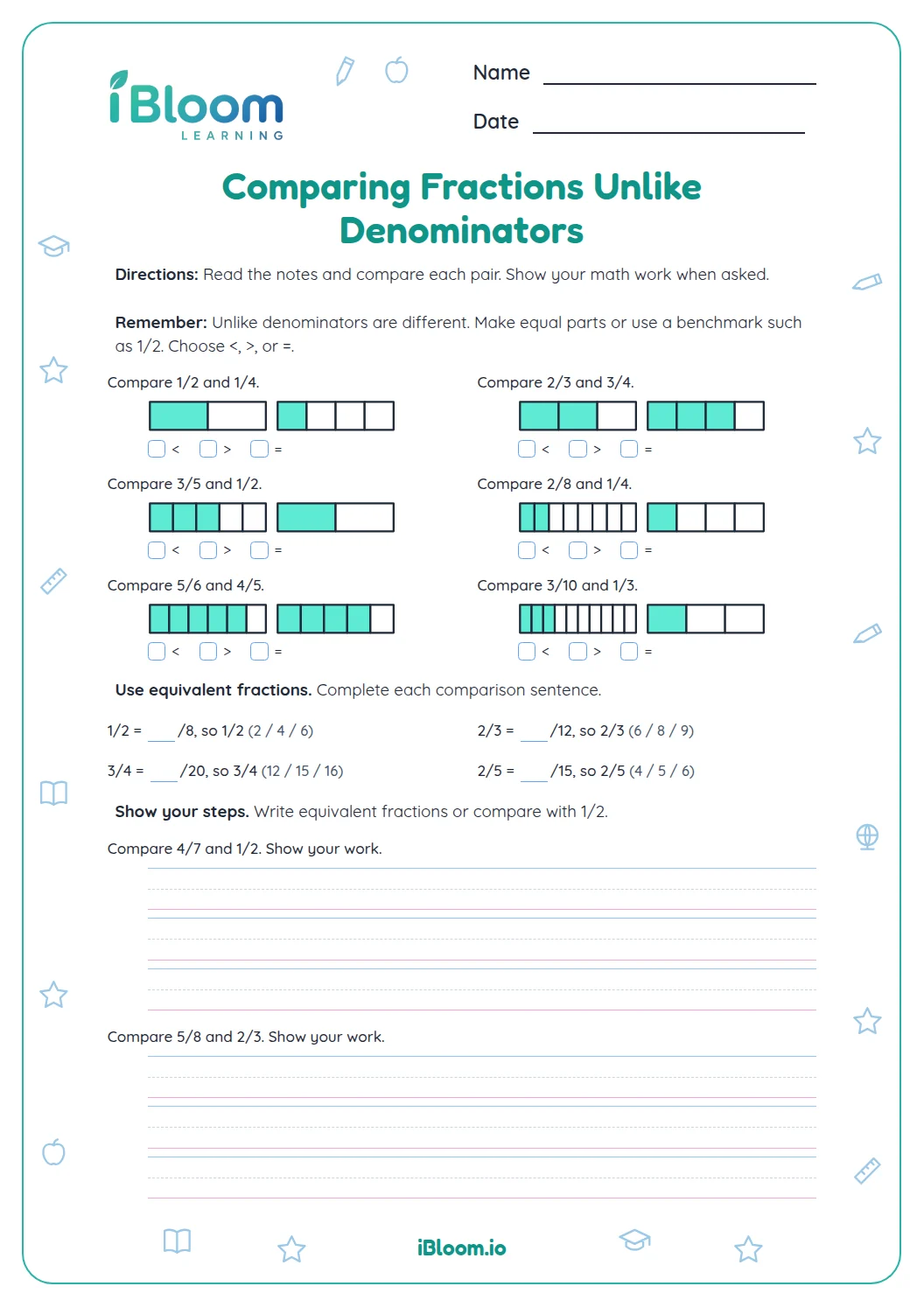
Question 3, 2/3 and 4/6, tests equality. Different denominators do not guarantee different values. Students should leave room for = as well as < and >.
How does a common denominator make the answer clear?
A common denominator expresses both amounts using the same size pieces. In question 2, eighths are convenient because fourths can be split into eighths. The amount stays the same when both numerator and denominator are multiplied by 2.
- 13/4 ___ 5/8
- 23/4 = 6/8
- 36 eighths is more than 5 eighths.
- 43/4 > 5/8
What counts as a good written justification?
Give the comparison and a reason that connects it to fraction size. For the ribbon question, Mia’s 2/3 meter is 8/12 meter while Leo’s 3/4 meter is 9/12 meter. Leo has the longer piece.
In question 14, a student claims 5/6 < 7/9 because 5 < 7. Renaming both fractions in eighteenths shows 15/18 > 14/18. That gives a corrected symbol and explains why comparing just the numerators failed.
The last two pairs differ by just one part after renaming: 4/7 and 3/5 become 20/35 and 21/35, while 9/16 and 7/12 become 27/48 and 28/48. In both cases the first fraction is smaller.
How to use this worksheet
- 1Read the reminder that all fractions refer to equal-sized wholes.
- 2Complete the twelve symbol comparisons without using the answer key.
- 3For a close pair, write equivalent fractions on scrap paper.
- 4Explain all four Part B comparisons with a benchmark or common denominator.
- 5Check the symbols and redo any missed comparison with equal-sized parts.
Mistakes to notice and fix
The mistake
Choosing the fraction with the larger denominator as the greater fraction.
The fix
Compare 3/4 as 6/8 with 5/8; the denominator alone does not decide the amount.
The mistake
Comparing only numerators, as in 5/6 < 7/9 because 5 < 7.
The fix
Use eighteenths: 15/18 is greater than 14/18.
The mistake
Changing the denominator without changing the numerator.
The fix
Multiply numerator and denominator by the same number: 2/3 becomes 4/6, not 2/6.
Curriculum alignment
Compare fractions with unlike denominators and justify the comparison symbols.
On this sheet: Students record twelve comparisons and justify four more using fractions of equal-sized wholes.
Show the official wordingHide the official wording
Compare two fractions with different numerators and different denominators, e.g., by creating common denominators or numerators, or by comparing to a benchmark fraction such as 1/2. Recognize that comparisons are valid only when the two fractions refer to the same whole. Record the results of comparisons with symbols >, =, or <, and justify the conclusions, e.g., by using a visual fraction model.
What to practice next
Make more practice
Further reading
Questions parents and teachers ask
How many fraction pairs are on the sheet?
There are twelve symbol comparisons in Part A and four more comparisons to explain in Part B. The twelve pairs include less than, greater than, and equal answers. Students compare fractions of equal-sized wholes throughout, then use the answer key to check both their symbols and their reasoning.
Must students always find a common denominator?
No, a benchmark such as one-half can settle some comparisons quickly. In question 1, 1/2 is greater than 2/5 because 2/5 is less than one-half. For close pairs such as 5/6 and 7/9, equivalent fractions with a common denominator give a clear written check.
Which Part A pairs are equal?
Questions 3 and 10 have equal values: 2/3 = 4/6 and 6/8 = 9/12. In each pair, both fractions describe the same amount of an equal-sized whole. Ask students to rename both fractions in a shared denominator or simplify them to confirm the equality.
Why does the worksheet mention equal-sized wholes?
A fraction comparison describes relative amounts fairly when the wholes are the same size. One-half of a large ribbon and one-half of a tiny ribbon are different lengths. This sheet keeps the wholes equal, and the ribbon question measures both pieces in meters so the comparison is meaningful.
What should the four written answers include?
Each written answer should give the comparison and a mathematical reason. The ribbon lengths become 8/12 and 9/12; the incorrect claim compares 15/18 with 14/18. The last two pairs become 20/35 and 21/35, then 27/48 and 28/48. Accept other valid reasoning that supports the same comparisons.