




About this worksheet
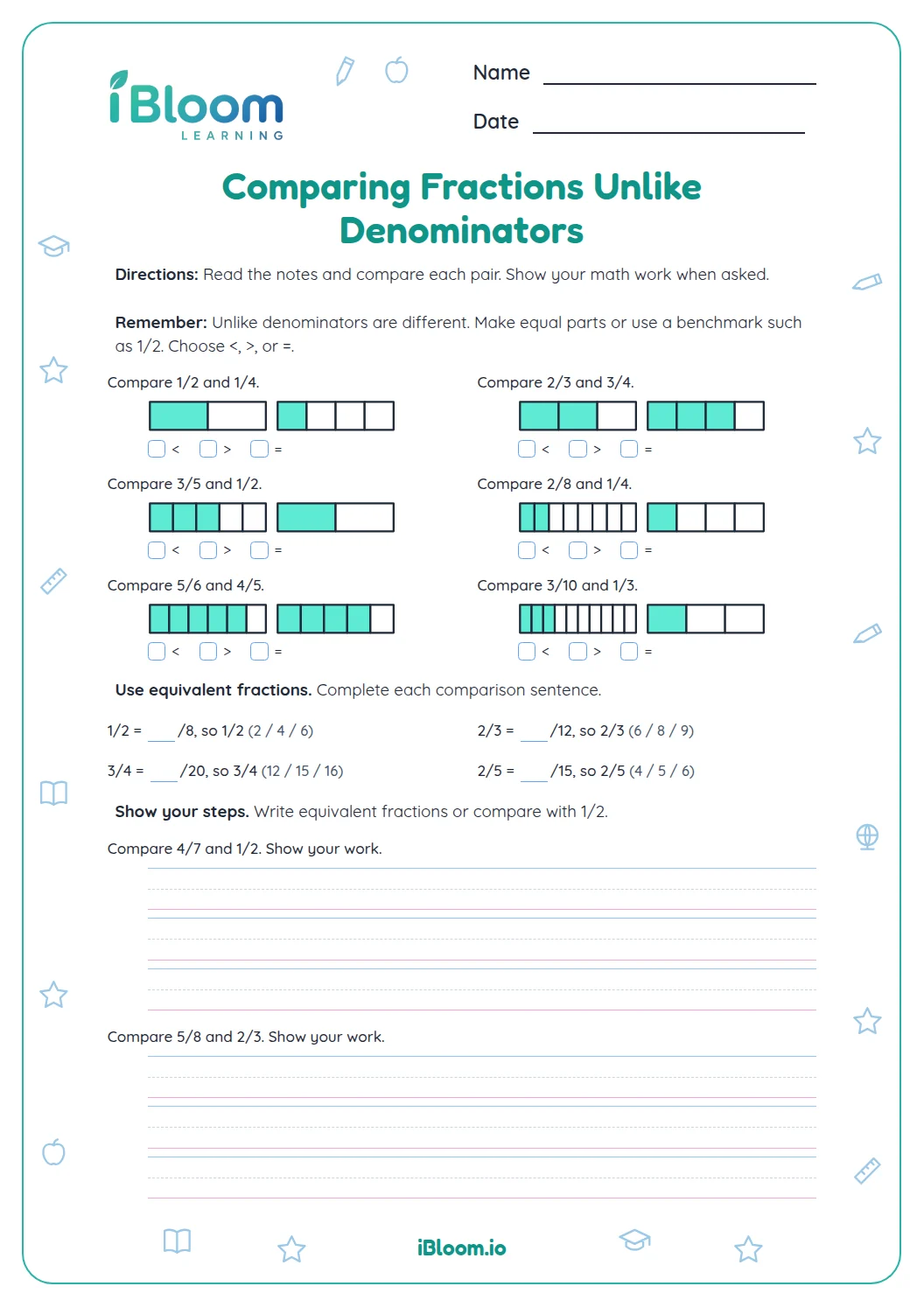
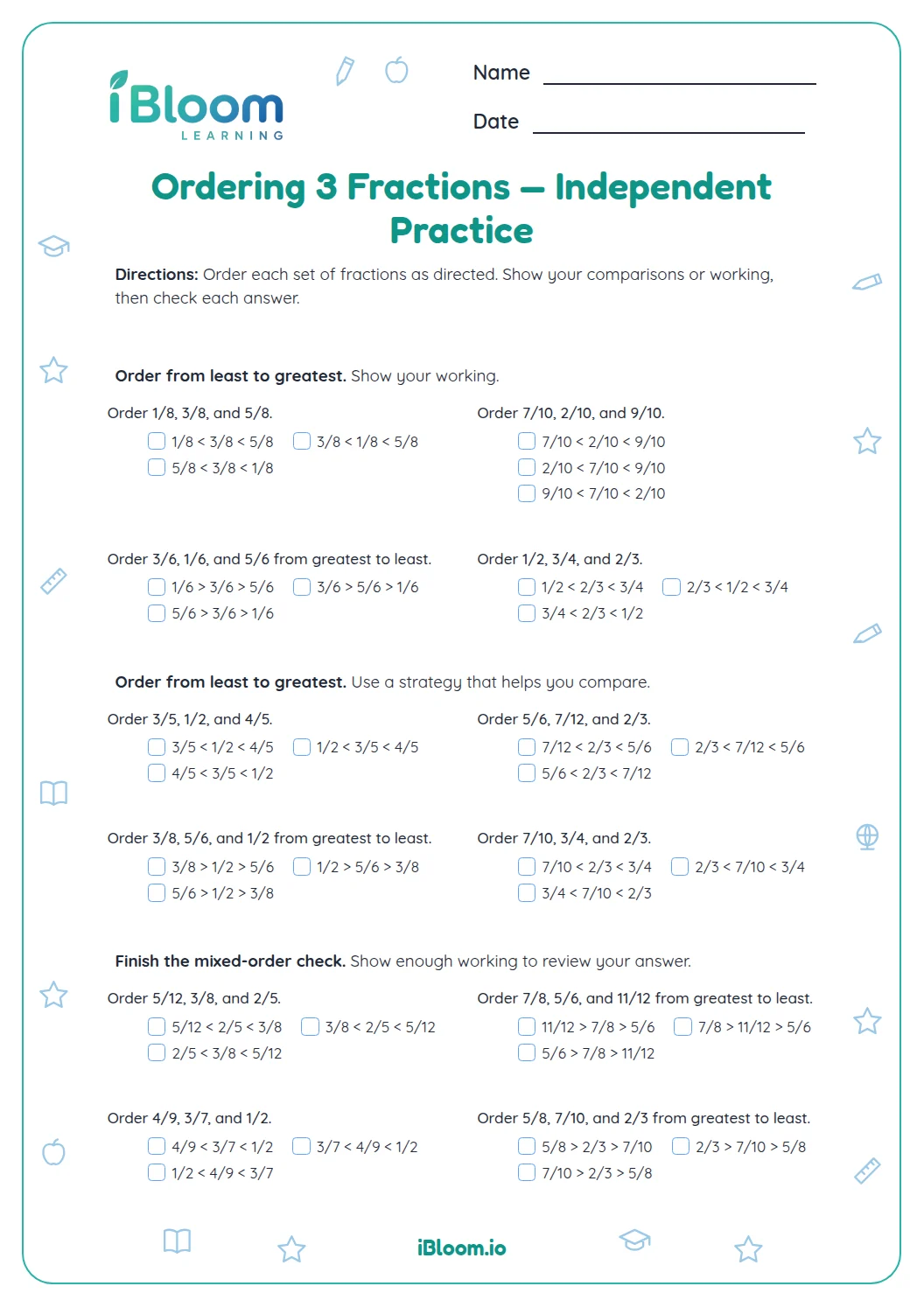
This Grade 4 worksheet gives learners 16 comparisons with unlike denominators. Items move from benchmark-friendly pairs to close comparisons that benefit from equivalent fractions, followed by brief reasoning and application. It practices CCSS 4.NF.A.2 and includes a separate answer key.
Aligned to 4.NF.A.2
How can benchmarks help compare fractions?
A benchmark such as 1/2 or 1 can help you estimate a fraction’s size before comparing. For 1/2 and 2/3, one is exactly half and the other is greater than half, so 1/2 < 2/3.
Question 1 uses that benchmark directly. For closer pairs, equivalent fractions make the pieces the same size.
- 11/2 ___ 2/3
- 21/2 is exactly one-half.
- 32/3 is greater than one-half.
- 4So 1/2 < 2/3.
When do equivalent fractions help?
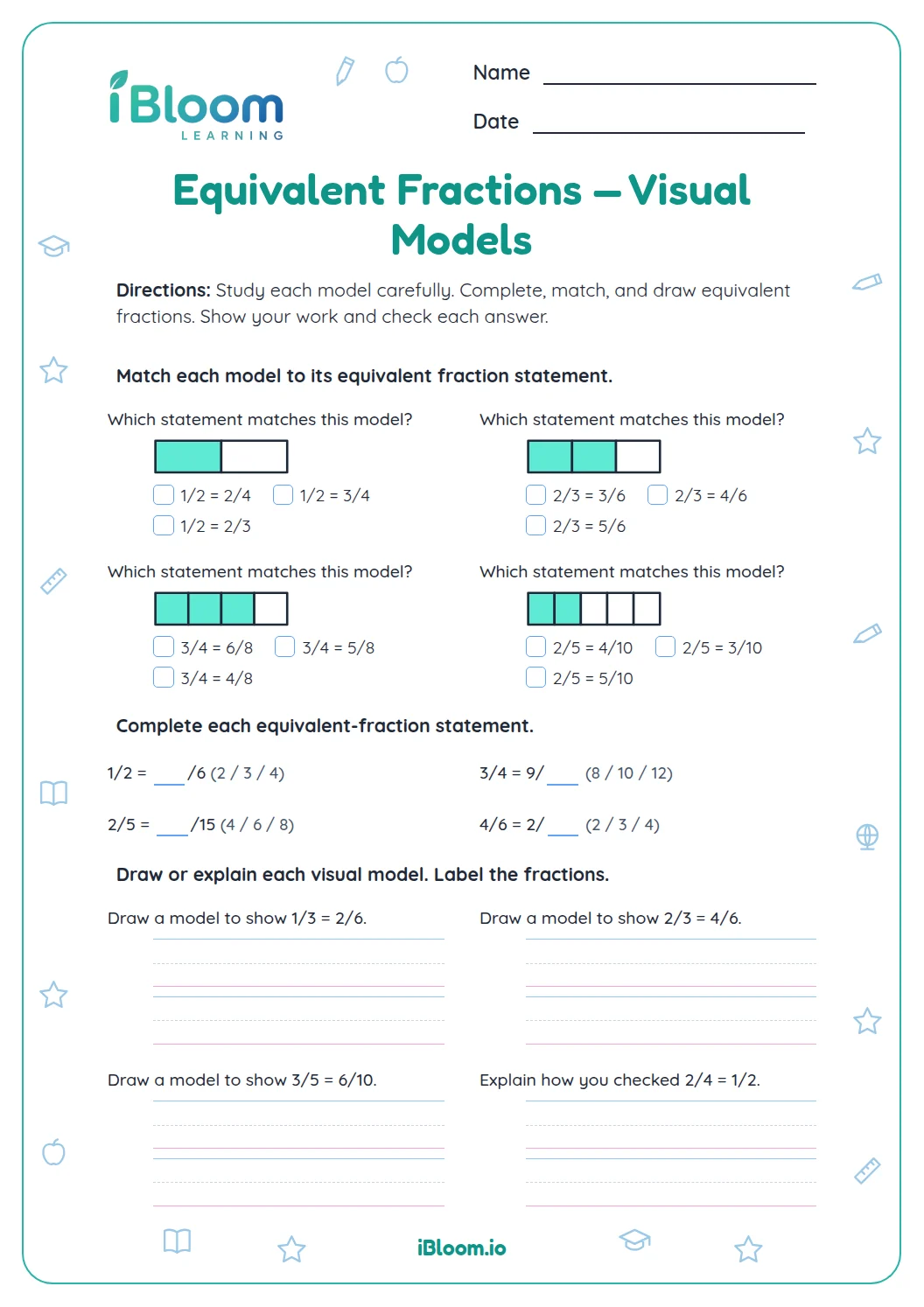
Rewrite each fraction with the same denominator to compare equal-sized parts. For 3/4 and 5/8, use eighths: 3/4 = 6/8, and 6/8 > 5/8.
How can a comparison be checked?
Estimate first, then use equivalent fractions if needed. The sign should agree with the sizes. Part C includes an explanation and short applications.
How to use this worksheet
- 1Read both fractions and identify a useful benchmark.
- 2Estimate which fraction is larger.
- 3If needed, rewrite both fractions with a common denominator.
- 4Write >, <, or = in the blank.
- 5Check that the point of the sign faces the smaller value.
Common mistakes and quick fixes
The mistake
Comparing denominators alone
The fix
Rewrite the fractions with equal-sized parts.
The mistake
Assuming a larger numerator means a larger fraction
The fix
Check the whole fraction value with a benchmark.
The mistake
Turning the sign toward the larger number
The fix
Read the statement aloud and point the open side at the larger value.
Common Core alignment
This worksheet practices comparing fraction values through visualizable number reasoning.
Compare fractions by reasoning about size and using equivalent forms.
On this sheet: Each item compares unlike denominators; the final part asks for a reason supporting a sign.
Show the official wordingHide the official wording
Compare two fractions with different numerators and different denominators, e.g., by creating common denominators or numerators, or by comparing to a benchmark fraction such as 1/2. Recognize that comparisons are valid only when the two fractions refer to the same whole. Record the results of comparisons with symbols >, =, or <, and justify the conclusions, e.g., by using a visual fraction model.
What to practice next
Make more practice
Further reading
Questions parents and teachers ask
What does an unlike denominator mean?
The denominators name different-sized fractional parts. In 1/2 and 2/3, one fraction is split into halves and the other into thirds. To compare, use a helpful benchmark or rewrite them as equivalent fractions with a common denominator. This keeps the comparison focused on the size of each value.
How can I compare 1/2 and 2/3?
One half is the benchmark: 2/3 is larger than 1/2, so 1/2 < 2/3. Another method is to write 1/2 as 3/6 and 2/3 as 4/6. Comparing 3/6 with 4/6 confirms the sign. Both methods show that equal-sized parts make the comparison easier to see.
Why are the signs easy to mix up?
The open side of > or < faces the larger value, while the point faces the smaller value. Read the full statement aloud as “left is less than right” or “left is greater than right,” then check whether the fraction sizes agree.
How many comparisons are included?
The worksheet has 16 fraction comparisons in three parts. Early pairs invite benchmark reasoning; later pairs include less obvious values and ask learners to justify a comparison. The key gives the correct sign for every pair. Learners can check their reasoning in the separate answer key.
Can children use equivalent fractions instead of benchmarks?
Yes. Equivalent fractions make the parts the same size, so the numerators can be compared directly. Benchmarks can be faster for familiar values such as one-half. The important step is comparing the fractions’ values, not just their numerators or denominators.