




About this worksheet
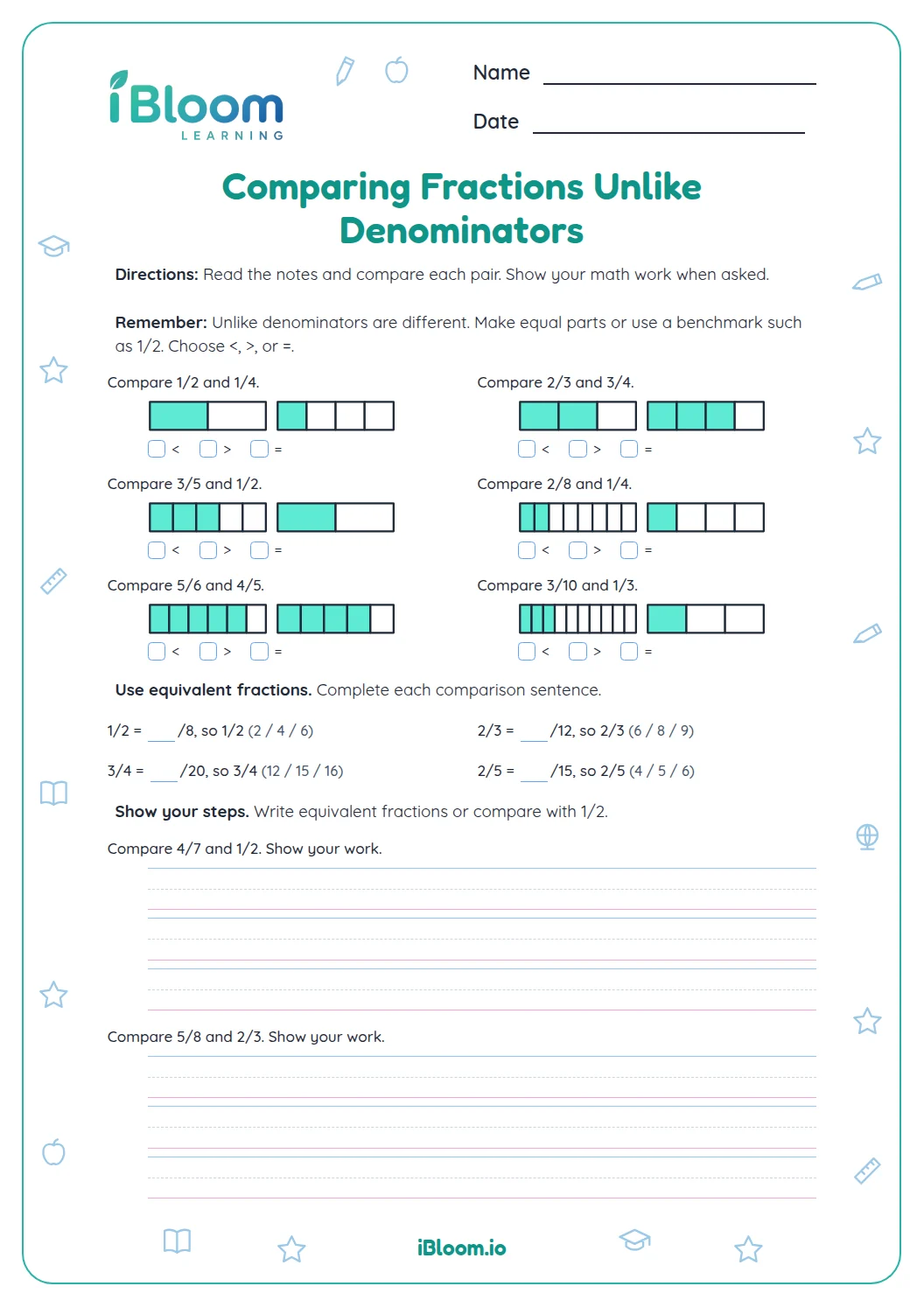
This Grade 4 worksheet gives practice comparing fractions with unlike denominators, completing an equivalent fraction, and applying comparisons to familiar lengths. It includes 14 questions in a compact printable and a separate answer key. The questions practice Common Core 4.NF.A.2; each comparison refers to equal-sized wholes.
Aligned to 4.NF.A.2
How do equivalent fractions help compare?
Write both fractions with the same denominator. Then compare the numerators because the parts are the same size. Question 9 compares 5/6 and 4/5: in thirtieths, they are 25/30 and 24/30, so 5/6 is greater.
- 1Question 9: 5/6 and 4/5
- 25/6 = 25/30
- 34/5 = 24/30
- 4So 5/6 > 4/5
When can a benchmark make comparing easier?
A familiar amount such as 1/2 or 1 can help when a fraction is clearly above or below it. For a close pair, find equivalent fractions with a shared denominator and compare the numerators. Always compare amounts that refer to the same whole.
What will students practice on the sheet?
Part A practices comparisons and an equivalent-fraction equation. Part B uses close pairs and an equality. Part C applies the same comparison skill to short distance and length situations.
How to use this worksheet
- 1Look at each pair before calculating; notice whether a fraction is near 0, 1/2, or 1.
- 2For unlike denominators, find a common denominator.
- 3Multiply the numerator by the same factor used for the denominator.
- 4Compare the new numerators and write the correct symbol.
- 5For word problems, identify the two amounts and subtract only after comparing.
- 6Check each response against the answer key and discuss any equivalent-fraction step.
Common mistakes and quick fixes
The mistake
Choosing the larger denominator as the larger fraction.
The fix
Use same-size pieces: rename both fractions with a common denominator before judging.
The mistake
Changing the denominator but not the numerator.
The fix
Whatever factor scales the bottom must also scale the top.
The mistake
Subtracting denominators when finding a difference.
The fix
Rename both fractions with the same denominator, then subtract numerators.
Common Core alignment
This sheet practices the listed Common Core skill through its printed questions.
Compare fractions with different numerators and denominators using common denominators or benchmarks.
On this sheet: Students compare unlike-denominator fractions and apply the results to distance and capacity amounts.
Show the official wordingHide the official wording
Compare two fractions with different numerators and different denominators, e.g., by creating common denominators or numerators, or by comparing to a benchmark fraction such as 1/2. Recognize that comparisons are valid only when the two fractions refer to the same whole. Record the results of comparisons with symbols >, =, or <, and justify the conclusions, e.g., by using a visual fraction model.
What to practice next
Make more practice
Further reading
Questions parents and teachers ask
What does unlike denominators mean?
Unlike denominators are different bottom numbers in two fractions. For example, 5/6 and 4/5 name different-sized parts. This worksheet asks students to compare such fractions, sometimes by rewriting them with a common denominator, then deciding which amount is greater or whether they are equal.
How many questions are on this worksheet?
There are 14 questions in three parts. Students compare fraction pairs, complete an equivalent-fraction equation, and apply comparisons to lengths. The separate answer key lists each correct comparison or result, so learners can check their work after finishing a section.
What is a common denominator?
A common denominator is a shared multiple of two denominators. For 5/6 and 4/5, 30 works: they become 25/30 and 24/30. Since 25 is greater than 24, 5/6 is greater. Equivalent fractions preserve the amount while making the pieces the same size.
How long will the worksheet take?
Plan for about 20 minutes, depending on how much working the student writes. The early questions ask for comparisons, while the later items apply the same skill to distances and amounts. Checking the answer key and explaining one strategy may take a little longer.
Does the page include an answer key?
Yes. A separate two-page key marks the correct comparison or answer for all 14 questions. For a written response, accept another mathematically sound method that supports the comparison. The key is useful after the student has completed the worksheet so the reasoning can be checked together.
How can I help if a student gets stuck?
Ask whether the fractions can be renamed with the same denominator. If one fraction is near one-half or one whole, that benchmark may help. For a word problem, identify the amounts first and use the comparison to decide which length is greater.