




About this worksheet
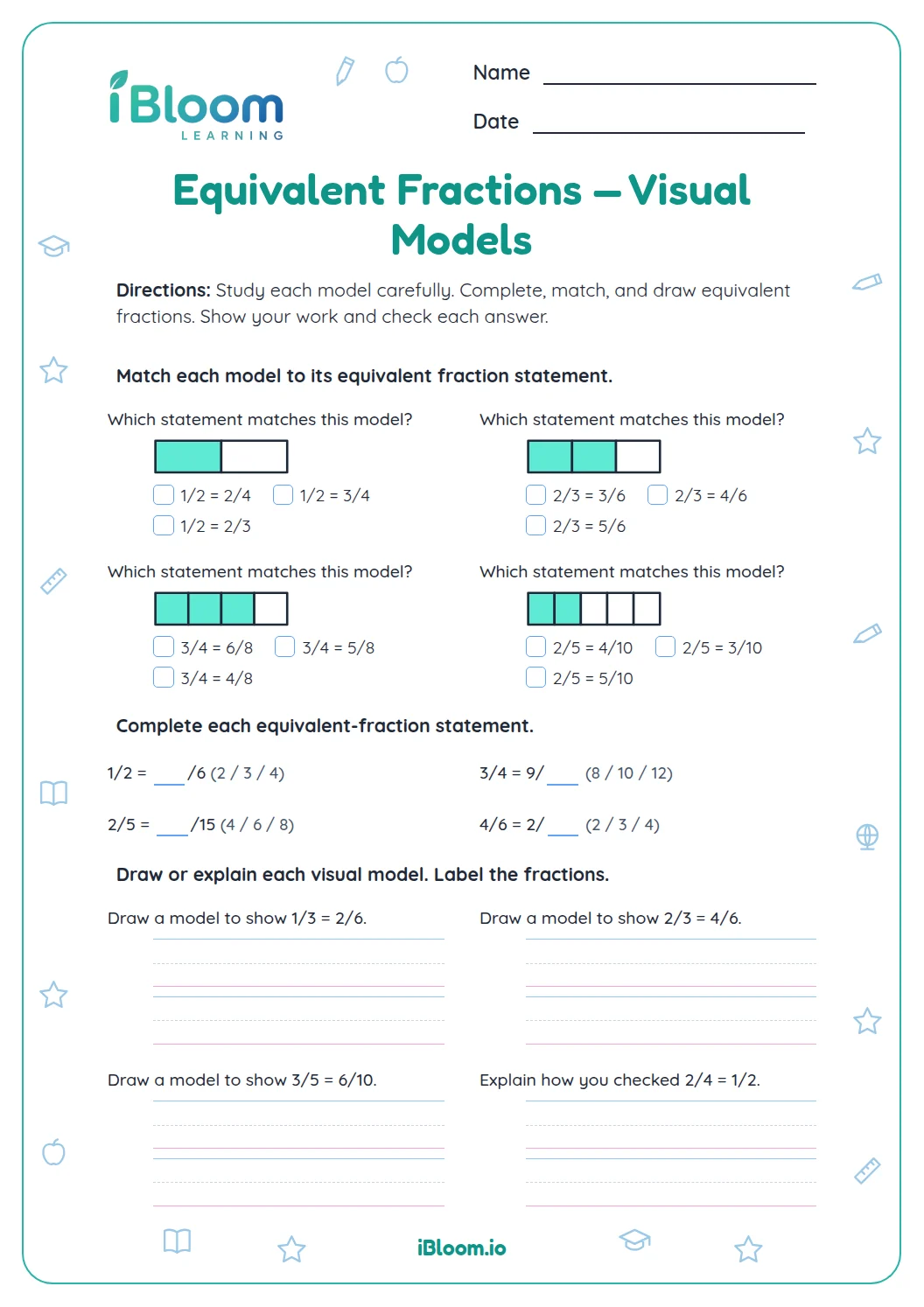
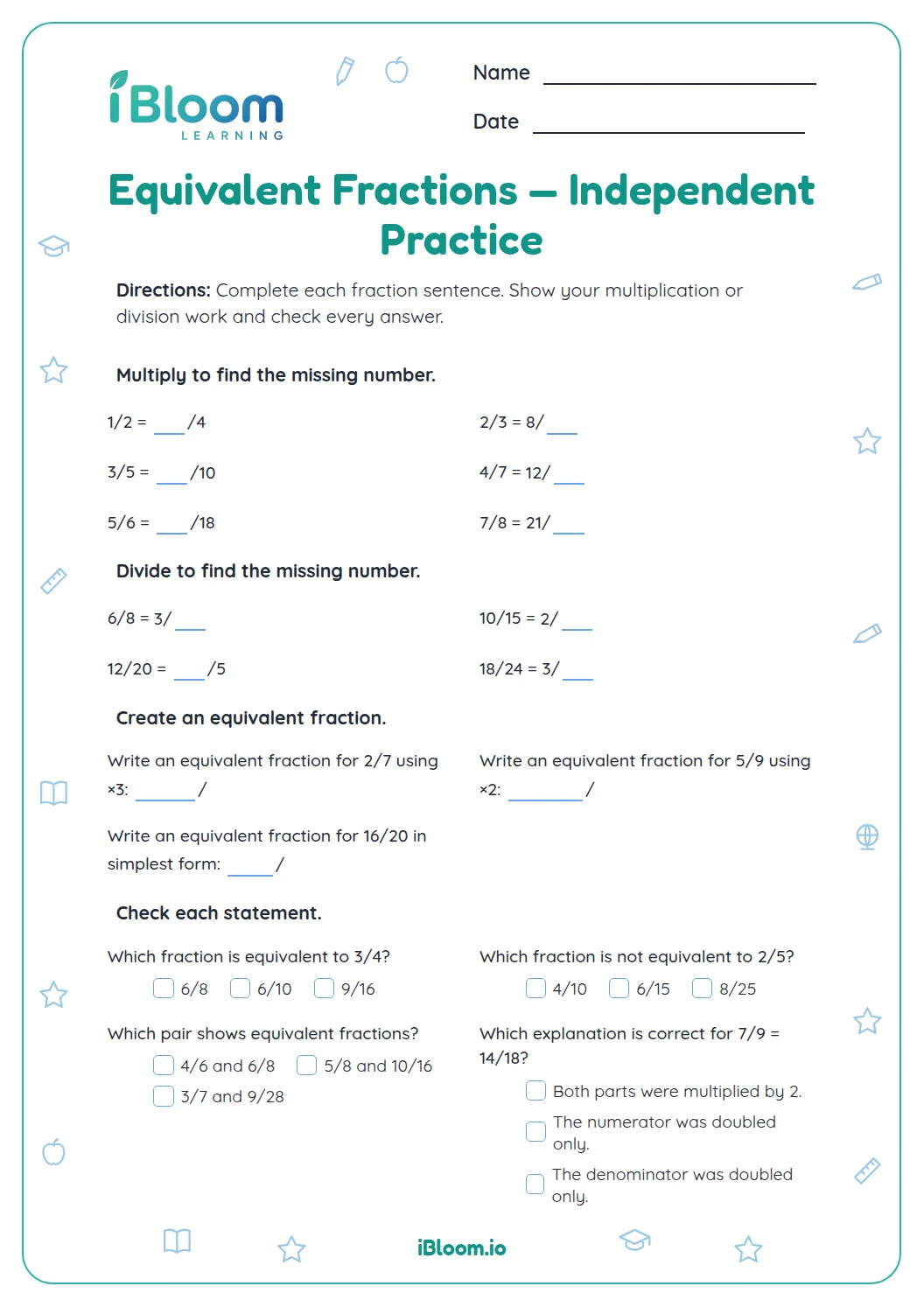
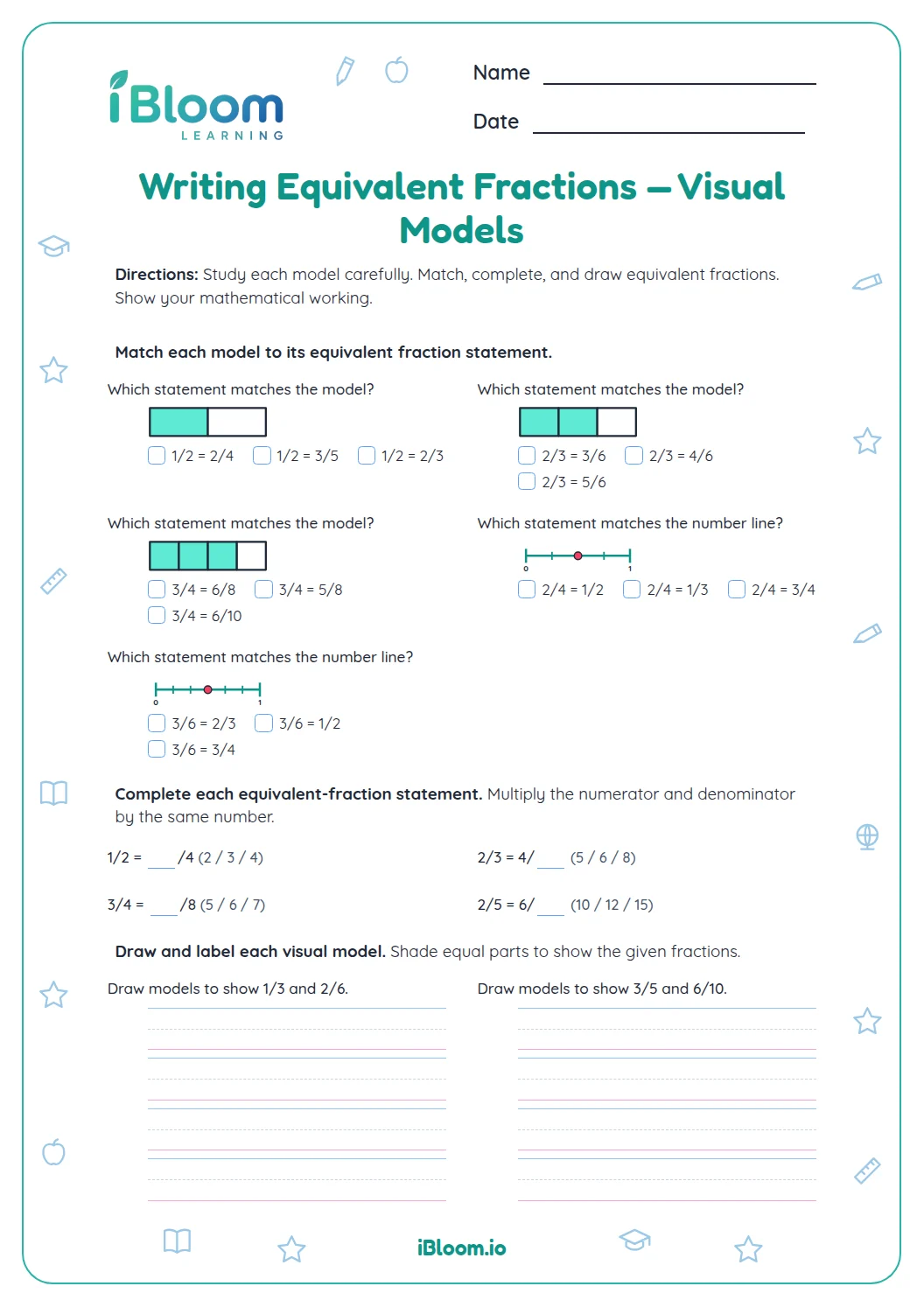
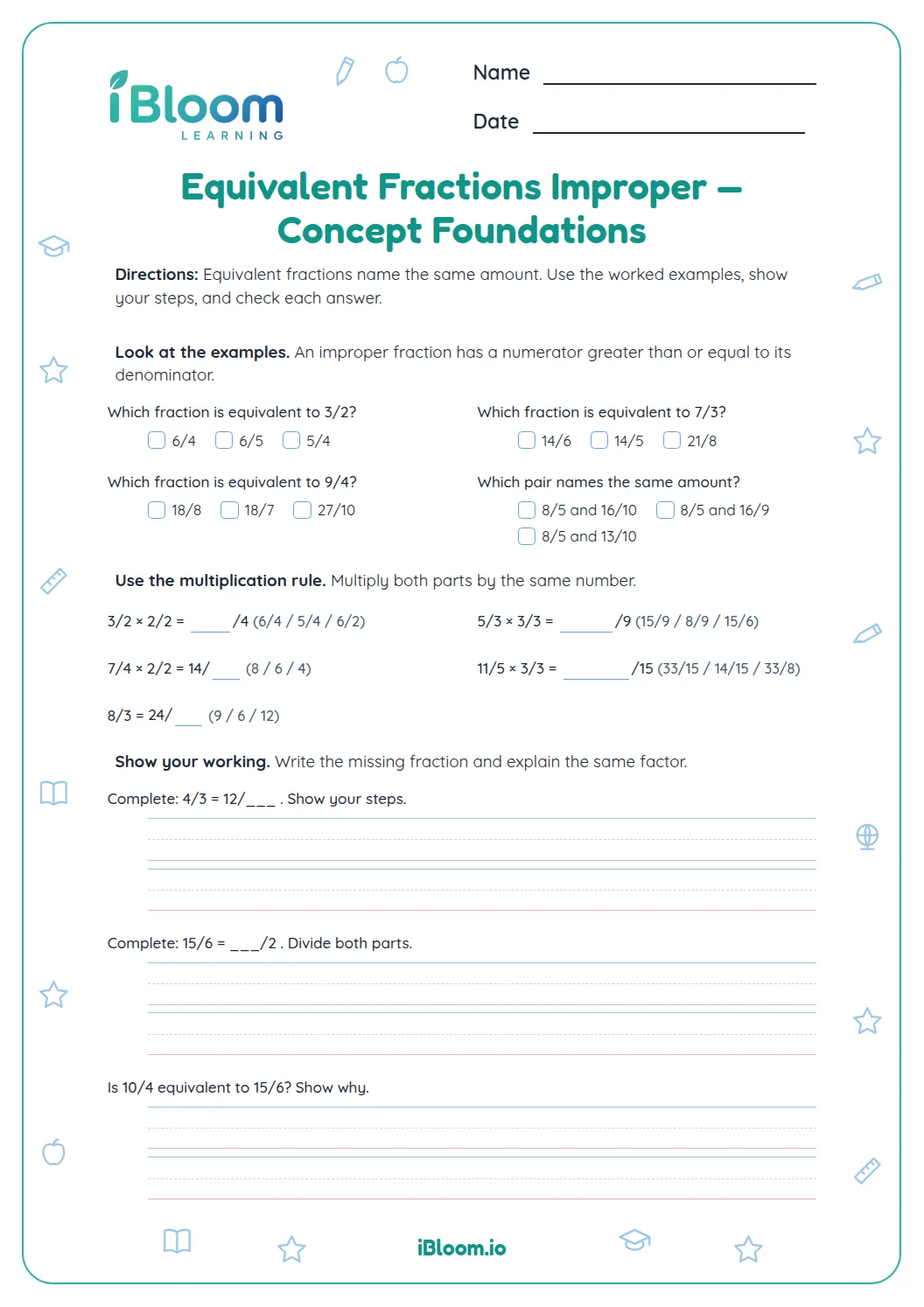
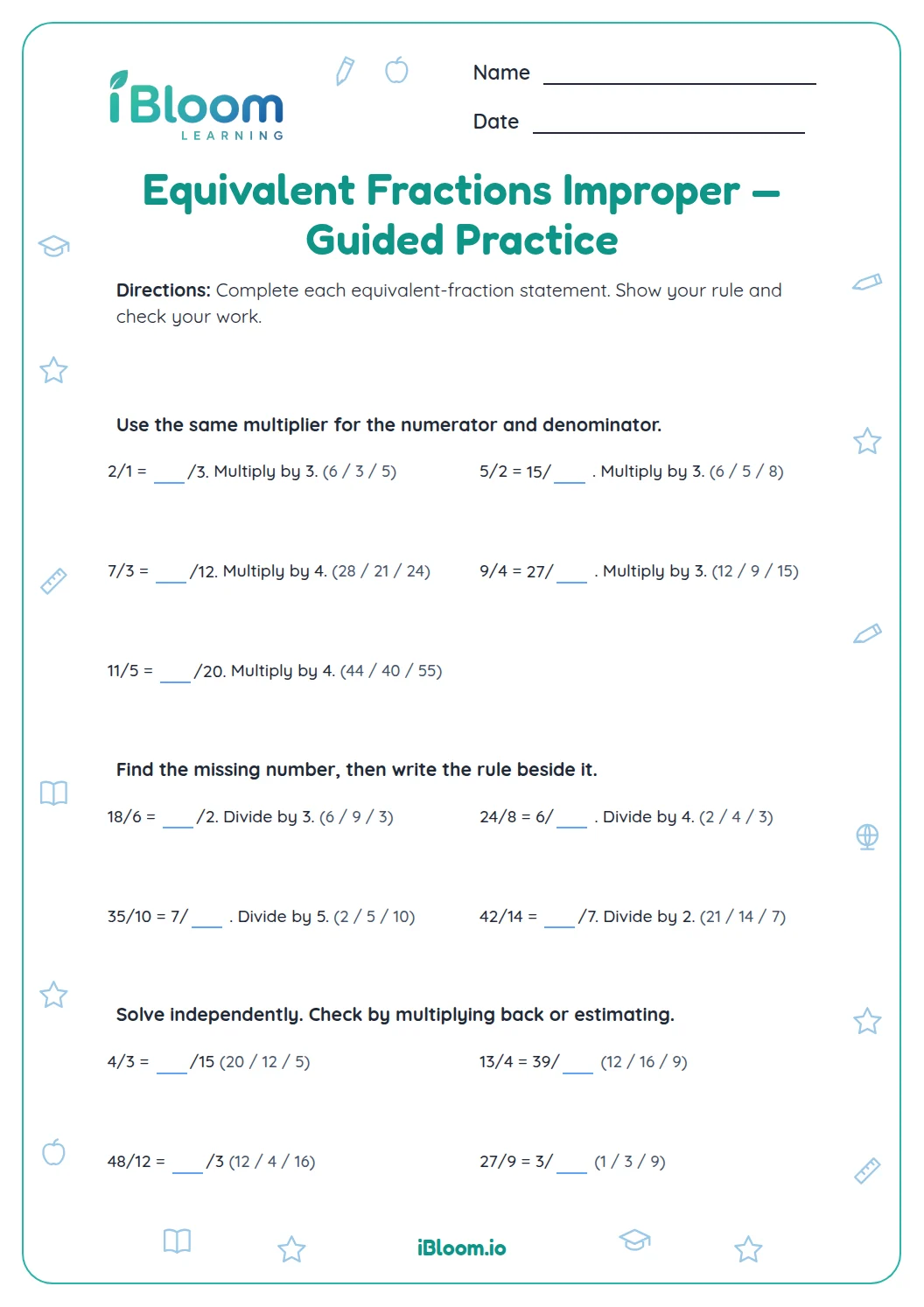
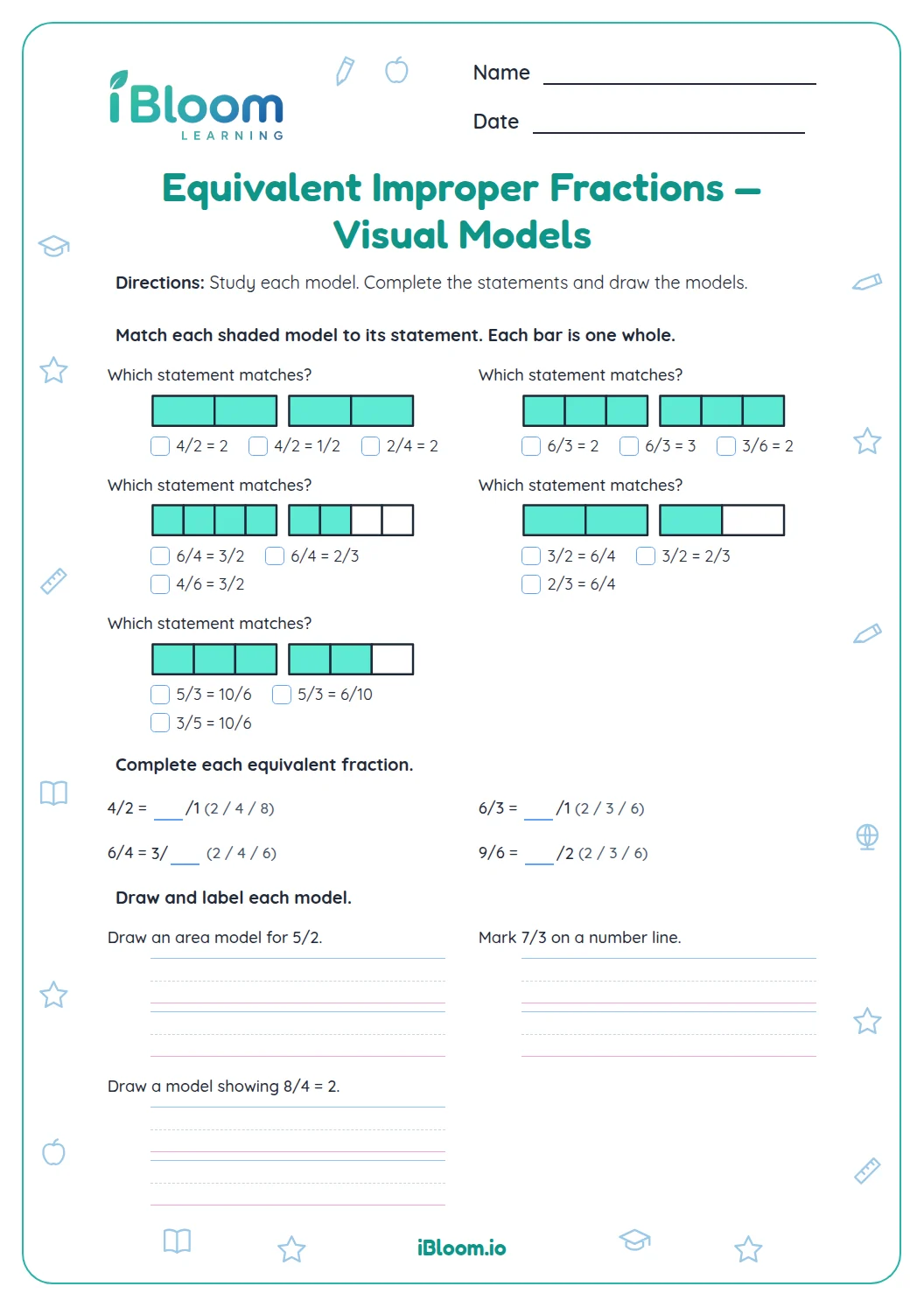
This free Grade 4 printable gives learners 16 guided questions on equivalent fractions. They complete fraction equations, identify equal values, and use bar models to connect the numbers to equal amounts. The separate answer key supports quick checking. The page practices CCSS 4.NF.A.1: recognize and generate equivalent fractions, including with visual fraction models.
Aligned to 4.NF.A.1
What makes two fractions equivalent?
Equivalent fractions name the same amount even when their numerators and denominators differ. For instance, one half and four eighths cover the same part of a whole. The denominator tells how many equal parts make the whole; the numerator tells how many parts are counted.
The model questions make that relationship visible before learners use multiplication or division to scale both fraction parts.
- 11/2 = ___/8
- 2A bar with 2 parts has 1 shaded.
- 3Divide each part into 4: 4 of 8 parts are shaded.
- 4So 1/2 = 4/8.
How do you make an equivalent fraction?
Multiply or divide the numerator and denominator by the same nonzero number. The value stays the same because the size and number of the fraction pieces change together.
- 11/2 = ___/8
- 22 became 8 by multiplying by 4.
- 3Multiply the numerator by 4 too: 1 × 4 = 4.
- 4Answer: 1/2 = 4/8.
What will learners practice on the pages?
Part A completes equivalent-fraction equations, with three bar models to connect the numbers to equal-sized amounts. Part B asks learners to select an equal fraction from choices. Part C gives another set of equations to solve independently.
The questions move from a visible model to independent number work.
How to use this worksheet
- 1Read the fraction equation and name the numerator or denominator that is missing.
- 2When a model appears, count all equal parts and then count the shaded parts.
- 3Find the factor that changes the known numerator or denominator.
- 4Apply that same factor to the other fraction part.
- 5Use a specified numerator or denominator to find the scale factor.
- 6Use the answer key to check both the value and the missing number.
Common mistakes and quick fixes
The mistake
Changing only one fraction part.
The fix
Use the same multiplier or divisor on numerator and denominator.
The mistake
Adding the same number to top and bottom.
The fix
Equivalent fractions come from scaling both parts, not adding.
The mistake
Treating a larger denominator as a larger amount.
The fix
Compare the fraction value; more pieces can mean smaller pieces.
Common Core alignment
This practice connects the named skill to a Common Core goal.
Generate equal fractions by scaling both numerator and denominator.
On this sheet: The models, equations, choices, and context questions all ask learners to recognize or generate equivalent fractions.
Show the official wordingHide the official wording
Explain why a fraction a/b is equivalent to a fraction (n × a)/(n × b) by using visual fraction models, with attention to how the number and size of the parts differ even though the two fractions themselves are the same size. Use this principle to recognize and generate equivalent fractions.
What to practice next
Make more practice
Further reading
Questions parents and teachers ask
Why do equivalent fractions look different?
They can use different numbers of equal parts while naming the same amount. One half is equal to two fourths because splitting each half into two smaller equal pieces creates four pieces, two of which cover the original half. Questions 1–5 use this same idea.
What is the answer to question 1?
The answer is 4. The bar shows one of two equal parts shaded, or 1/2. To express that amount in eighths, multiply both numerator and denominator by 4, giving 4/8. The answer key lists the missing number for every equation.
Should learners simplify every answer?
Use the form requested by each question. If a numerator or denominator is specified, keep that form even when the fraction can be simplified. For question 1, 1/2 = 4/8 uses the requested denominator of 8. The key also follows the requested form.
How can I help if the multiplication factor is unclear?
Ask which number changes the known numerator or denominator into the target number. If 3 becomes 12, the factor is 4. Then have the learner multiply the other fraction part by 4 as well and check that the model still represents the same amount.
What is included in the answer key?
The separate key gives answers to all 16 questions across two pages. It is especially useful for checking the requested numerator or denominator in each part. The key also shows equivalent fraction forms, so a learner can check that the value stays the same.