


About this worksheet
This worksheet gives students focused practice with equivalent fractions. Questions move from identifying the skill to using it independently, with a separate answer key for checking.
Aligned to CCSS 4.NF.A.1
How to approach equivalent fractions
Read each question carefully and identify the skill it asks you to use. Work through the parts in order; later questions ask you to apply the same idea with less support.
Use the answer key to check your work. When an answer differs, return to the question and explain the rule or evidence that supports the correct response.
What is on this worksheet?
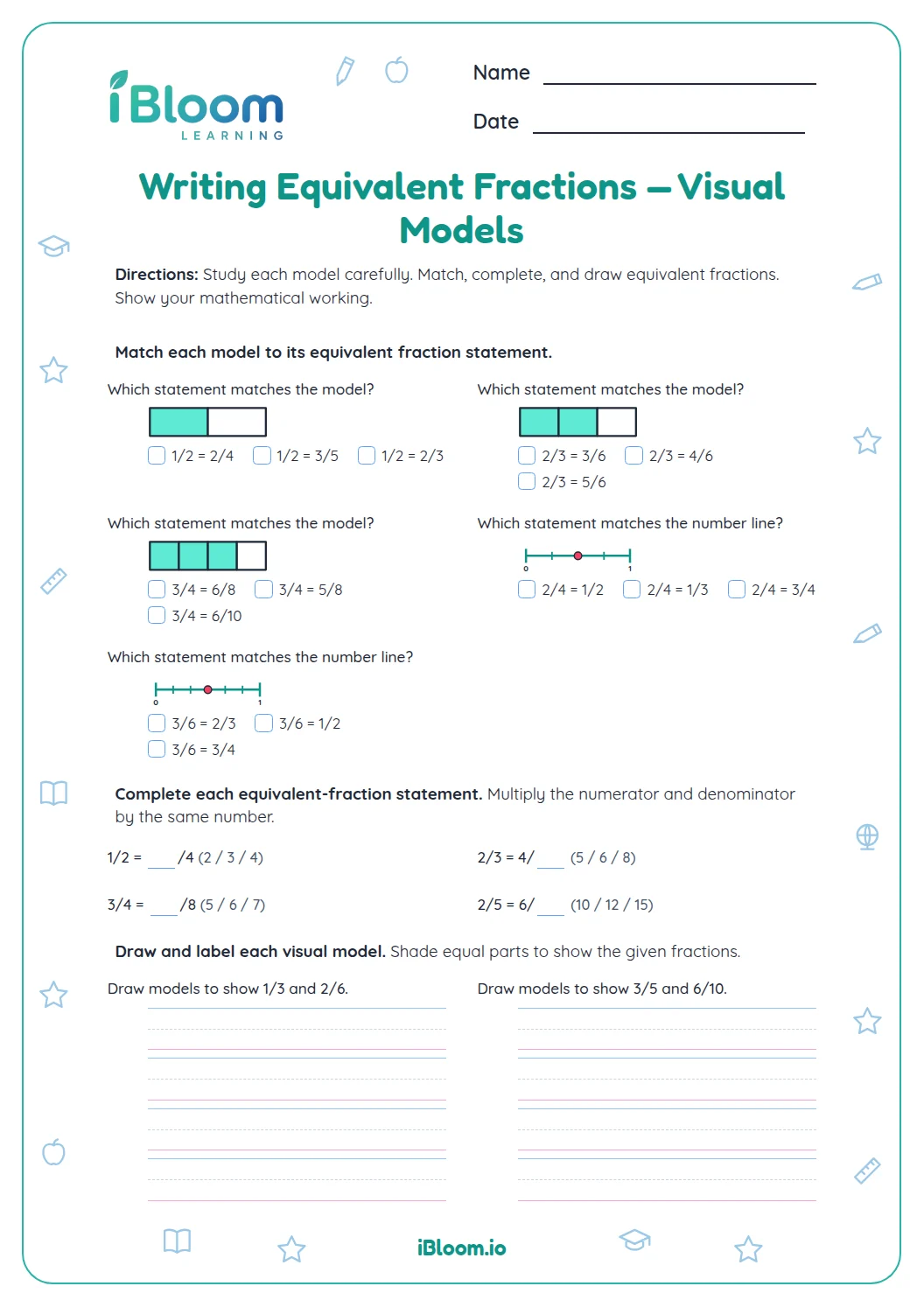
The printable includes 16 questions across several parts. It begins with recognition or guided practice and ends with independent application.
Print the worksheet pages for practice and keep the separate key nearby for review.
How to use this worksheet
- 1Read the one-sentence directions before starting.
- 2Complete each part in order and use the provided response space.
- 3Check the answer key and explain any corrections.
Common mistakes and quick fixes
The mistake
Rushing and overlooking a key word or detail.
The fix
Reread the full prompt and point to the clue that supports your answer.
The mistake
Changing an answer without checking the rule.
The fix
Use the skill named in the question to verify your choice.
Common Core alignment
This page supports the named skill at the listed grade level.
Generate equivalent fractions by multiplying the numerator and denominator by the same number.
On this sheet: Students complete equivalent-fraction statements and identify equal fractions.
Show the official wordingHide the official wording
Explain why a fraction a/b is equivalent to a fraction (n × a)/(n × b) by using visual fraction models, with attention to how the number and size of the parts differ even though the two fractions themselves are the same size. Use this principle to recognize and generate equivalent fractions.
What to practice next
Questions parents and teachers ask
What makes two fractions equivalent?
Equivalent fractions name the same amount, even when their numerators and denominators differ. Multiplying or dividing both parts by the same nonzero number keeps the value unchanged. A fraction strip or area model can help show why the pieces cover the same amount.
How do I find the missing number?
Multiply the numerator and denominator by the same number to keep the fraction’s value unchanged. For instance, multiplying both parts of 1/2 by 4 gives 4/8. The guided items ask students to find this scale factor and complete the missing numerator.
Should I simplify every answer?
Follow the form requested in each prompt. If the blank is a numerator or denominator, write that missing number. When a question asks for an equivalent fraction, any correct equivalent form that matches the requested denominator is suitable.
Is an answer key included?
Yes. Some items ask for a missing numerator, while others ask students to select or write an equal fraction. Check that the same factor was applied to the numerator and denominator, then simplify or compare the values to verify.