





About this worksheet
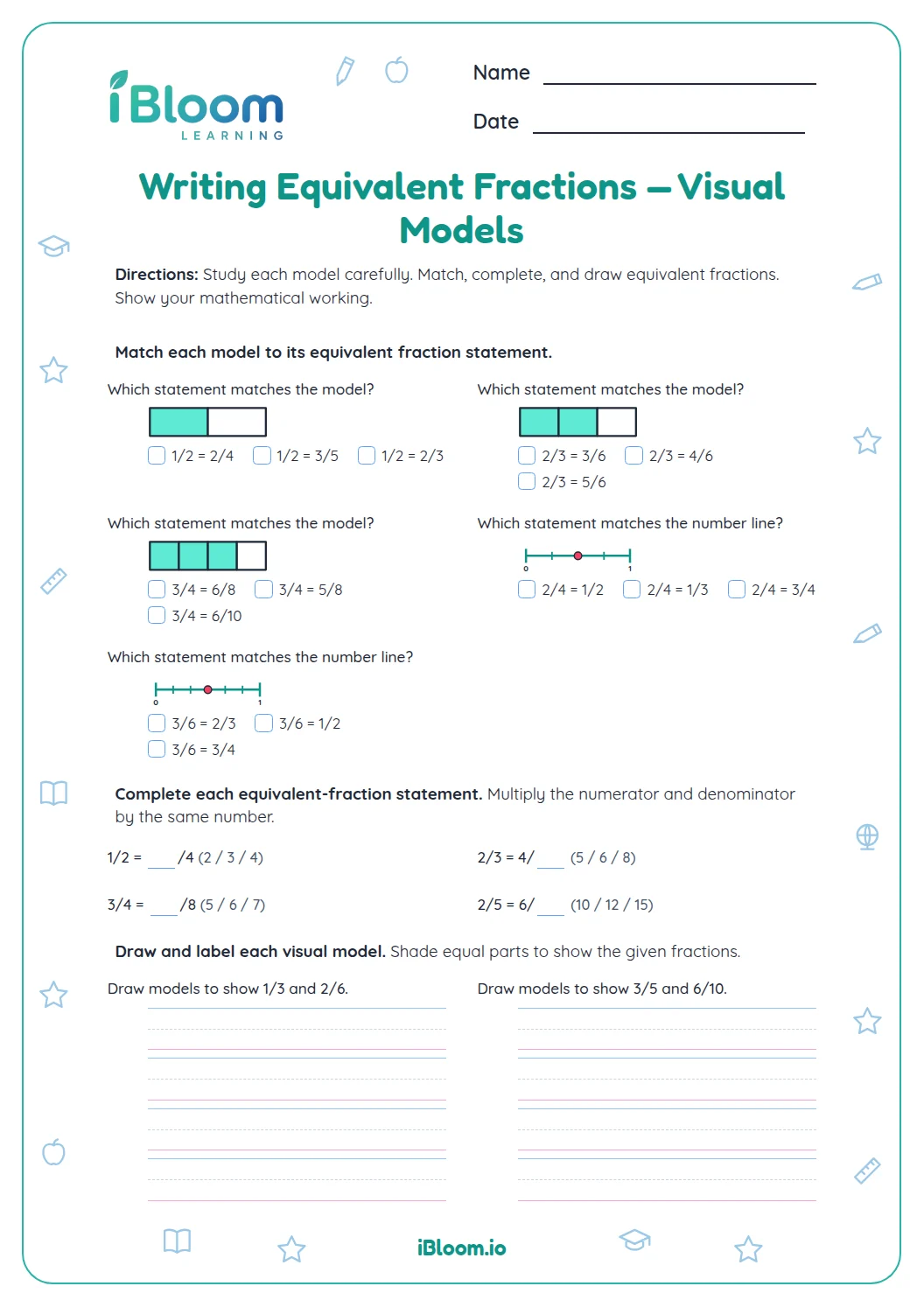
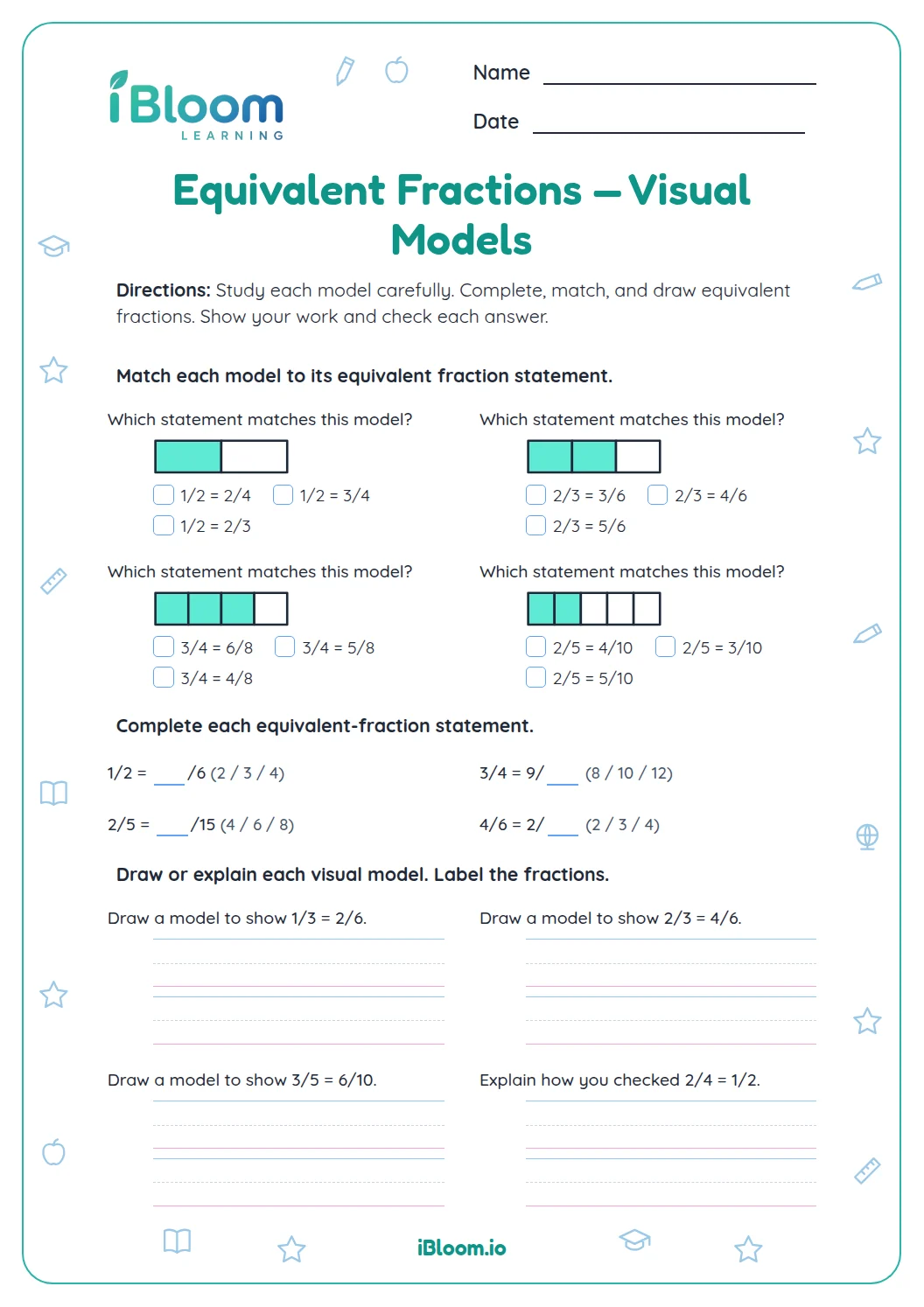
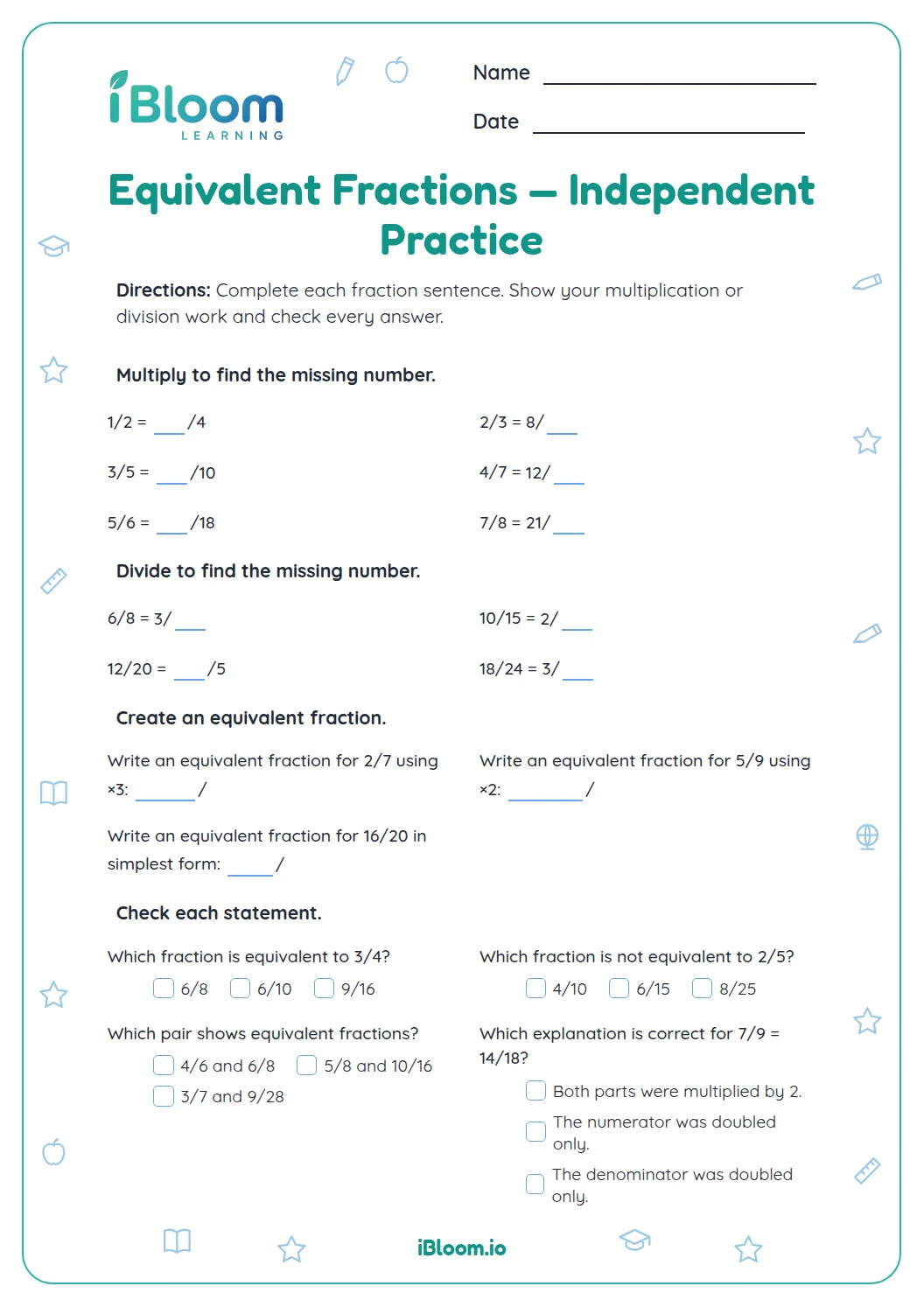
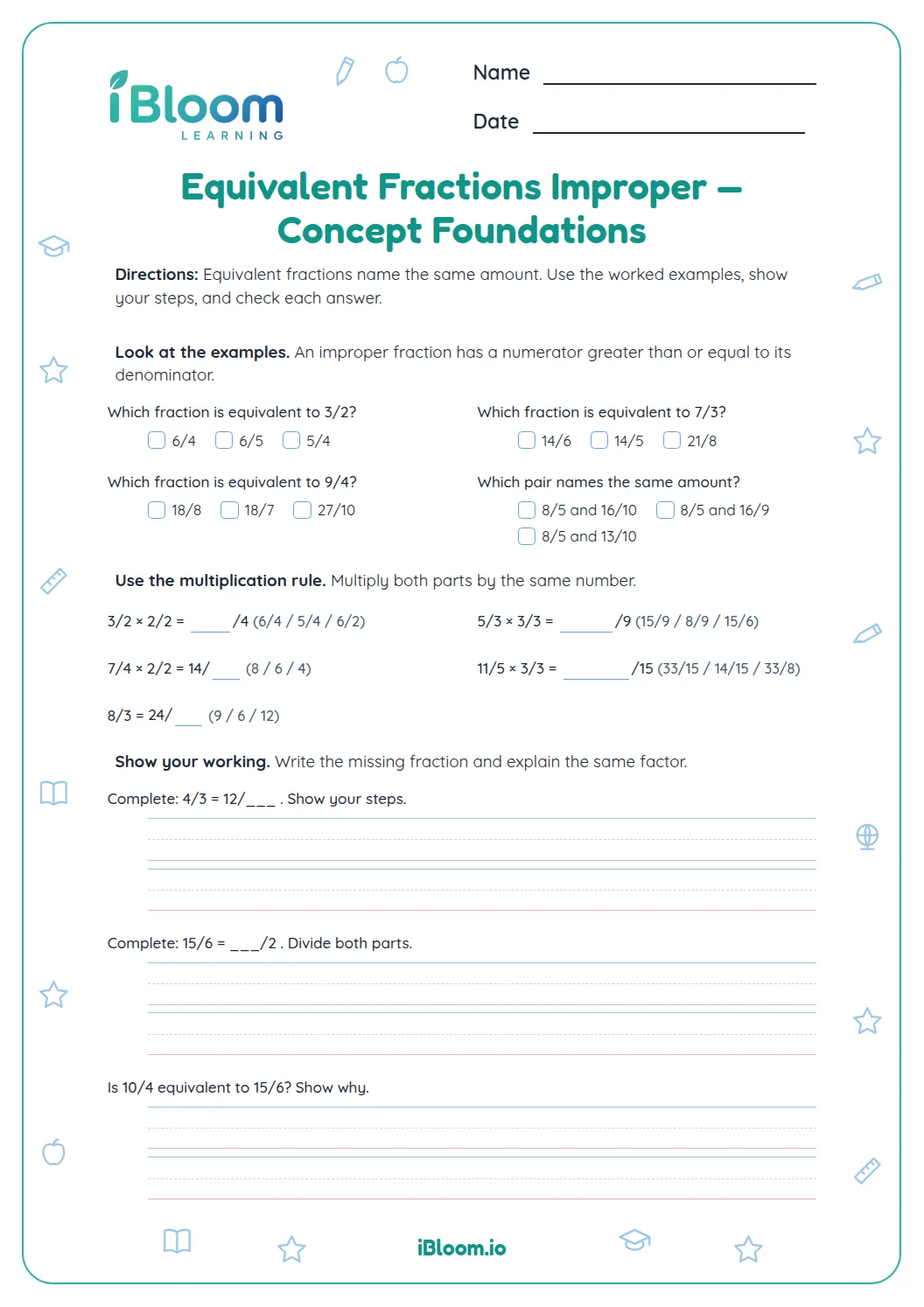
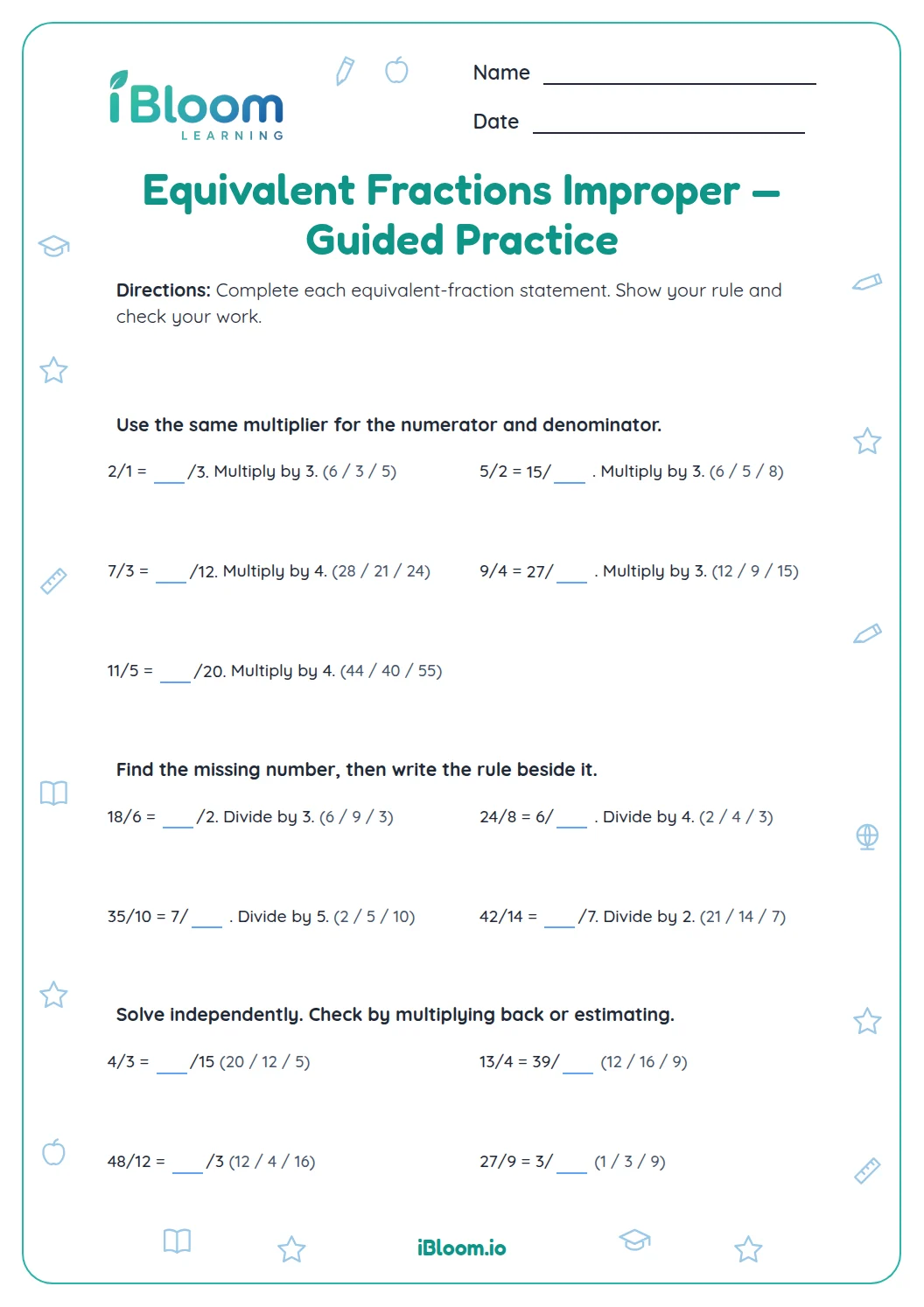
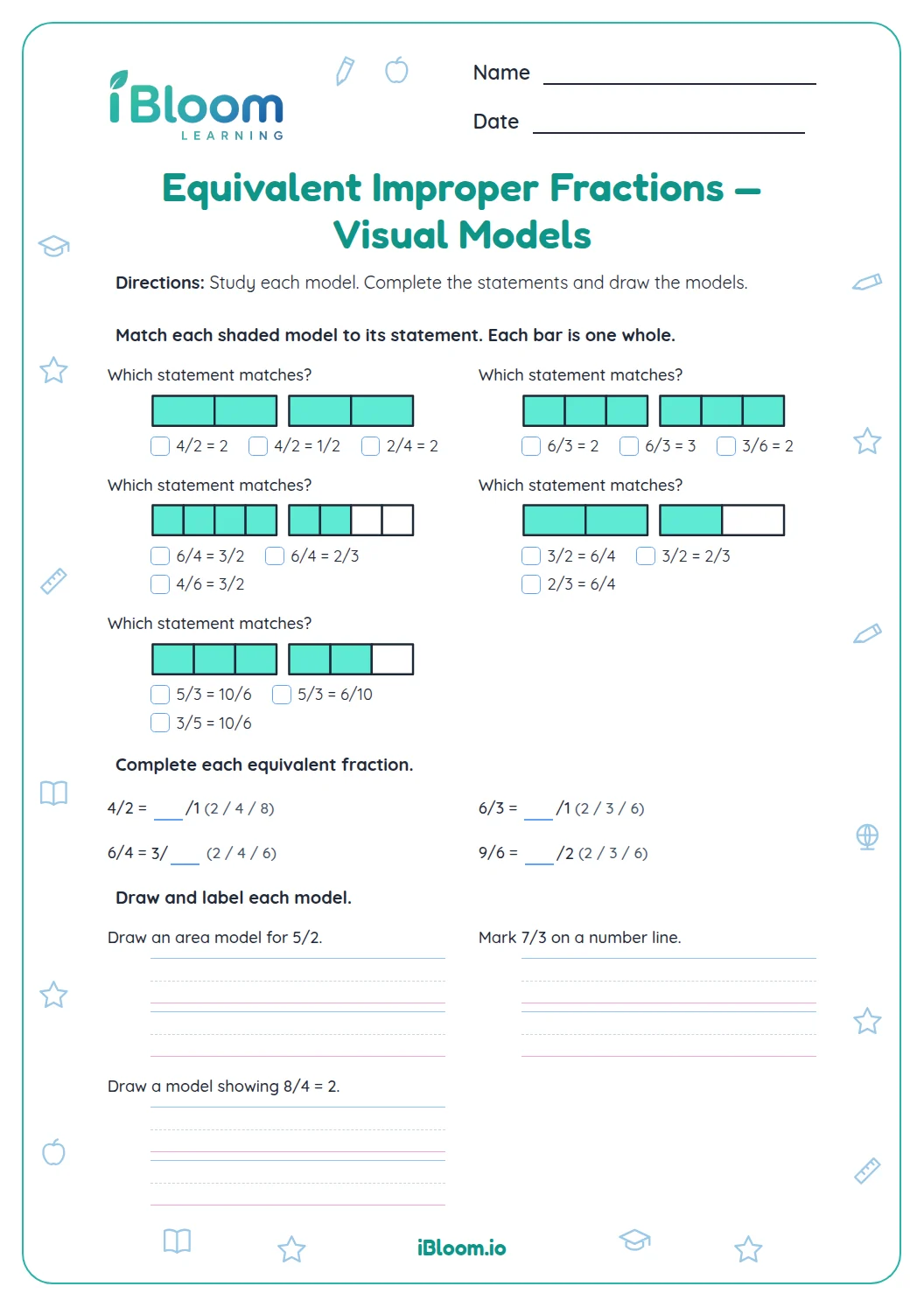
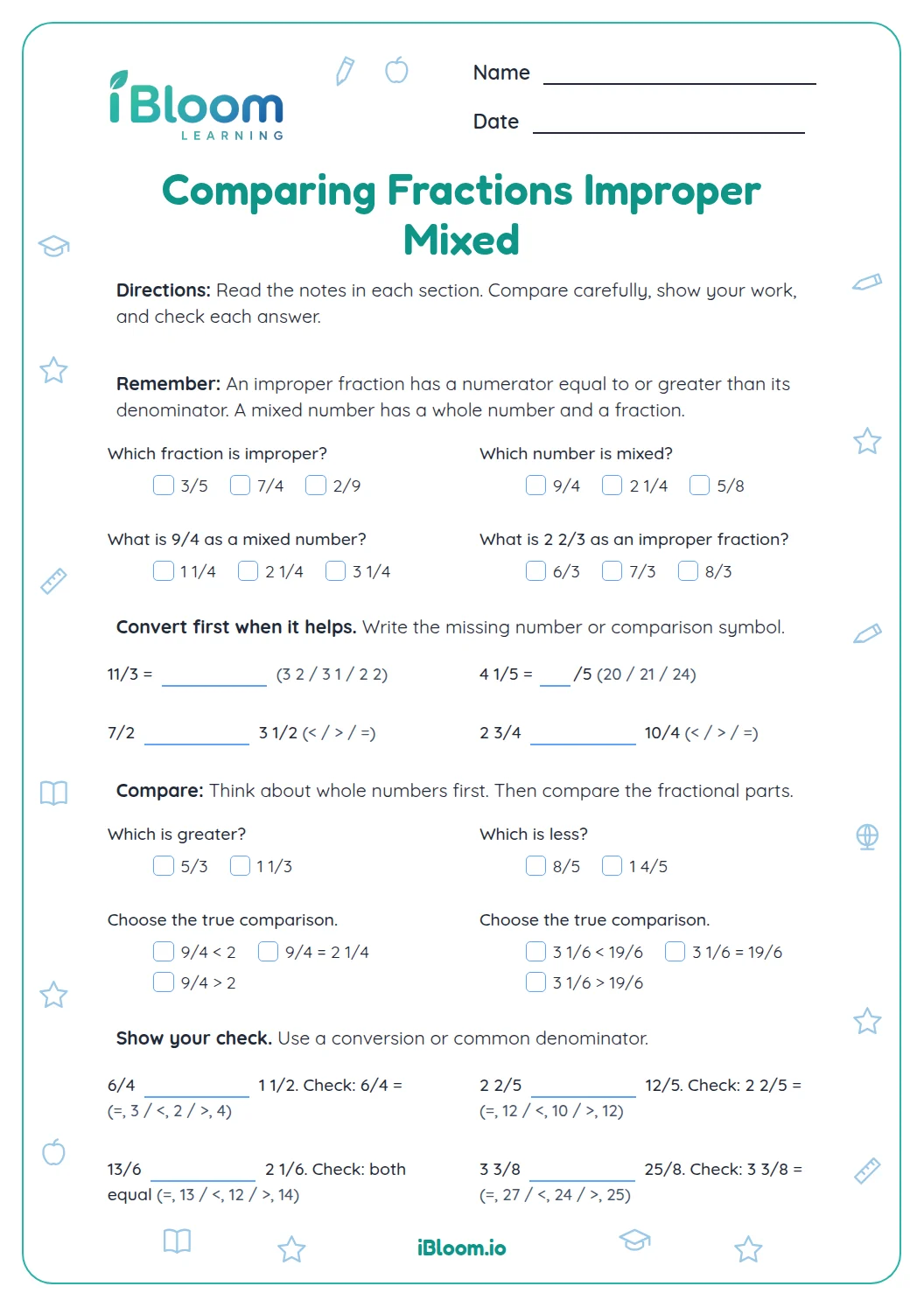
This Grade 4 printable builds equivalent-fraction fluency with missing-number equations and multiple-choice checks. Students find a matching numerator or denominator by applying the same scale factor to both parts of a fraction. It includes 16 questions, a separate answer key, and practice aligned with CCSS 4.NF.A.1.
Aligned to 4.NF.A.1
How can a fraction keep the same value?
Multiply or divide both the numerator and denominator by the same nonzero number. The number and size of the pieces change together, so the amount stays the same.
- 12/3 = ?/6
- 23 × 2 = 6, so multiply the top by 2 too.
- 32 × 2 = 4
- 42/3 = 4/6
How do you find a missing number?
Compare the known denominators or numerators to find the scale factor. In 3/4 = 9/___, the numerator was multiplied by 3, so multiply 4 by 3 to get 12.
How can you check equivalence?
Reduce both fractions or compare their scale factors. For 7/10 = 70/100, both numbers were multiplied by 10, so the value remains unchanged.
How to use this worksheet
- 1Read the numerator and denominator carefully.
- 2Find the factor that changes one known number into the other.
- 3Apply that same factor to the other part of the fraction.
- 4Write the missing number in the blank.
- 5Check by reducing both fractions or reversing the scale.
- 6Keep the numerator above the fraction bar and denominator below it.
Common mistakes and quick fixes
The mistake
Multiplying the numerator but not the denominator.
The fix
Use the same factor on both parts.
The mistake
Adding the same number to top and bottom.
The fix
Equivalent fractions come from multiplying or dividing both terms by the same factor.
The mistake
Switching numerator and denominator.
The fix
Keep the numerator on top and denominator on the bottom while scaling.
Common Core alignment
Equivalent fractions preserve the same amount when numerator and denominator are scaled equally.
Generate equivalent fractions by multiplying numerator and denominator by the same number.
On this sheet: Generate equivalent fractions by multiplying numerator and denominator by the same number.
Show the official wordingHide the official wording
Explain why a fraction a/b is equivalent to a fraction (n × a)/(n × b) by using visual fraction models, with attention to how the number and size of the parts differ even though the two fractions themselves are the same size. Use this principle to recognize and generate equivalent fractions.
What to practice next
Make more practice
Further reading
Questions parents and teachers ask
What does equivalent fraction mean?
Equivalent fractions have the same value even though they use different numerators and denominators. For example, 2/3 and 4/6 both represent the same amount because both parts of 2/3 were multiplied by 2. For example, 2/3 and 4/6 name the same amount.
Why must both numbers change by the same factor?
The numerator counts parts and the denominator describes the size of the parts. Multiplying both by the same factor divides each part into smaller equal pieces while keeping the total amount unchanged. Scaling both parts keeps the relationship between the numerator and denominator.
How do students solve a missing denominator?
Find how the numerator or denominator changes, then apply that same factor to the other number. In 3/4 = 9/___, the top is multiplied by 3, so the bottom is 4 × 3 = 12. The displayed example shows how a factor on one part determines the other.
Are these fractions in the Grade 4 range?
The starting fractions use Grade 4 denominators such as 3, 4, 5, 6, 8, and 10. Some equivalent forms use larger denominators, including 100, as students apply the same factor to the numerator and denominator. The starting denominators use Grade 4 fractions; some equivalent forms are larger.
Is there an answer key?
Yes. The separate answer key gives each missing value and the correct choice. Students can check their work by confirming that both fractions reduce to the same amount or share the same scale factor. Yes. The key includes all missing values and the correct multiple-choice selections.