



About this worksheet
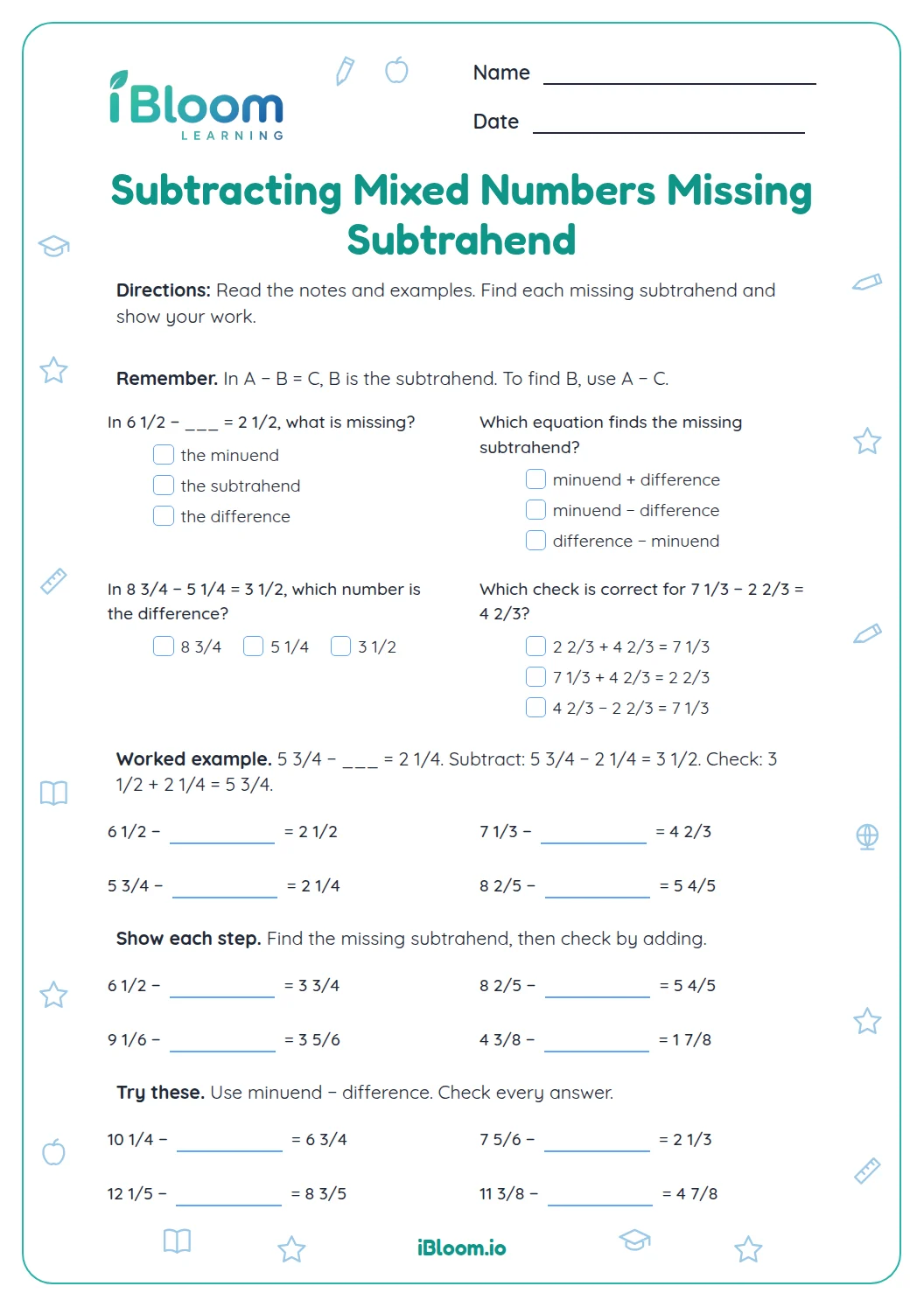
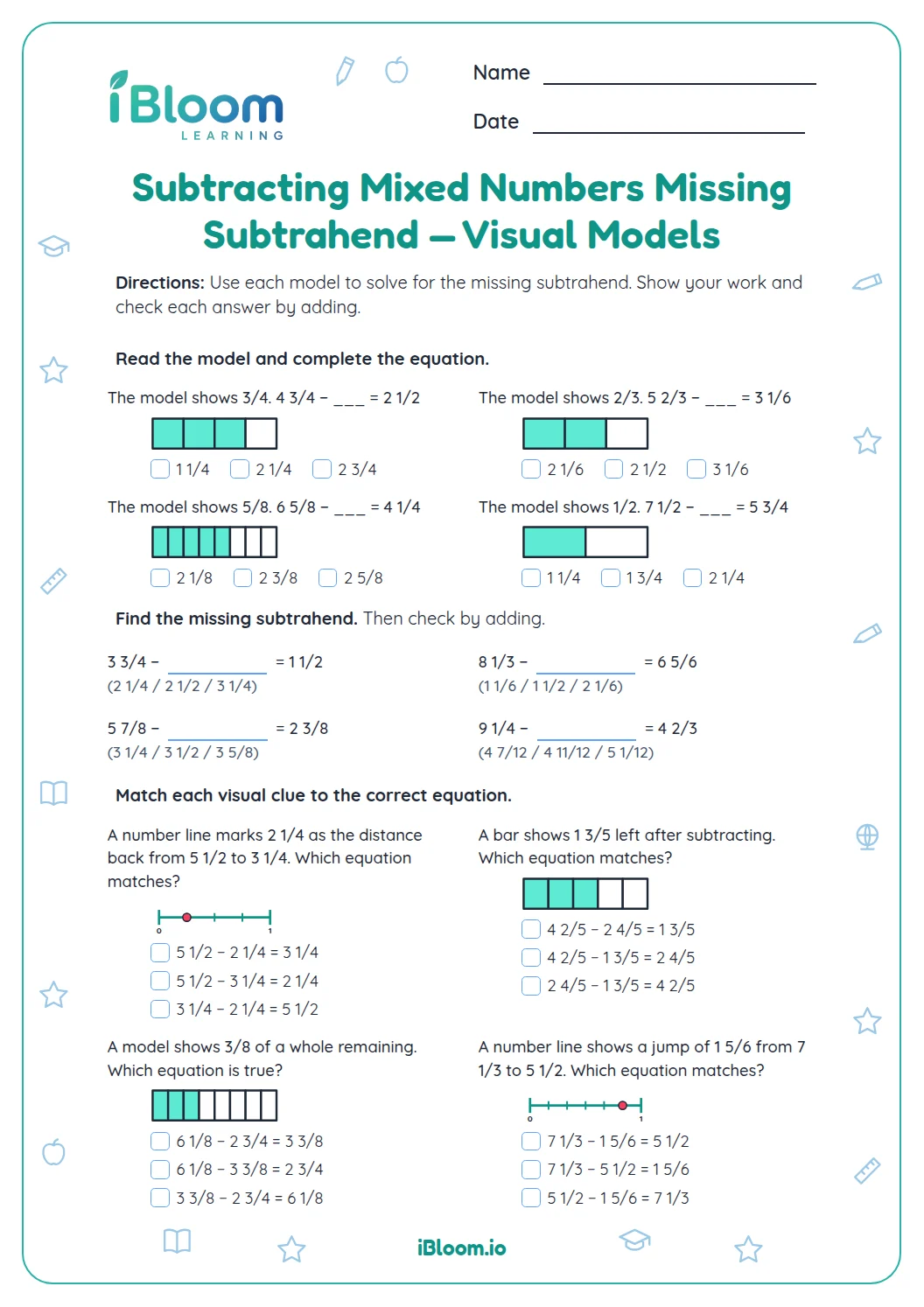
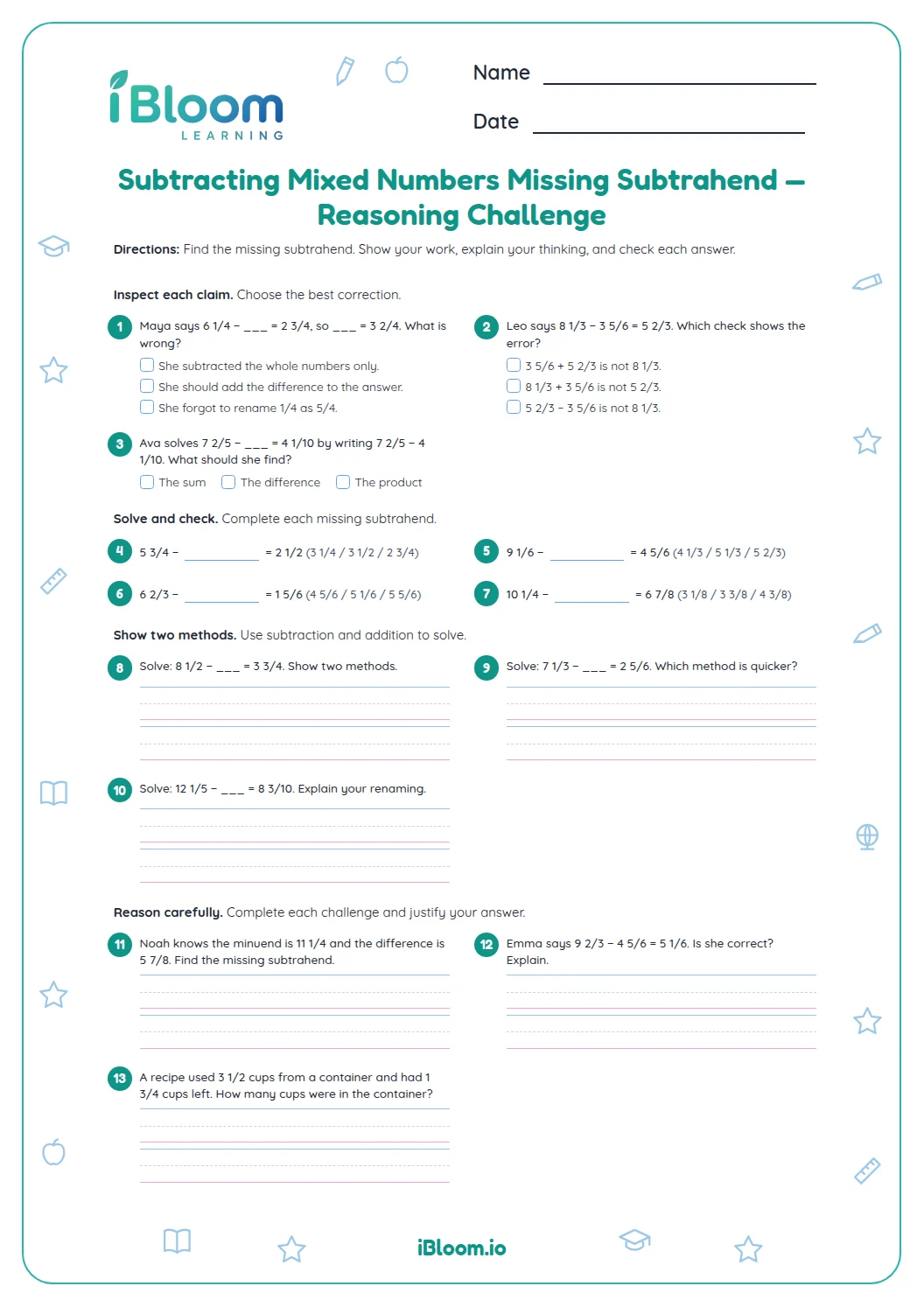
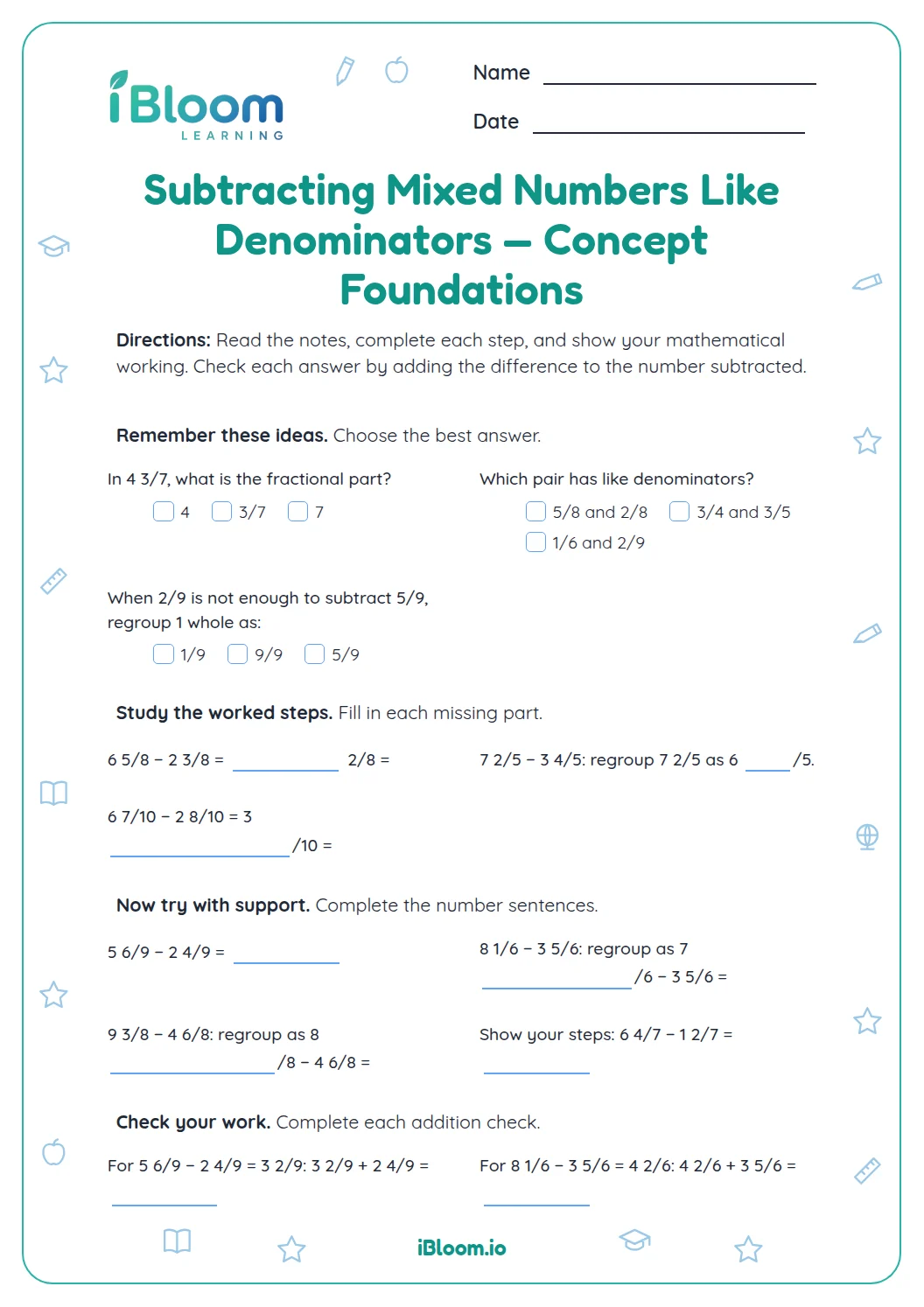
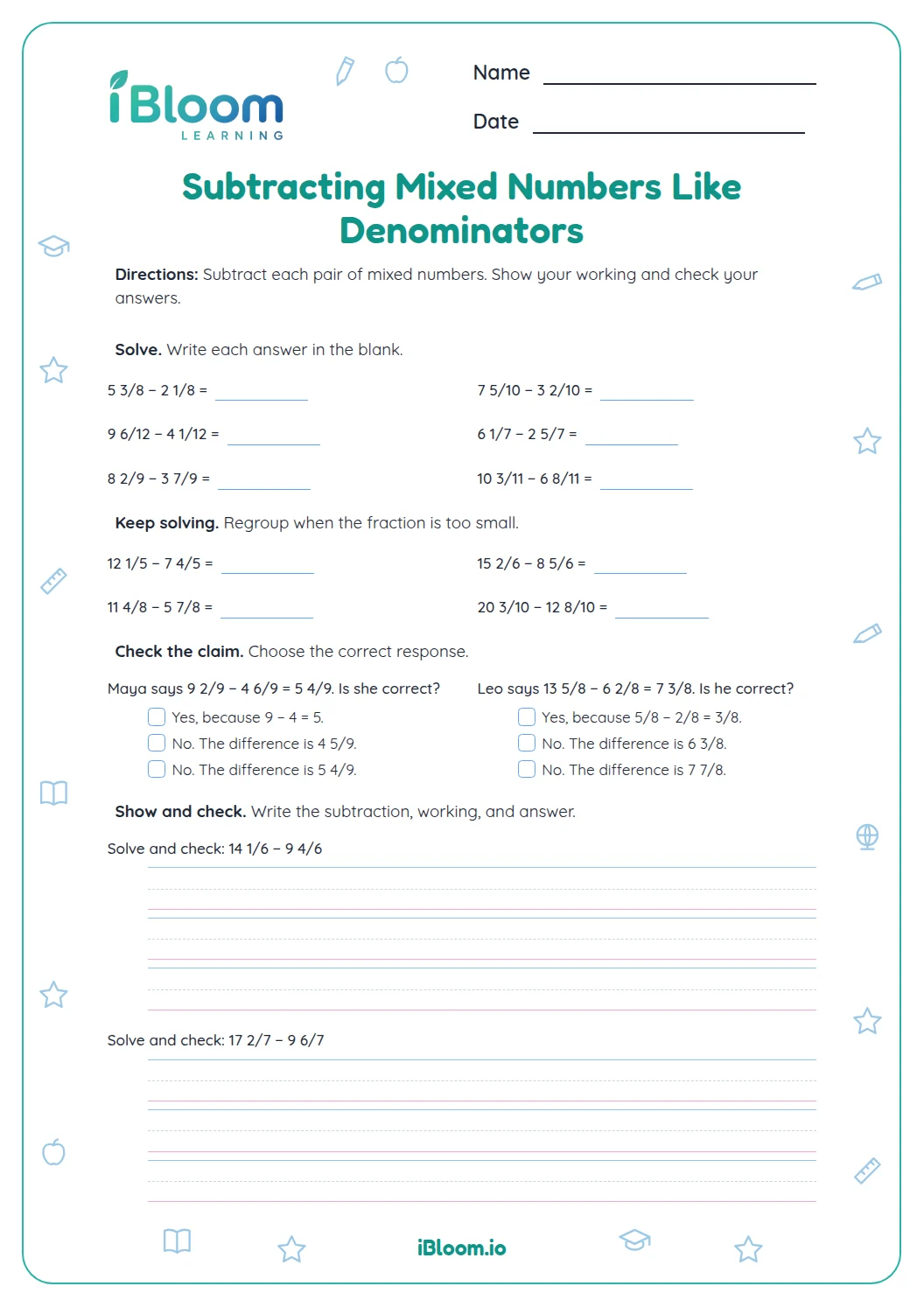
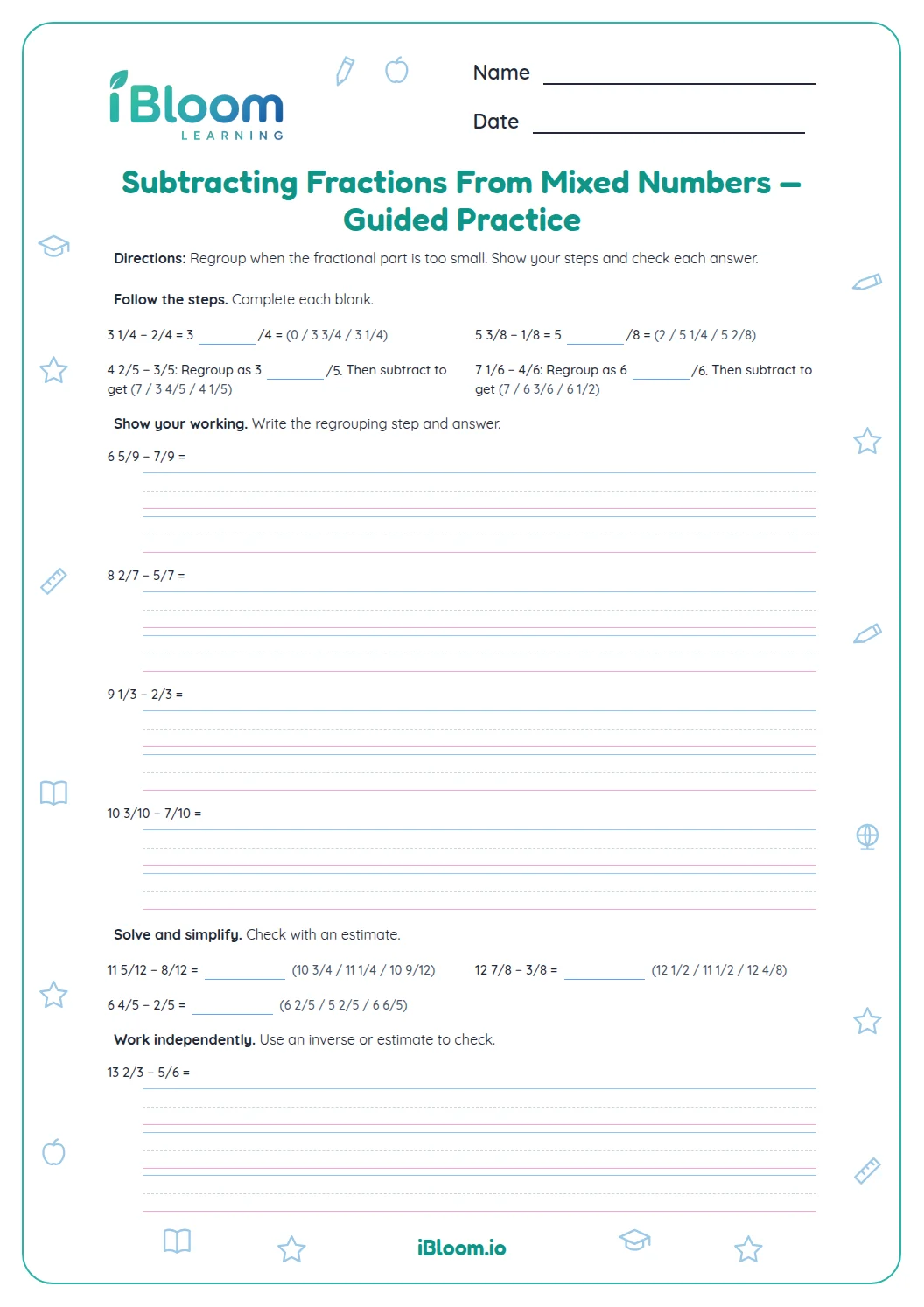
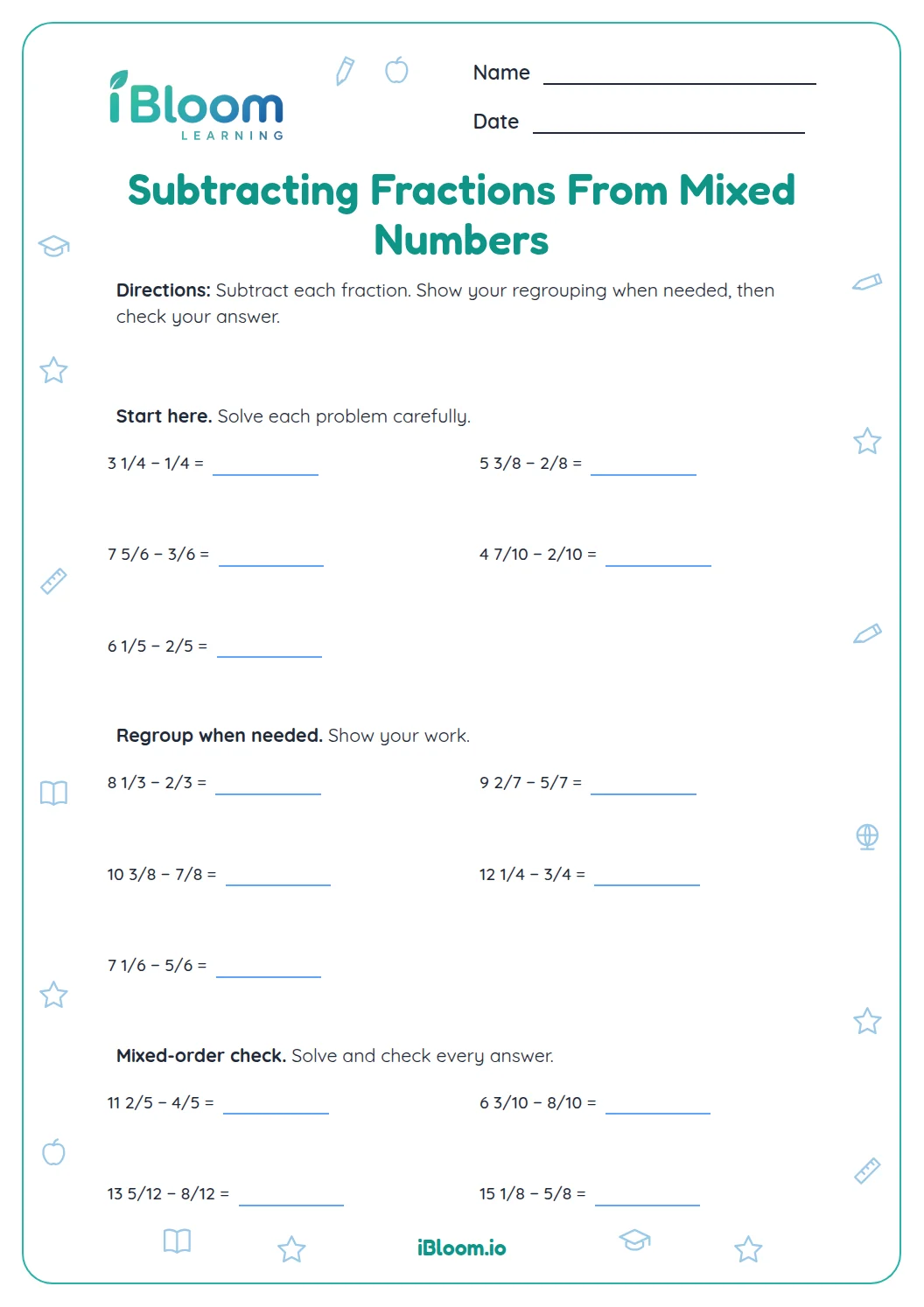
Every equation has a missing subtrahend: the amount taken away. Find it by subtracting the amount left from the starting mixed number, regrouping one whole when needed. Use a final addition check to confirm each result.
Aligned to 4.NF.B.3.c
What is the subtrahend?
The subtrahend is the number being subtracted. In 5 3/8 − ___ = 2 1/8, it is the unknown amount removed.
Subtract the difference from the starting value. When the fractional part of the start is smaller, regroup one whole into equal fractional parts before subtracting.
- 15 3/8 − 2 1/8 = 3 1/4
- 23 1/4 + 2 1/8 = 5 3/8
- 3The missing subtrahend is 3 1/4.
Independent practice
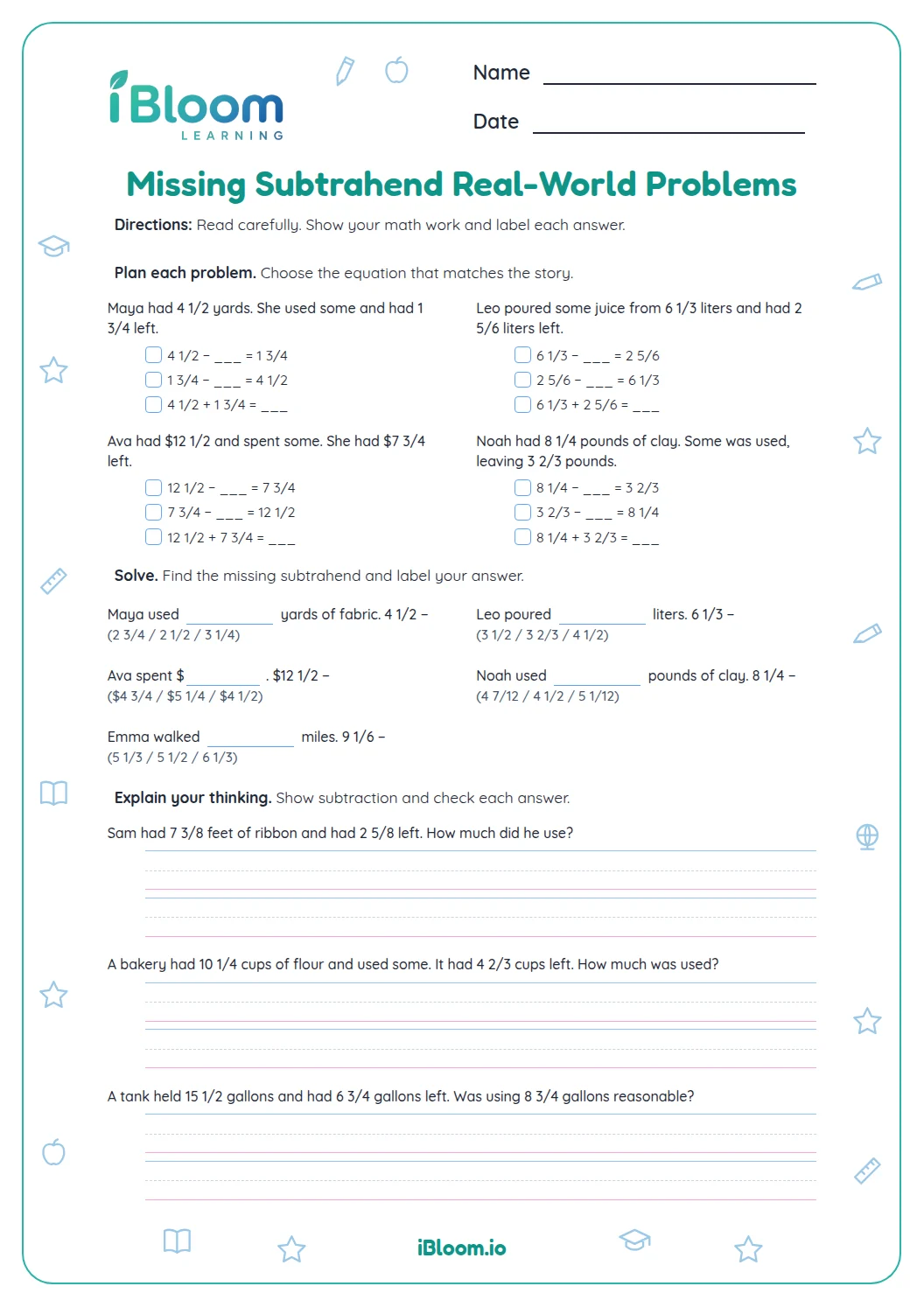
Part A builds fluency with like fractional units. Part B includes regrouping. Part C puts the same relationship into gallons, feet, miles, and yards.
Solve and check
- 1Read the equation and name the start and the amount left.
- 2Subtract amount left from start to find the missing subtrahend.
- 3Regroup one whole if the fractional part in the start is too small.
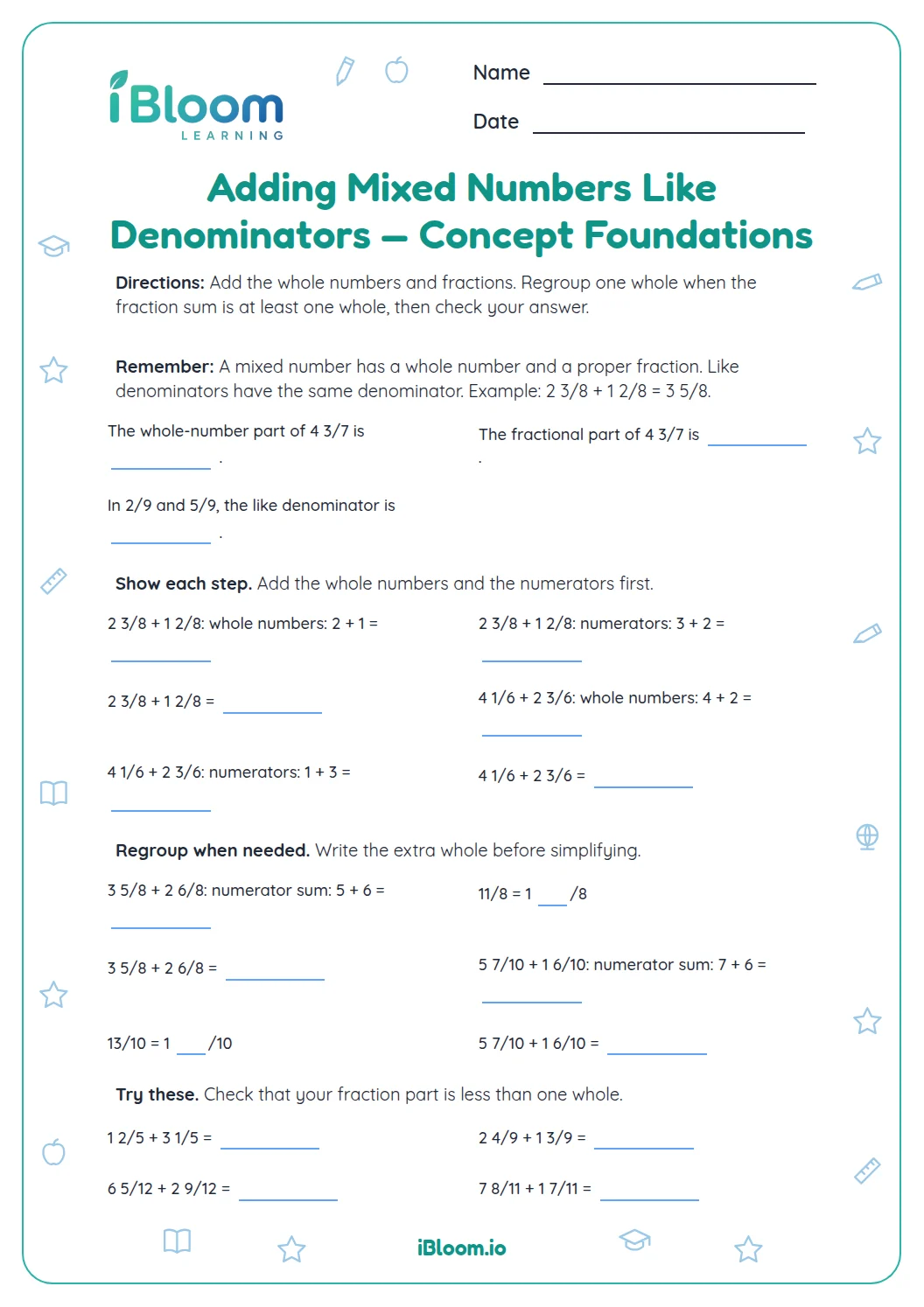
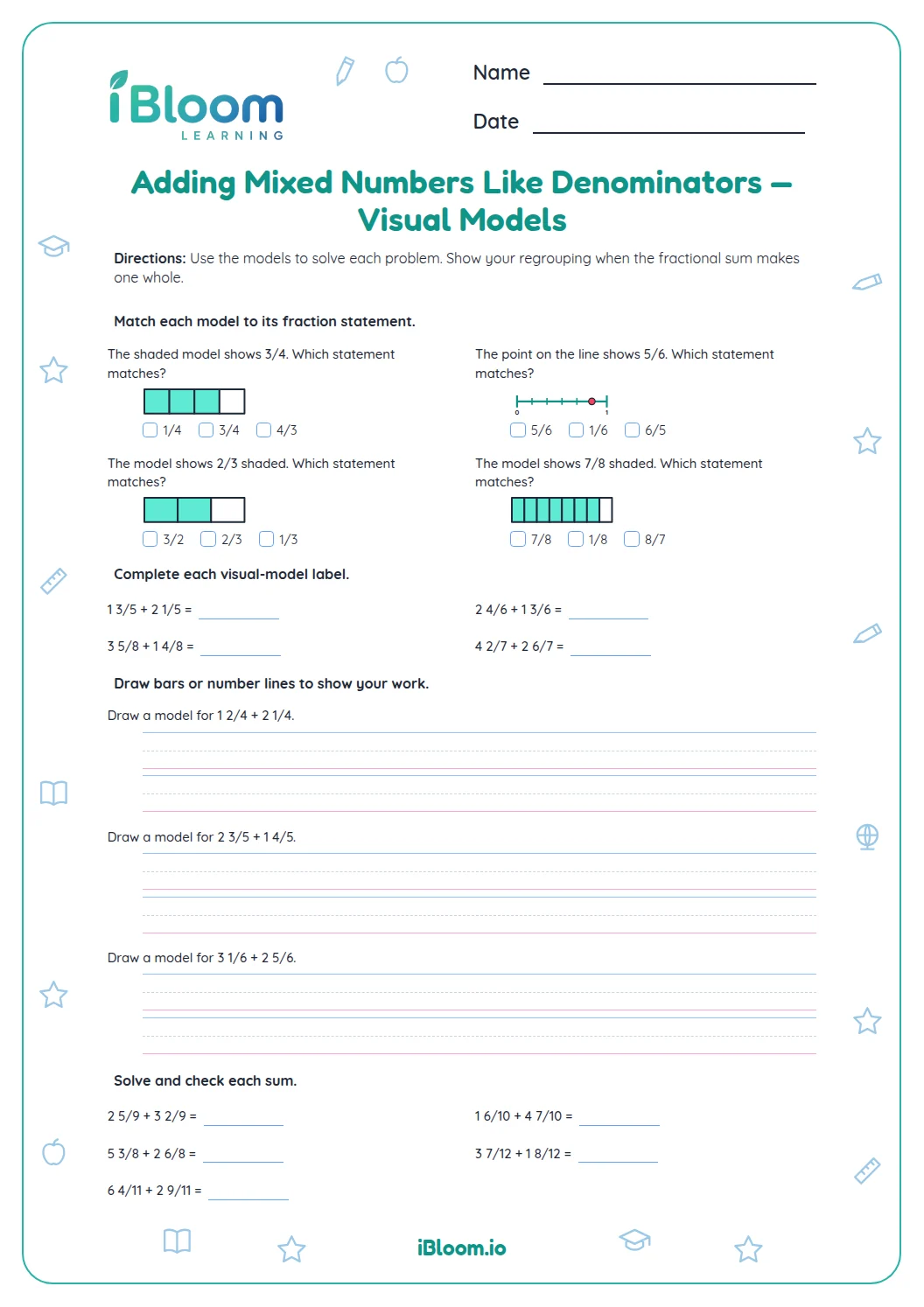
- 4Add your answer to the amount left to check the starting number.
Common mistakes
The mistake
Subtracting the start from the amount left.
The fix
The missing amount is removed from the start, so calculate start minus amount left.
The mistake
Forgetting the whole number when regrouping.
The fix
Trade one whole for the denominator number of fractional parts, then subtract.
Common Core alignment
This worksheet practices the following Common Core skill.
Add and subtract mixed numbers with like denominators.
On this sheet: Each item uses mixed-number subtraction with like denominators and the inverse addition check.
Show the official wordingHide the official wording
Add and subtract mixed numbers with like denominators, e.g., by replacing each mixed number with an equivalent fraction, and/or by using properties of operations and the relationship between addition and subtraction.
What to practice next
Make more practice
Further reading
Questions parents and teachers ask
What does “missing subtrahend” mean?
The subtrahend is the amount being subtracted. A missing-subtrahend equation gives the starting mixed number and the amount left, then asks how much was taken away. Subtract the amount left from the start to find it, then check by addition.
When should a student regroup?
Regroup when the starting number has fewer fractional parts than the amount left. Trade one whole for a number of parts equal to the denominator, then subtract the fractional parts and whole numbers. For example, one whole is 8/8 when working with eighths.
How can I check the missing amount?
Add the amount you found to the amount remaining after subtraction. The sum should match the original starting number. For example, 3 1/4 + 2 1/8 = 5 3/8 checks the first equation and confirms the missing subtrahend. Use the same check for the stories.
What do the story problems ask?
The final four questions use gallons, feet, miles, and yards. Each gives a starting amount and a remaining amount or distance, then asks how much was used, removed, or traveled. The answer key keeps the unit with each story answer.
What is in the answer key?
A separate two-page answer key shows all 16 missing amounts, including the four answers that carry measurement units. Use addition with the amount left to check each subtraction result. The problems include both like-fraction subtraction and regrouping. Each key page matches a worksheet page.