




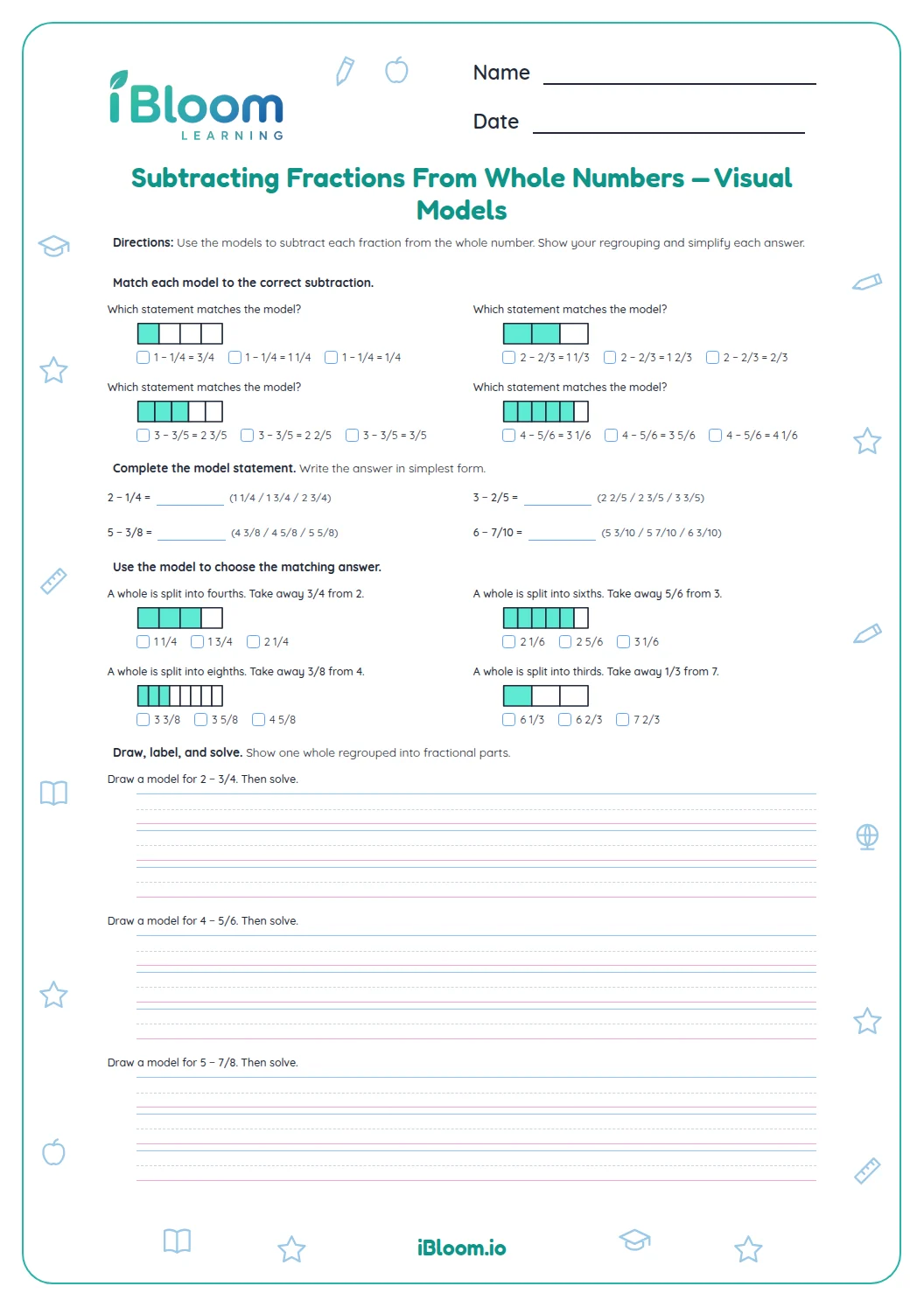

About this worksheet
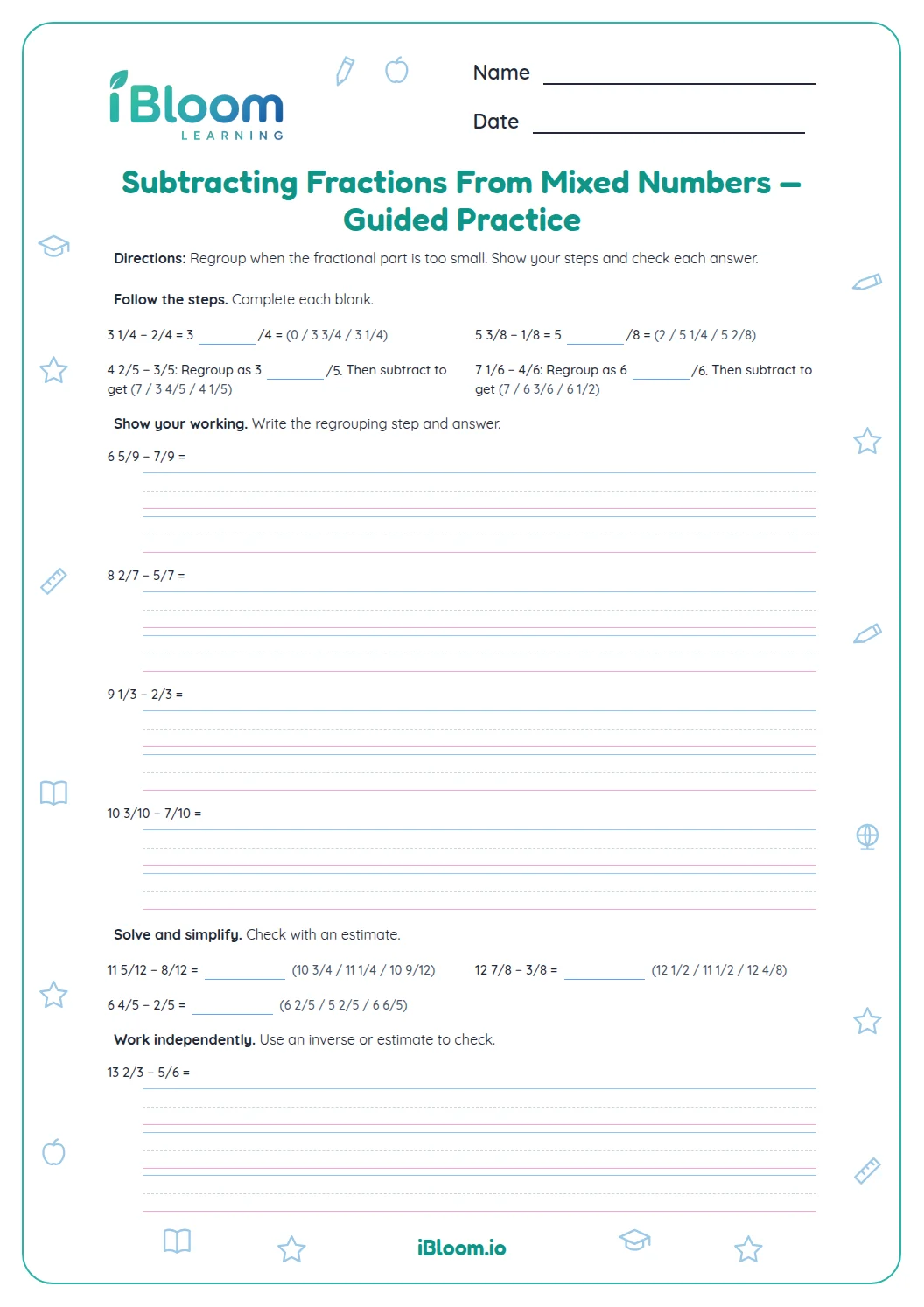
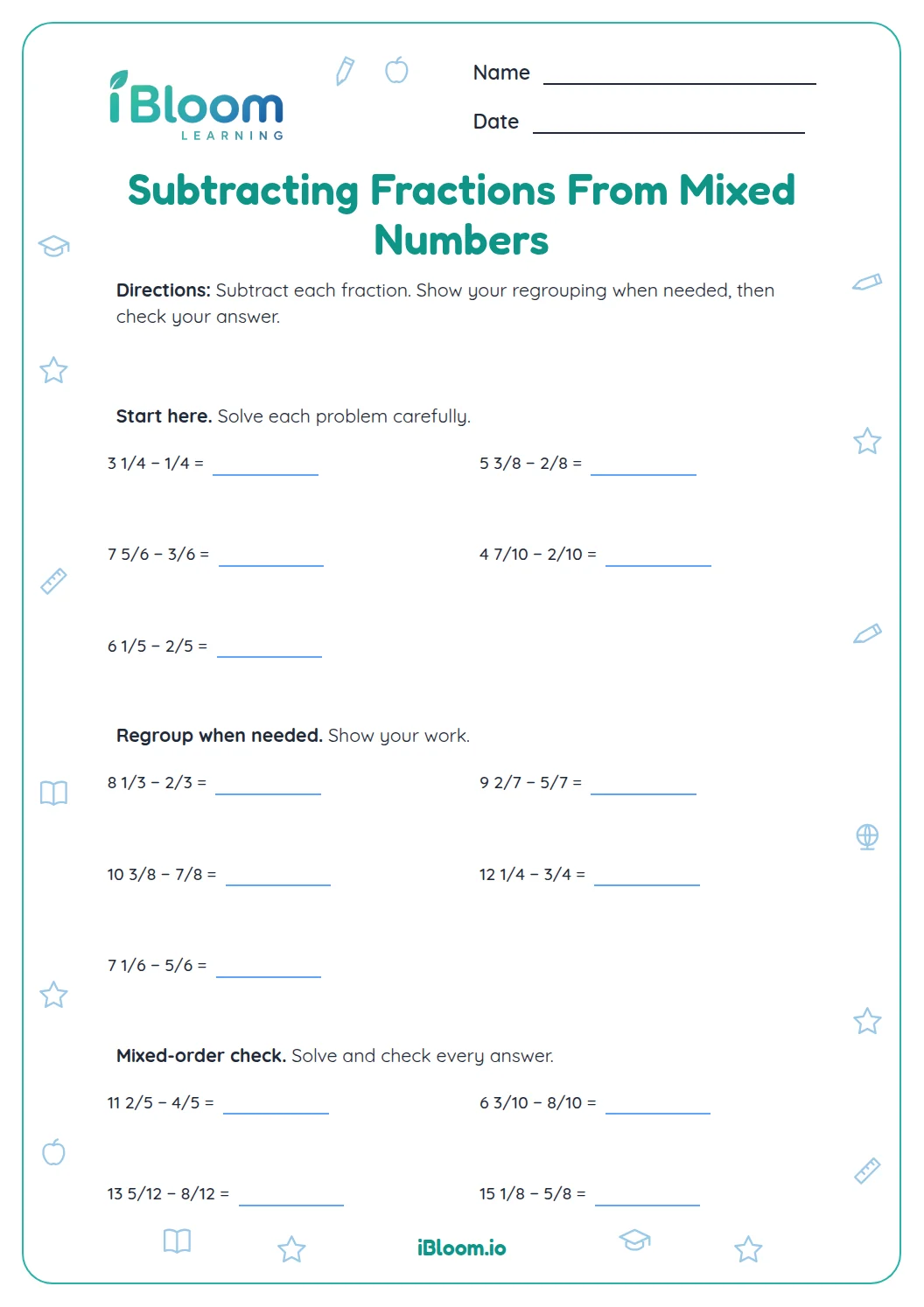
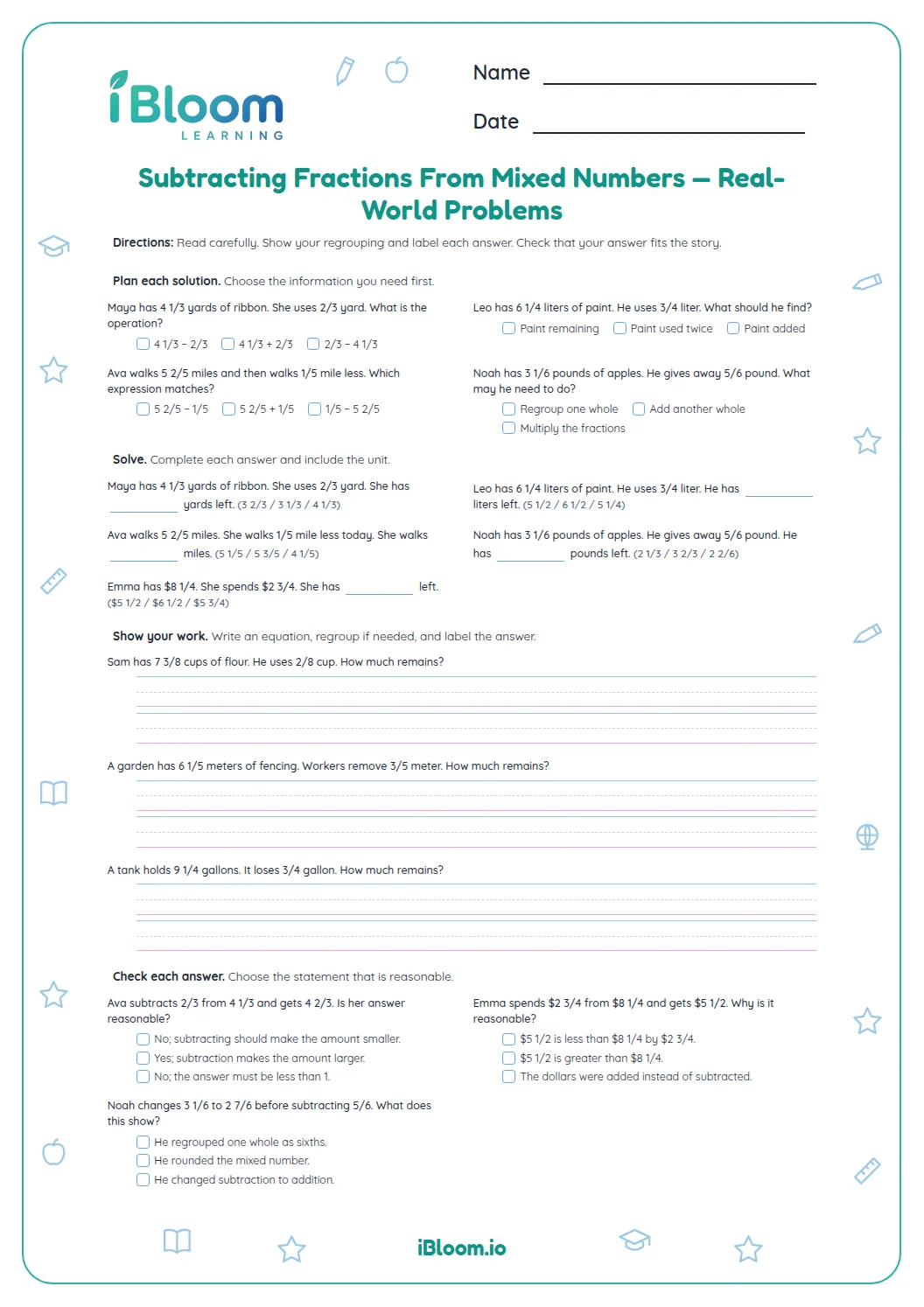
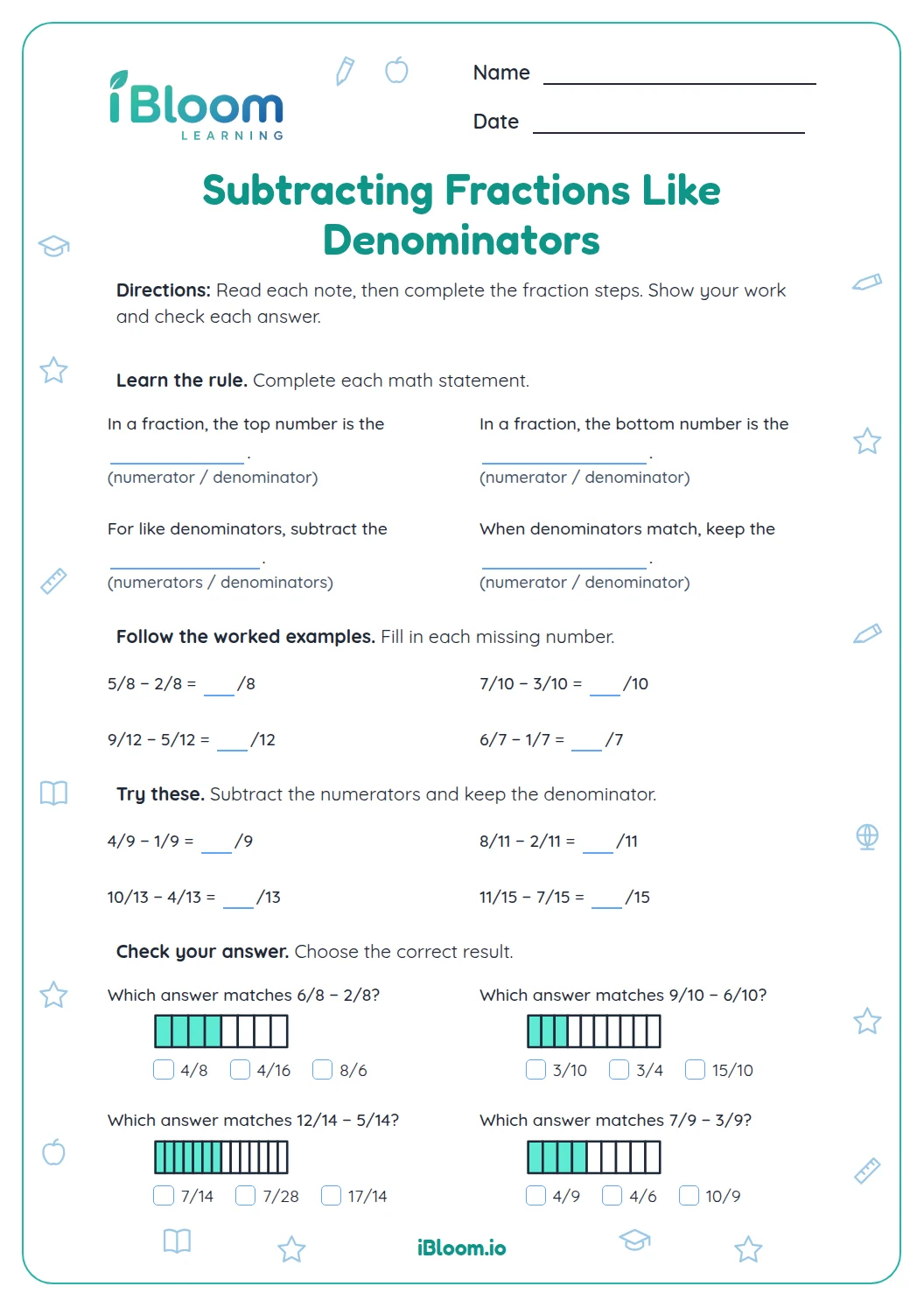
Practice subtracting a fraction from a mixed number with like denominators. The 16 items begin without regrouping, then trade one whole when needed, and finish with four short measurement situations.
When can you subtract the fractions directly?
When the starting fraction is at least as large as the fraction being subtracted, keep the whole number and subtract the numerators. For 2 3/8 − 1/8, the result is 2 2/8, or 2 1/4.
- 12 3/8 − 1/8 = 2 2/8 = 2 1/4
- 2The denominator stays 8; simplify 2/8 to 1/4.
How do you regroup one whole?
When the starting fraction is smaller, trade one whole for a fraction equal to one whole. In q7, 3 1/4 becomes 2 5/4, so 2 5/4 − 3/4 = 2 2/4 = 2 1/2.
How does the method work in a measurement problem?
Keep the unit in the answer. For q11, subtracting 1/8 yard from 2 3/8 yards leaves 2 2/8, or 2 1/4 yards.
How to use this worksheet
- 1Read the directions for the part.
- 2Complete each question before checking the key.
- 3Show a step or quick model when it helps.
- 4Review missed answers and try them again.
Common mistakes and quick fixes
The mistake
Subtracting the smaller numerator from the larger without regrouping.
The fix
If the starting fraction is too small, exchange one whole first.
The mistake
Changing the denominator while subtracting.
The fix
Keep the denominator because the fractional parts are the same size.
The mistake
Leaving an answer unsimplified.
The fix
Reduce the fraction when its numerator and denominator share a factor.
What to practice next
Make more practice
Questions parents and teachers ask
How many questions are included?
This printable has fourteen questions arranged in three parts. The items move from direct practice toward applying the skill in short situations, so learners can work in order and check one section at a time. Adults can pause between parts and talk through a strategy.
Does the printable include an answer key?
Yes. A separate answer key lists all 16 results in order, including units for the four short measurement situations. Learners can compare their subtraction steps after finishing each part, then redo any question where the answer or regrouping step differs.
How can I use this worksheet at home?
Print the worksheet and read the directions together before starting. Learners can complete the parts independently or talk through one example with an adult, then use the answer key to review their work. Keep the key nearby for checking after a section is complete.
How long should learners spend on it?
Plan for about twenty minutes, with more time for a discussion or a second try. The pace depends on whether learners read and solve independently or pause to explain their reasoning. A short review after each part can make the practice more useful.
What grade is this printable for?
The worksheet is designed for the grade named near its title. An adult may read a direction aloud or model one example, then let the learner complete the remaining questions and check the key. The activities work for home practice, tutoring, or classroom review.