






About this worksheet
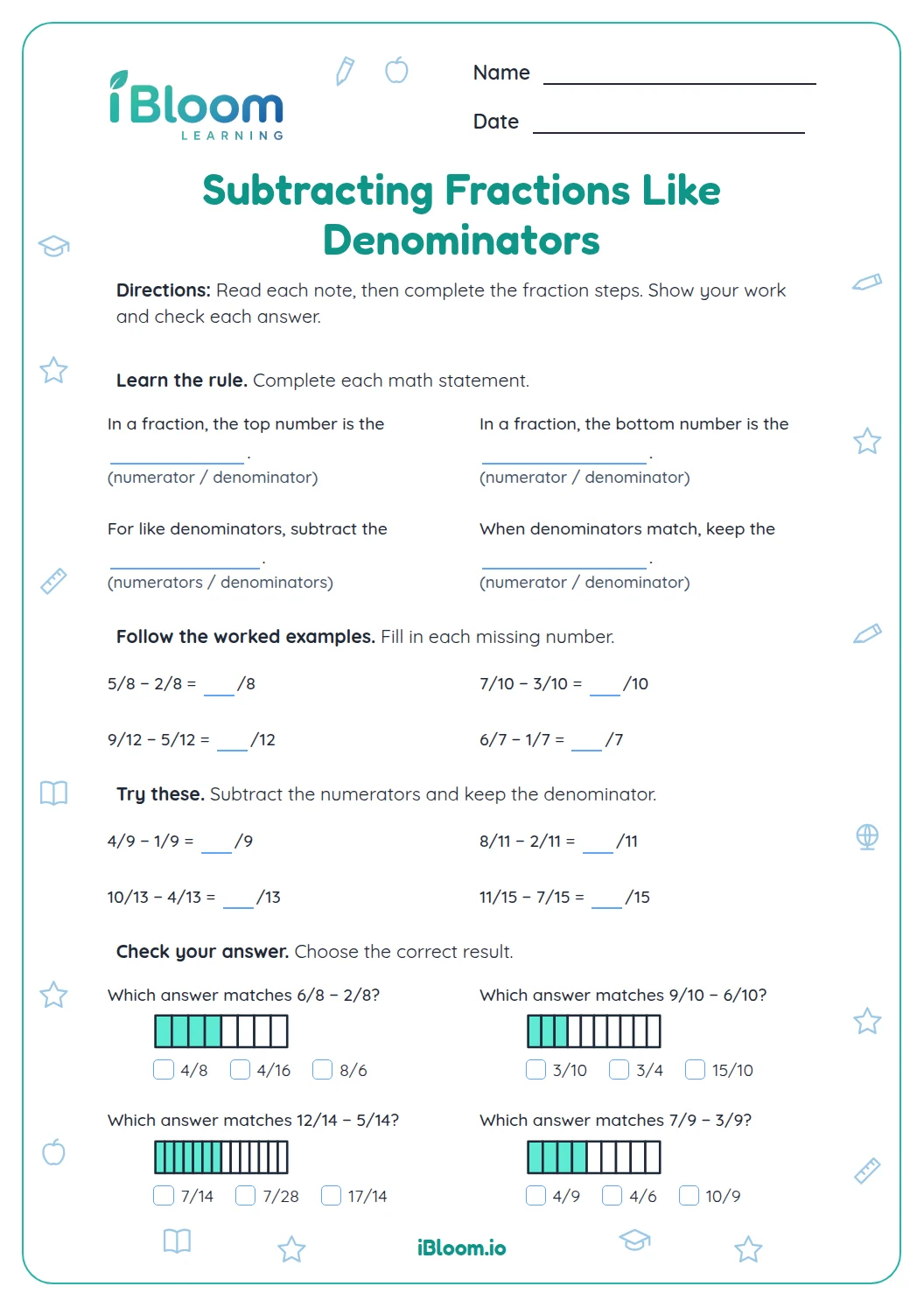
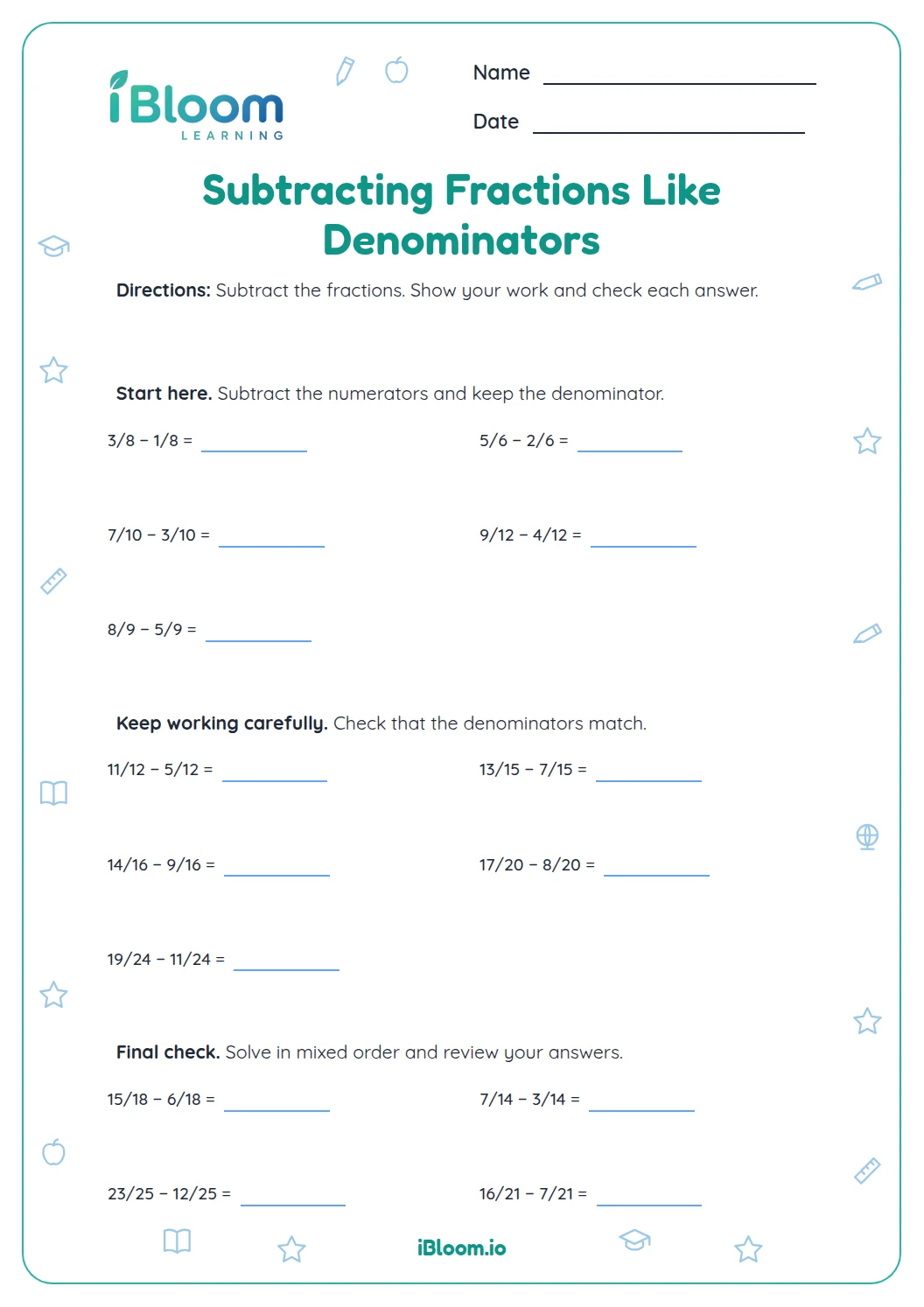
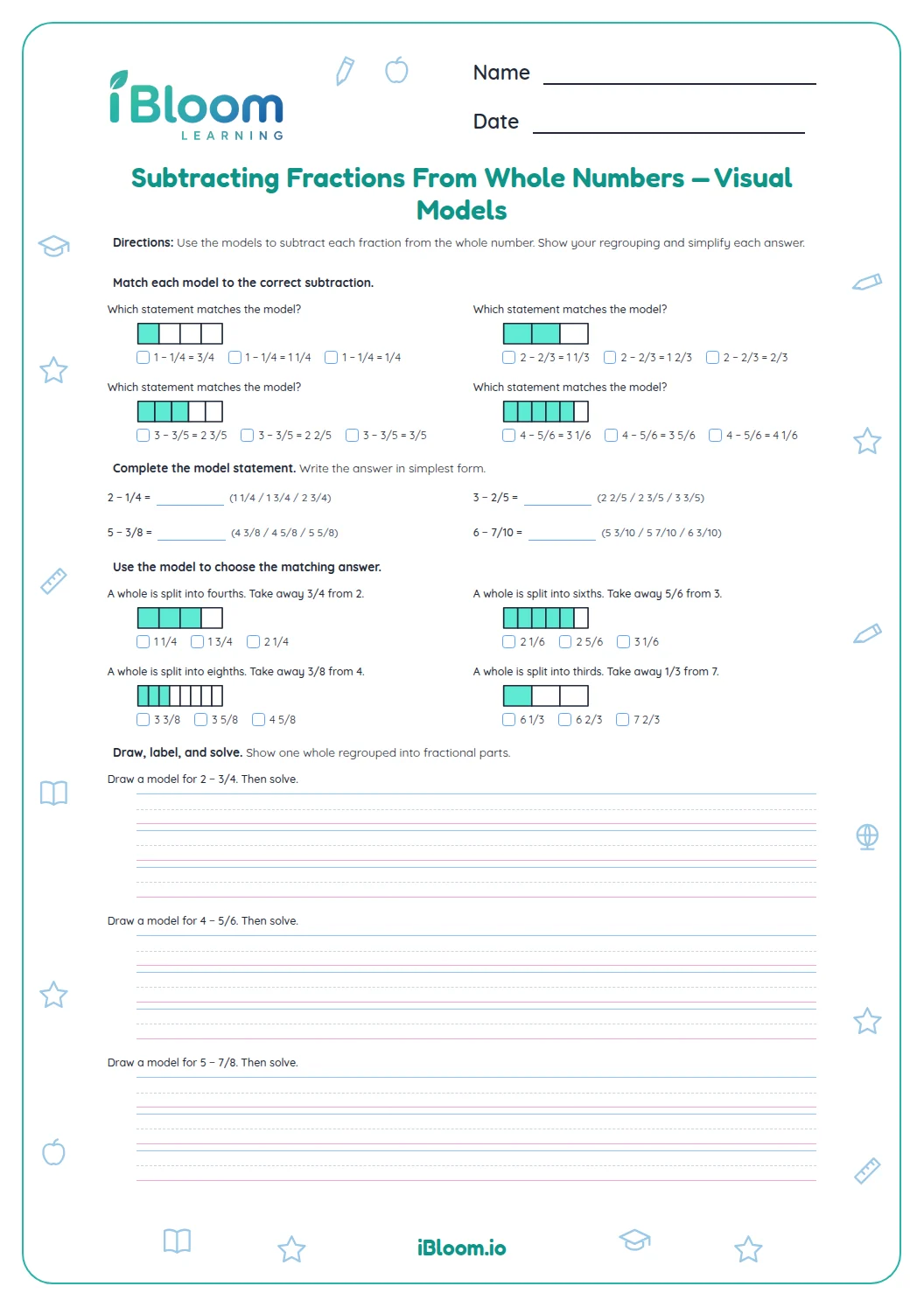
This free Grade 4 worksheet uses shaded fraction models to make subtraction with like denominators visible. Students read each model, take away a stated number of equal parts, complete fraction equations, find missing terms and solve short situations. The answer key gives results and sample model explanations. The page practices Common Core 4.NF.B.3.a by treating fraction subtraction as separating parts of the same whole.
Aligned to 4.NF.B.3.a
What does a fraction model show during subtraction?
Fourteen questions in two parts. Students read two fraction models, then complete twelve subtraction statements and short story problems.
The numerator changes because the number of parts changes; the denominator stays six because the size of each part does not change.
- 15/6 − 2/6 = 3/6
- 2Five sixth-size parts with two removed leave three sixth-size parts.
How do you subtract fractions with like denominators?
Keep the common denominator and subtract the numerators. For example, 9/12 − 5/12 = 4/12. The answer describes four pieces, each still one twelfth of the same whole.
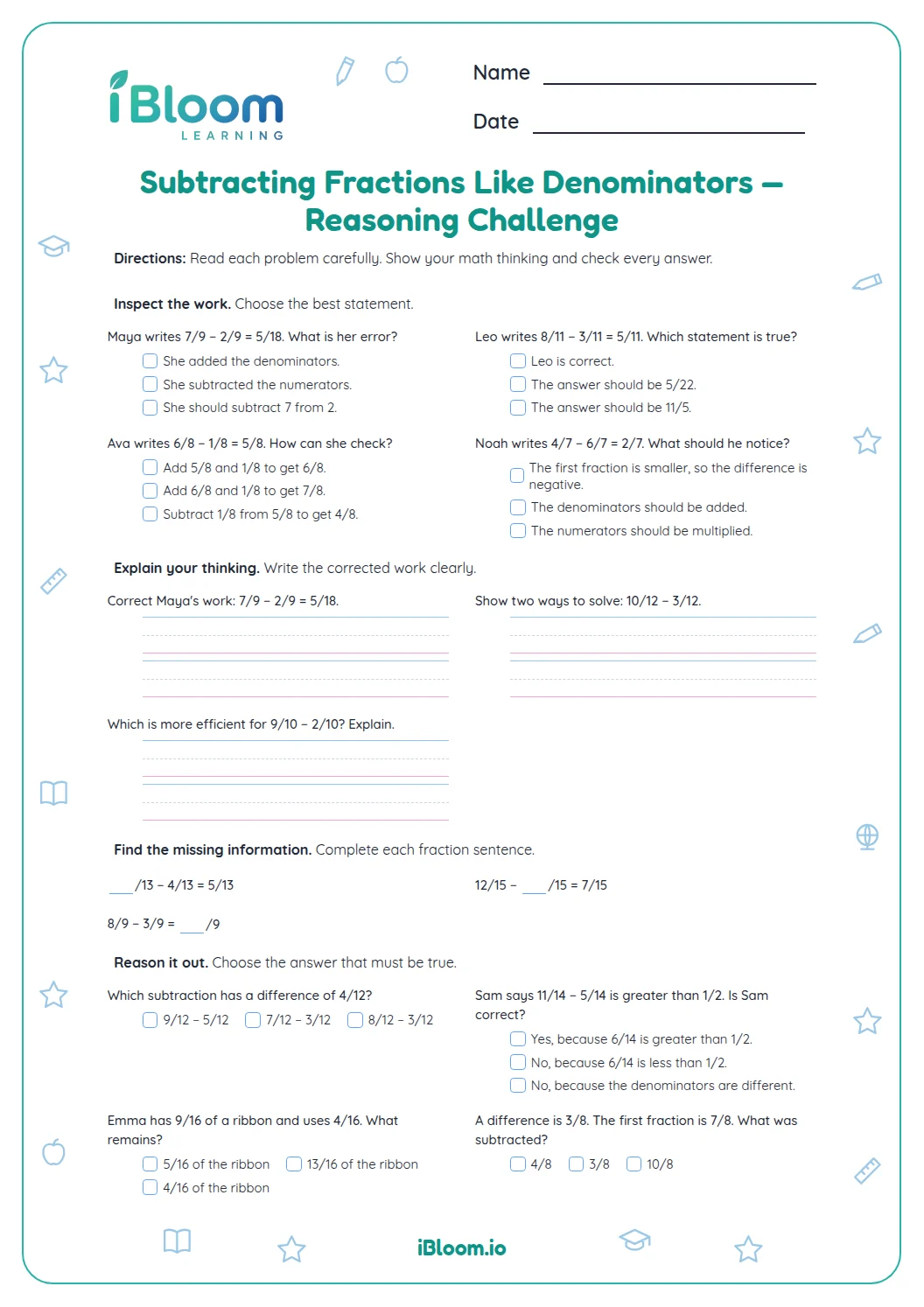
Questions 7 through 9 reverse or complete the equation, so addition can help check a missing fraction.
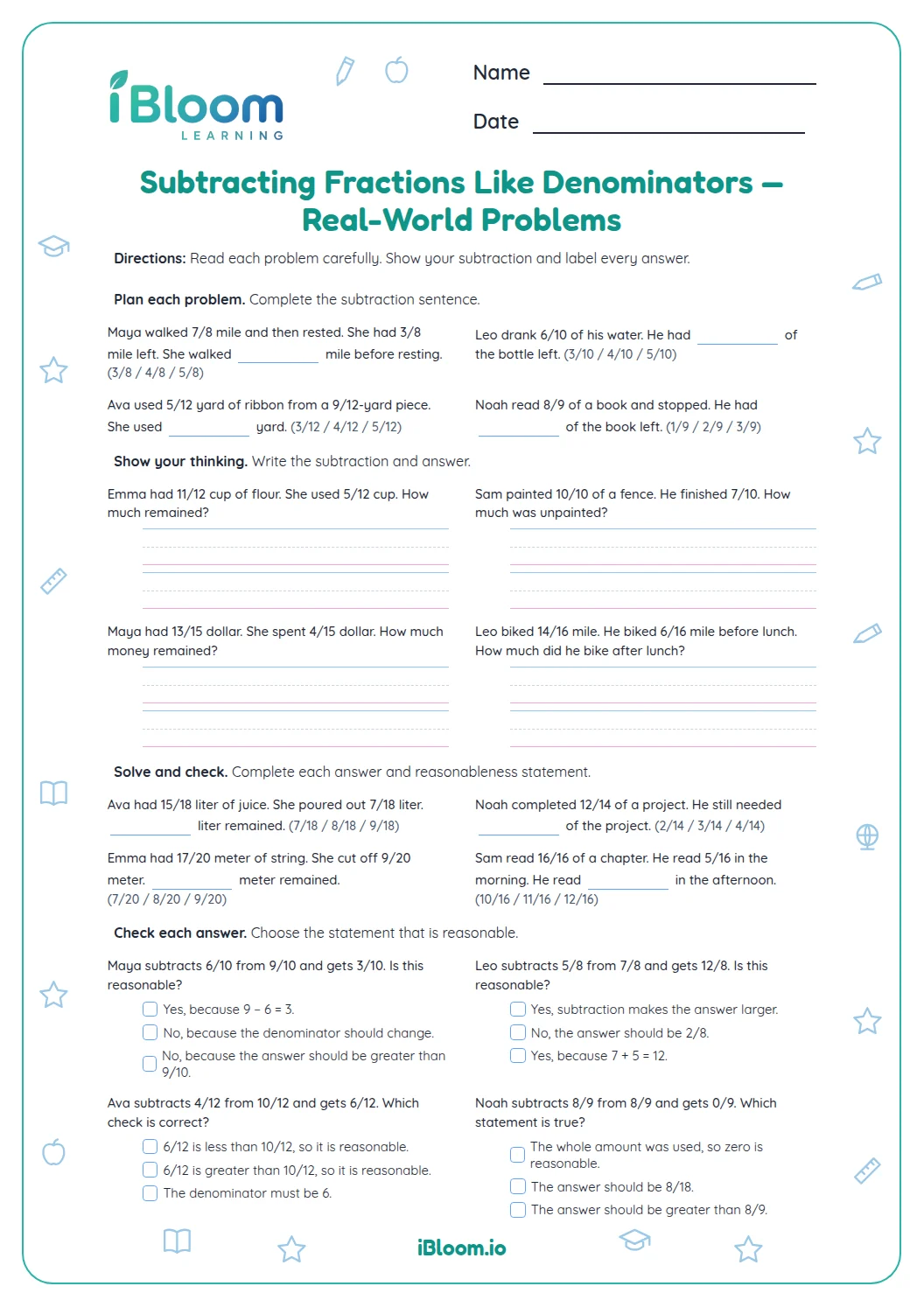
How can a word problem reveal the subtraction?
Look for the starting amount and the amount taken away, used or served. Then write a subtraction equation with the same denominator. Question 10 starts with 5/8 mile and removes 2/8 mile, leaving 3/8 mile.
Check that the answer is sensible: taking away some of an amount should leave less than the starting amount.
How to use this worksheet
- 1For each model, count the equal parts in the whole before reading the shaded amount.
- 2Write the starting fraction and the amount removed.
- 3Subtract the numerators while keeping the denominator.
- 4For a missing fraction, use addition to check what completes the equation.
- 5In story problems, include the unit when the question gives one.
Common mistakes and quick fixes
The mistake
Subtracting the denominators too.
The fix
The denominator names the part size; subtract only the number of parts.
The mistake
Changing the denominator after taking parts away.
The fix
Check that each piece is still the same size as before.
The mistake
Giving an answer larger than the starting amount after subtraction.
The fix
Use addition to verify: answer plus amount removed should equal the start.
Common Core alignment
The visual models and equations connect subtraction to separating equal parts of one whole.
Use fraction models to understand subtraction as separating parts of the same whole.
On this sheet:
Show the official wordingHide the official wording
Understand addition and subtraction of fractions as joining and separating parts referring to the same whole.
What to practice next
Make more practice
Further reading
Questions parents and teachers ask
Do denominators change when subtracting like fractions?
No. The denominator stays the same because each fraction part keeps the same size. In 7/9 − 2/9, subtract 2 from 7 and keep ninths, giving 5/9. Adding 5/9 and 2/9 checks the starting amount, 7/9. This confirms the subtraction.
What does the first shaded model represent?
The bar is divided into six equal parts, with five shaded. Question 1 asks which action models taking away two sixths. The circle shows seven eighths; question 2 asks which action models taking away three eighths. Students then calculate with fraction equations. Each model shows one whole.
Should a child simplify each answer?
The key keeps the original denominator in answers such as 3/6. An equivalent fraction such as 1/2 represents the same amount, but keeping sixths shows that the pieces remain the same size as the model and the starting fraction. The picture remains clear.
How can students check a missing fraction?
Add the known fraction and the proposed missing fraction. For 8/10 − ___ = 3/10, the missing amount is 5/10 because 3/10 + 5/10 equals 8/10. This check uses addition to confirm the subtraction and verify the starting amount in the equation.
What do the short story problems practice?
Each context gives a starting amount and an amount used, removed or served. Students subtract fractions with the same denominator and write the remaining amount. The examples use ribbon, meters, liters and cake, so the unit stays visible in each prompt.
What can we practice after this worksheet?
Try adding fractions with like denominators and compare the steps: addition joins same-size parts, while subtraction separates them. The related worksheets on subtracting from whole numbers and mixed numbers extend the same idea to larger starting amounts with the same strategy.