



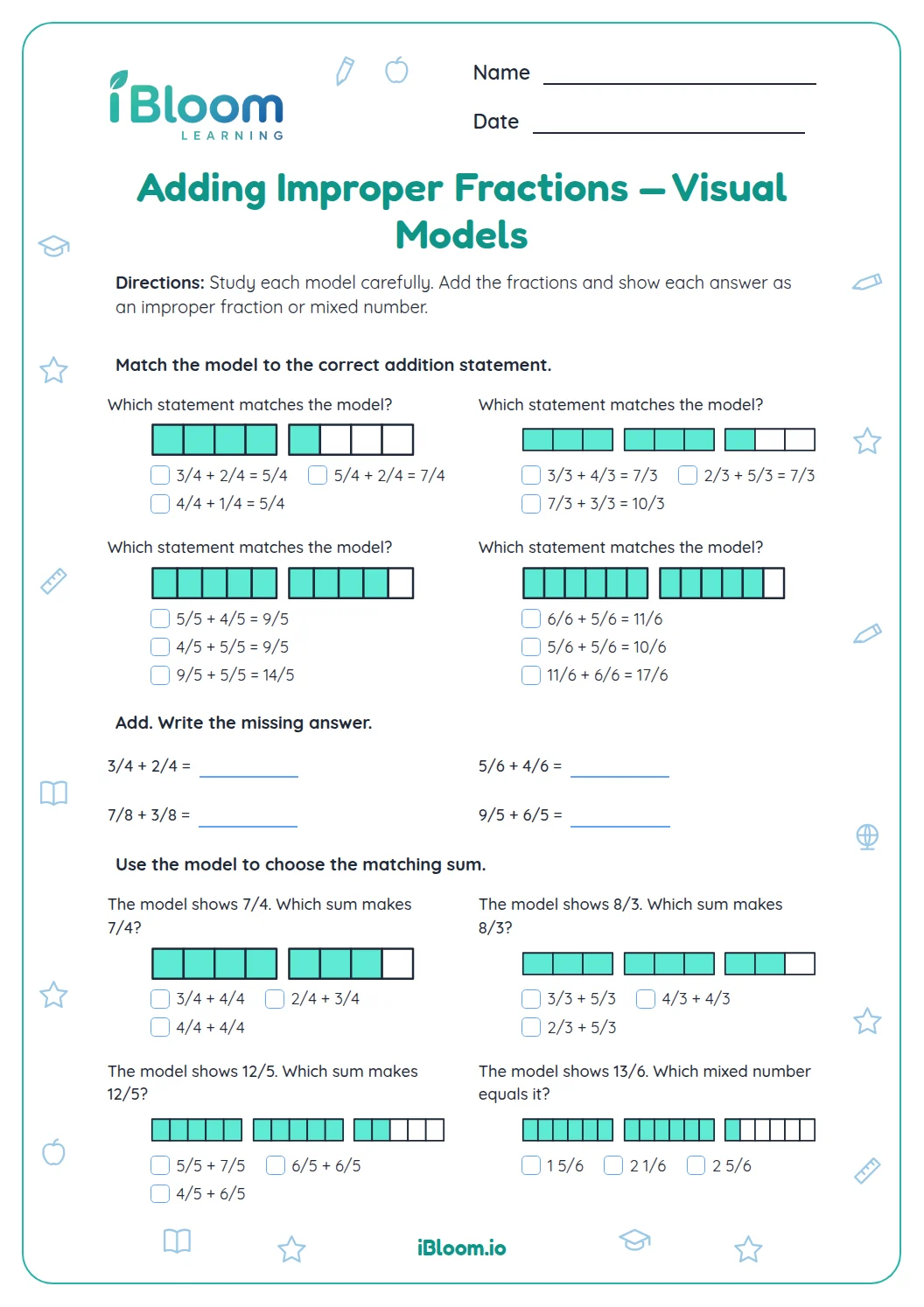

About this worksheet
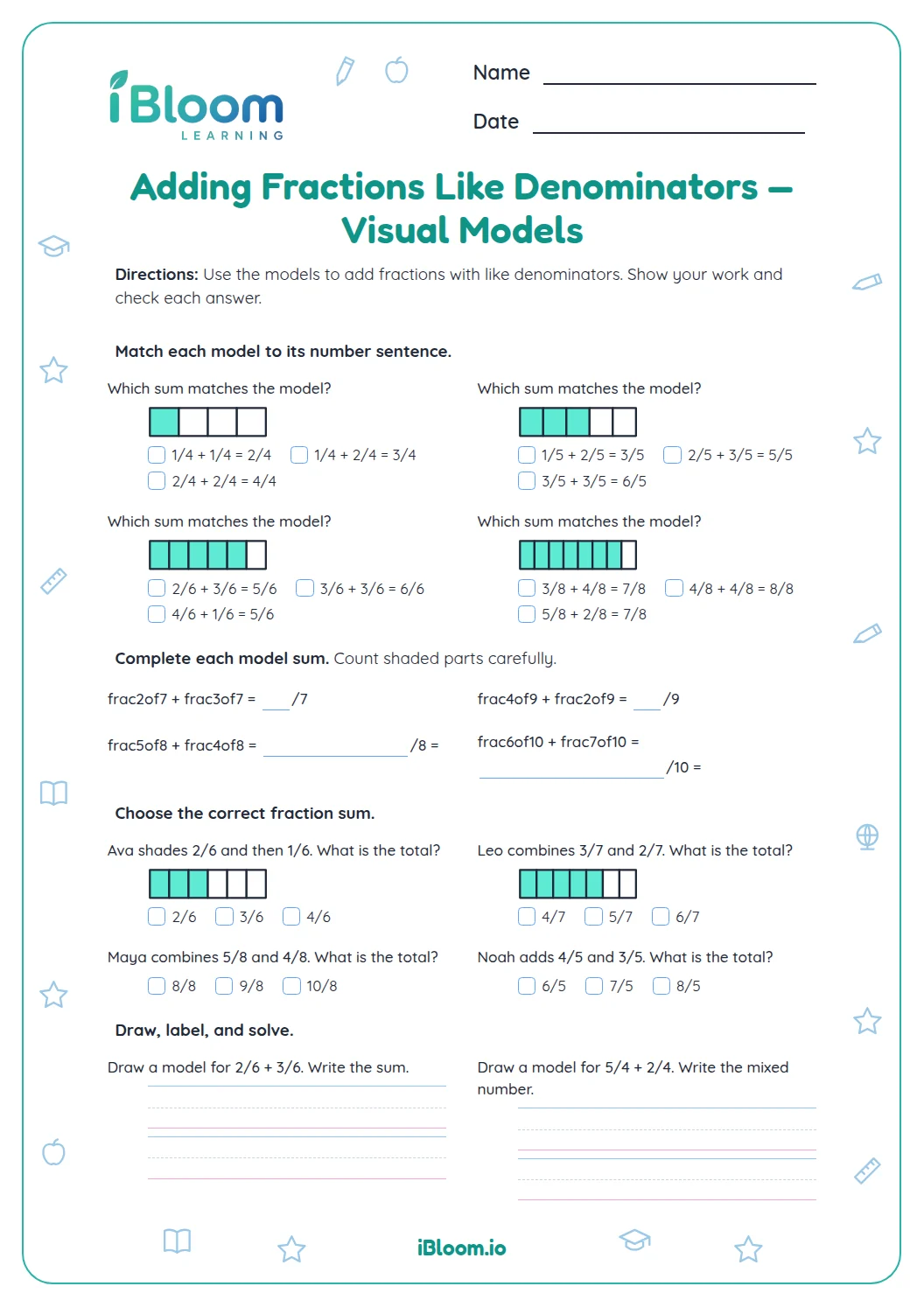
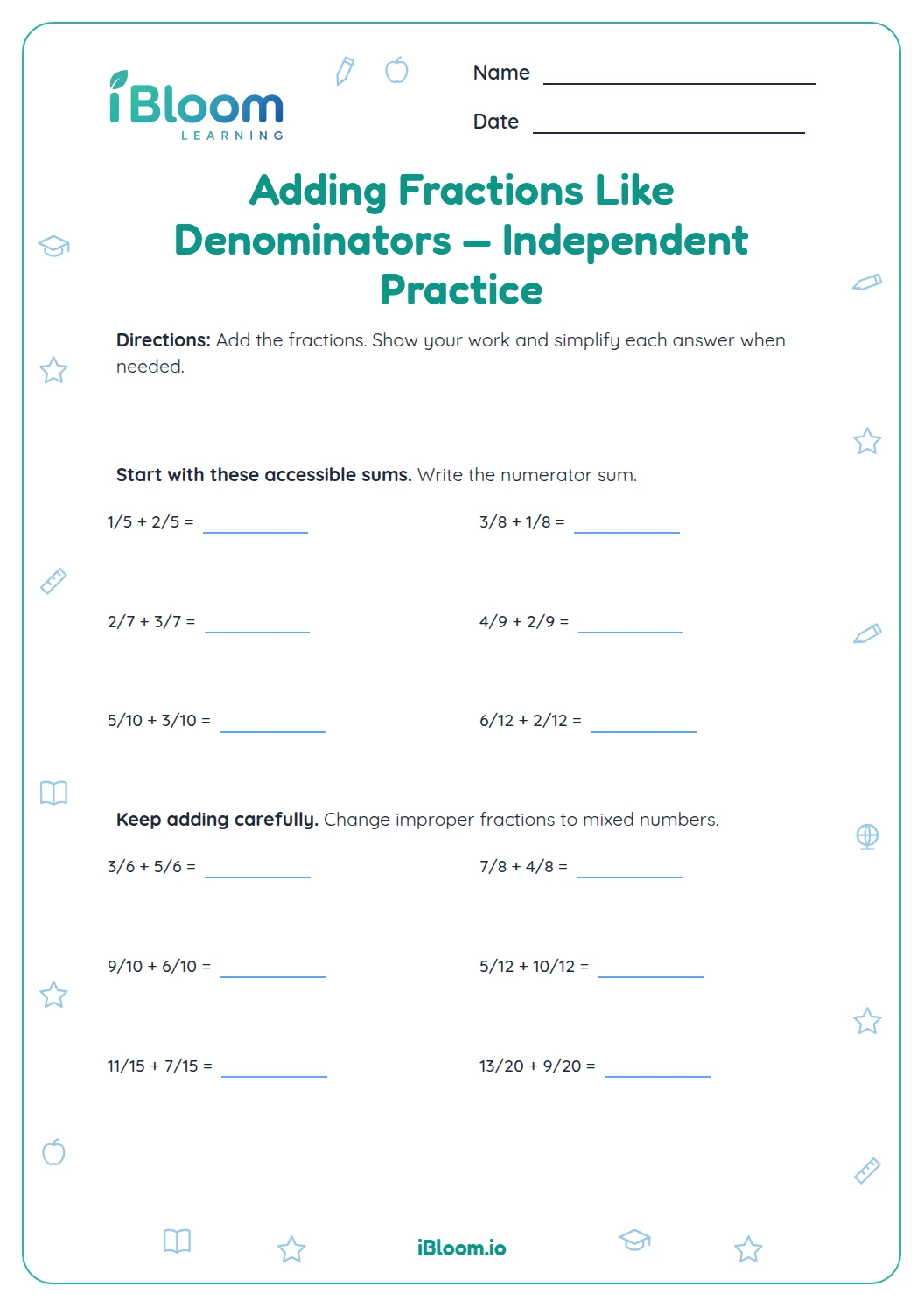
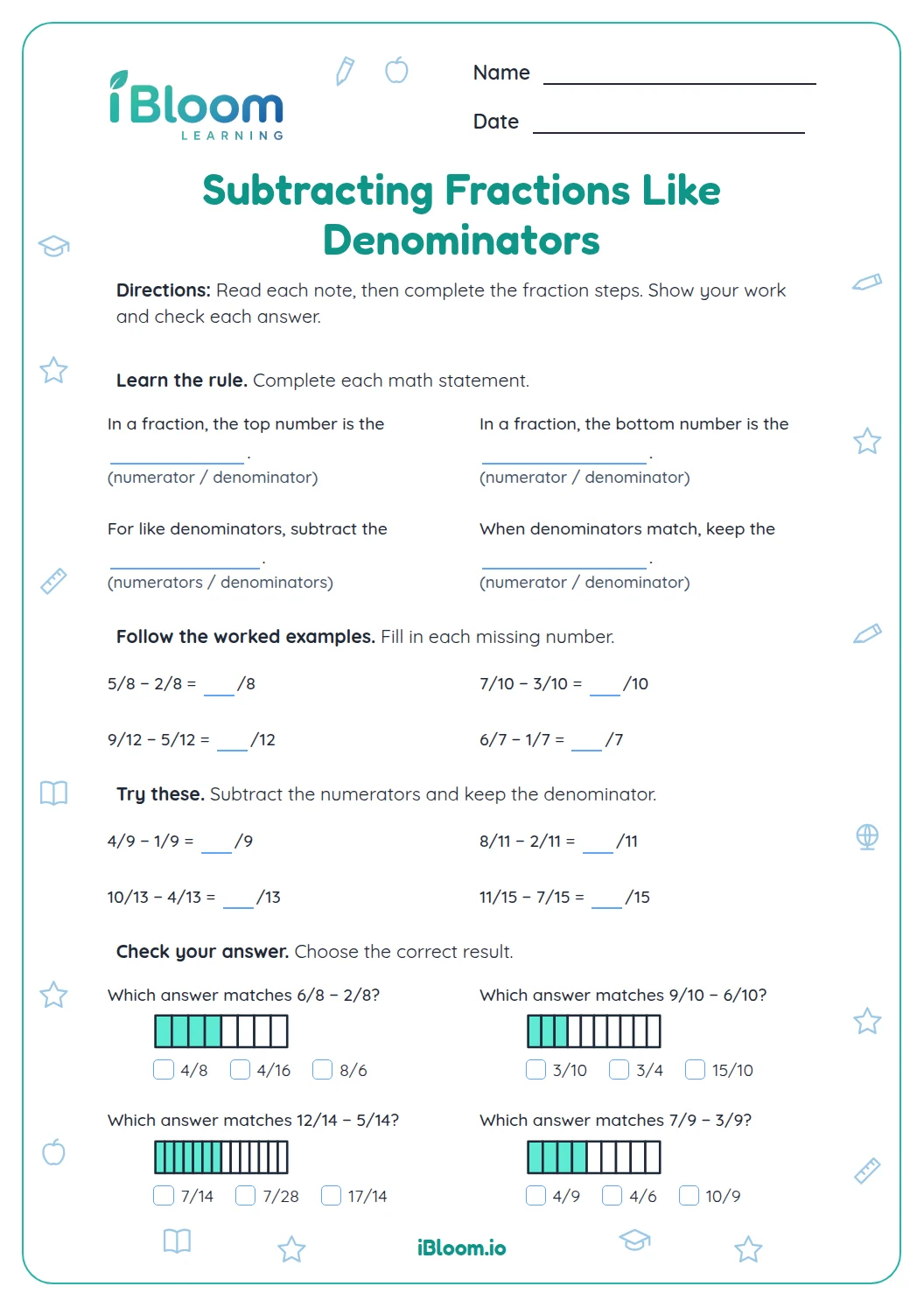
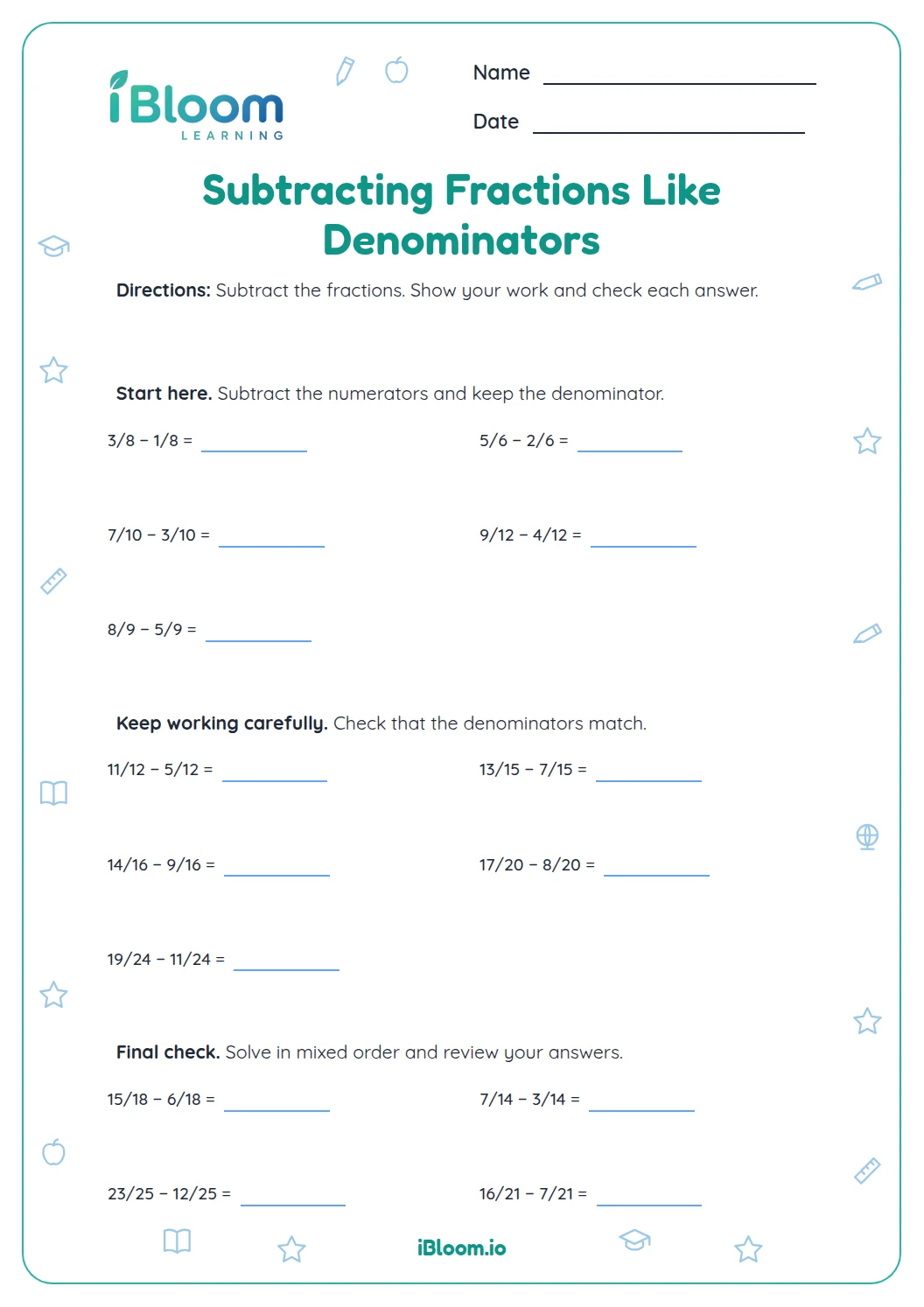
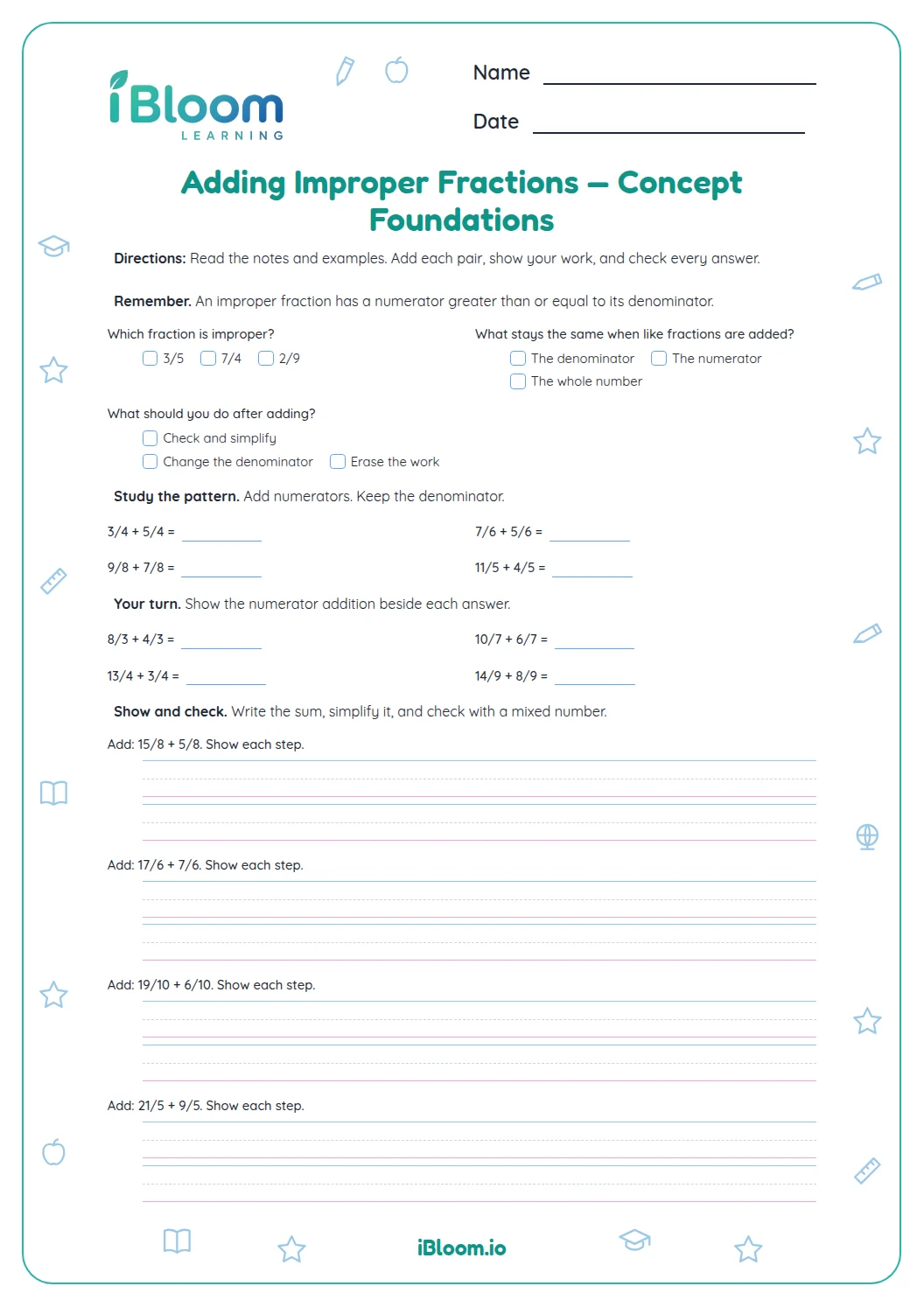
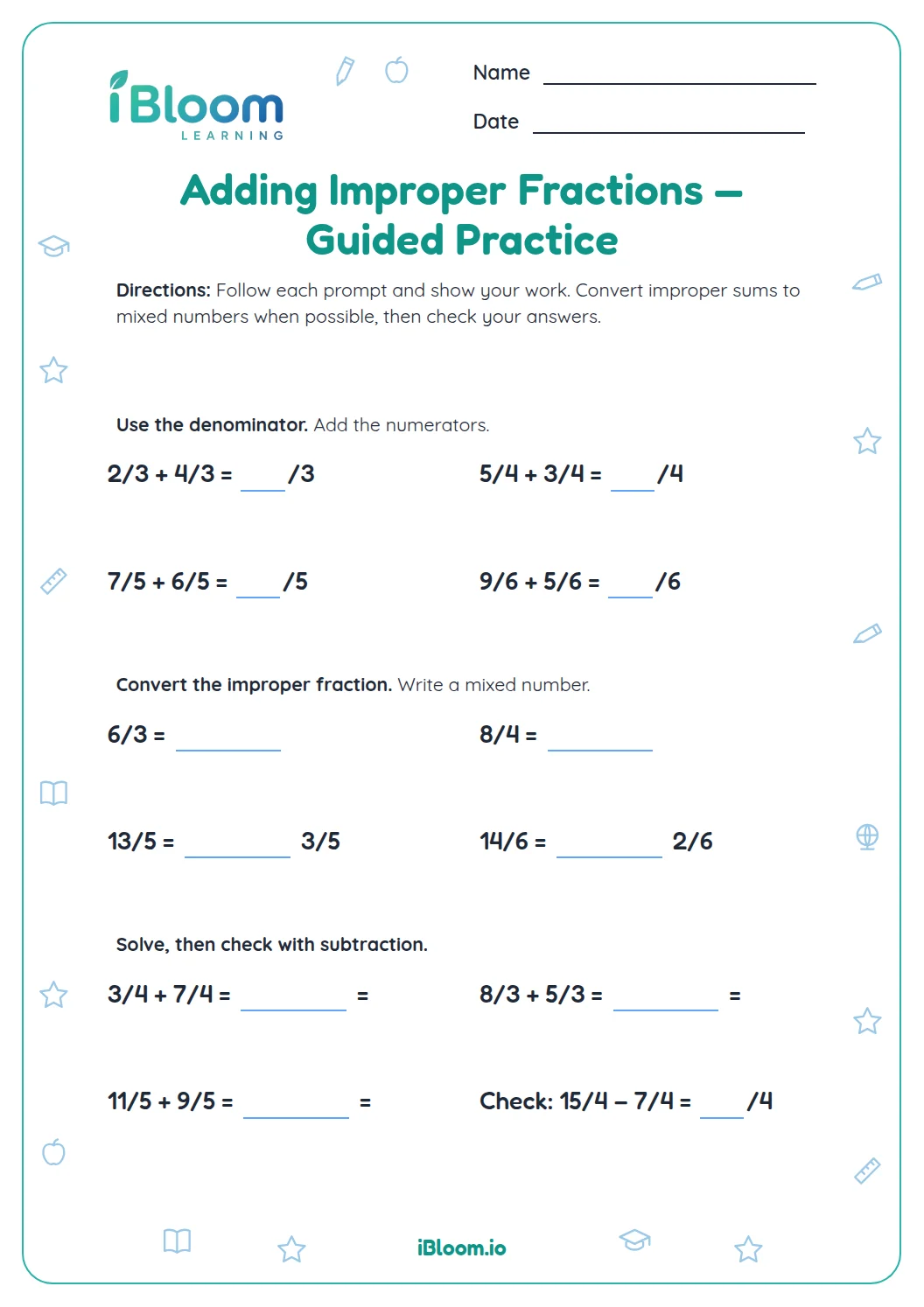
This free Grade 4 worksheet builds from joining fractional parts to adding and simplifying fractions with like denominators. Part A has four sums described in words. Part B gives four equations with a worked model. Part C asks for improper fractions and mixed numbers. Part D adds a subtraction check, an estimate, and two word problems. The 16 questions practice Common Core 4.NF.B.3a and 4.NF.B.3d. A separate answer key gives simplified sums, both fraction forms for Part C, and equations for the word problems.
Aligned to 4.NF.B.3a and 4.NF.B.3d
What makes this guided practice?
Part A names the pieces being joined: one eighth plus two eighths makes three eighths. Part B prints a worked addition-and-simplification model. Students then name sums greater than one as improper fractions and mixed numbers, before checking and applying the same addition method in Part D.
Why does the denominator stay the same?
The denominator names the size of a part relative to one whole. Joining eighths makes more eighths. It does not cut the whole into smaller pieces, so the denominator remains 8.
- 1Join one eighth and two eighths.
- 2Add the part counts: 1 + 2 = 3.
- 3The parts are still eighths of the same whole.
- 41/8 + 2/8 = 3/8.
How do students simplify and check their sums?
In question 5, 5/12 + 4/12 = 9/12. Divide the numerator and denominator by 3 to get 3/4. Simplifying changes how the fraction is written, while keeping its value the same.
Question 9 gives 9/6, which is 1 3/6 or 1 1/2. Write 9/6 and the simplified mixed number, as Part C asks. In Part D, subtract an addend to check one sum, then round each addend to estimate another. The final two questions apply addition to portions of one ribbon and one pitcher.
How to use this worksheet
- 1Read each Part A sum aloud and name the size of the parts being joined.
- 2Add numerators, keep the denominator, and simplify the resulting fraction.
- 3Use the worked model in Part B before solving its four equations.
- 4For Part C, write the improper sum, divide it into whole units and leftover parts, and simplify the mixed number.
- 5Complete the subtraction check and estimate in Part D, then write equations for the two word problems.
- 6Compare with the key and check that each answer uses the form requested.
Mistakes to notice and fix
The mistake
Adding denominators as well as numerators.
The fix
Ask whether the pieces changed size; eighths stay eighths when joined.
The mistake
Writing 9/6 as 1 9/6.
The fix
One whole uses 6 of the 9 sixths. The 3 sixths left make 1 3/6, or 1 1/2.
The mistake
Dropping the unit from a word-problem answer.
The fix
Say what was measured: 5/8 of the ribbon or 5/6 of the pitcher.
Common Core alignment
Join equal-sized fractional parts of the same whole.
On this sheet: The opening word prompts connect fraction addition to joining equal parts of the same whole.
Show the official wordingHide the official wording
Understand addition and subtraction of fractions as joining and separating parts referring to the same whole.
Use equations to add like-denominator fractions in two word problems.
On this sheet: Students add portions of one ribbon and one pitcher, keeping the unit whole consistent.
Show the official wordingHide the official wording
Solve word problems involving addition and subtraction of fractions referring to the same whole and having like denominators, e.g., by using visual fraction models and equations to represent the problem.
What to practice next
Make more practice
Further reading
Questions parents and teachers ask
Do students need to simplify their answers?
Yes. Simplify each sum by dividing the numerator and denominator by the same common factor. In question 5, 9/12 becomes 3/4. Part C also asks for the improper fraction before the simplified mixed number, so students show how the total parts become wholes and a remainder.
What does “like denominators” mean?
Like denominators are matching bottom numbers, such as the two 8s in 1/8 + 2/8. They name equal-sized parts of the same whole. Students add the counts of those parts, then simplify if needed. Question 2 joins two sixths and two sixths to make 4/6, or 2/3.
Why are there two word problems?
The word problems ask students to apply fraction addition to measured portions. One joins two pieces of the same ribbon, and the other joins two amounts that fill the same pitcher. Students write an equation before giving the combined fraction, keeping the whole consistent in each situation.
How do we write a sum greater than one?
Write the improper fraction first, then separate its whole units from the remaining parts. In question 9, 5/6 + 4/6 = 9/6. Six sixths make one whole and three sixths remain, giving 1 3/6. Simplify that mixed number to 1 1/2 for the final form.
Which Common Core skills are practiced?
The worksheet practices joining parts of the same whole under CCSS 4.NF.B.3a and solving like-denominator fraction word problems under 4.NF.B.3d. The opening prompts name the equal parts, while the final ribbon and pitcher questions ask students to represent the situation with an addition equation.