




About this worksheet
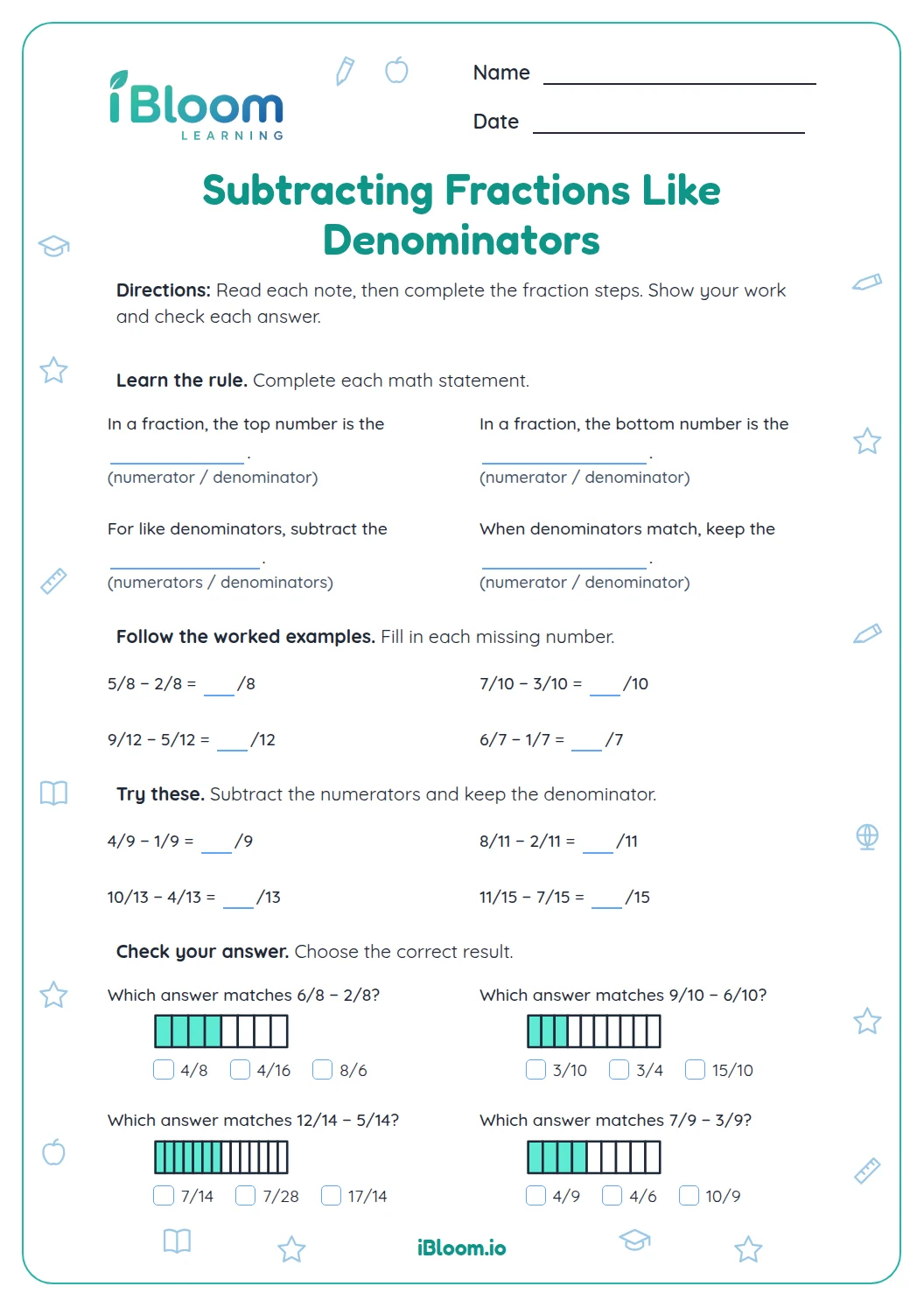
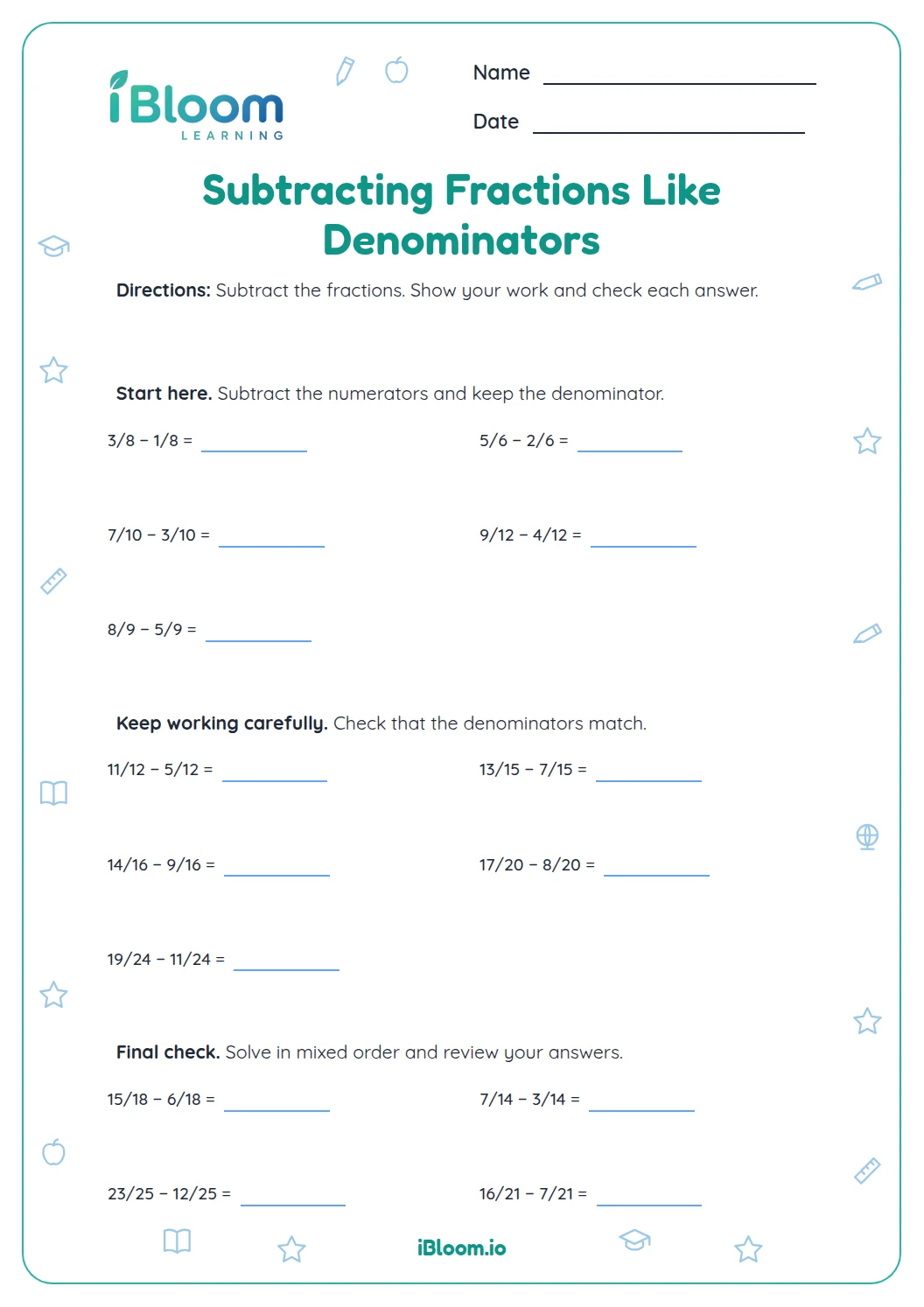
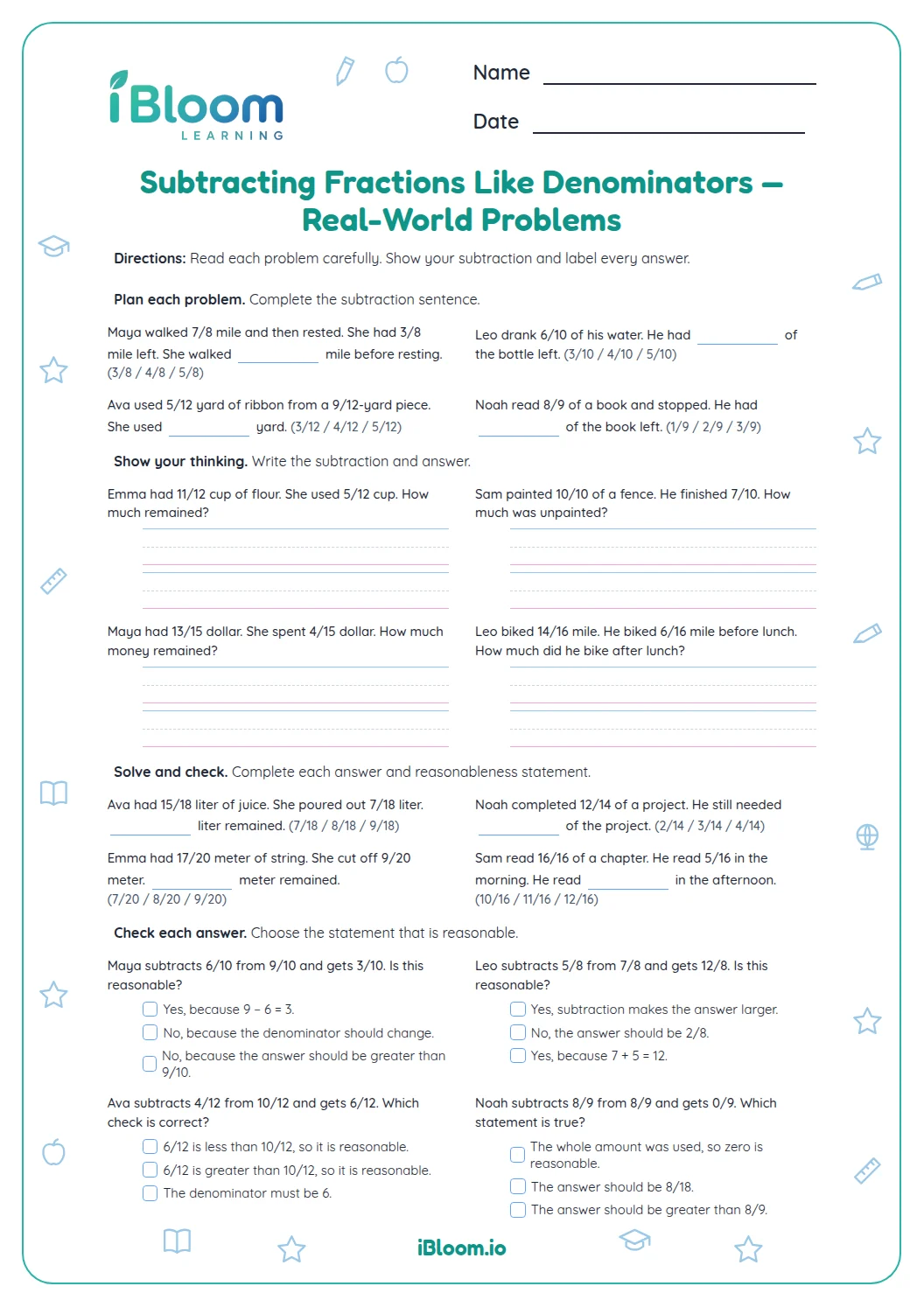
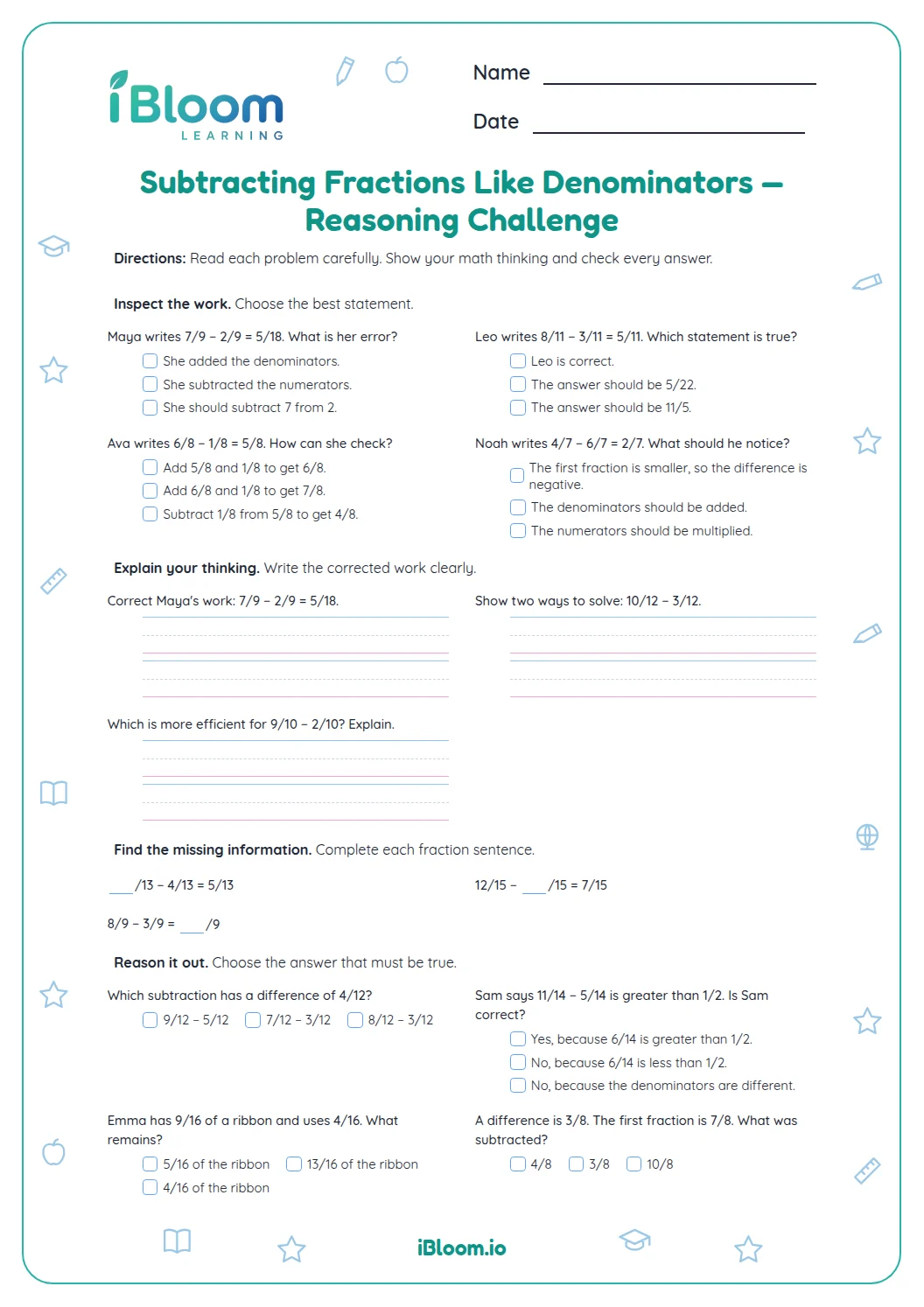
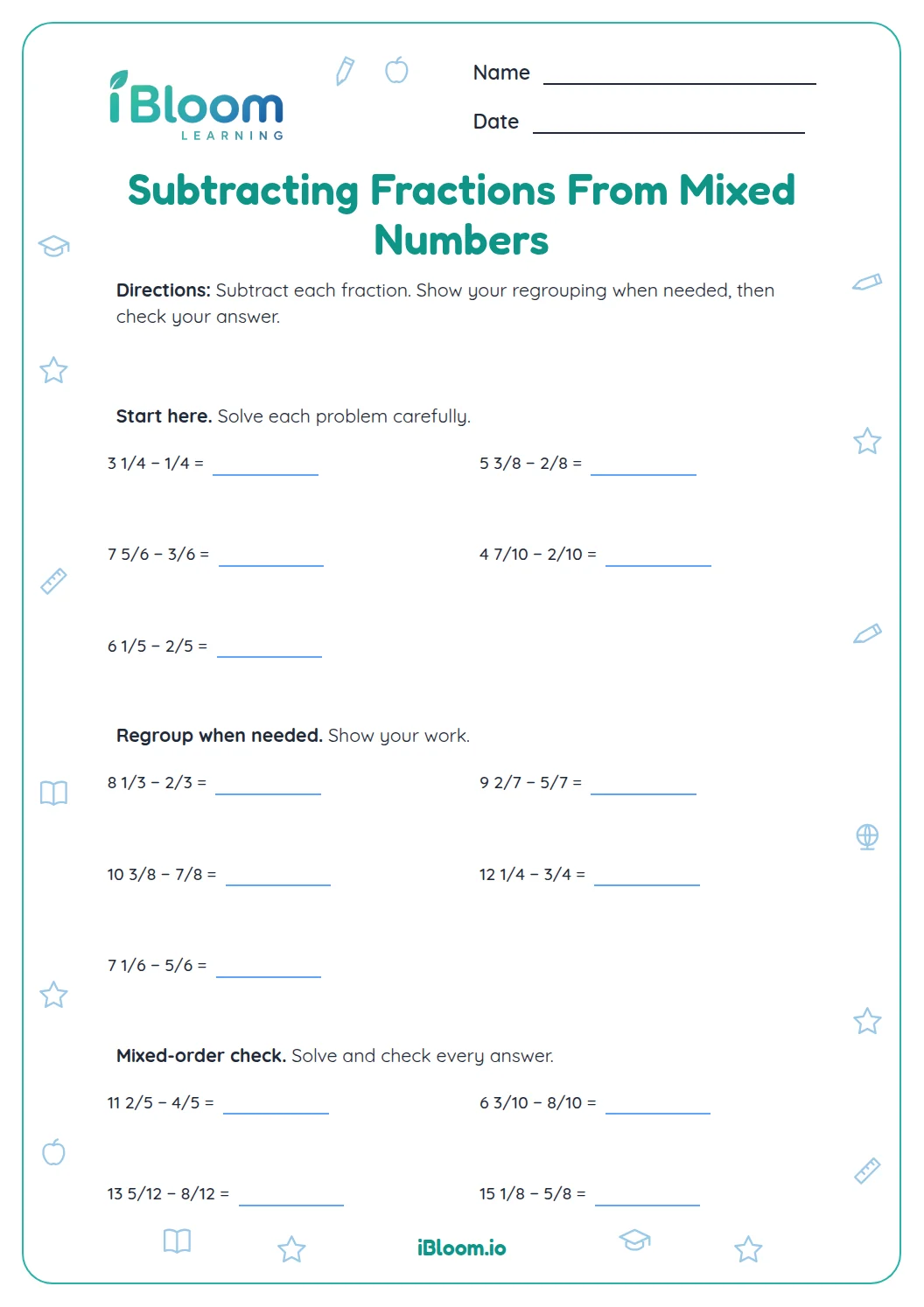
This Grade 4 printable gives focused practice subtracting fractions with like denominators. Fourteen questions move from direct subtraction to checks, estimates, and two short applications. The sheet aligns with CCSS 4.NF.B.3.a and includes a separate answer key.
Aligned to 4.NF.B.3.a
How do you subtract fractions with like denominators?
The denominator names the size of each piece. When the denominators match, subtract the numerators and keep that denominator.
For 7/8 − 2/8, five eighths remain. Adding 5/8 and 2/8 checks the starting amount, 7/8.
- 17/8 − 2/8
- 2Subtract numerators: 7 − 2 = 5
- 3Keep eighths: 5/8
How can addition check a subtraction answer?
Add the amount taken away to the difference. The sum should equal the starting fraction. A valid check for 9/10 − 4/10 = 5/10 is 5/10 + 4/10 = 9/10.
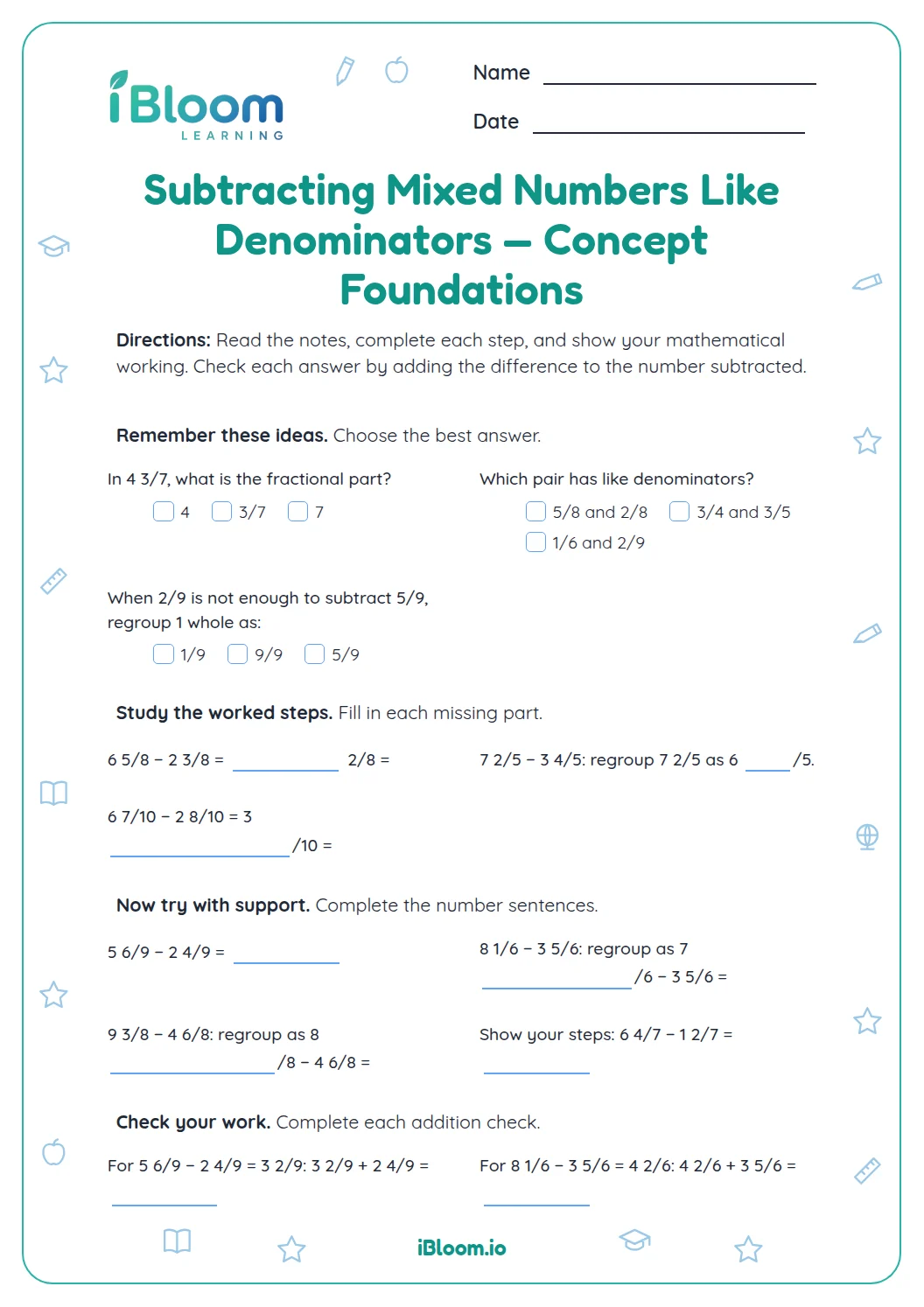
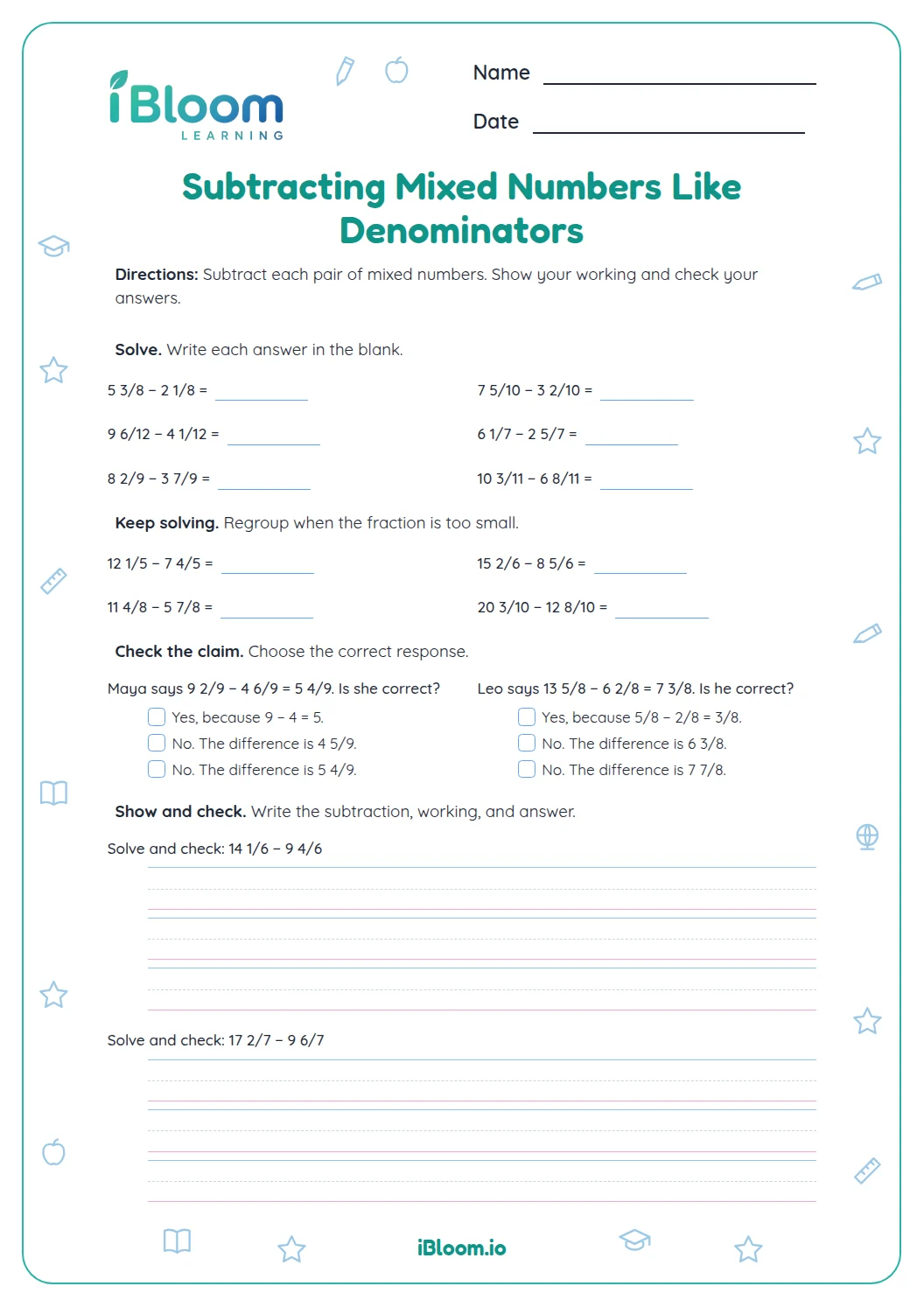
What is included in the two pages?
Part C applies like-denominator subtraction to short measurement situations. Keep the unit from the question and check that the result is less than the starting amount.
How to use this worksheet
- 1Read each fraction as equal-size pieces.
- 2Subtract the numerators and copy the denominator.
- 3Choose the true addition check in Part B.
- 4Solve the short application problems in Part C.
- 5Use the key to check equivalent fractions.
Common mistakes and quick fixes
The mistake
Subtracting both top and bottom numbers.
The fix
Keep the denominator because the size of the pieces stays fixed.
The mistake
Changing the denominator during the subtraction.
The fix
Check that each fraction is still measured in the same-size pieces.
The mistake
Accepting a difference larger than the starting fraction.
The fix
Estimate first: taking away a positive amount must make the fraction smaller.
Common Core alignment
This worksheet gives focused practice with the standard below.
Understand fraction addition and subtraction as joining and separating parts of the same whole.
On this sheet: Understand fraction addition and subtraction as joining and separating parts of the same whole.
Show the official wordingHide the official wording
Understand addition and subtraction of fractions as joining and separating parts referring to the same whole.
What to practice next
Make more practice
Further reading
Questions parents and teachers ask
Do I subtract the denominators too?
No. With like denominators, subtract only the numerators and keep the denominator. The denominator names the size of the pieces, and those pieces stay the same size throughout the subtraction. For 7/9 − 2/9, five ninths remain. Use the answer key to check the result and revisit the matching item if needed.
How can I check a fraction subtraction?
Add the difference to the amount taken away. For example, 5/9 + 2/9 = 7/9, which returns to the starting fraction. The worksheet asks learners to identify true addition checks and estimate a difference. Use the answer key to check the result and revisit the matching item if needed.
Are unreduced answers accepted?
Yes. Answers such as 6/12 are equivalent to 1/2 and show the subtraction directly. The answer key accepts equivalent fractions when the numerator and denominator represent the same amount. Use the answer key to check the result and revisit the matching item if needed.
What is on the worksheet?
There are 14 questions in three parts: eight direct subtractions, four choices about checks or estimates, and two short story problems. A separate key gives the answers. Use the answer key to check the result and revisit the matching item if needed.
What should a learner do after finishing?
Ask the learner to explain one answer and verify another with addition. The related practice links lead to adding fractions with like denominators and subtracting mixed numbers with like denominators. Use the answer key to check the result and revisit the matching item if needed.