





About this worksheet
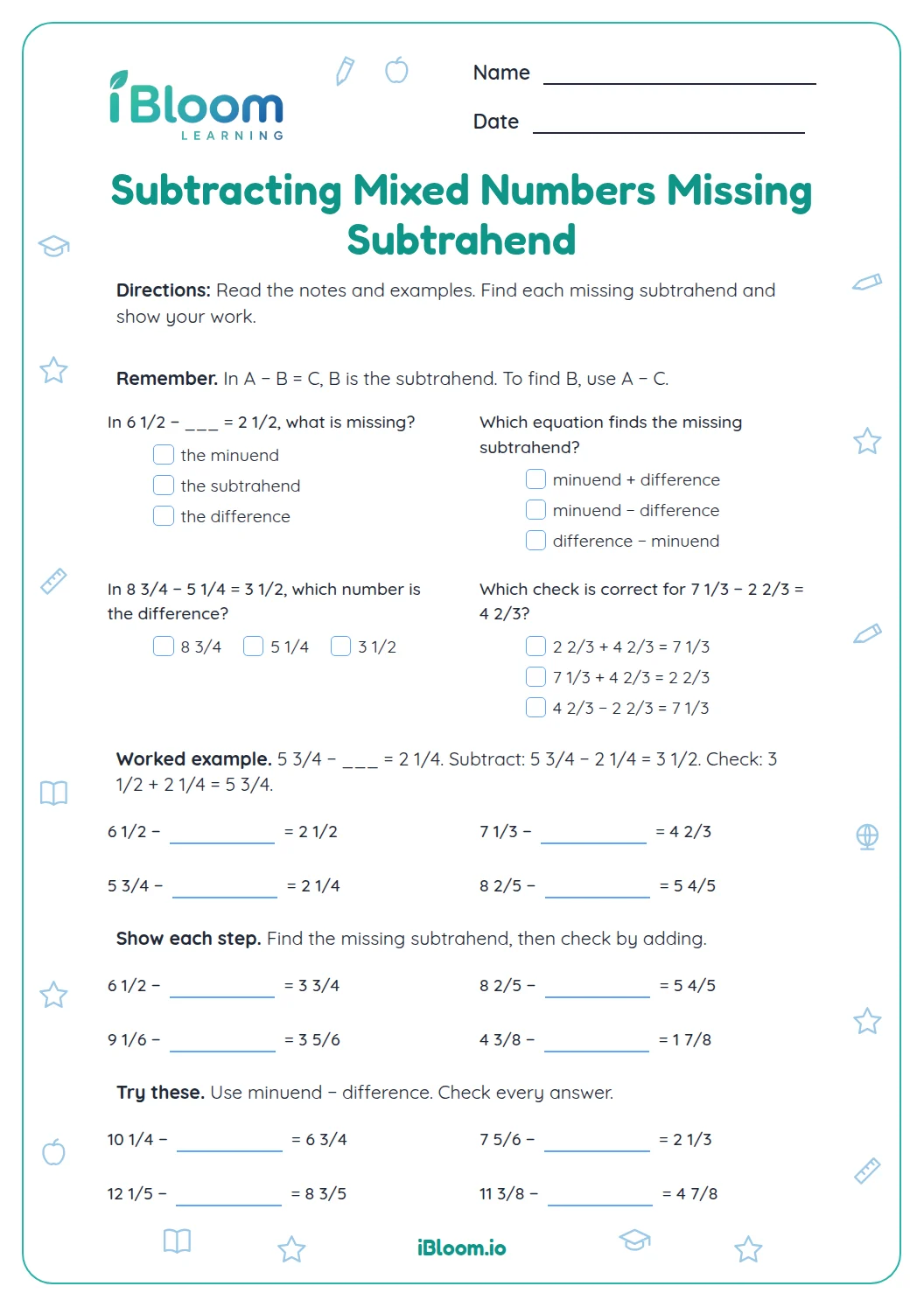
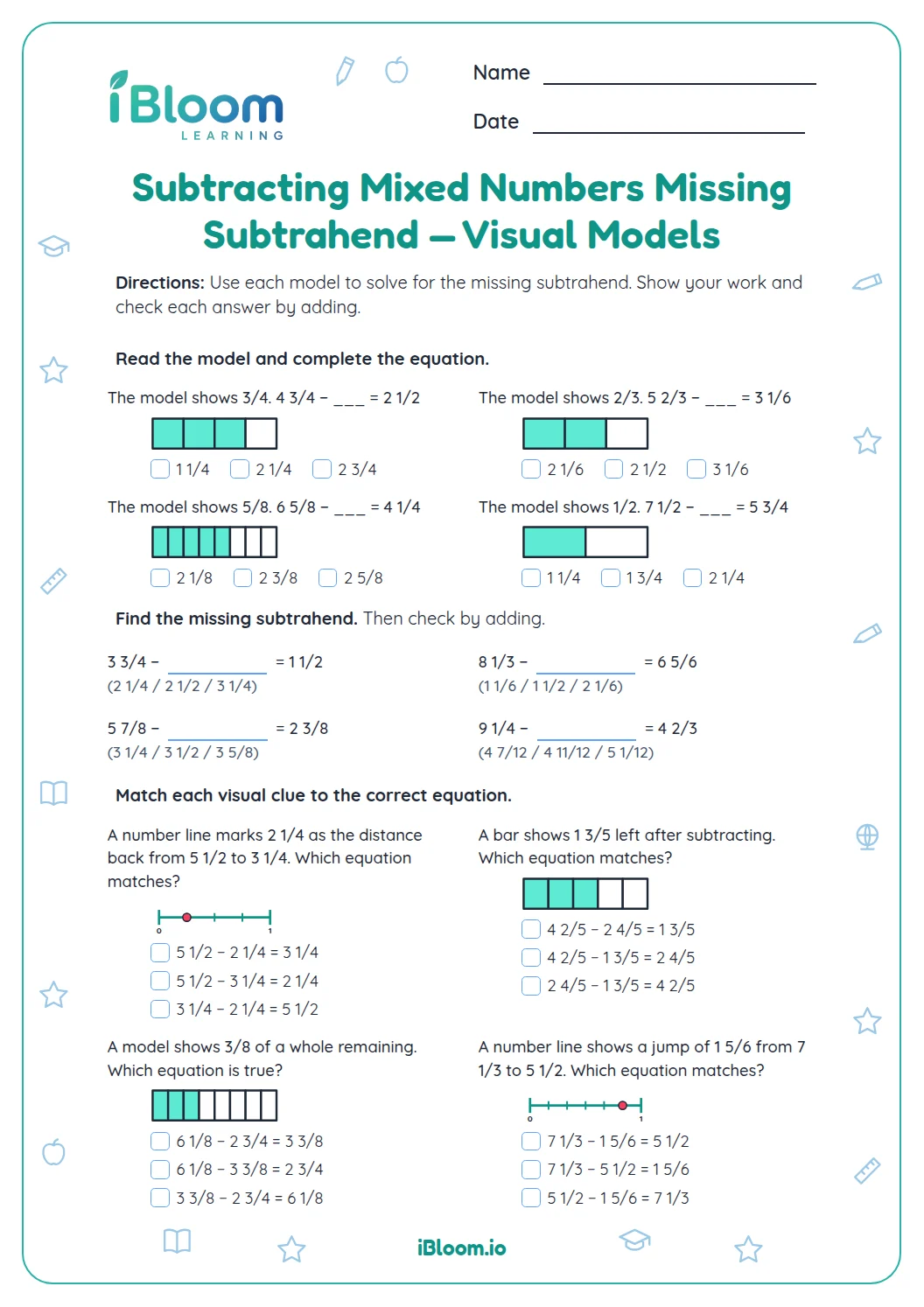
This free printable Grade 4 reasoning worksheet uses fractions and mixed numbers with unlike denominators. Twelve questions ask students to find differences and missing values, judge subtraction strategies and write two explanations. Students rename fractions as equal-sized parts before subtracting, regroup a whole when needed and check by adding back. The work practices Common Core 5.NF.A.1 through equivalent fractions and subtraction of mixed numbers. A separate answer key includes numerical results, correct choices and sample explanations.
Aligned to 5.NF.A.1
When do you need both a common denominator and regrouping?
Question 1 asks for 3 1/4 − 2/3. Fourths and thirds are different-sized parts, so first write 1/4 as 3/12 and 2/3 as 8/12. Three twelfths is too little to remove eight twelfths, so rename one whole as twelve twelfths.
That changes 3 3/12 to 2 15/12 without changing its value. Subtract eight twelfths to get 2 7/12.
- 13 1/4 − 2/3 = 3 3/12 − 8/12
- 23 3/12 = 2 15/12
- 32 15/12 − 8/12 = 2 7/12
- 4Check: 2 7/12 + 8/12 = 3 3/12 = 3 1/4
What reasoning does each part ask for?
Part A has four differences, one missing starting number and one missing amount removed. The questions include subtracting a proper fraction and subtracting another mixed number.
Part B repairs a denominator error, selects an addition check, decides whether regrouping is necessary and recognizes an improper fraction. Part C compares two methods and explains why a result is below a nearby whole number.
How can students check answers and choose a method?
Add the removed amount back to the result. For question 4, 3 3/8 + 2 3/4 = 6 1/8. A correct check recovers the original mixed number.
Regrouping and improper fractions both preserve value. In question 11, students solve 7 1/3 − 2 5/6 by each method. The explanations can differ from the sample as long as both calculations are correct.
How to use this worksheet
- 1Identify the denominators and find a common multiple.
- 2Rewrite both fractional parts with the common denominator.
- 3Compare those parts and regroup one whole when needed.
- 4Solve Part A, adding back to check differences and recover missing starting numbers.
- 5Test each Part B choice with an equation or equivalent fraction.
- 6Write both methods in question 11 and a size-based explanation in question 12.
Mistakes to notice and fix
The mistake
Subtracting numerators and denominators separately.
The fix
In question 7, use 5 2/12 − 9/12, then regroup to 4 14/12 − 9/12.
The mistake
Adding fraction pieces without reducing the whole-number part.
The fix
Renaming 3 3/12 gives 2 15/12: one of the three wholes supplies the twelve extra twelfths.
The mistake
Regrouping whenever denominators differ.
The fix
First use a common denominator. In 4 2/5 − 1 3/10, four tenths is enough to subtract three tenths.
Common Core alignment
Use equivalent fractions with common denominators to subtract fractions and mixed numbers.
On this sheet: Students find common denominators, subtract fractions and mixed numbers, and explain equivalent forms.
Show the official wordingHide the official wording
Add and subtract fractions with unlike denominators (including mixed numbers) by replacing given fractions with equivalent fractions in such a way as to produce an equivalent sum or difference of fractions with like denominators. For example, 2/3 + 5/4 = 8/12 + 15/12 = 23/12. (In general, a/b + c/d = (ad + bc)/bd.)
What to practice next
Make more practice
Further reading
Questions parents and teachers ask
What fraction skills should students use here?
Students use equivalent fractions, common denominators, mixed numbers and the connection between addition and subtraction. They rename fourths and thirds as twelfths, for example, before subtracting. Some questions also need a whole renamed as fraction parts; others can be solved directly after finding the common denominator.
Does every question require regrouping?
No, question 3 can be solved without regrouping. Rewrite 4 2/5 as 4 4/10, then subtract 1 3/10 to get 3 1/10. Question 9 asks students to recognize why this works: four tenths is already enough to remove three tenths without trading a whole.
What is the missing number in question 6?
The missing amount is 2 9/10. Find it by subtracting 5 3/10 from 8 1/5: rewrite the starting number as 8 2/10, then regroup to 7 12/10. Check by adding 2 9/10 to 5 3/10 and recovering the original 8 1/5.
Should students use regrouping or improper fractions?
Either method works when equivalent fractions are used correctly. Question 11 specifically asks students to show both methods for 7 1/3 − 2 5/6. They can regroup to 6 8/6 or convert the starting number to 44/6; both routes give the same answer, 4 1/2.
How should I mark the written explanations?
Accept clear mathematical reasoning even when the wording differs from the key. Question 11 needs two valid methods and the result 4 1/2. Question 12 needs the comparison 1/4 < 2/3 and an addition check that would recover 3 1/4 from the difference and removed fraction.