







About this worksheet
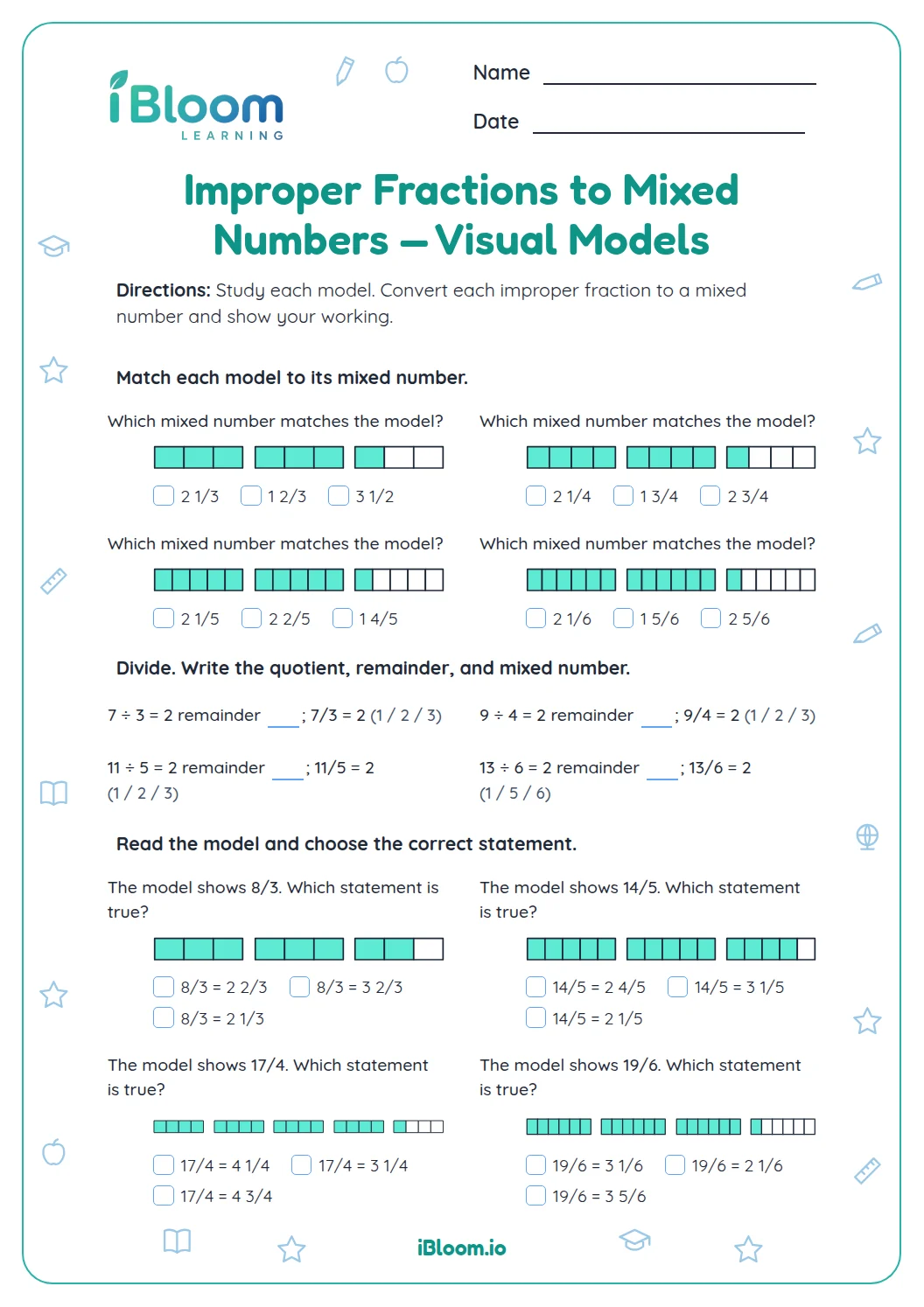
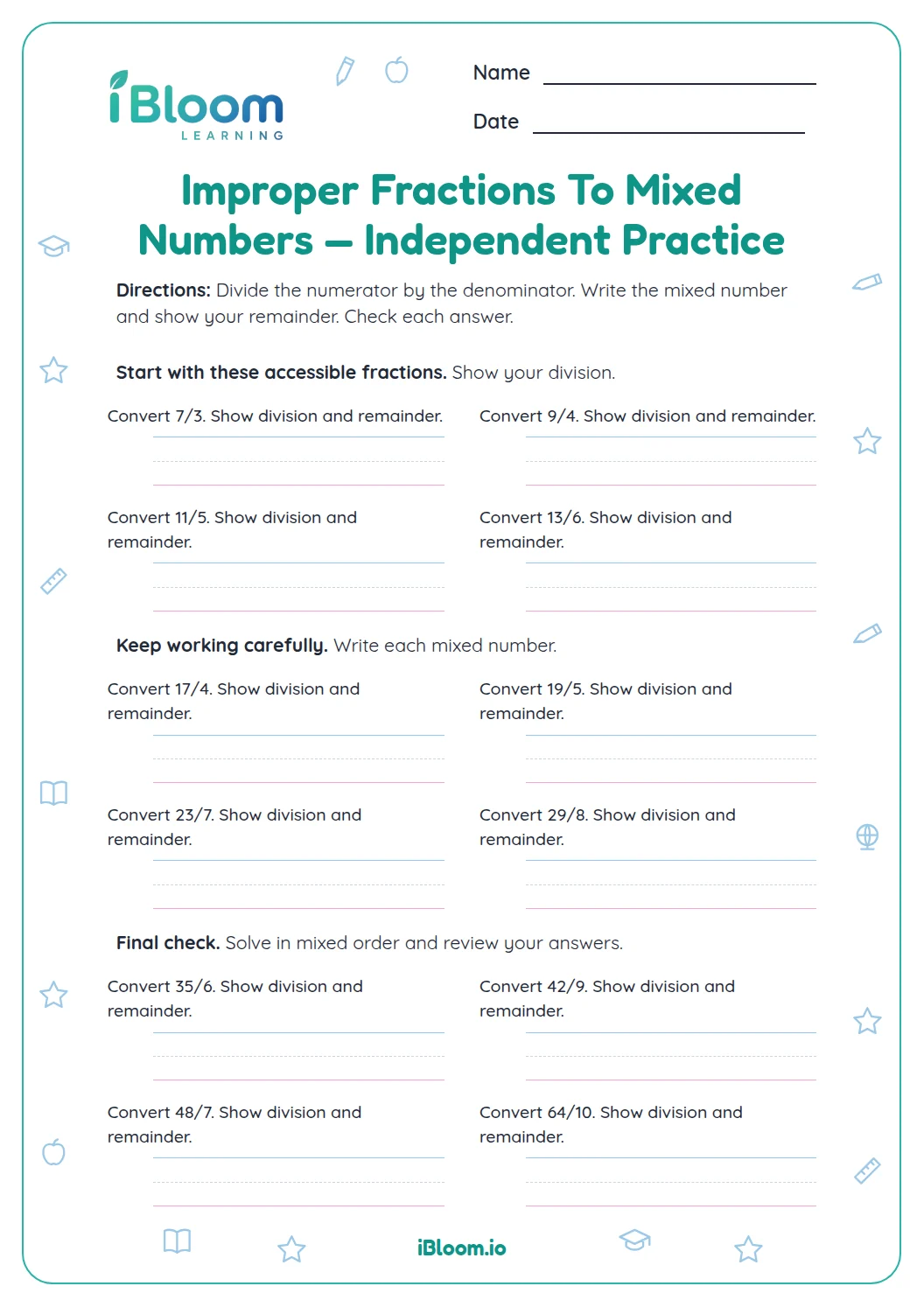
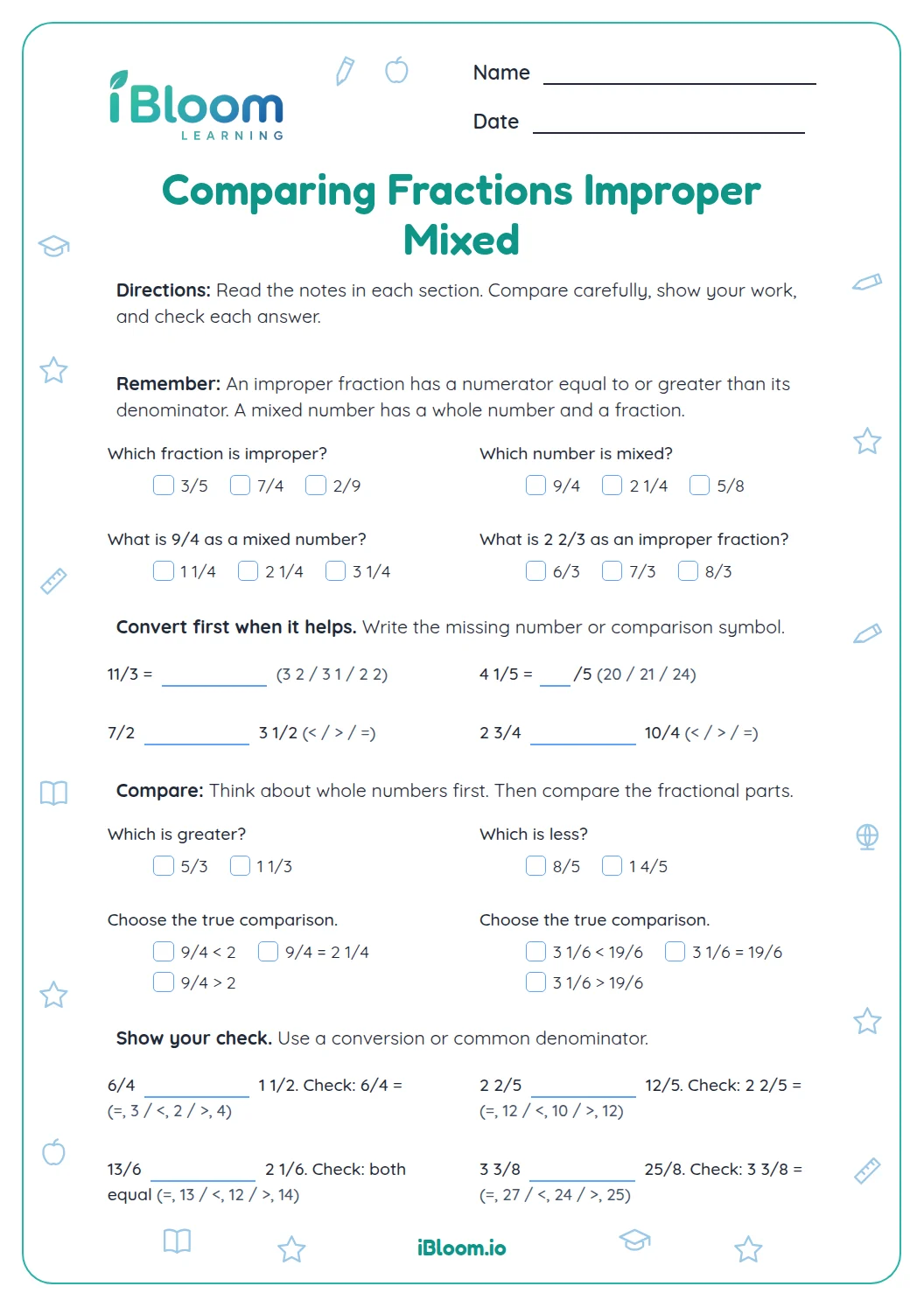
This free printable Grade 4 worksheet uses shaded bars to connect mixed numbers with improper fractions. Students count all the shaded parts in eight models, then use four more models to connect fraction sums with single improper fractions. The last pairs show the same quantity grouped two ways. This work practices Common Core 4.NF.B.3.b through visual decompositions and equations. Each question identifies a whole and keeps the size of its parts consistent. A separate answer key gives all twelve fractions with the model’s original denominator.
Aligned to 4.NF.B.3.b
What counts as one whole in these models?
One complete bar is one whole. Each whole in a question is divided into the same number of equal parts. The fully shaded bars count too: they supply all their pieces, not just one piece each.
The instructions ask students to keep the model’s denominator. This makes every answer a direct count of the pieces drawn and lets children compare the written fraction with the picture.
Why do we multiply the whole number by the denominator?
The denominator tells how many pieces fill each whole. Two wholes divided into fourths contain two groups of four pieces. Adding the pieces in the partial whole gives the numerator of the improper fraction.
- 12 3/4 has 2 complete bars and 3 shaded fourths.
- 22 × 4 = 8 fourths in the complete bars.
- 38 + 3 = 11 shaded fourths altogether.
- 42 3/4 = 11/4
Why do the last questions repeat the same amounts?
Questions 9 and 10 both show 2 1/4, but one sum lists the two wholes separately and the other combines them as 8/4. Both lead to 9/4. Questions 11 and 12 do the same with 3 2/3 and 11/3.
Read each sum while pointing to its matching shaded region. The paired questions show that grouping equal parts differently preserves the total amount.
How to use this worksheet
- 1Point to one whole shape and count its equal parts.
- 2Name each part using the denominator before counting all the shaded pieces.
- 3Count the parts in the complete shapes, then add the parts in the partial shape.
- 4Write that total above the same denominator.
- 5For Part B, match each fraction in the sum with a group of shaded parts.
- 6Check that each improper fraction has the same value as its mixed number.
Mistakes to discuss
The mistake
Adding the whole number straight to the numerator.
The fix
Convert the whole number into parts first: two wholes contain eight fourths, not two fourths.
The mistake
Changing the denominator while counting more shapes.
The fix
The denominator names the size of one part of one whole, so it stays fixed.
The mistake
Counting only the last, partly shaded shape.
The fix
Point to every complete shaded shape and include all of its equal parts.
Common Core alignment
Use equal parts to connect mixed numbers, fraction sums, and improper fractions.
On this sheet: The models connect whole groups of equal parts to improper fractions; Part B records decompositions.
Show the official wordingHide the official wording
Decompose a fraction into a sum of fractions with the same denominator in more than one way, recording each decomposition by an equation. Justify decompositions, e.g., by using a visual fraction model.
What to practice next
Make more practice
Further reading
Questions parents and teachers ask
What is an improper fraction on this worksheet?
An improper fraction has a numerator greater than its denominator in these questions, because every modeled amount is greater than one whole. The numerator counts all shaded pieces, including pieces in complete shapes. The denominator names how many equal pieces make one whole bar.
How can students keep track of all the shaded parts?
Count one whole bar first, then use that count for each complete bar. Finally, add the shaded parts in the partial bar. Students can point to each bar as they count, or say a running total aloud, to avoid skipping a whole or counting it twice.
Should students simplify the improper fractions?
Students should keep the model’s denominator, as the directions specify. This allows a direct match between the written answer and the pieces they counted. All chosen answers are already in simplest form, so children can focus on converting the mixed number without needing an additional simplifying step.
Why do questions 9 and 10 have the same answer?
They show two decompositions of the same amount, two and one fourth. One sum treats the wholes as four fourths plus four fourths; the other combines them into eight fourths first. Both include the extra one fourth, so both total nine fourths and have the answer 9/4.
How can I check a conversion using the drawing?
Group the counted pieces back into wholes of the size shown. For question 5, eleven fourths can be grouped into four fourths, another four fourths, and three fourths left over. That rebuilds two whole bars and three fourths of a bar, matching the original mixed number.