




About this worksheet
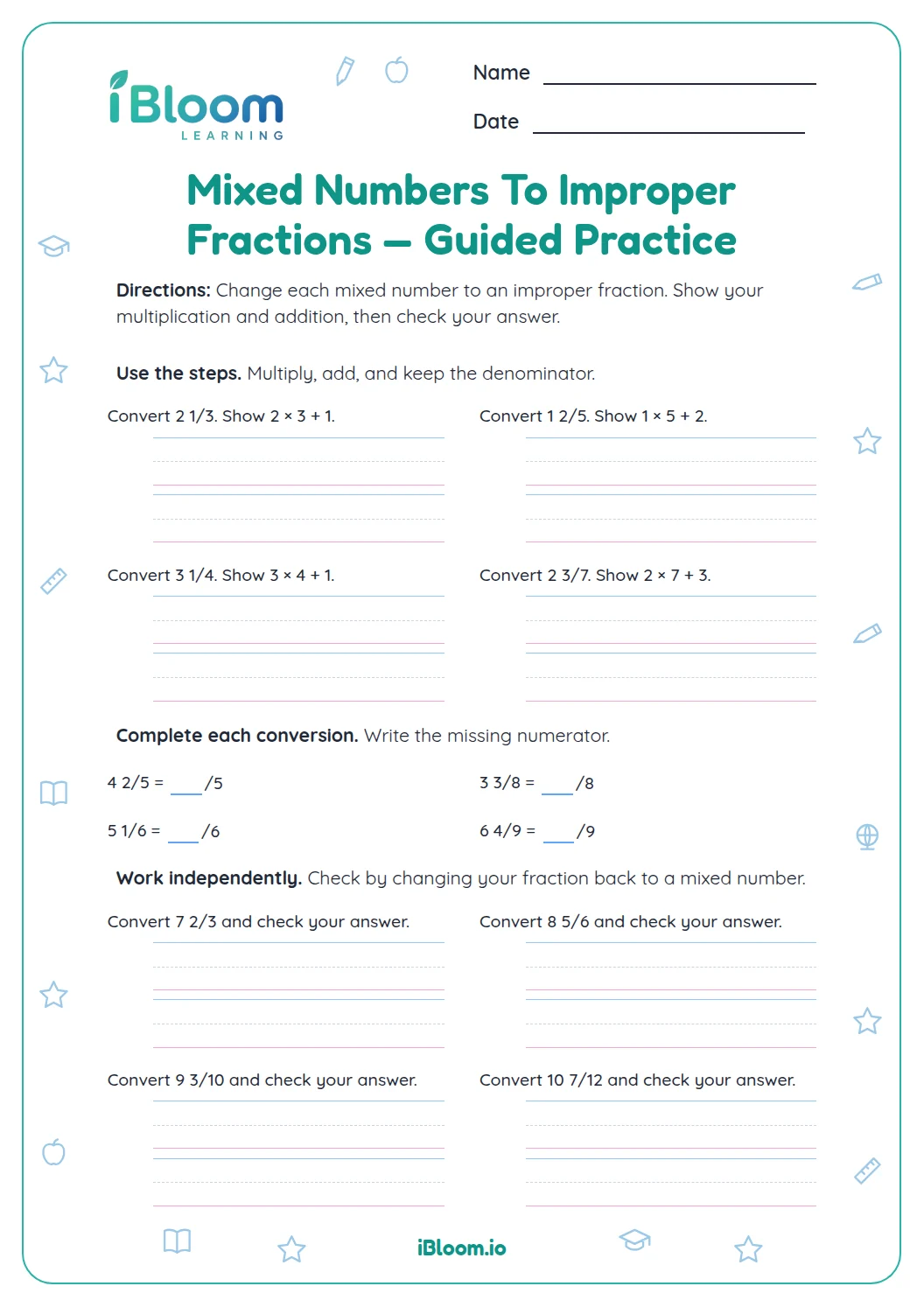
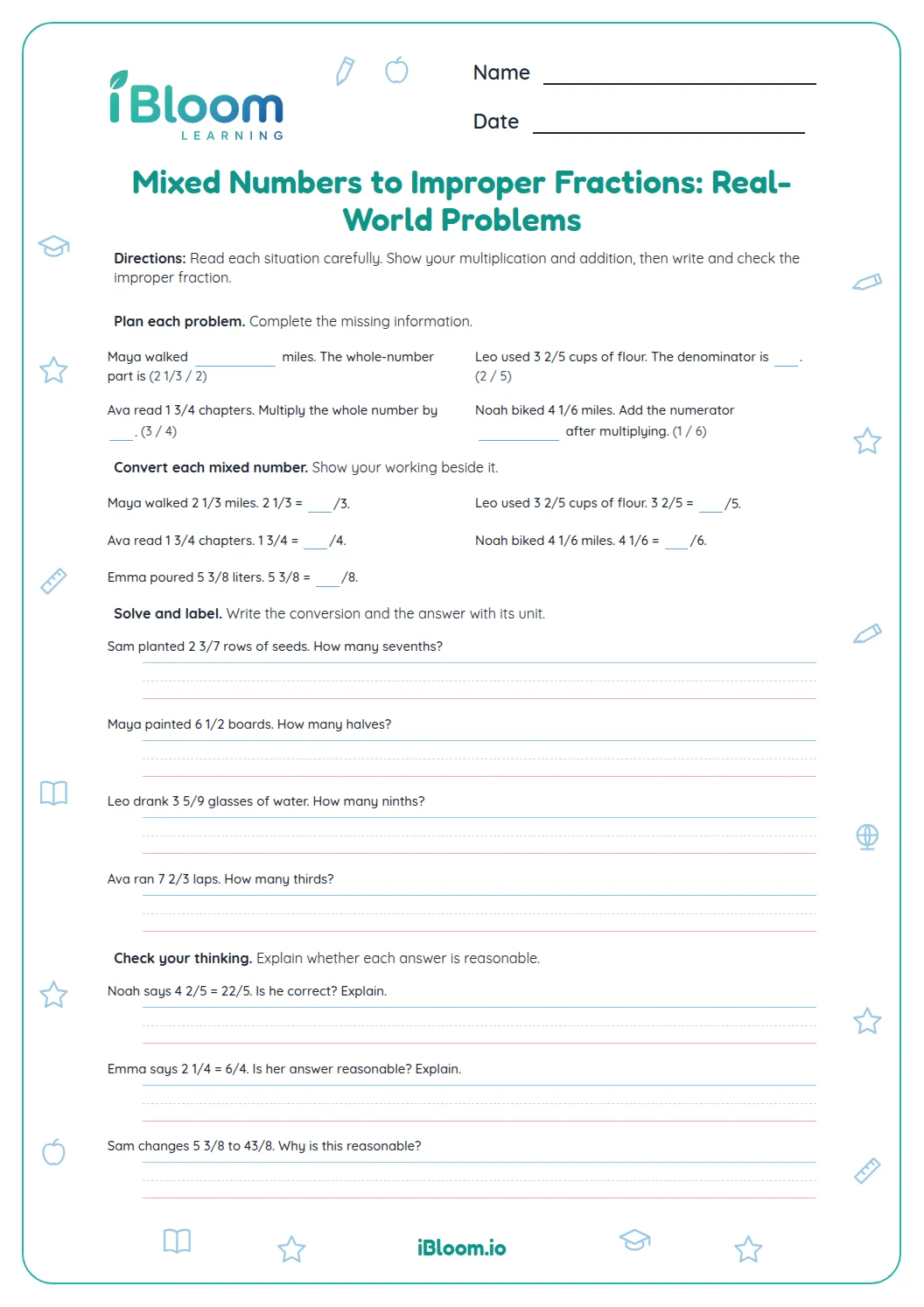
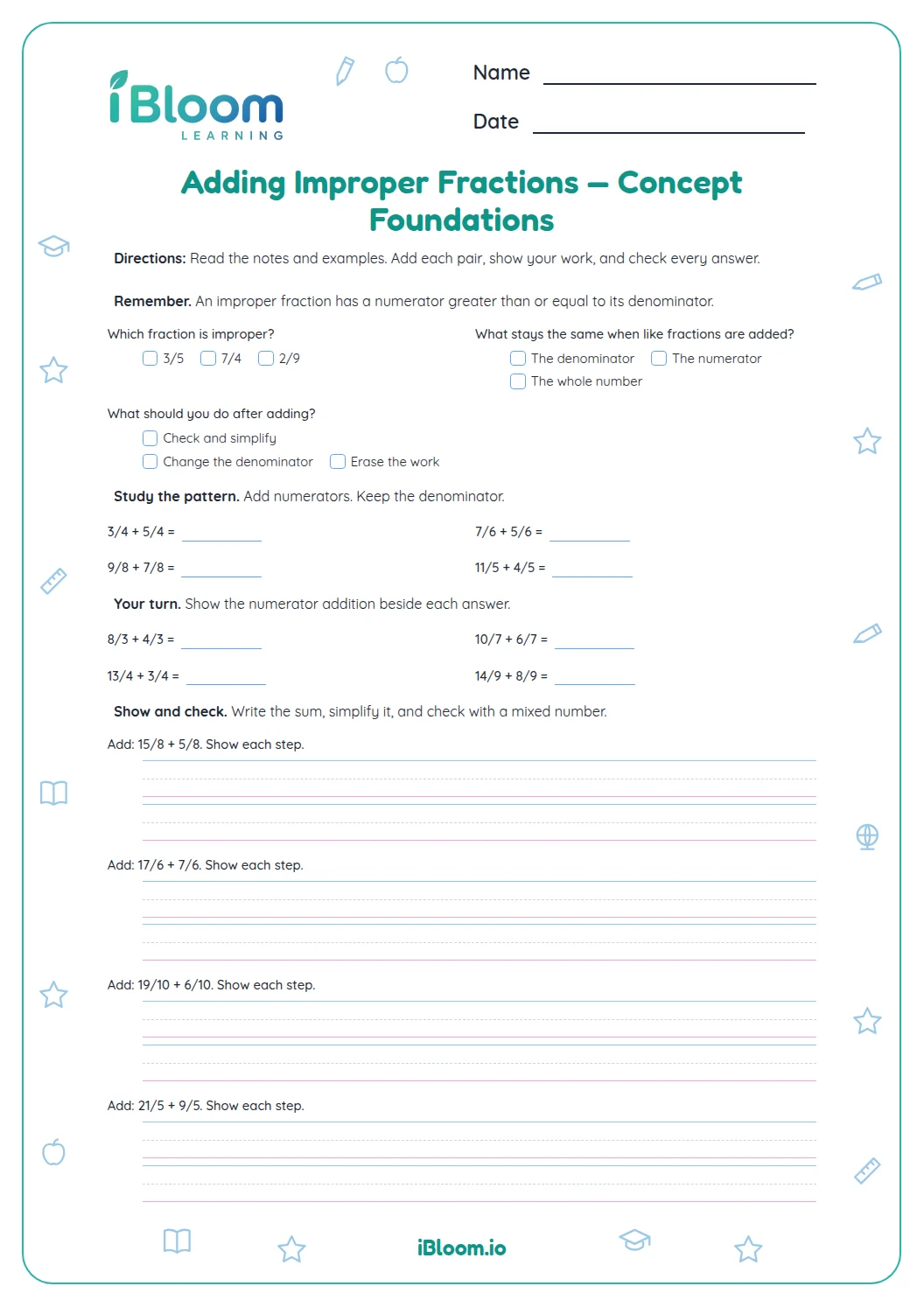
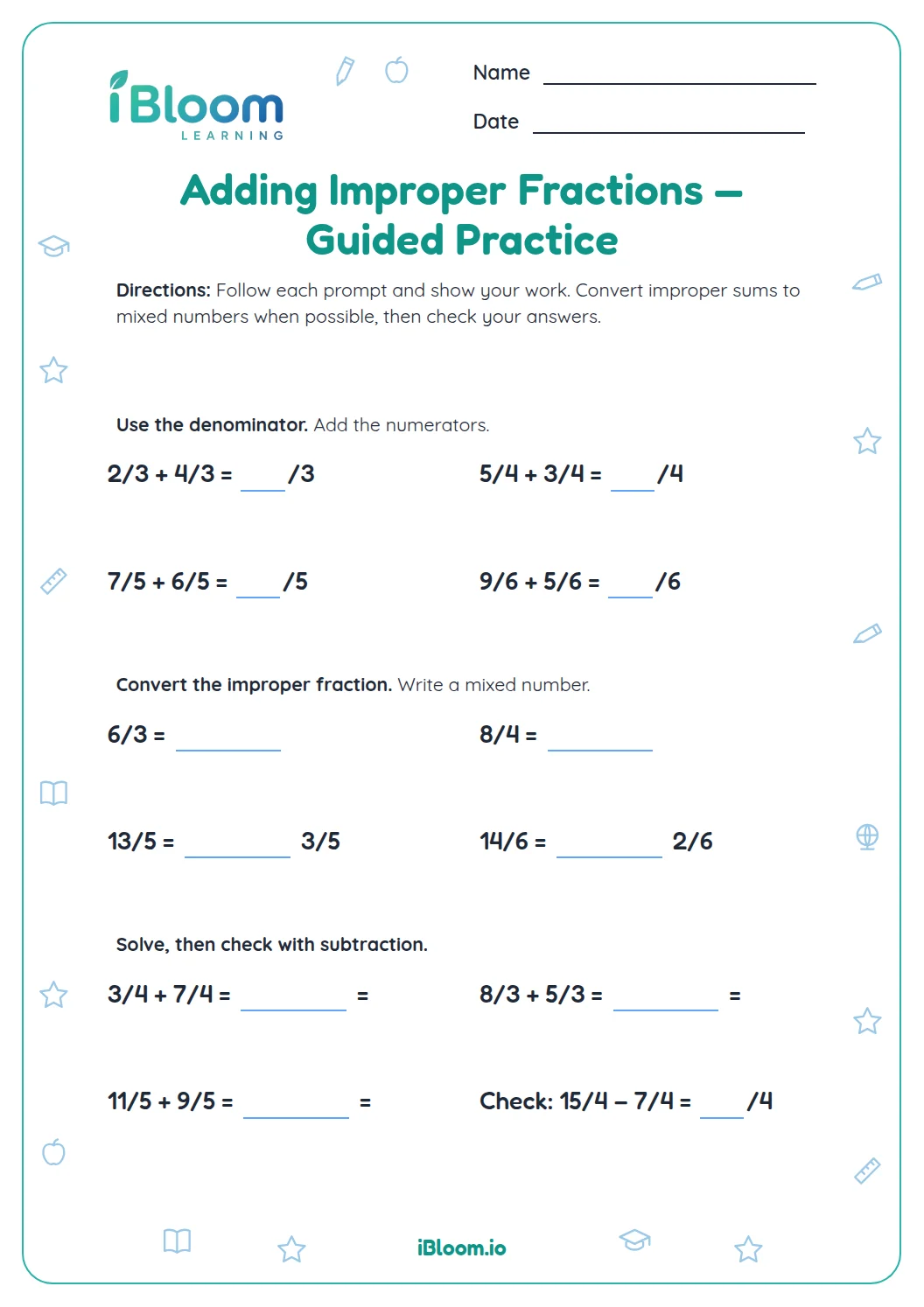
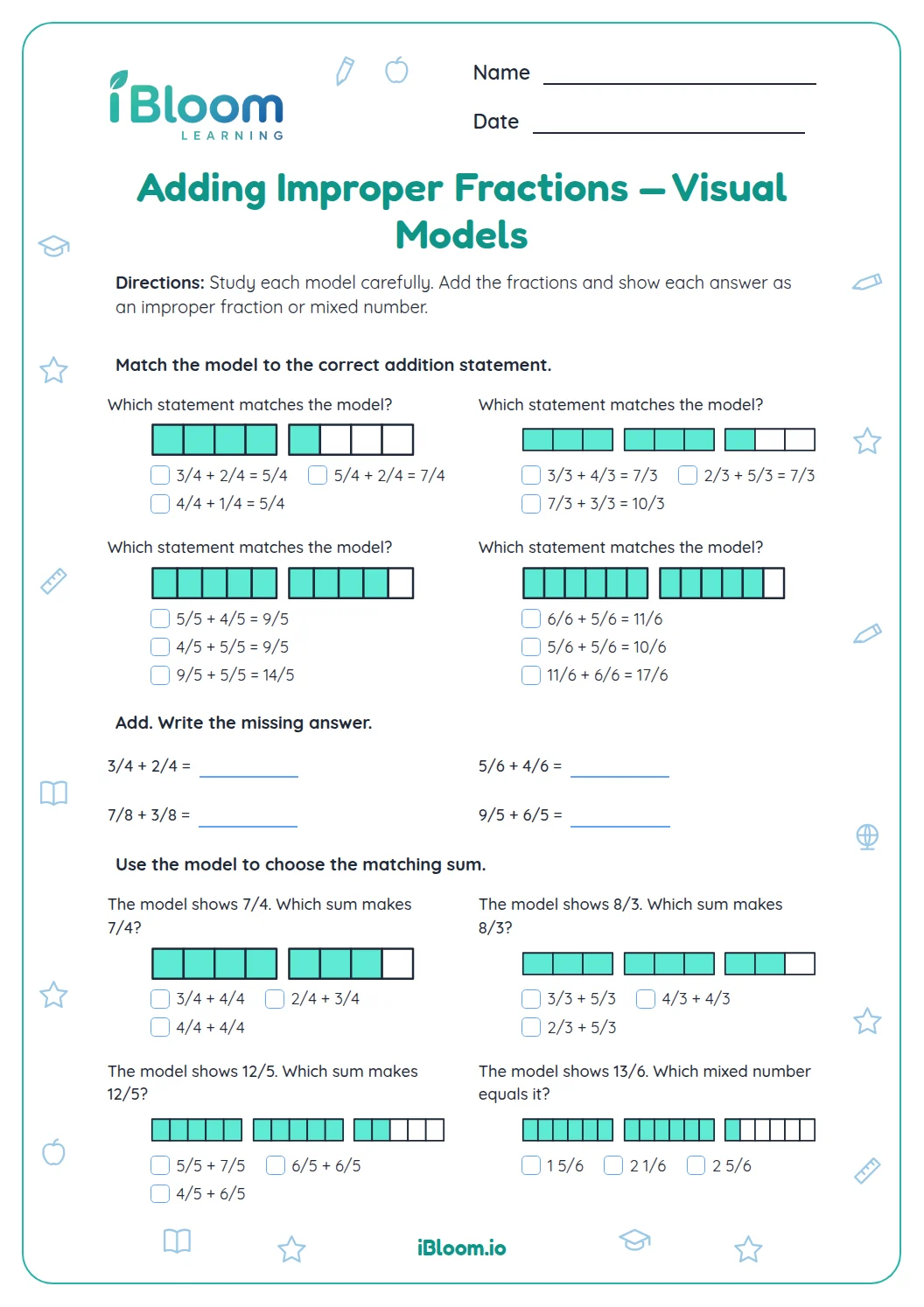
This free Grade 4 worksheet gives students 16 problems on changing mixed numbers to improper fractions and improper fractions back to mixed numbers. The first section builds the conversion rule with denominators from fifths to tenths; later questions ask students to compare equivalent forms and explain a common error. A separate answer key is included. The work connects to CCSS 4.NF.A.1, which asks students to explain and use equivalent fractions.
Aligned to 4.NF.A.1
How do you turn a mixed number into an improper fraction?
The denominator tells how many equal parts make one whole. Multiply the number of wholes by that denominator, add the extra parts, and keep the same denominator. For 2 1/3, two wholes contain 6 thirds; adding 1 third gives 7/3.
Question 3 uses the same reasoning with fifths: 3 wholes are 15/5, then add 2/5.
- 13 2/5
- 23 × 5 = 15 fifths
- 315 + 2 = 17 fifths
- 43 2/5 = 17/5
How can you check the conversion?
Group the numerator into complete sets of the denominator. In 37/8, four groups of 8 make 32, with 5 eighths left, so the mixed number is 4 5/8. The remainder must be smaller than the denominator.
What is on the worksheet?
There are 14 questions in three parts: five mixed-to-improper conversions, five improper-to-mixed conversions, and four reasoning or equivalence checks. The denominators are 3, 4, 5, 6, 8, and 10. A separate answer key follows the two worksheet pages.
How to use this worksheet
- 1Name how many equal parts make one whole by reading the denominator.
- 2Multiply the whole number by that denominator.
- 3Add the numerator to count all the parts.
- 4Write the total over the original denominator.
- 5For an improper fraction, divide the numerator by the denominator; the remainder is the new numerator.
- 6Check that both forms name the same amount.
Common mistakes and how to check
The mistake
Multiplying only the whole number and writing 3 2/5 as 15/5.
The fix
Add the extra 2 fifths: 15/5 + 2/5 = 17/5.
The mistake
Changing the denominator during conversion.
The fix
Keep the denominator because the size of each part stays the same.
The mistake
Writing a remainder as large as the denominator when converting back.
The fix
Divide to find complete wholes; the leftover parts must be fewer than the denominator.
Common Core alignment
This worksheet practices 4.NF.A.1 through the reading or math tasks on the page.
Use equivalent fractions to check that each conversion names the same amount.
On this sheet: Explain that two fractions are equivalent when they name the same amount, and use that idea to check each conversion.
Show the official wordingHide the official wording
Explain why a fraction a/b is equivalent to a fraction (n × a)/(n × b) by using visual fraction models, with attention to how the number and size of the parts differ even though the two fractions themselves are the same size. Use this principle to recognize and generate equivalent fractions.
What to practice next
Make more practice
Further reading
Questions parents and teachers ask
How do you convert 2 1/3 to an improper fraction?
Two wholes contain 6 thirds because 2 × 3 = 6. Add the extra third to get 7 thirds, so 2 1/3 = 7/3. The denominator stays 3 because the parts are still thirds. Question 1 uses this exact conversion.
How do you change an improper fraction into a mixed number?
Divide the numerator by the denominator. The quotient counts whole groups and the remainder counts leftover parts. For example, 19 ÷ 6 is 3 remainder 1, so 19/6 = 3 1/6. Check that the remainder, 1, is smaller than 6.
Why does 3 2/5 equal 17/5?
Each whole contains five fifths, so three wholes contain 15/5. Adding the remaining 2/5 gives 17/5. This is the idea behind question 3: count all fifths, rather than placing the whole number beside the numerator. This is why the numerator counts all the fifths in the number.
What denominators appear on this worksheet?
The 16 questions use thirds, fourths, fifths, sixths, eighths, and tenths. These denominators stay attached to the same-sized parts during conversion. Students also consider equivalent forms and compare two ways to name an amount. The page gives a chance to check that idea in more than one form.
Does the worksheet include an answer key?
Yes. The answer key is printed separately after the two worksheet pages and gives the expected result for every item. For the multiple-choice reasoning questions, it identifies the correct choice; students can show conversion steps in the worksheet space and compare their work afterward.