


About this worksheet
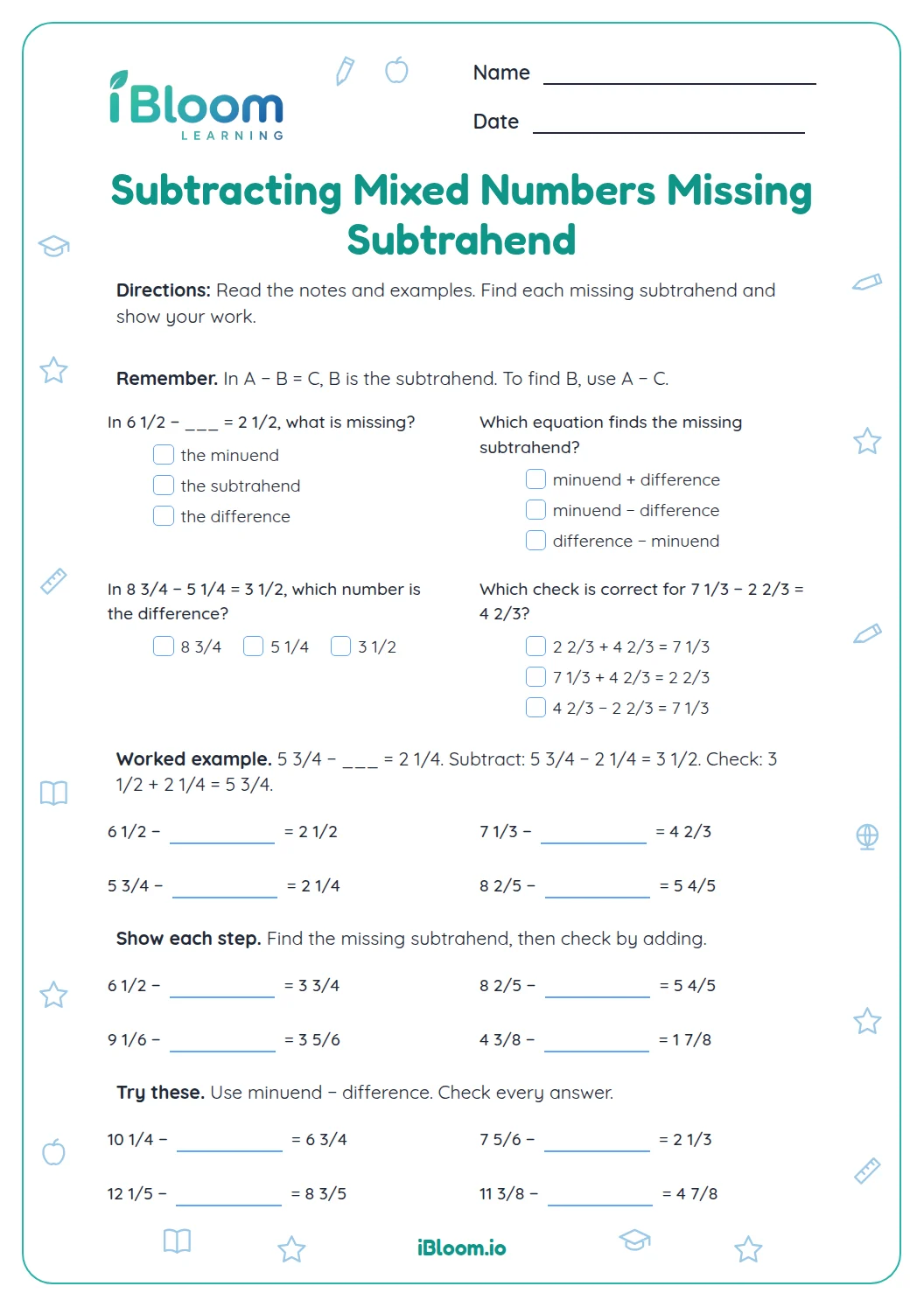
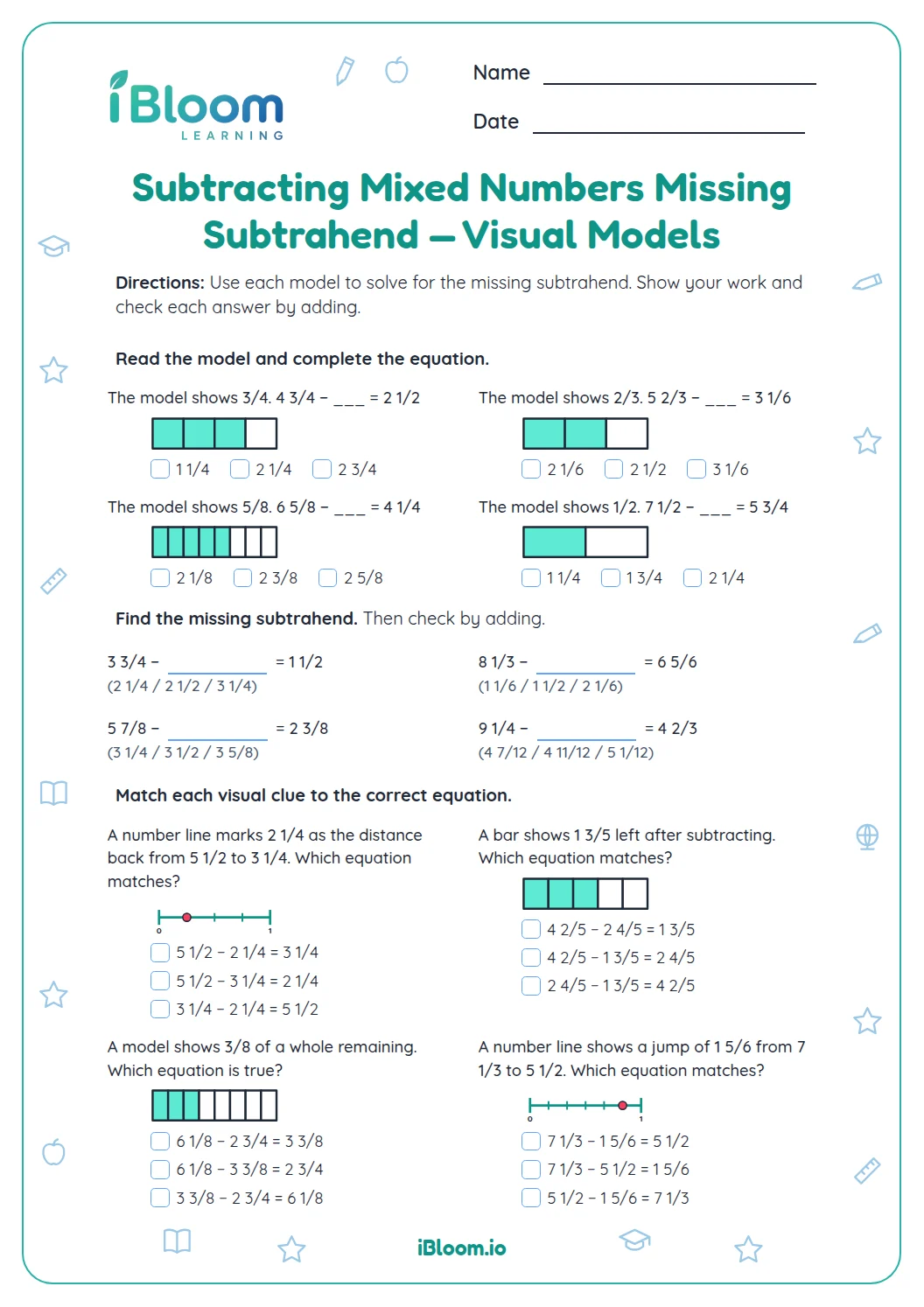
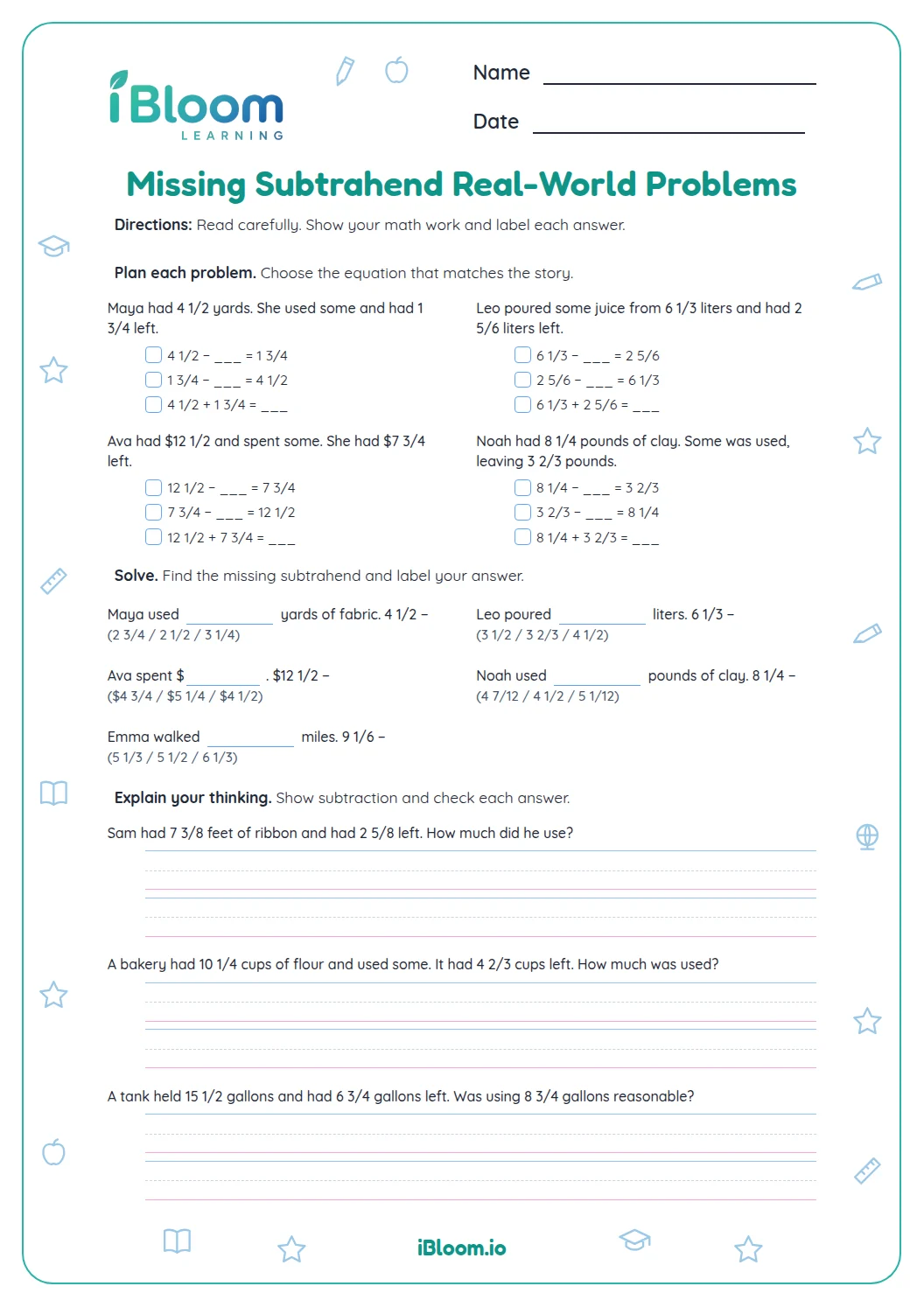
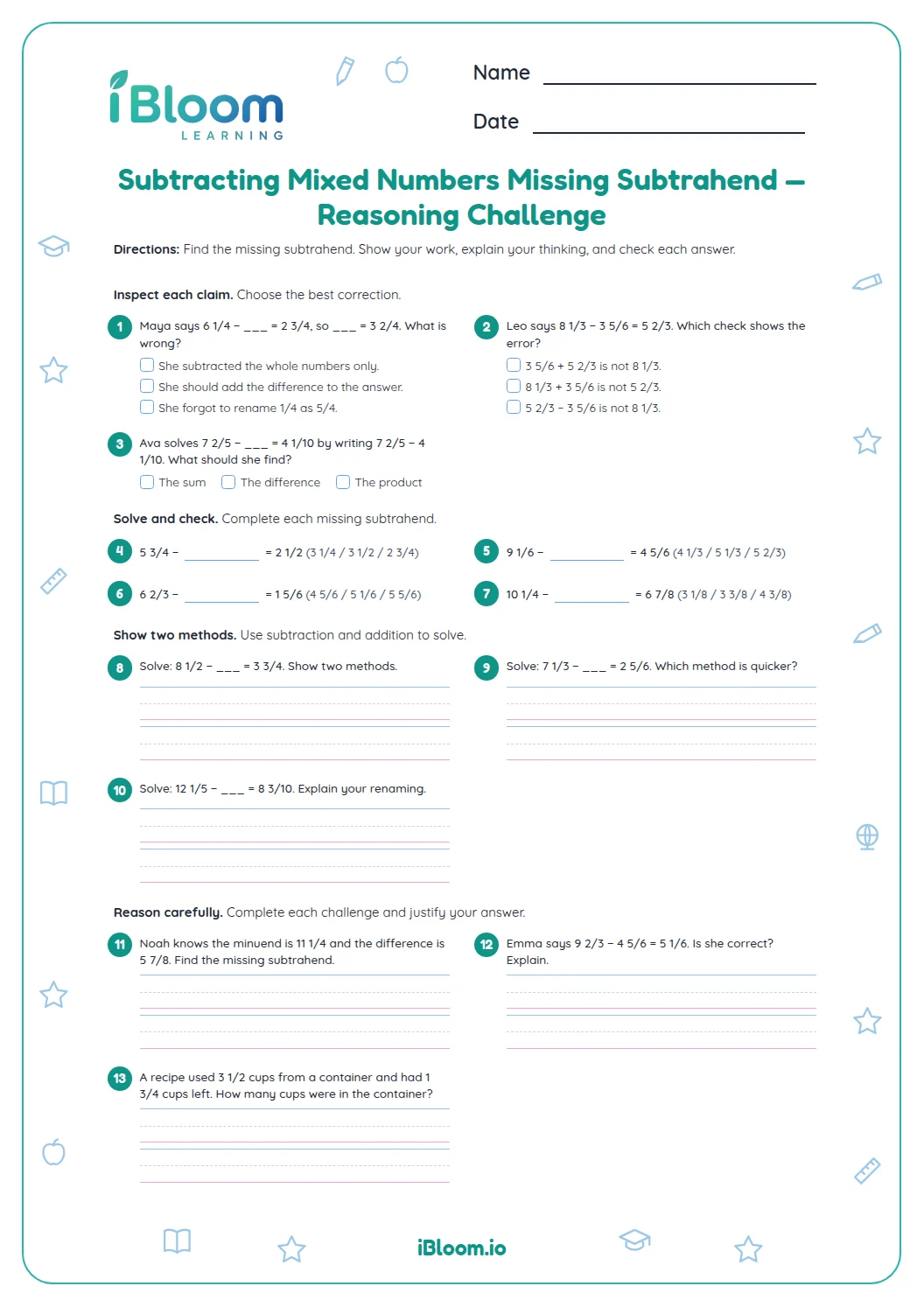
This free printable Grade 4 worksheet helps students find the missing amount in subtraction equations such as 5 3/4 − ___ = 2 1/4. Part A models subtracting the amount left from the starting amount and guides a regrouping example. Part B offers eight missing-number equations; Part C applies the same relationship to ribbon and trail distances. Students practice CCSS 4.NF.B.3.c by subtracting mixed numbers with like denominators and checking through addition. The separate answer key gives simplified answers, while the page explains how to recognize equivalent forms during checking.
Aligned to 4.NF.B.3.c
What does the missing subtrahend represent?
The subtrahend is the amount taken away. In 5 3/4 − ___ = 2 1/4, the starting amount and the amount left are known. Their difference tells how much was removed.
Part A prints this relationship in its model. Students choose the missing amount, then work through a regrouping question before using the method independently.
- 1Start with 5 3/4; 2 1/4 remains.
- 2Missing amount = 5 3/4 − 2 1/4.
- 3Subtract wholes and fourths: 3 2/4 = 3 1/2.
- 4Check: 2 1/4 + 3 1/2 = 5 3/4.
When does finding the missing amount require regrouping?
Regroup when the fractional part of the starting number is smaller than the fractional part you need to subtract. To calculate 4 1/6 − 1 5/6, rename 4 1/6 as 3 7/6. One whole becomes six sixths, which join the existing one sixth.
Now subtract 1 5/6 from 3 7/6 to get 2 2/6, or 2 1/3. Questions 2 and 3 guide this sequence, and later equations give students another chance to use it.
How does addition check the missing number?
Add the missing amount to the amount left. Their sum must equal the original starting amount. This check is especially useful when a student has regrouped and needs to confirm that the whole-number part changed correctly.
For the ribbon problem, 2 3/8 yd remains from 6 7/8 yd. The missing 4 1/2 yd combines with 2 3/8 yd to restore 6 7/8 yd. Encourage students to keep the unit beside the final answer.
How to use this worksheet
- 1Read the Part A model as “start minus missing amount equals amount left.”
- 2Work through question 1, then check the chosen answer with addition.
- 3For questions 2 and 3, rename one whole as sixths before subtracting.
- 4Complete Part B and simplify each fraction in the answer.
- 5Write an addition check for each Part C word problem and include its unit.
Mistakes to catch and how to fix them
The mistake
Adding the two known amounts to fill a subtrahend blank.
The fix
Subtract the amount left from the start; adding would find a missing starting amount.
The mistake
Renaming 4 1/6 as 4 7/6 when regrouping.
The fix
Trade one whole for 6/6: the whole-number part becomes 3, so 4 1/6 = 3 7/6.
The mistake
Subtracting the smaller numerator from the larger regardless of order.
The fix
Keep the subtraction order. Rename 5 1/4 as 4 5/4 before subtracting 2 3/4.
Common Core alignment
Find a missing amount by subtracting mixed numbers with like denominators.
On this sheet: Students regroup when needed and check a missing subtrahend by adding it to the difference.
Show the official wordingHide the official wording
Add and subtract mixed numbers with like denominators, e.g., by replacing each mixed number with an equivalent fraction, and/or by using properties of operations and the relationship between addition and subtraction.
What to practice next
Make more practice
Further reading
Questions parents and teachers ask
What is a subtrahend?
A subtrahend is the amount taken away in a subtraction equation. In 5 3/4 − ___ = 2 1/4, the blank is the subtrahend. The worksheet asks students to find that missing amount by subtracting what remains from the starting amount, then checking the result with addition.
Does the worksheet include regrouping?
Yes, Part A guides regrouping with 4 1/6 − 1 5/6. Students choose the equivalent form 3 7/6 before finding the missing amount. Part B then includes equations that require the same trade of one whole for fractional parts, mixed with equations that can be solved directly.
Must answers be in simplest form?
Part B asks students to simplify, and the answer key uses simplified mixed numbers. An equivalent answer can still show correct subtraction: 4 4/8 represents the same amount as 4 1/2. Recognize the correct value first, then ask the student to divide the numerator and denominator by their common factor.
How do I check the ribbon problem?
The ribbon amount cut off is 4 1/2 yards. Add that amount to the 2 3/8 yards remaining: 4 4/8 + 2 3/8 = 6 7/8. The sum matches the original ribbon length. The worksheet provides working space for students to record this addition check beside their solution.
Can students use improper fractions instead of regrouping?
Yes, equivalent improper fractions give another valid method. For 4 1/6 − 1 5/6, students can subtract 11/6 from 25/6 to get 14/6, then write 2 1/3. Ask them to place that result in the original missing-number equation and check that it leaves the stated amount.