
About this worksheet
This free printable Grade 4 worksheet gives students focused practice with adding mixed numbers like denominators. It moves from supported examples to independent problems and familiar applications, with 16 questions across 3 parts. The questions use age-appropriate numbers and clear contexts so students can practice the target skill and check their work with the separate answer key.
Aligned to 4.NF.B.3.c
How does the practice build adding mixed numbers?
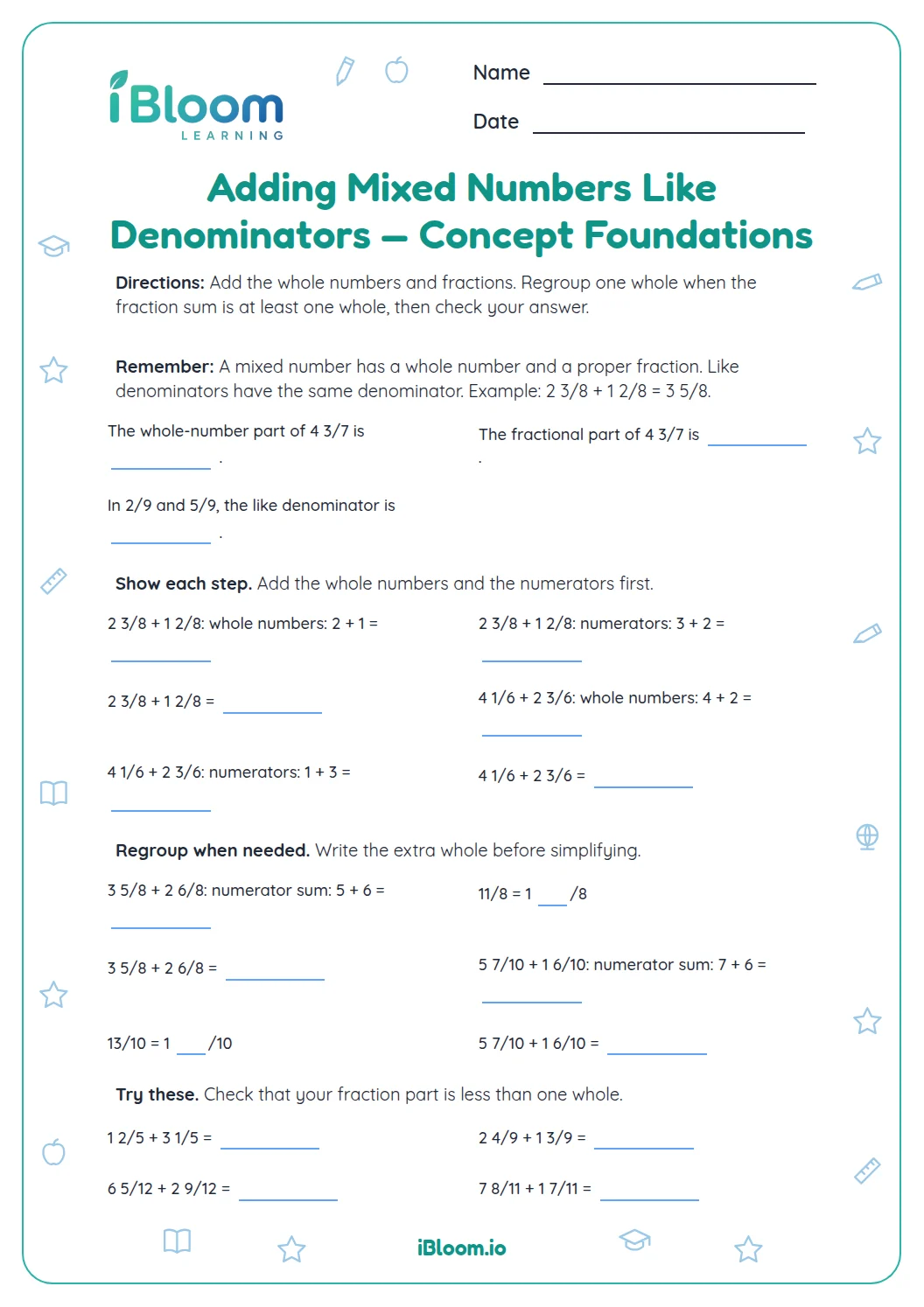
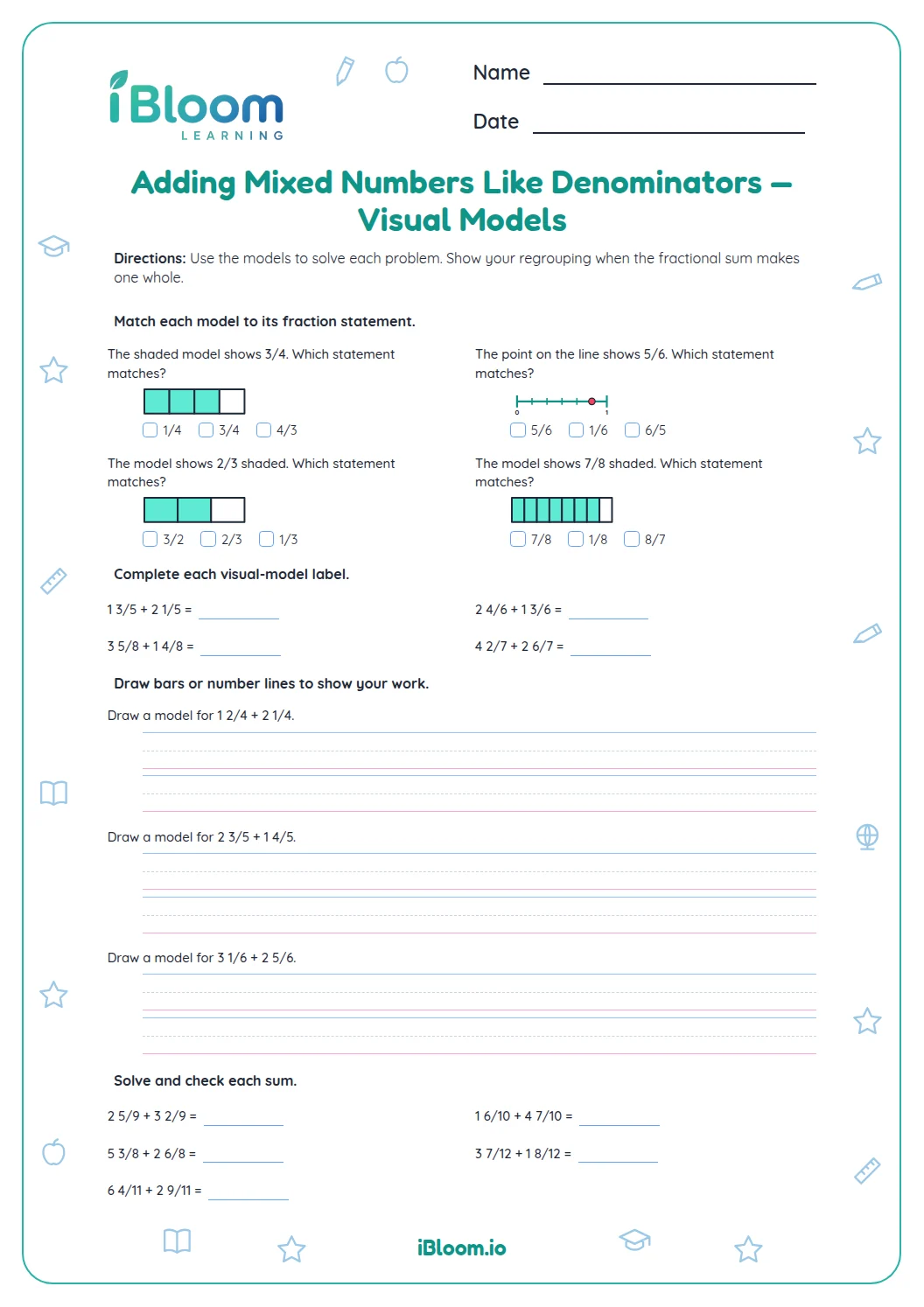
The first part practices add whole numbers and like-denominator fractions. Each item gives a clear chance to apply the target skill.
- 11 2/8 + 2 3/8
- 21 + 2 = 3; 2/8 + 3/8 = 5/8. The sum is 3 5/8.
How do students use the skill in context?
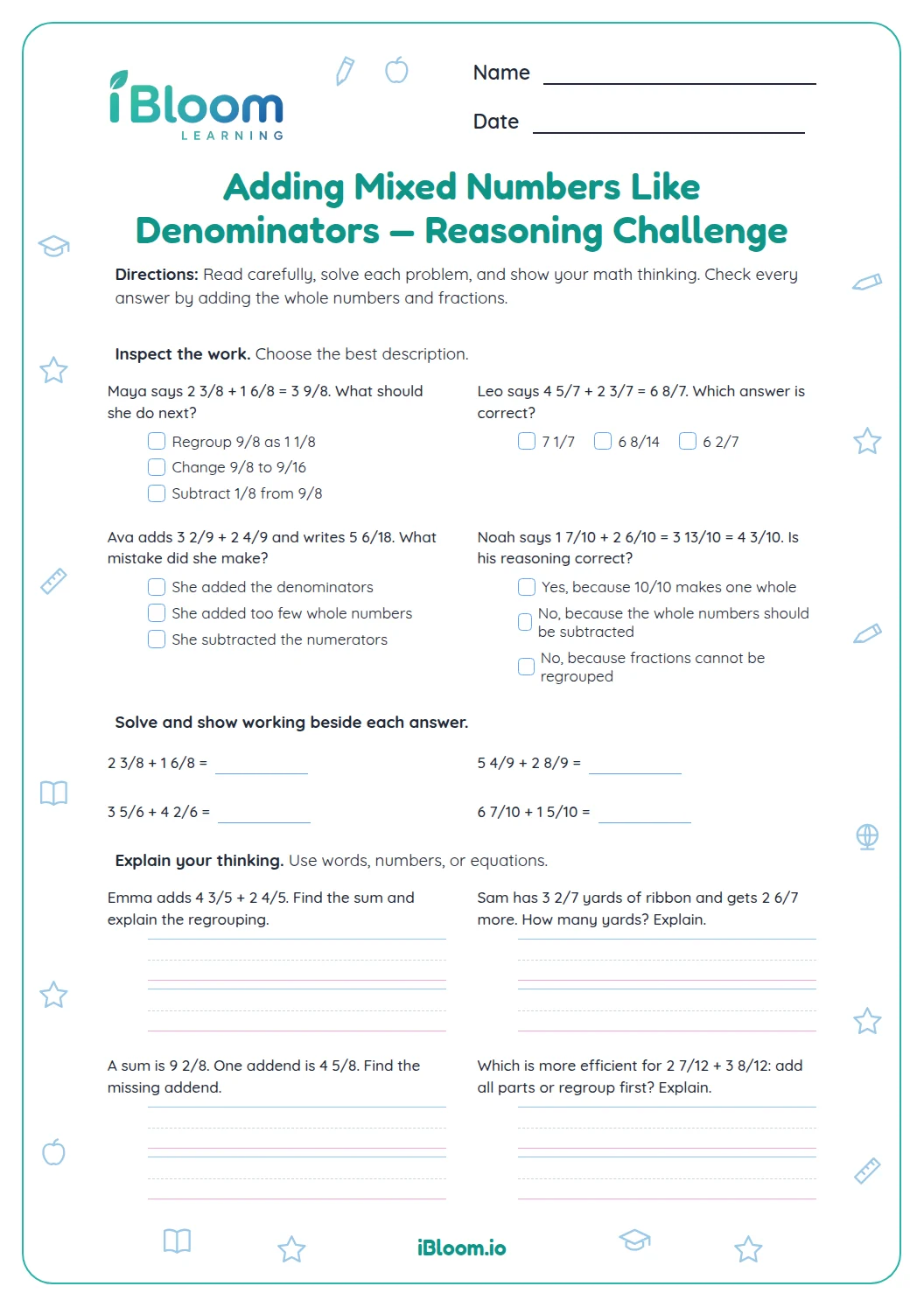
Later items use the same skill in the situations named in each prompt. Read the units and conditions before calculating, then check that the answer fits the context.
What is included on the worksheet?
The 16 questions are grouped into 3 parts, from supported practice to independent use. The answer key is printed separately.
- Add the fractions: 6 questions
- Regroup when needed: 6 questions
- Use the sum in a situation: 4 questions
How can students work through the page?
- 1Read the direction at the start of each part.
- 2Complete the first item carefully and use it to check the strategy.
- 3Solve each item, showing steps when the question provides working space.
- 4Reread the prompt and check units, symbols, and labels.
- 5Use the answer key to review any response that needs another try.
What should students check as they work?
The mistake
Rushing past an important word or unit in the prompt.
The fix
Underline what is being asked and keep the unit with the answer.
The mistake
Using a familiar procedure without checking whether it fits this item.
The fix
Pause to name the relationship or operation the question needs.
The mistake
Stopping after getting a result without checking it.
The fix
Substitute or estimate to see whether the response makes sense.
Common Core alignment
This worksheet practices adding mixed numbers through the skills described in this standard.
Add mixed numbers with like denominators, including sums that require regrouping.
On this sheet: The questions directly practice adding mixed numbers.
Show the official wordingHide the official wording
Add and subtract mixed numbers with like denominators, e.g., by replacing each mixed number with an equivalent fraction, and/or by using properties of operations and the relationship between addition and subtraction.
What to practice next
Make more practice
Further reading
Questions parents and teachers ask
What skill does this worksheet practice?
This sheet practices adding mixed numbers whose fractional parts have the same denominator. Students add the whole numbers and the fractional parts, then regroup a full group of equal parts when the sum reaches one whole. Sixteen questions build from number sentences to short contexts.
How many questions are included?
There are 16 questions in three parts. Students first add like-denominator mixed numbers, then practice cases that require regrouping, and finally apply addition in short situations involving distance, ribbon, recipes, and trail lengths. The answer key lists each final sum.
Is an answer key included?
Yes. The answer key is separate from the practice pages and gives a response for all 16 questions. For the short situations, it includes the total with its measurement unit. Students can compare each result, then return to any sum that needs another calculation.
How should students use the worksheet?
Students can add the whole-number parts and fractional parts separately when the denominators match. If the fractional sum is one whole or more, regroup that amount as a whole and add it to the whole-number total. Check that the final fraction is sensible.
How does regrouping work?
Regroup when the numerators add to at least the denominator. For example, ten tenths make one whole, so a sum of 4 9/10 is greater than 4 but less than 5. Check the fractional total first, then combine it with the whole-number sum.