




About this worksheet
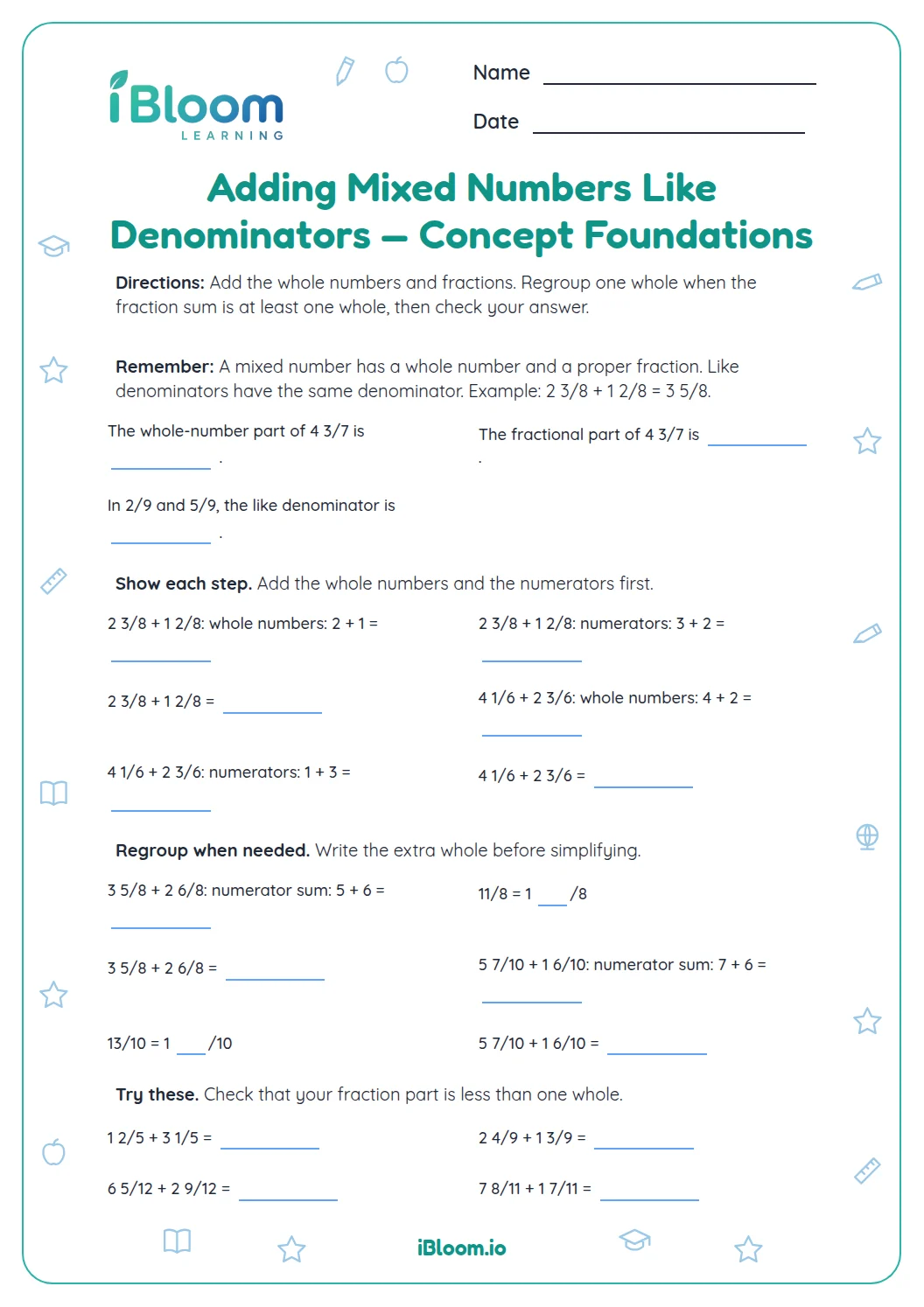
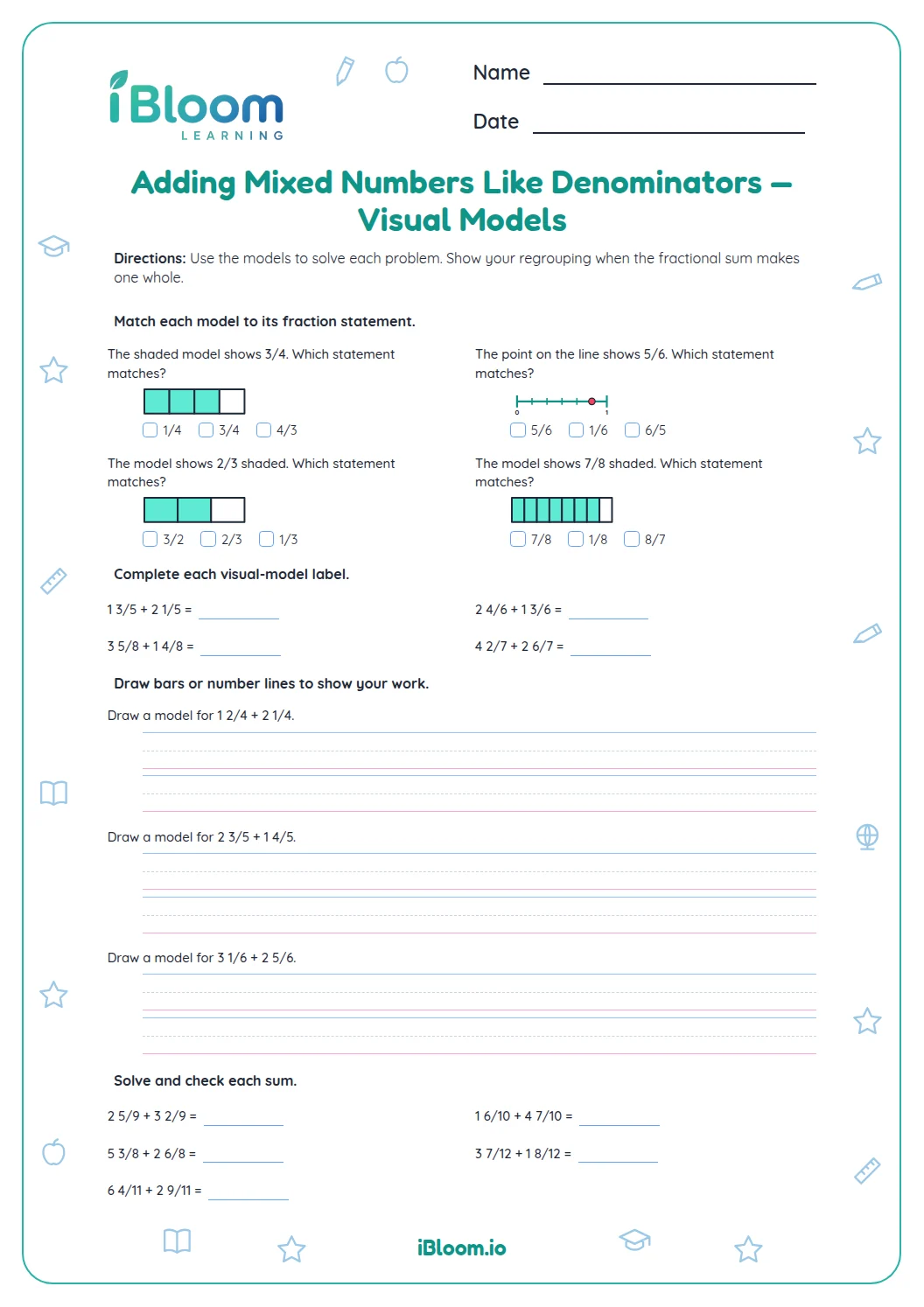
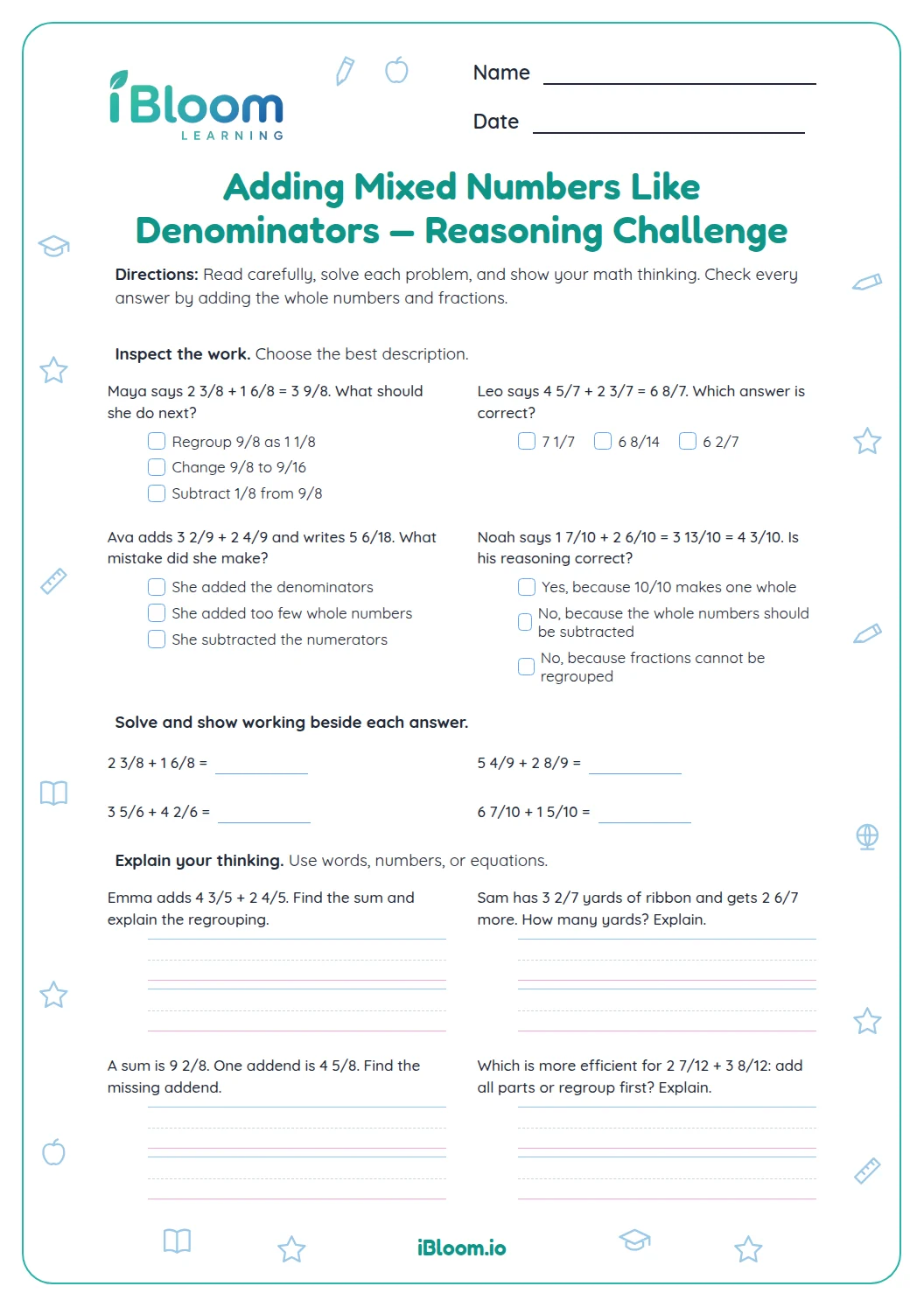
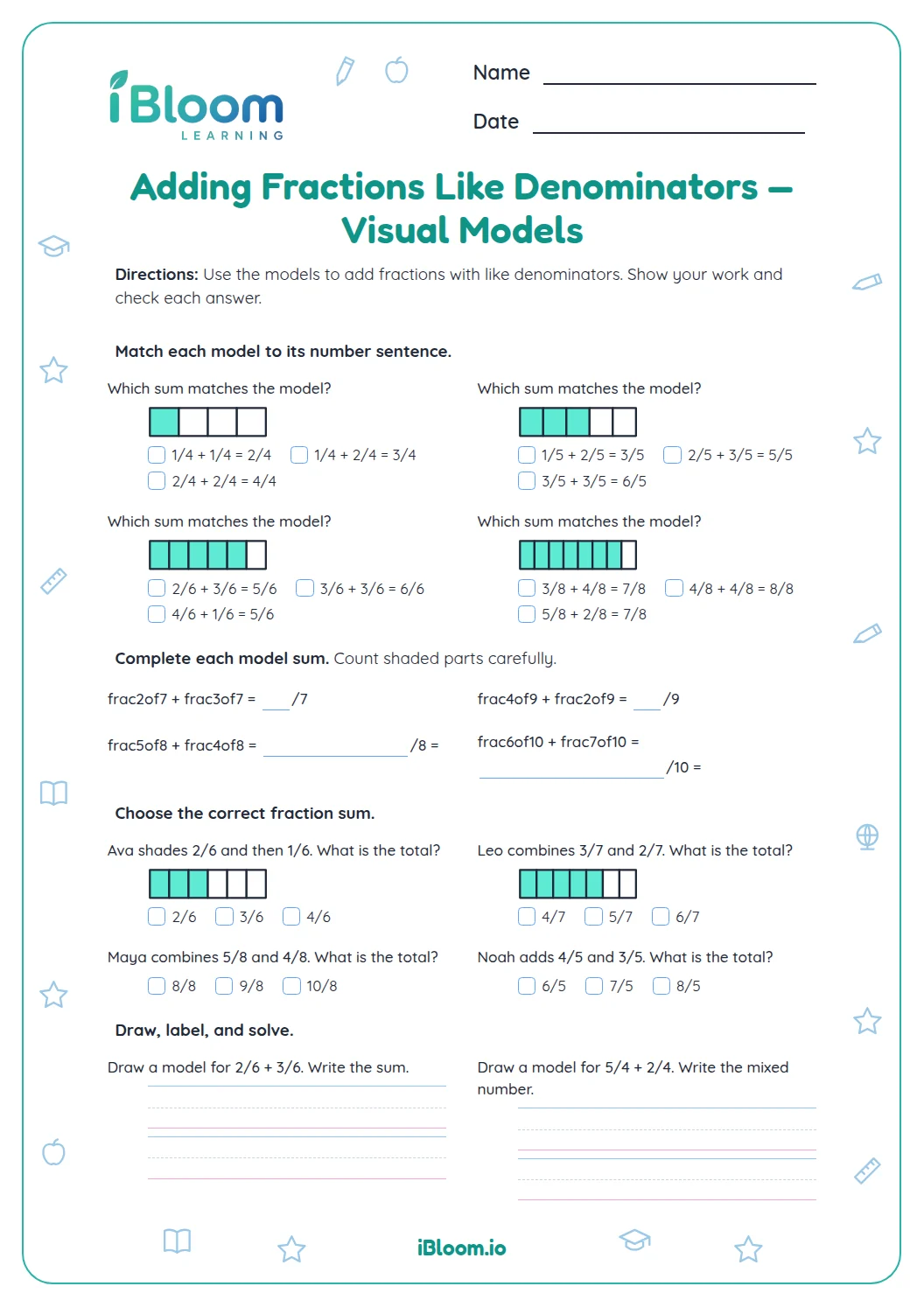
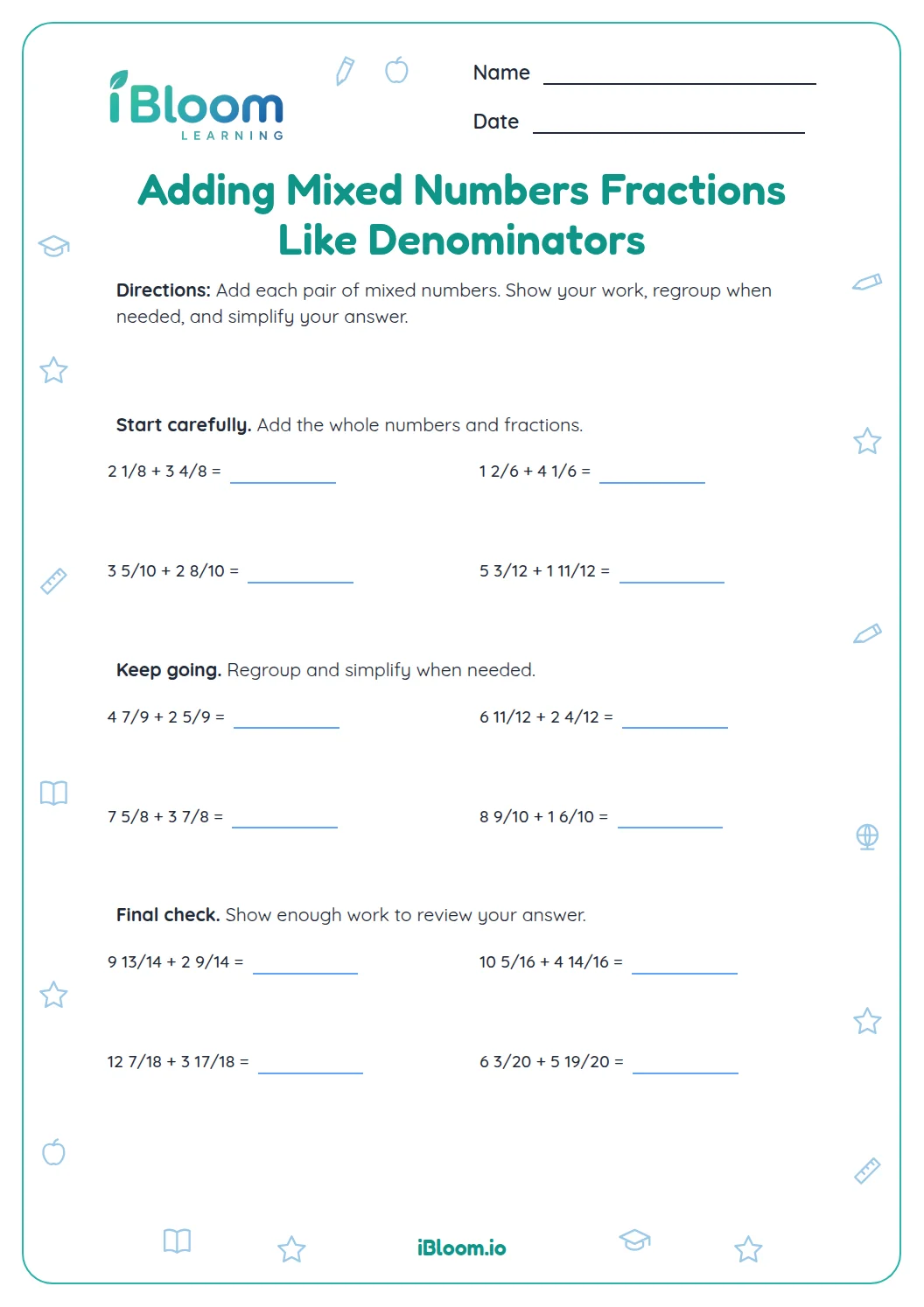
This Grade 4 printable practices adding mixed numbers with like denominators through number sentences and real-world problems. Students add fractional parts, regroup a whole when needed, and record one equation in a dedicated work area. The sheet has two pages and a separate two-page answer key. The questions practice Common Core 4.NF.B.3.d.
Aligned to 4.NF.B.3.c and 4.NF.B.3.d
How do you add mixed numbers with like denominators?
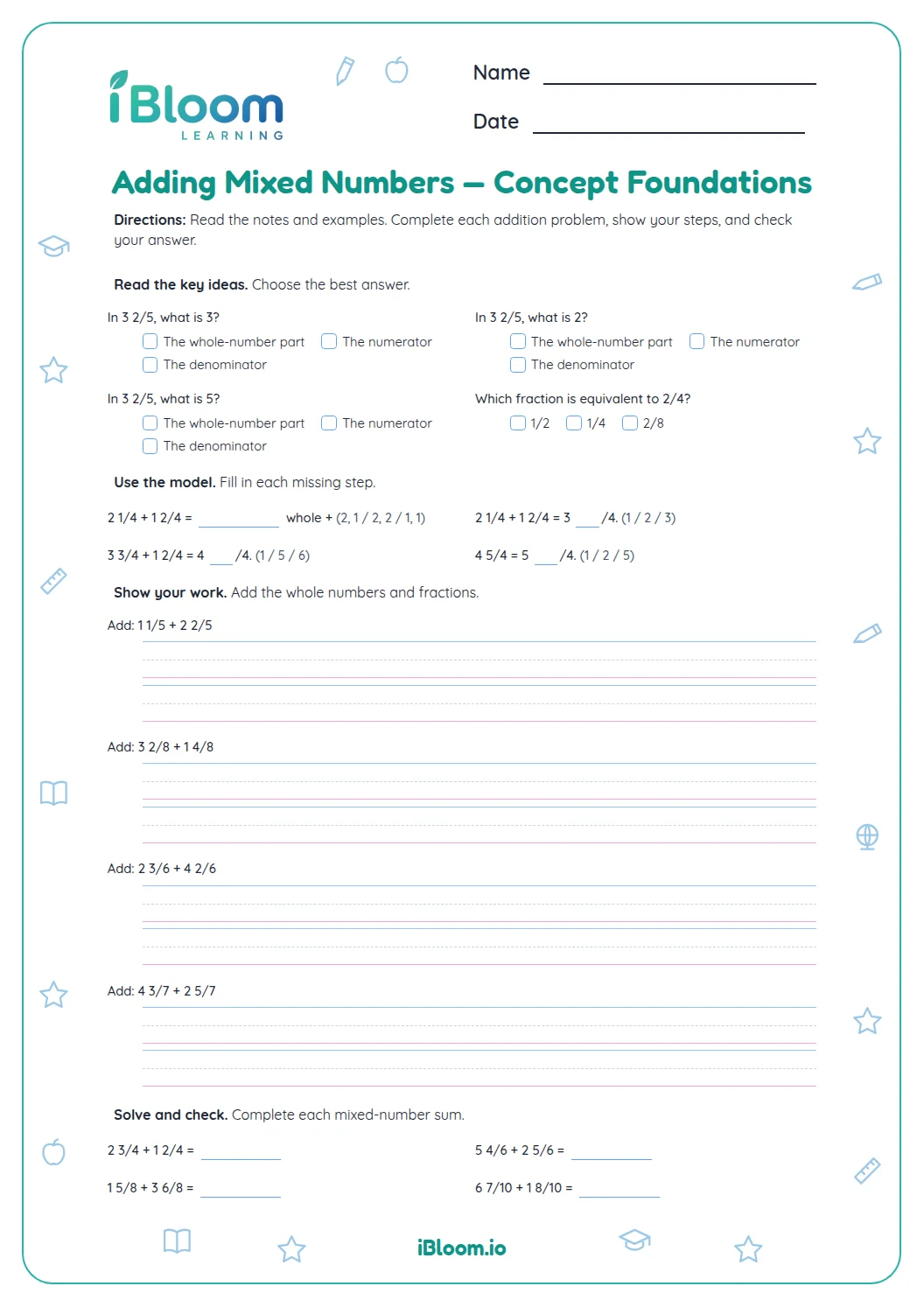
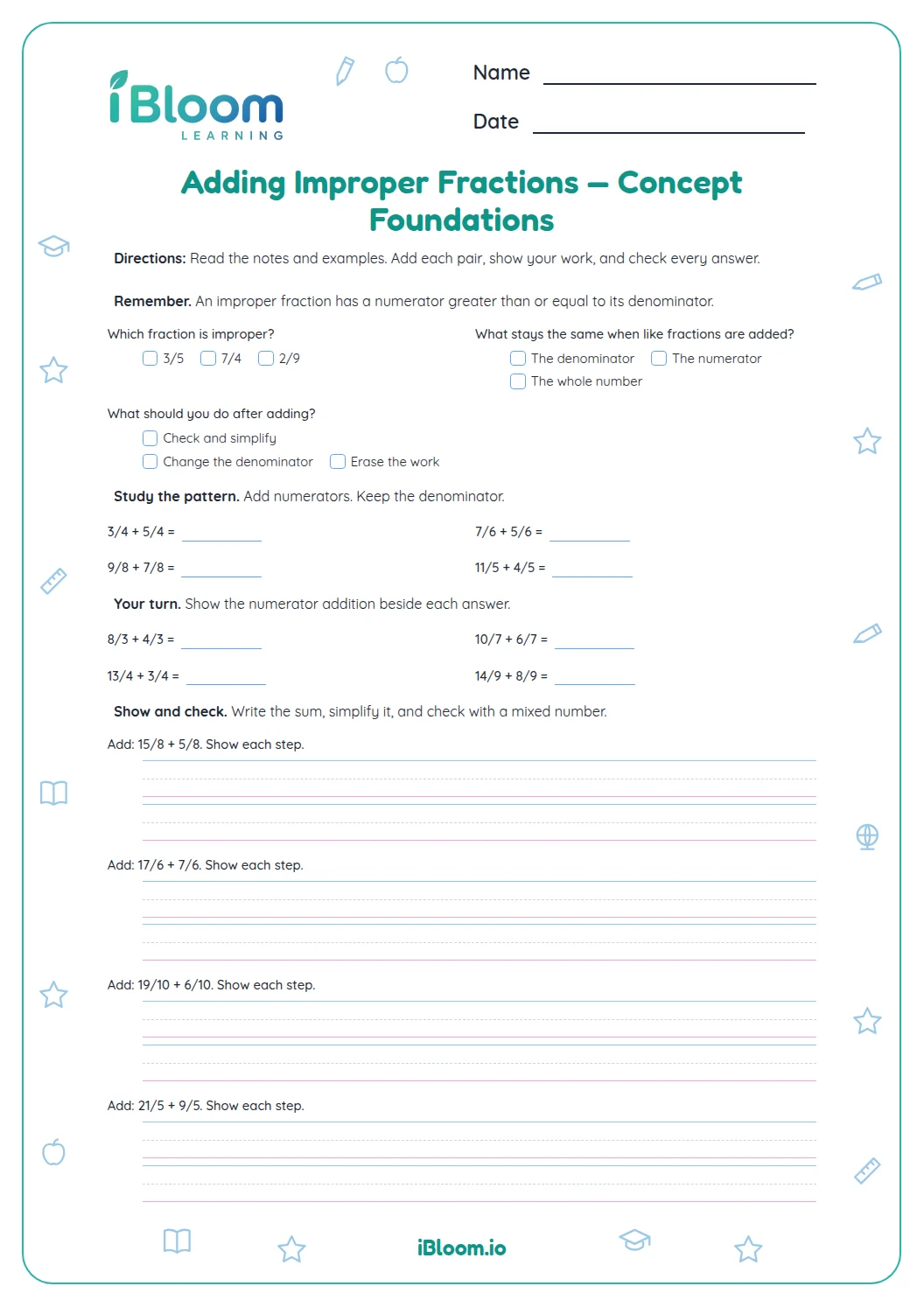
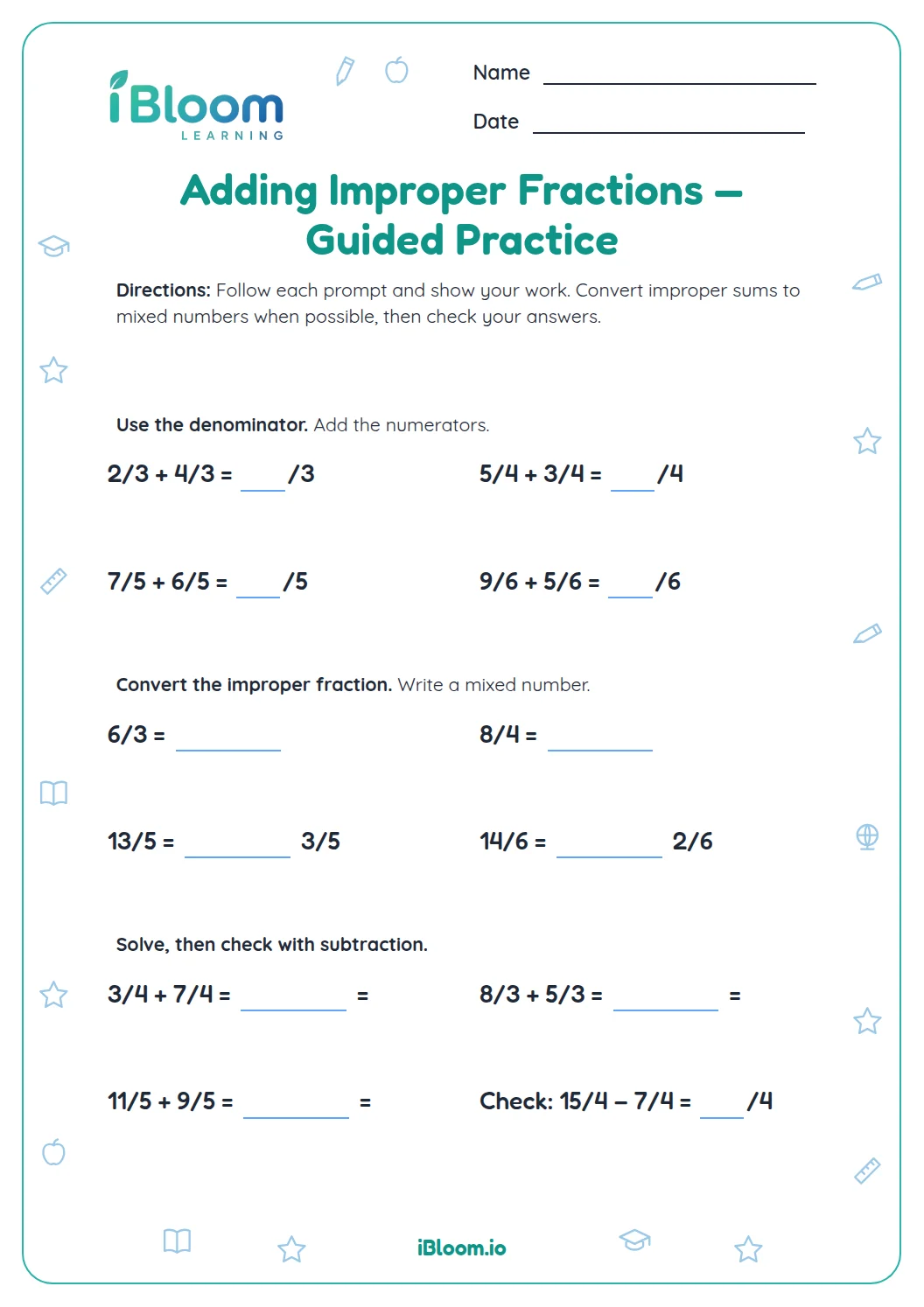
Add the whole-number parts and the numerators separately. Keep the common denominator. If the fractional sum is at least one whole, regroup it into the whole-number total.
- 11 2/8 + 2 3/8 = 3 5/8
- 2Add whole numbers: 1 + 2 = 3. Add numerators: 2 + 3 = 5; keep eighths.
What if the fractions make a whole?
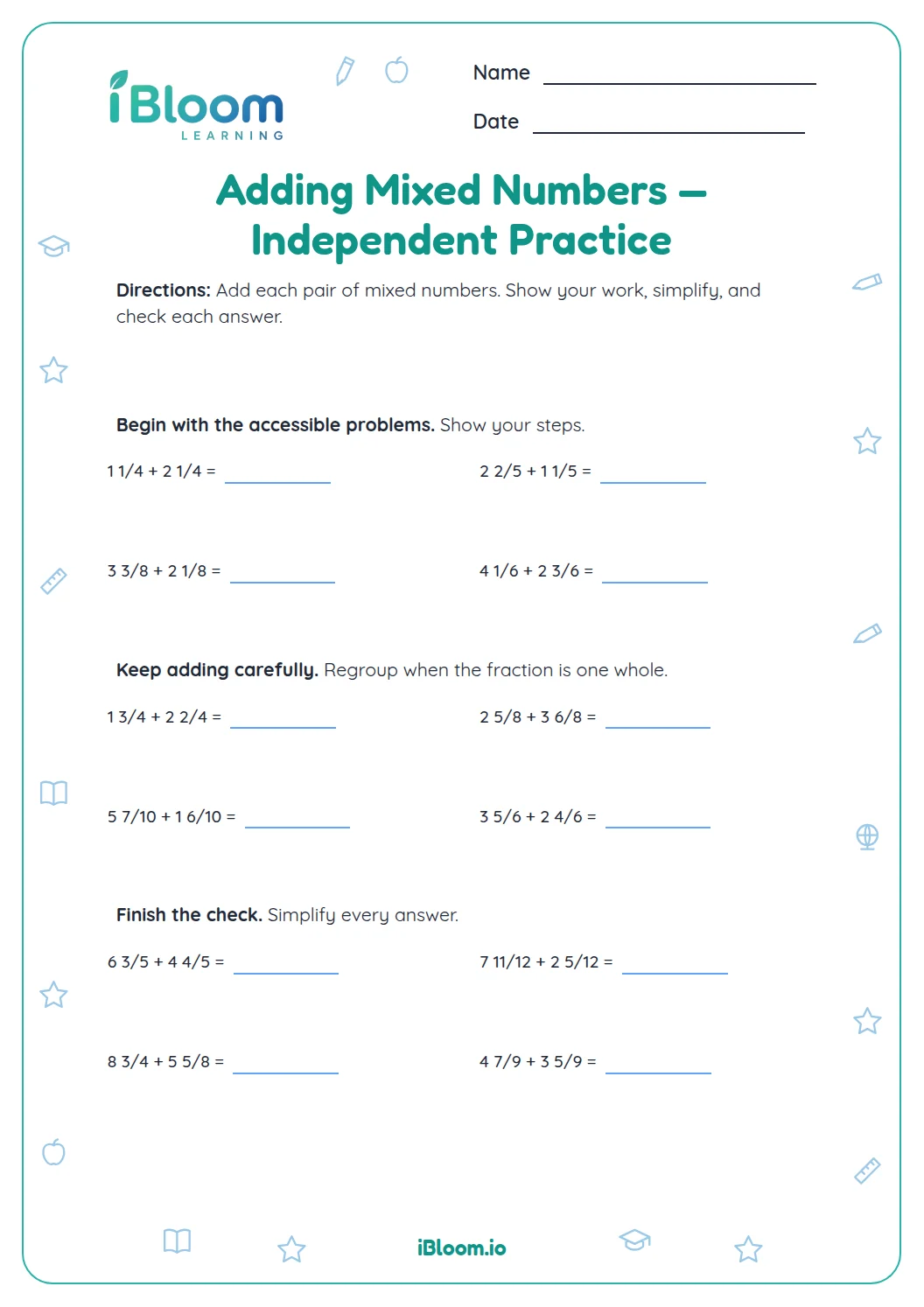
For 1 7/10 + 2 6/10, the whole numbers total 3 and the fractions total 13/10. Trade 10/10 for 1, leaving 4 3/10. Reduce the fraction when possible.
How do you solve the word problems?
Choose addition because each story combines two lengths, amounts, or distances. Write the two mixed numbers with matching denominators, add, and include the unit in the answer.
Steps for each sum
- 1Line up the whole-number parts and fractional parts.
- 2Add the whole numbers.
- 3Add the numerators and keep the shared denominator.
- 4Regroup any full whole in the fractional sum.
- 5Reduce the fractional part when possible.
- 6For a story, label the final answer with its unit.
Common mixed-number addition slips
The mistake
Adding the denominators.
The fix
Keep the denominator because the fractional parts are equal-sized.
The mistake
Leaving an improper fraction in the final mixed number.
The fix
Trade each full group of denominator parts for one whole.
The mistake
Dropping the unit from a story answer.
The fix
Reread the question and name the total in liters, yards, miles, cups, or feet.
Common Core alignment
The problems practice fraction addition with like denominators and equations for real-world situations.
Add mixed numbers with like denominators and regroup fractional sums.
On this sheet:
Show the official wordingHide the official wording
Add and subtract mixed numbers with like denominators, e.g., by replacing each mixed number with an equivalent fraction, and/or by using properties of operations and the relationship between addition and subtraction.
Solve like-denominator fraction word problems with equations.
On this sheet:
Show the official wordingHide the official wording
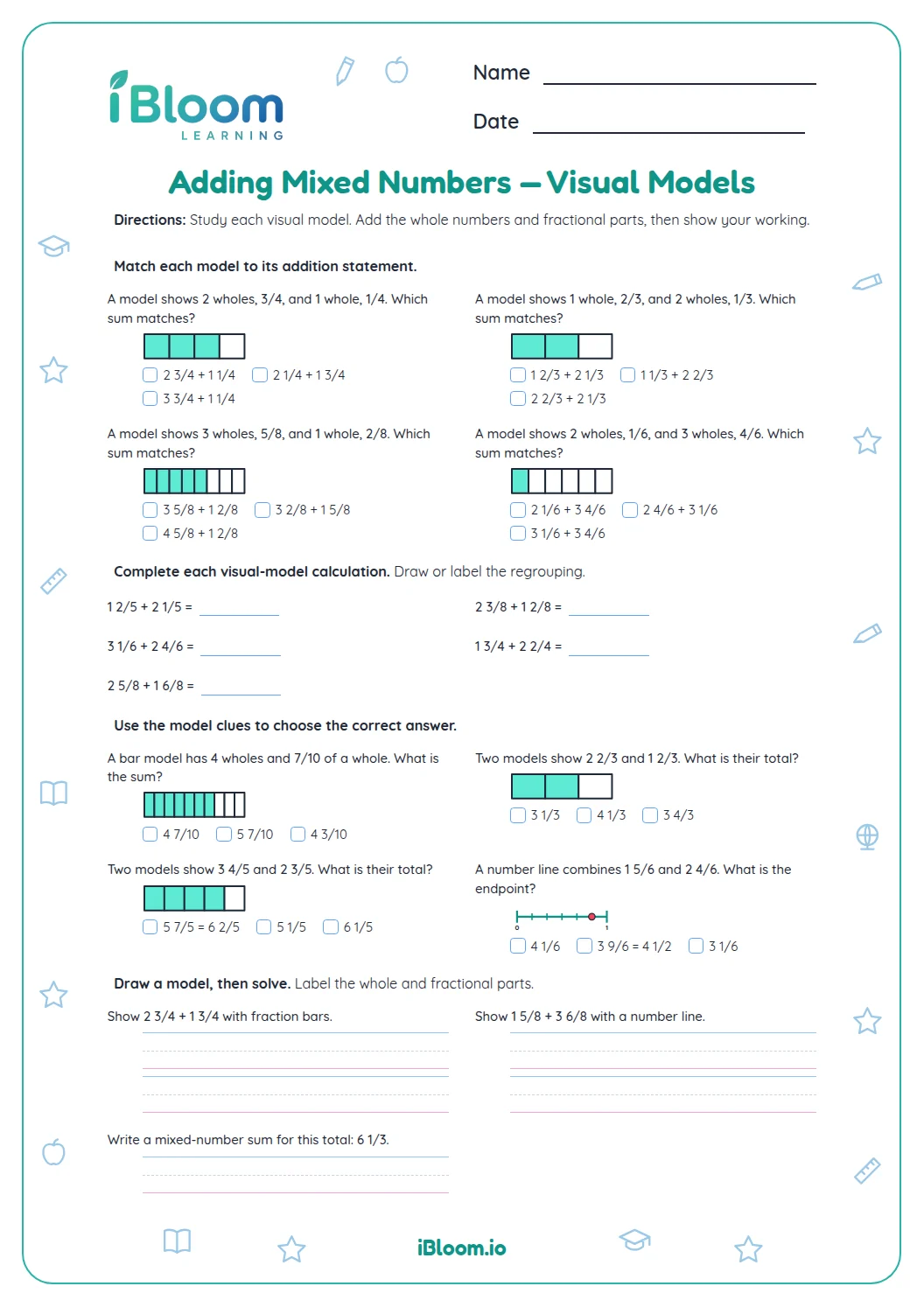
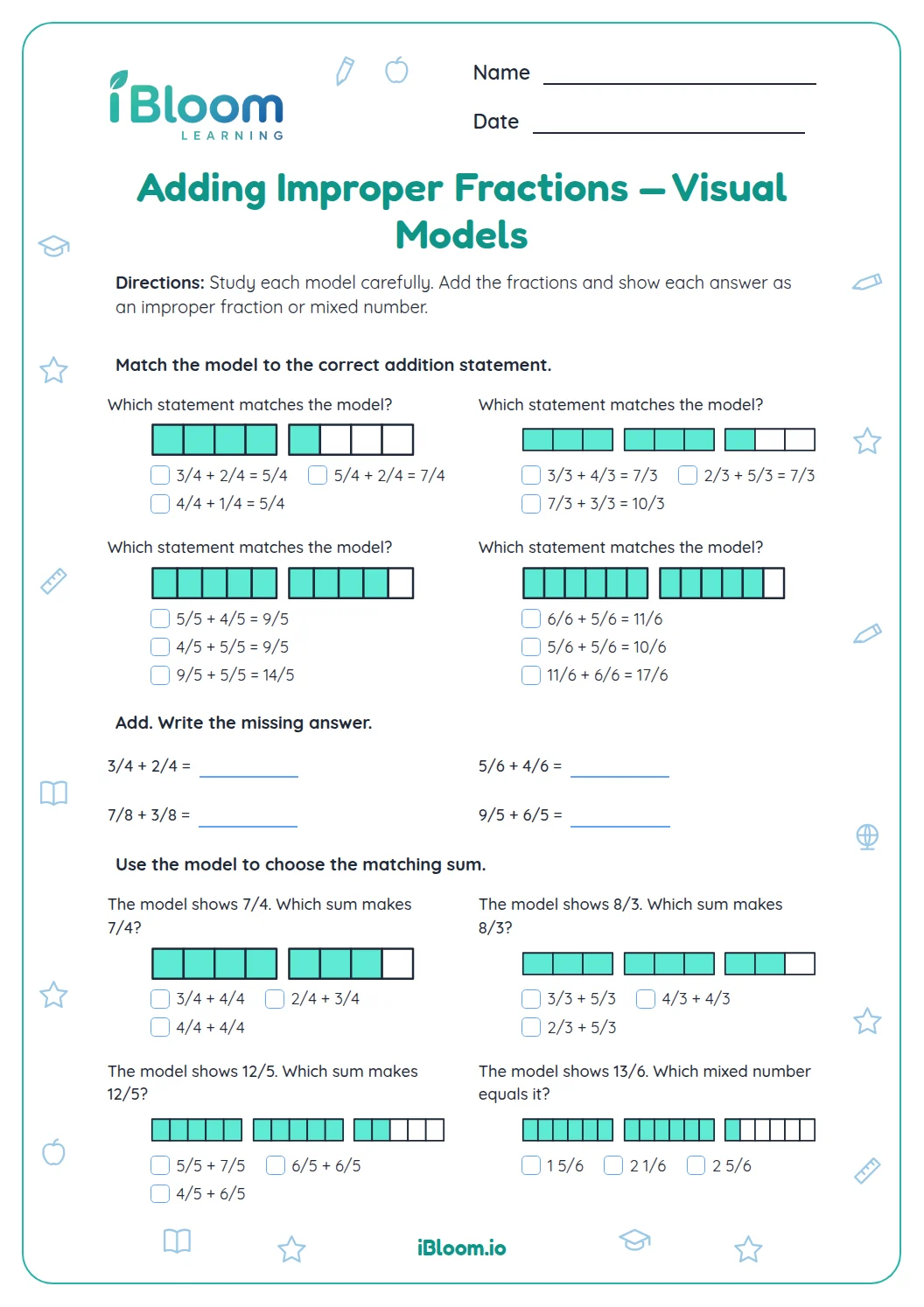
Solve word problems involving addition and subtraction of fractions referring to the same whole and having like denominators, e.g., by using visual fraction models and equations to represent the problem.
What to practice next
Make more practice
Further reading
Questions parents and teachers ask
How do you add mixed numbers with the same denominator?
Add the whole numbers, then add the numerators and keep the common denominator. If the fraction reaches a whole, regroup it into the whole-number part and simplify the remaining fraction when possible. The worksheet includes examples that need this regrouping step.
How many problems are included?
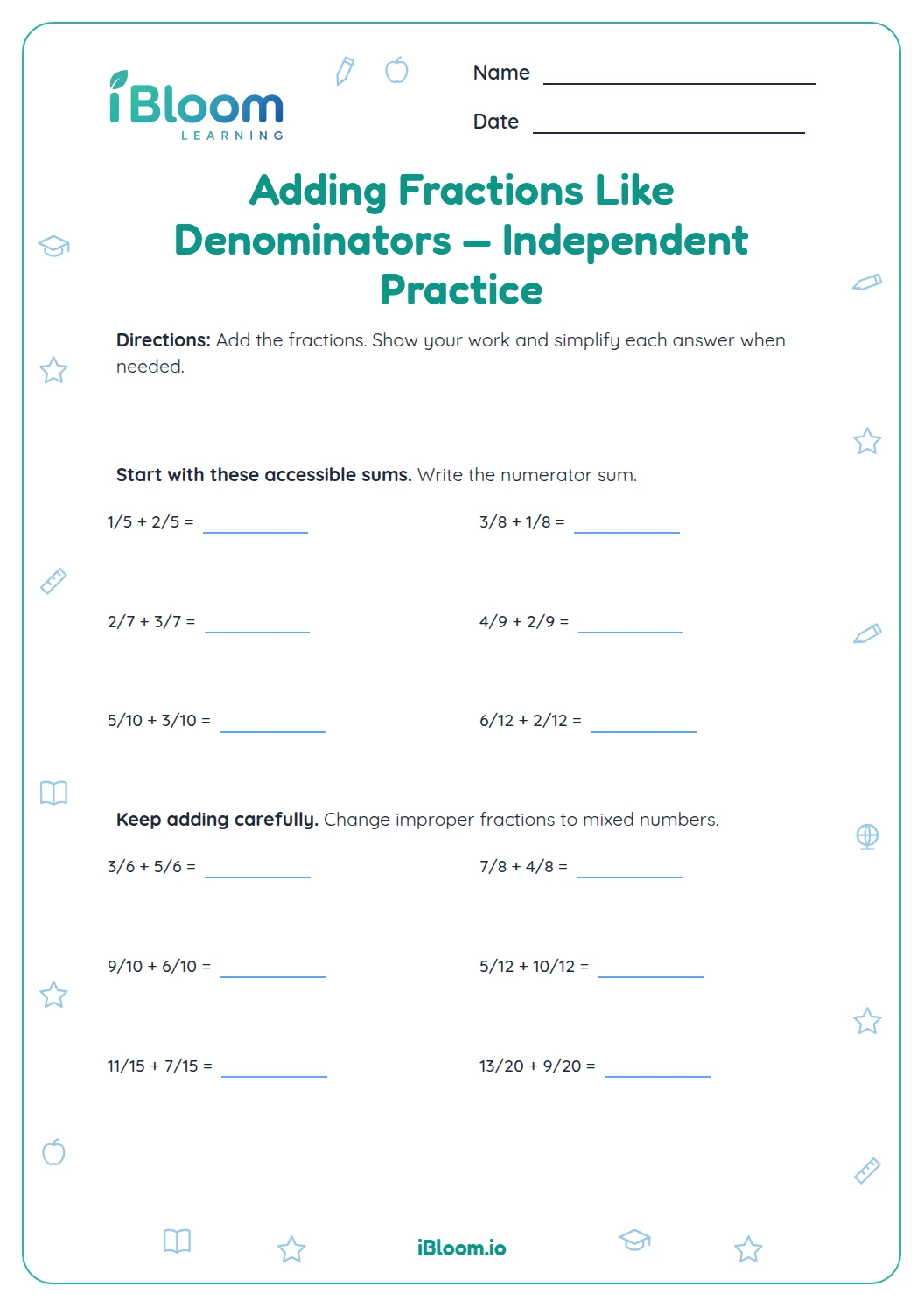
There are 14 questions: eight numerical sums and six real-world problems. Students apply like-denominator addition to amounts of liquid, distance, ribbon, and board length. The answer key gives each total with its matching unit. One story problem includes working space for an equation and result.
Does the answer key include units?
Yes. Each story answer includes the unit named in its prompt, such as liters, yards, miles, cups, or feet. Results are written as mixed numbers, simplified where possible, so the key and worksheet use one consistent answer style. Check both the amount and its unit.
Which problems require regrouping?
Several sums have fractional numerators that total a full denominator or more. For example, 1 7/10 + 2 6/10 gives 13/10 in the fractional part, which is regrouped as one whole and 3/10 before simplifying. Check the regrouped total against the original addition sentence.
How long should the worksheet take?
Allow about 25 minutes for 14 problems. The six sums are compact, while the story questions ask learners to identify the amounts, add like-denominator mixed numbers, and record the total with its unit. One problem has a work grid for writing an equation; the others use short answer lines.